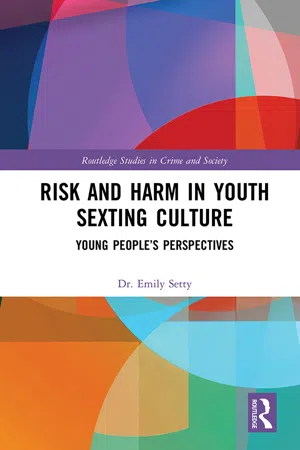
This book explores young people's perspectives on risk and harm in youth sexting, specifically privacy violations and unwanted, pressured and coerced sexting.
This book engages with key debates, academic literature and evidence, as well as findings of a study into young people's perceptions of, attitudes toward and experiences of sexting. It challenges predominant assumptions that youth sexting is inherently risky and deviant and sets out the specific contexts in which privacy violations and unwanted sexting occur. It explores the sociocultural contexts underpinning harm, including gender, sexism, sexuality, status and power, and associated constructs of risk and shame, as well as broader youth cultural contexts that create and giving meaning to sexters and sexting practices, particularly related to victim-blaming, social shaming, bullying, harassment and abuse. Finally, it discusses young people's attitudes and beliefs about interventions to reduce the prevalence of youth sexting. In doing so, the book critically engages with young people's perspectives in order make practical recommendations for encouraging a 'digital sexual ethics' based on rights to bodily and sexual expression, autonomy and integrity, positive bystander intervention, and anti-victim blaming and abuse messages.
This book will be of great interest to scholars and students of criminology, education, social care, sociology and health. It will also be a valuable resource for those working in educational and social care settings such as sex educators, youth and social workers, youth counsellors and mental health professionals.
- 208 pages
- English
- ePUB (mobile friendly)
- Available on iOS & Android
eBook - ePub
About this book
Trusted by 375,005 students
Access to over 1.5 million titles for a fair monthly price.
Study more efficiently using our study tools.
Information
1 Introduction
I first came across the phenomenon of ‘youth sexting’ in 2013 when I read about Jesse Logan, an 18-year-old young woman from Cincinnati, Ohio. I happened upon an article on Today.com (Celizic 2009) detailing how Jesse shared sexual images of herself with her former boyfriend, who later forwarded the images to other girls at their high school. Jesse subsequently suffered bullying and harassment from her peers and, tragically, was found having hanged herself in her bedroom. I found the story shocking; while communication technology, including social media, was firmly ensconced in mine and most of my contemporaries’ lives by that time, it got me thinking about privacy online and the implications of non-consensual sharing of personal content. Notable to me was that the unethical treatment of Jesse Logan (the distribution of her images, and the bullying and harassment by peers) had little to do with technology and was infused with social meanings and cultural norms around sex and the body that long predate the arrival of phenomenon such as sexting. The bullying, for example, was characterised by gendered and sexualised name-calling directed at Jesse.
Searching around the internet, one thing stood out. When involving young people under the age of 18 sharing sexual images, sexting is potentially illegal under laws prohibiting the production, possession and distribution of illicit images of minors. This includes individuals who produce images of themselves because they have, in a legal sense, produced an illicit image of a minor, even though they themselves are the minor. What is the purpose of the application of these laws to young people, and what are the implications, given the risks and harms young people seemingly face when engaging in these practices? I consider these questions in Chapter 2 when discussing the policy responses to youth sexting; suffice to say, youth sexting raises legal complexities but is also associated with wider social and moral anxieties surrounding youth, sex and technology (Lee et al. 2013), which may, somewhat, explain the moves to criminalise young people’s practices.
Since first stumbling across the phenomenon of youth sexting and subsequently subjecting it to investigation and analysis in doctoral-level research, there has been a plethora of public debate, research studies and policy-making surrounding young people’s practices and how to protect them from harm. While I conducted research in England in the UK, the focus on youth sexting has occurred internationally (Moran-Ellis 2012). Interestingly, while sexting can involve the production and exchange of personal sexual images and messages, it is the former – sexual images – that has most captured public, policy and research attention across different jurisdictions (Cooper et al. 2016; Crofts et al. 2015; Symons et al. 2018). There is something about digitally mediated sexual and bodily self-expression through the production of intimate images that has unsettled or, at least from an academic perspective, interested us, particularly when practised by young people (see Chalfen 2009).
When I first started examining youth sexting, it was predominantly discussed in the public sphere in terms of a ‘risk and harm’ discourse (Döring 2014). Stories such as those about Jesse Logan encapsulated public anxiety about young people’s supposed thoughtless and fool-hardy digital practices, their dismissal of privacy concerns, and the emotional, social and reputational risks they face. Young people who produce and share personal sexual images (of themselves and others) were – and often still are – conceptualised as engaging in an inherently deviant and exploitative practice (Karaian 2014; Lee et al. 2013).
Subsequent years have seen increasing nuance and complexity in public and academic debate about young people’s sexting practices (e.g. Temple 2015). Döring (2014) referred to a ‘normalcy framework’, in which youth sexting is portrayed as a normal form of intimate communication. Such portrayals, she argued, tend to be found in cultural, media, communication, sexuality, gender, and some legal academic papers, which conceive of sexting as being about the “mutual expression of sexual desire and affection, playfulness and pleasure, as well as bonding and trust” (ibid: np). While such conceptualisations of sexting were, at the time Döring wrote, quite marginalised in the overall debate (Lee et al. 2013), they have since gained traction. Scholars have, for example, argued for an articulation of ‘rights’ for young people in their digital sexual cultures (Albury 2017; Dobson 2018; Livingstone and Third 2017). Such an articulation is based upon a growing body of qualitative research that locates risky and harmful sexting in terms of breaches of privacy and consent, rather than the production and exchange of personal sexual images per se (Crofts et al. 2015; Hasinoff 2015a; Klettke et al. 2019).
In this book, I explore these arguments and set out suggestions for how we – be that academics, policy-makers or professionals responsible for the welfare of young people – should understand and respond to young people’s practices in their digital sexual cultures. To that end, I draw upon findings from both my own research with teenagers and the wider literature to explore young people’s perspectives on risk and harm in youth sexting culture. The purpose is not to provide an uncritical, celebratory description of these perspectives. Rather, I deconstruct their accounts to explore the specific contexts within which risk and harm arise, and, therefore, the social processes and cultural practices that need to be tackled if we wish to address harm in a youth-centred, meaningful and impactful way. The book is, therefore, likely to be relevant to scholars and students interested in young people’s digital sexual practices and related concepts of online privacy; sexual consent; digital sexual ethics; and sexual agency, empowerment and literacy; as well as broader issues around gender, adolescent sexuality, peer culture, (the legitimacy and effectiveness of) Sex and Relationships Education (SRE) and the legal context to young people’s digital sexual practices. I also hope that professionals and practitioners working with young people within educational, community, justice and child-protection settings will find the book helpful for drawing together some of the evidence on youth sexting and for advancing a set of suggestions and recommendations for policy and practice around responding to the phenomenon.
Conceptualising youth sexting
Conceptualising youth sexting firstly requires clarity about what is meant both by ‘youth’ and by ‘sexting’. The term ‘youth’ does not have fixed meaning; in some of the literature on sexting, youth is taken to include those up to the age of 25 (e.g. Crofts et al. 2015), while elsewhere it refers just to teenagers. I conducted my research with teenagers aged 14 to 18. I was particularly interested in the perspectives of those for whom producing and sharing personal sexual images is legally prohibited (see Chapter 2).1 For the purposes of this book, when I use the term ‘youth’ or ‘young people’, I am specifically referring to teenagers. Where I draw upon research wholly or partly conducted with individuals up to the age of 25, I use the term ‘young adults’ to refer to these individuals.
The term ‘sexting’, meanwhile, is somewhat trickier to conceptualise. There is the nature of the term ‘sexting’ itself. Young people tend not to use the term sexting when referring to or discussing their practices, preferring terms such as ‘pics’ of ‘nudes’ to refer to sexual images (Albury et al. 2013). They perceive ‘sexting’ to be a media-produced term, used by adults to refer to a range of behaviours, some of which they would not classify as sexting (Albury et al. 2013; Karaian 2012). The term ‘youth-produced sexual imagery’ has increasingly been used as a broader, less colloquial alternative in policy, practice and academic circles. Throughout the book, I use the term sexting for consistency, but also refer to youth-produced sexual imagery (or some version thereof) where appropriate. This is particularly important given I focus on young people’s perspectives on producing and sharing sexual images rather than messages. As explored in Chapter 5, however, even the ‘sexual’ aspect of the terminology may be problematic; bodily expression is not inherently sexual, at least from the perspective of young people (see Bobkowski, Shafer and Ortiz 2016). As I found in my research, the extent to which self-produced images are intended as sexual or infused with sexuality has implications for privacy and rights within youth sexting culture.
Aside from the terminology, there are debates about how youth sexting should be conceptualised as a phenomenon and practice. Is it inherently harmful and exploitative, or a potentially normative part of adolescent (and adult) sexual and bodily expression and experimentation (Karaian 2012)? Should sexting be understood as a practice undertaken by individuals, for whom there may be a variety of underlying ‘risk factors’ and negative consequences arising from their practices? Or, should sexting be understood as a youth cultural phenomenon, in which young people come together to make it meaningful and, therefore, contribute to the circumstances in which risk and harm arise? If we take the latter as a starting point, how exactly do the social norms, meanings and expectations circulating within young people’s peer cultural contexts shape and interact with their decision-making, choices and practices at individual and interpersonal levels?
Youth sexting as a technology-facilitated expression of the sexualisation of children and young people
Before returning to the conceptualisation of youth sexting as an individual, social and cultural phenomenon, it is important to note that a focus on individual sexting actors does not preclude acknowledgement of a broader sociocultural context to young people’s practices. There has been extensive public discussion about whether youth sexting represents a digitally mediated expression of the unhealthy and excessive ‘sexualisation’ of children and young people. In other words, technology, in particular smartphones and other internet-enabled devices, is believed to facilitate the reproduction by young people of the depictions of sex and body that they observe in a ‘sexualised’ cultural context (Draper 2012; Lunceford 2010). By ‘sexualised’, I refer to:
… a contemporary preoccupation with sexual values, practices and identities; the public shift to more permissive sexual attitudes; the proliferation of sexual texts; the emergence of new forms of sexual experience; the apparent breakdown of rules, categories and regulations designed to keep the obscene at bay; our fondness for scandals, controversies and panics around sex.
(Attwood 2006: 78)
There have long been fears regarding the impact of young people’s exposure to cultural depictions of sex and sexuality on their sexual identities and development (Bailey 2011; Department for Education 2011; Papadopoulos 2010; Rush and La Nauze 2006; Zurbriggen et al. 2007). Regarding sexting specifically, there is a belief that young people – namely, girls and young women – would not engage in sexual and bodily self-expression were it not for a sexualised culture teaching them to do so (Brennan and Epp 2015). Sexting is seen, therefore, as inappropriate and evidence of the malign effects of a sexualised culture on young people (Hasinoff 2015a). Technology then, supposedly, provides the tools for the digital mediation of young people’s excessive and unhealthy sexualisation (Lunceford 2010).
Young people – as digital natives (Prensky 2011) – are thought to be operating in a ‘virtual world’ with new norms, standards and tactics of behaviour (Cupples and Thompson 2010; Vanden Abeele 2015). Unencumbered by traditional concerns about privacy, they are supposedly throwing caution to the wind and sharing their private, intimate selves in public forums for all (at least to have the potential) to see. Adults – as ‘digital immigrants’ (Prensky 2011) – are, meanwhile, thought to lack access to and understanding of this world and, therefore, any control or insight into what ‘their’ young people are doing and being exposed to online (Arcabascio 2009; King 2012; Livingstone and Helsper 2010; Schmitz and Siry 2011). Communication technology is particularly disconcerting in this sense, due to how it removes young people from traditional social contexts and constraints on their behaviour (Hasinoff 2012).
How exactly should we understand the role of broader representations of sex and the body, along with the affordances of digital communication technology, within young people’s sexting cultures? Turning to technology, it is undeniable that the nature and intensity of technological developments have impacted upon all of us, including young people. Hodkinson (2015) describes an ‘always on’ culture and compulsory engagement with technology as a feature of current times. Ringrose and Harvey (2015), meanwhile, conceptualise ‘hyperconnectivity’, in which technologies of choice change rapidly and are a way of keeping in touch, whereby “technological processes are re-shaping and re-mediating teen sociality and sexuality – friendship, dating, intimacy and conflict” (p.2). The relationships and practices themselves may be familiar, but, it is argued, there are new norms and standards of practice, and they are being played out to broader, more fluid and diffuse audiences...
Table of contents
- Cover
- Endorsements
- Half Title
- Series Page
- Title Page
- Copyright Page
- Table of Contents
- List of illustrations
- Acknowledgements
- 1. Introduction
- 2. The legal and educational policy context to youth sexting
- 3. Young people, technology and sexting
- 4. Privacy violations in youth sexting culture
- 5. Sexting and consent: Unwanted, pressured and coerced image-sharing
- 6. Social shaming and victim blaming
- 7. Responding to youth sexting: Young people’s perspectives
- 8. Reducing risk and harm in youth sexting: Conclusions and ways forward
- Index
Frequently asked questions
Yes, you can cancel anytime from the Subscription tab in your account settings on the Perlego website. Your subscription will stay active until the end of your current billing period. Learn how to cancel your subscription
No, books cannot be downloaded as external files, such as PDFs, for use outside of Perlego. However, you can download books within the Perlego app for offline reading on mobile or tablet. Learn how to download books offline
Perlego offers two plans: Essential and Complete
- Essential is ideal for learners and professionals who enjoy exploring a wide range of subjects. Access the Essential Library with 800,000+ trusted titles and best-sellers across business, personal growth, and the humanities. Includes unlimited reading time and Standard Read Aloud voice.
- Complete: Perfect for advanced learners and researchers needing full, unrestricted access. Unlock 1.5M+ books across hundreds of subjects, including academic and specialized titles. The Complete Plan also includes advanced features like Premium Read Aloud and Research Assistant.
We are an online textbook subscription service, where you can get access to an entire online library for less than the price of a single book per month. With over 1.5 million books across 990+ topics, we’ve got you covered! Learn about our mission
Look out for the read-aloud symbol on your next book to see if you can listen to it. The read-aloud tool reads text aloud for you, highlighting the text as it is being read. You can pause it, speed it up and slow it down. Learn more about Read Aloud
Yes! You can use the Perlego app on both iOS and Android devices to read anytime, anywhere — even offline. Perfect for commutes or when you’re on the go.
Please note we cannot support devices running on iOS 13 and Android 7 or earlier. Learn more about using the app
Please note we cannot support devices running on iOS 13 and Android 7 or earlier. Learn more about using the app
Yes, you can access Risk and Harm in Youth Sexting by Emily Setty in PDF and/or ePUB format, as well as other popular books in Social Sciences & Social Work. We have over 1.5 million books available in our catalogue for you to explore.