eBook - ePub
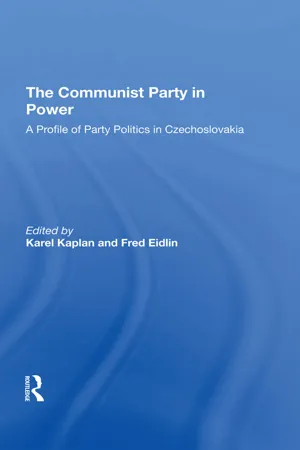
The Communist Party In Power
A Profile Of Party Politics In Czechoslovakia
- 231 pages
- English
- ePUB (mobile friendly)
- Available on iOS & Android
eBook - ePub
The Communist Party In Power
A Profile Of Party Politics In Czechoslovakia
About this book
The aim of this book is simple. It seeks to describe the main features of the internal life and functioning of a communist party. It reflects both the results of a historian's research and the long years of experience of a communist official and party apparatchik.
Trusted by 375,005 students
Access to over 1.5 million titles for a fair monthly price.
Study more efficiently using our study tools.
Information
1
Institutions Without Power
Members
The Communist party of Czechoslovakia (CPCz) has about 1.5 million members, and they can be categorized according to their reasons for joining the party. Participants in the struggle to establish the monopoly of power are still heavily represented. They joined believing in the rightness of party policy. This mass, once a million strong, has become differentiated over time. Some, thanks to the party, attained advantageous positions of power and prestige and became firm supporters. Others later became disenchanted and either quit or were expelled. Still others lost their earlier enthusiasm, remaining members while lapsing into a total passivity accentuated by their old age. The second category consists of members who joined under pressure and out of fear, or for careerist reasons, only after communist rule had been established. In this period only a small proportion joined out of political conviction. The third category consists of those who became communists after the Soviet occupation of Czechoslovakia in August 1968. The communist leadership at that time sought to make up for the loss of the half million expelled members and functionaries by bringing in new workers, mainly young ones. Most of these are motivated by the privileges they see as associated with party membership rather than by political conviction.
A member’s situation in the party is determined by the party’s role as backbone of a power monopoly. He has to defend and implement policies that he had no part whatsoever in formulating. He is little more than an instrument, implementing the will of the party leadership. He cannot even express his opinions about party policies, since these are presented to him as instructions intended only to be carried out. Binding party resolutions and instructions also contribute to establishing limits to the political thinking and behavior of communists.
Most members either do not fulfill even their basic party obligations or do so lackadaisically and purely as a matter of form. They remain passive or limit their activities to occasional attendance at party meetings and fulfillment of a few other basic obligations, such as subscription to the party press and participation in party training. Sometimes local and district functionaries attempt to get rid of passive members, whom they regard as ballast that drags them down. They want a party of action, a party of true, faithful, and obedient wielders of power, a party of functionaries—small, but ideologically firm. Their demands encounter resistance from higher-level party institutions, which intentionally maintain the mass character of the party. In this way they are able to bind a tenth of the whole population and a quarter of the adult population to the communist leadership by various organizational and ideological ties and to subordinate them to its influence. It makes possible the existence of a network of party organizations extensive enough for the leadership to be able to impress its will into all the pores of society and for there to be a party organization or a sufficient number of communists in every factory, workshop, office, school, and university secretariat. It also serves as a permanent reservoir of functionaries and an entity capable of living a life of its own, as well as being a substantial source of income for the party.
Most members react to their powerlessness by passivity. This is the way they express distaste for carrying out policies in which they do not believe. They also know that they can play no role in policy formation or even influence policy in their own situations. Yet they do not want to break with the party or are afraid to. Most communists thus live at odds with themselves. They behave one way at party meetings and at work, where they mechanically voice agreement with party policy, and quite another way among family, friends, and colleagues, with whom they do not want to talk about politics at all. Only a few give vent to their convictions and express their criticisms of party policy among those close to them.
The reasons for their reluctance to get out of the party are similar those for joining. Most common is the fact that party membership gives a certain protection from the political persecution to which the majority of citizens are exposed. Members of the intelligentsia view membership as a kind of professional obligation and fear the social consequences of leaving the party. For some, membership offers or facilitates the way to a career. Only a small part of this passive membership is bound to the party by ideas and the inertia of long years of membership. Nevertheless, despite the costs involved, tens of thousands of members break with the party, thus giving public expression to their dissatisfaction with party policies and practices.
The proportion of passive members is difficult to determine accurately because it depends on the criteria used. If we use regular participation in meetings as the criterion, 40–50 percent are passive. If the criterion is that someone, although present at meetings, avoids party life and holds no position entrusted to him by the party, the proportion rises to at least two-thirds. But of those who have had to accept functions in the factory or community, a majority does not exercise them. Thus, around 25–30 percent of party members are active communists. Of course, only part of them participate in the exercise of power or in the realization of party policies in public.
There is another aspect of the passivity of a large part of the membership that is unpleasant for the party leadership. It blurs the boundary between the politically conscious communists and those outside the party. It weakens the ideological resistance of the politically conscious and makes it possible for the views of outsiders to seep into the ranks of the party. This problem constantly disturbs the ideological stability and monolithic character of the party for which the leadership strives so much. This state of affairs becomes very dangerous in times of internal party crisis, when (in Czechoslovakia in 1956, 1963, and mainly in 1968) the passive members are set in motion. Their repressed opinions and pent-up dissatisfaction burst out and are vented at the party leadership.
The communist leadership keeps watch over the development of the membership base, especially its social structure. On the basis of resolutions from the center, the district and regional organizations deal with these matters every month, the center at least twice a year. They pay special attention to the proportion of workers and farmers in the party. This is partly attributable to ideological motives, i.e., awareness that a party proclaiming itself to be the vanguard of the working class has to demonstrate this, at least by having a preponderance of workers in its ranks.
There are, however, power motives at work too. The communist leadership strives to maintain its influence among workers and to keep them as an important social support for its power. The top leadership of the party labors under a cultivated self-deception that the highest proportion of supporters of its policies is to be found among the workers. For these reasons workers enjoy a privileged position within the party. Many of the party offenses they commit are regarded more mildly. They can get away with more criticism and can criticize more audaciously than others. Furthermore, their opinions are considered to be the most important in determinations of the reactions of communists to various measures.
As soon as the proportion of workers in the party falls below a certain level—usually one-third—an alarm goes off at central headquarters, and an organized membership campaign is launched. The numbers of workers to be recruited is established for the regions, which then distribute these quotas among the districts, which in turn assign them to the organizations where the actual recruitment plans are prepared. In factories workers are sought out and persuaded to join the party. Promises of advantages as well as threats are held out to them.1 Despite all efforts it has not been possible to put a stop to the decline in the number of worker-communists, let alone to significantly raise their numbers.2 Thus the basis for party membership has changed conclusively from political conviction to the party’s status as a social institution.
This constant decrease of worker-members was a natural consequence of the party’s becoming the backbone of a power monopoly. It became a party of power wielders and overseers of society. This process began immediately after the establishment of communist power and was completed during the years 1968–1970. During this period the absolute numbers of worker-members also declined, from 47 percent in 1947 to 32.9 percent in 1966. On January 1, 1970, they made up only 26.1 percent (431,000). Then, while the absolute number continued to decline, the relative decline in participation slowed due to massive expulsions of nonworker members. The proportion of workers leveled off at 25–26 percent, i.e., about one-fifth the total number of workers in the country. Such numbers of worker-communists suffice to constitute “a class ornament or facade” for the party and a base for the selection of functionaries for the party, state, and economic apparats—a solid foundation for the party’s power. This mass of worker-communists also serves to break the unity of opinion among the workers.
The true significance of working-class party members is completely different from what the communist leadership understands it to be. Workers represent the largest group of members and functionaries who are socially independent of party organs. Party organs neither determine what their employment is to be nor approve their appointments to positions. This makes it possible for workers to criticize the policies of the party without much risk. This accentuates the fact that it is workers’ demands alone that can compel the respect of the leadership, and their political activity evokes the greatest fears within the pọwer elite.
The changes that have been taking place in party membership since the establishment of communist rule affect both the party’s internal profile and its internal relations. More and more of those who join and control the party see membership as a job requirement; as a necessary prerequisite for their careers or improved social status; as a source of privilege or as the only possibility for their social and political fulfillment. In the final analysis most workers who join do so to obtain various advantages. The party leadership accepts this state of affairs, knowing that such social and existential bonds are the most solid and that they are an especially strong source of unconditional allegiance. However, the situation also has its drawbacks. It undermines the determination, even of functionaries, to defend and enforce unpopular party policy—a problem that becomes especially apparent in the party’s difficult moments.
Significant changes have taken place in the relationship of members to the party leadership. Although elements of mistrust have been increasing on both sides, it is much more pronounced on the part of the members. They receive every significant decision of the leadership already doubting its rightness or not believing that it can be realized. Thus, at party meetings, remarks expressing the annoyance of members are not infrequently heard: “We’ve already heard that.” “You tell us that all the time,” and the like. Perhaps the following example most typically illustrates this change in the relationship of the membership to the leadership. At the beginning of the fifties, communists still used the expression, “our leading comrades, our leadership”; just ten years later, only “those up there at the top.” The party leadership and its apparat have to use considerable force—compared to earlier days—to convince the party’s own members and lower-level functionaries of the rightness of party policy.
Furthermore, the ideological stability that characterized the party during its struggle for monopoly of power and in the early days following the establishment of this power monopoly no longer exists. The everyday bitter experience of members with the regime has resulted in a shrinkage of the once-numerous group of sincere party fanatics who acted out of enthusiasm and belief in ideals, to no more than a handful of functionaries. Historical experiences have been accumulating in the consciousness of communists—for example, revelation of the crimes of Stalin, partial criticism of the party’s own policies, and denunciation of former leading comrades suddenly abandoned for advocating political principles that had only recently been extolled—and act as a warning sign and permanent source of lack of confidence. Such gaps in the party’s ideological stability have, over time, taken on a magnitude that ideological education and campaigns can only partly remedy, perhaps temporarily improve, but in no way eliminate.
The Supreme Authorities—Democratic Facade
Party rules proclaim that the annual members’ meetings, the biannual district and regional conferences, and the party congress (which takes place every five years) are the party’s ...
Table of contents
- Cover
- Half Title
- Title
- Copyright
- Contents
- List of Tables and Figures
- Preface
- Introduction
- 1 Institutions Without Power
- 2 The System of Power Groups
- 3 The Party Apparat
- 4 The Party Aktiv
- 5 External Influences
- Instead of a Conclusion
- Appendixes
- About the Editor
- Index
Frequently asked questions
Yes, you can cancel anytime from the Subscription tab in your account settings on the Perlego website. Your subscription will stay active until the end of your current billing period. Learn how to cancel your subscription
No, books cannot be downloaded as external files, such as PDFs, for use outside of Perlego. However, you can download books within the Perlego app for offline reading on mobile or tablet. Learn how to download books offline
Perlego offers two plans: Essential and Complete
- Essential is ideal for learners and professionals who enjoy exploring a wide range of subjects. Access the Essential Library with 800,000+ trusted titles and best-sellers across business, personal growth, and the humanities. Includes unlimited reading time and Standard Read Aloud voice.
- Complete: Perfect for advanced learners and researchers needing full, unrestricted access. Unlock 1.5M+ books across hundreds of subjects, including academic and specialized titles. The Complete Plan also includes advanced features like Premium Read Aloud and Research Assistant.
We are an online textbook subscription service, where you can get access to an entire online library for less than the price of a single book per month. With over 1.5 million books across 990+ topics, we’ve got you covered! Learn about our mission
Look out for the read-aloud symbol on your next book to see if you can listen to it. The read-aloud tool reads text aloud for you, highlighting the text as it is being read. You can pause it, speed it up and slow it down. Learn more about Read Aloud
Yes! You can use the Perlego app on both iOS and Android devices to read anytime, anywhere — even offline. Perfect for commutes or when you’re on the go.
Please note we cannot support devices running on iOS 13 and Android 7 or earlier. Learn more about using the app
Please note we cannot support devices running on iOS 13 and Android 7 or earlier. Learn more about using the app
Yes, you can access The Communist Party In Power by Karel Kaplan,Fred H Eidlin in PDF and/or ePUB format, as well as other popular books in Politics & International Relations & Politics. We have over 1.5 million books available in our catalogue for you to explore.