This book focuses on the nature of the Soviet-East European relationship in the Gorbachev era and on the prospects for the adaptation of that relationship to changing conditions in today's world, examining trends and tendencies in Soviet-East European relations.
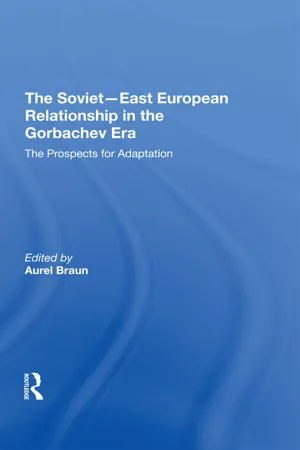
eBook - ePub
The Sovieteast European Relationship In The Gorbachev Era
The Prospects For Adaptation
- 250 pages
- English
- ePUB (mobile friendly)
- Available on iOS & Android
eBook - ePub
About this book
Trusted by 375,005 students
Access to over 1.5 million titles for a fair monthly price.
Study more efficiently using our study tools.
Information
Part One
Soviet Perspectives
1
Soviet Political and Ideological Perceptions and Policies Toward Eastern Europe
Even though Soviet views of Eastern Europe and its relationship to the USSR have gone through a period of reappraisal since Mikhail Sergeevich Gorbachev was elected General Secretary of the Communist Party of the Soviet Union (CPSU) in March 1985, that reappraisal has done little to erode the firm Soviet commitment to Eastern Europe as a geographically contiguous entity, populated by peoples who share a long historical memory of relations with Russia, and governed by like-minded Communist leaders. Therefore, it was not surprising that Gorbachev, upon coming to power, should have chosen to emphasize that of all the issues on his foreign policy agenda, he would take as his “first commandment” the strengthening of relations with Eastern Europe.1 Far from receding as US-Soviet arms control negotiations began to dominate international news, Gorbachev continued to underline the centrality of Eastern Europe, emphasizing at a Moscow meeting of bloc prime ministers and Party secretaries convened in October 1987 to discuss economic reform that the Soviet Union “views cooperation with socialist countries as the most important, priority direction of its policy.”2
From the inception of the Gorbachev period, there was every reason to believe that Eastern Europe would occupy a central place on the Soviet policy agenda. Gorbachev reaffirmed during such occasions as the renewal of the Warsaw Treaty in April 1985 and the 27th Party Congress in March 1986 that the Soviet and East European people still share a “common historical destiny,”3 emphasizing in the process the fact that he, like his predecessors, considers core Soviet strategic, ideological, and economic interests to be invested in Eastern Europe. His admission of Soviet culpability for mismanaging relations in the past and for failing, for example, to “avert crisis situations,”4 underlined only his commitment to reappraise certain important aspects of the relationship, without suggesting for a moment that Moscow was considering allowing a situation to develop which would lead to the denunciation or overthrow of socialism in Eastern Europe or the demise of the Soviet alliance system in Eastern Europe. While admitting that the development of the socialist bloc has encountered a large number of problems, Gorbachev himself clearly sees the existence of the bloc as a major force in international politics. As Gorbachev himself wrote:
Over the postwar decades socialism has become a strong international formation and a major factor in world politics. A socialist form of economy functions in a large group of countries. The foundations have been laid for an international division of labor. Multilateral organizations of socialist states have gained a varied experience of activity. Scientific and cultural exchanges have assumed large proportions. Of course, this does not mean that the development of world socialism always proceeded successfully.5
In attempting to discern the extent to which Soviet perceptions and policies toward Eastern Europe have changed since Gorbachev was elected General Secretary, the analyst is presented with several major difficulties. First of all there exists little agreement among scholars and policymakers in the West about the basic nature of Soviet policy in Eastern Europe before March 1985, when Gorbachev came to power. The field is riven by disagreements, many of them—particularly in the United States—coalescing around two opposite poles which suggest that Soviet preeminence in Eastern Europe is derived on the one hand from the imperative of maintaining a military posture in Eastern Europe for the forward defense of the Soviet heartland and on the other from Marxism-Leninism itself, whose very essence is seen by adherents to this second pole as thriving and depending upon external expansion to maintain its legitimacy as a world force.
These two poles which dominate American Sovietology are supplemented by other, but no less agreed, views emanating primarily from the spectrum of European public opinion. There the views are more extreme, stemming from closer geographical proximity and more direct experience in coping with Soviet power. The European right is even more convinced than its American counterpart that Soviet military power in central Europe is offensively oriented and not intended ultimately for the defense of Russia. This suspicion of Soviet motives is shared, for different reasons, by social democratic, communist, and emigre groups, all of whom see the Soviet position in Eastern Europe as stemming not from what they see as the humanist aspirations of Marxism, but from the despotic impulses of Stalinism.
These views are supplemented in Europe and the United States by a very strong centrist sentiment which at its roots believes that Soviet hegemony in Eastern Europe is not a sine qua non of Soviet power—that given thoroughgoing de-Stalinization and detente the bloc system created by Stalin and bolstered by the Cold War would also have to be fundamentally revised.
All of these views are echoed among unofficial circles in the Soviet Union and Eastern Europe, where dissident communities have been united in their condemnation of Soviet hegemony in Eastern Europe but disunited in their analysis of its sources. To these perspectives must, of course, be added the official Soviet and East European view of their mutual relationship—namely that the Red Army liberated these countries from fascism, creating the conditions for indigenous progressive and communist parties to flourish; but that in no way was socialism imposed from outside after the Second World War, and nor has it been maintained by force since. The community of socialist states to which the Soviet Union and the East European countries belong has traditionally been seen and portrayed as a voluntary association of countries who have allied themselves economically, politically and militarily for the defense and promotion of socialist ideals.
Because of continued disagreement over the root sources of Soviet policy in the region, considerable debate in both the West and throughout the Eastern bloc remains about the prospects of maintaining the current reform momentum in the long term, much less achieving fundamental structural changes in the bloc system which has dominated Europe for the past forty years. All of these views are, however, united in agreement that Eastern Europe is, and has always been, of the most fundamental importance to the Soviet Union. For this reason, it is also agreed that the most careful scrutiny must be given to Gorbachev’s East European policies as they unfold; since success in Eastern Europe is the crucial litmus test for Gorbachev’s power, skill, and determination.
There is universal agreement, too, on a third point: namely that Gorbachev has already had a significant impact on Soviet-East European relations. East European officials, dissidents and public opinion are universal in agreeing both that Gorbachev represents a major force for change in the region and that this force has already been unleashed, albeit with differing results. It is the progress made so far, both in words and in deeds, and less the still uncertain prospects for the future, that is the subject of this article.
Gorbachev’s efforts in Eastern Europe have been directed along three lines:
- Pereotsenka (or reappraisal) of certain core ideological and philosophical formulations which had shaped the broader world outlook of Soviet leaders and which consequently also had a crucial effect on the course of Soviet-East European relations in the past;
- Perestroika (or restructuring) of the specific ideological basis governing Soviet-East European relations; and
- Perevyazka (or bandaging) of old wounds which have been allowed to fester in the past, to the detriment of normal, healthy intra-bloc relations.
Pereotsenka
Recognition by Gorbachev that Soviet-East European relations require fundamental transformation has produced “new thinking” in all areas. This effort has benefitted first and foremost from the reappraisal of core ideological precepts which have guided Soviet policy for decades. Among these is (1) the changed view of the nature of the international system and the Soviet Union’s place in it; and (2) a redefinition of the entire concept of correlation of forces.
The nature of the international system
Gorbachev and his closest advisors have rejected the traditional “two-camp” doctrine which posed the notion of implacable hostility between the socialist and capitalist worlds. This doctrine has been replaced with a more complex view of the international system which poses interdependence between socialism and capitalism as the new iron law. The ideological justification for this transformation was offered by Yevgeniy Primakov, Director of the USSR Academy of Sciences’ Institute of World Economics and International Relations, in a September 1987 article in the CPSU’s premier theoretical journal, Kommunist:
In Party documents of the last two years, it has been repeatedly pointed out that the Soviet Union and socialism as a whole are influencing the course of global events under the conditions of the dialectical compatibility between the division of the world into two opposite sociopolitical systems and the preservation of its unity. This indicates the rejection of the previously unilateral approach, in which the first part of the formula of “unity and struggle of opposites” was if not ignored, at least clearly underestimated by Soviet social scientists in their study of historical developments. However, without a clear understanding of these dialectics we may draw the false conclusion that the past, present and future influence of socialism on the contemporary world is possible only through its confrontation with capitalism.6
This notion, that the historical dialectic between communism and capitalism can proceed both on a competitive and a cooperative plane, eliminates in a stroke much of the ideological objection which had previously been voiced to closer East-West relations in general and East European-West European relations in particular.
Redefinition of correlation of forces
It is aided by an equally new conception of how to measure the correlation of forces between capitalism and socialism. Lenin had once called the correlation of forces (sootnosheniye sil) “the main point in Marxism and Marxian tactics,” further stating that “we, Marxists, have always been proud of the fact that by a strict calculation of the mass forces and mutual class relations we have determined the expediency of this or that form of struggle.”7 However, while the correlation of forces was meant to take into account the grand sum of a society’s total capabilities in the social, economic, political, moral and military spheres, its calculation was increasingly distorted by the dual phenomena of on the one hand over-reliance on military power and quantitative economic indicators and on the other ritualistic assertions that the “correlation of forces is shifting in favor of socialism.”
Both phenomena have now been rejected. More attention is being paid to qualitative indicators in the non-military fields, with the result that all Soviet leaders and theoreticians have become much more critical of the failings of Soviet-style socialism and much more accepting of certain inherent and long-term strengths of capitalism. Equally, it is by no means assumed that the correlation of forces will proceed to shift in favor of socialism without setbacks and uneven development between, for example, military strength and social factors. As Primakov states, in the article cited above, “change in the correlation of forces is … a lengthy process encompassing a number of spheres—political, economic, military—whose development proceeds unevenly.”8 Indeed, Primakov goes on to maintain:
The study of the real correlation between the interests of social development, on the one hand, and class interests, on the other, is of the greatest possible significance in terms of the balance of forces between the two systems at the contemporary stage. V.I. Lenin considered that the interests of the development of society as a whole superseded those of the working class.9
The result of this reformulation has been extensive both in the Soviet Union and in Eastern Europe. In both, much more attention, as a result, has been given to the enhancement of an agenda for social reform, encompassing glasnost, multi-candidate elections, economic restructuring, and attention to legality and human rights, details of which are presented in the section on perevyazka below It is important here to emphasize that such reforms stem from a fundamental shift in core Soviet ideological perspectives. It is precisely because they are the result of this deep reappraisal that both Soviet and East European leaders express optimism that they are irreversible.
Perestroika
The reformulation of ideological precepts has proceeded from the general process of pereotsenka to the specific reconstruction or perestroika of the ideological assumptions underlying Soviet-East European relations. These relations have been transformed by the following new formulations: (1) the rejection of the notion of a single universal “model” of socialism; (2) the redefinition of socialist internationalism; and (3) a broader conceptualization of Europe as “a common home”.
Rejection of a single model of socialism
Gorbachev himself set the standard in revising these notions, beginning at the 27th Party Congress when he specifically emphasized “unconditional respect in international practice for the right of every people to choose the paths and forms of its development.” In what appeared as almost a mea culpa for past Soviet practices, Gorbachev stated that “unity has nothing in common with uniformity, with a hierarchy.”10 Gorbachev was subsequently to outline in detail the source of previous problems:
In the field of state building, too, the fraternal socialist states largely relied on the Soviet example. To an extent, this was inevitable. Assertions concerning the imposition of the “Soviet model” distort this objective necessity of that time [immediate post-war era)….
But it was not without losses, and rather serious ones at that. Drawing on the Soviet experience, some countries failed duly to consider their own specifics. Even worse, a stereotyped approach was given an ideological tint by some of our theoreticians and especially practical leaders who acted as almost the sole guardians of truth. Without taking into consideration the novelty of problems and the specific features of different socialist countries, they sometimes displayed suspicion toward those countries’ approaches to certain problems.
… Furthermore, negative accretions in these relations were not examined with a sufficient degree of frankness, which means that not everything obstructing their development and preventing them from entering a new, contemporary stage was identified.11
If this was the problem, the solution also appeared clear: Ado...
Table of contents
- Cover
- Half Title
- Title
- Copyright
- Dedication
- Contents
- Preface
- Acknowledgments
- Introduction
- PART ONE SOVIET PERSPECTIVES
- PART TWO EAST EUROPEAN CONCERNS
- PART THREE DILEMMAS AND PROSPECTS
- Epilogue
- Bibliography
- About the Editor and Contributors
- Index
Frequently asked questions
Yes, you can cancel anytime from the Subscription tab in your account settings on the Perlego website. Your subscription will stay active until the end of your current billing period. Learn how to cancel your subscription
No, books cannot be downloaded as external files, such as PDFs, for use outside of Perlego. However, you can download books within the Perlego app for offline reading on mobile or tablet. Learn how to download books offline
Perlego offers two plans: Essential and Complete
- Essential is ideal for learners and professionals who enjoy exploring a wide range of subjects. Access the Essential Library with 800,000+ trusted titles and best-sellers across business, personal growth, and the humanities. Includes unlimited reading time and Standard Read Aloud voice.
- Complete: Perfect for advanced learners and researchers needing full, unrestricted access. Unlock 1.5M+ books across hundreds of subjects, including academic and specialized titles. The Complete Plan also includes advanced features like Premium Read Aloud and Research Assistant.
We are an online textbook subscription service, where you can get access to an entire online library for less than the price of a single book per month. With over 1.5 million books across 990+ topics, we’ve got you covered! Learn about our mission
Look out for the read-aloud symbol on your next book to see if you can listen to it. The read-aloud tool reads text aloud for you, highlighting the text as it is being read. You can pause it, speed it up and slow it down. Learn more about Read Aloud
Yes! You can use the Perlego app on both iOS and Android devices to read anytime, anywhere — even offline. Perfect for commutes or when you’re on the go.
Please note we cannot support devices running on iOS 13 and Android 7 or earlier. Learn more about using the app
Please note we cannot support devices running on iOS 13 and Android 7 or earlier. Learn more about using the app
Yes, you can access The Sovieteast European Relationship In The Gorbachev Era by Aurel Braun in PDF and/or ePUB format, as well as other popular books in Politics & International Relations & International Relations. We have over 1.5 million books available in our catalogue for you to explore.