Originally published in 1983. Attention is focused in this book on the principal functional, spatial and morphological changes which had taken place within West Germany's uniquely arranged mosaic of cities, towns and intervening rural areas during the postwar period. The topics covered here have been carefully selected as key foci of interest, and their thematic approach is supported by a large variety of detailed, local case studies. This title will be of interest to students of urban geography and urban studies.
- 272 pages
- English
- ePUB (mobile friendly)
- Available on iOS & Android
eBook - ePub
Urban and Rural Change in West Germany
About this book
Information
1 INTRODUCTION: THE PATTERNING OF CITIES AND RURAL AREAS IN WEST GERMANY
Trevor Wild
Perusal of any standard atlas map of western Europe which shows the distribution of cities and intervening spaces, brings to light a remarkable range of international differences. Very noticeably, West Germany, with its diffuse pattern of major cities and intricate arrangement of rural areas, represents one end of the diversity spectrum. Indeed, these two interrelated characteristics are so crucially important in the spatial organisation of West Germany, that a perspective on the realities of their spatial expression is needed by any student of urban and rural change within this highly individualised country. This, therefore, will form the theme of the introduction to this book: moreover, it will be a focus of interest which will serve to acquaint the reader with an appropriate geographical setting for the text which follows.
The Distribution of Cities
The distinctiveness of West Germany, in terms of its lack of a dominating ‘metropolitan’ capital and its frequency of major ‘regional’ cities, has been described recently in the following factual statements:
When it is compared with those of other west European countries, the urban structure of West Germany is distinguished first and foremost by the absence of a national focus as dominating as a capital city such as Paris, London, Madrid or Brussels. If West Berlin is left aside as a special case, Hamburg with 1,688,000 inhabitants is the largest single centre … Yet this city accommodates only 2.7 per cent of the national population, a remarkably low proportion when one considers figures for other ‘primate’ cities. Comparisons with France and the United Kingdom, to take perhaps the two most obvious examples, show corresponding percentages of 16.2 percent for Greater Paris and 13.9 for Greater London …
Another outstanding characteristic is the significant number of large regional centres … Again comparisons with France and the United Kingdom are revealing, for while West Germany now has thirty-two cities with populations above 200,000, these two countries have only twenty-one and twenty respectively. Above the 500,000 mark the difference is even more striking, with West Germany having as many centres of this size as France and the United Kingdom together.1
There is no single explanation for the diffuse distribution of major cities and metropolitan functions in West Germany. A common fallacy is to attach too much weight to the political events of the early postwar years, namely the division of Germany, the bisecting of Berlin (4.3 million inhabitants in 1939, representing 7.0 per cent of the Reich population), the creation of a federative system of regional government and, lastly, the choice of Bonn, hitherto just a small provincial city, as the ‘provisional’ federal capital. These decisions served to amplify, rather than initiate, an urban system and framework of city-size relationships which, apart from some interesting individual changes in rank positioning during the postwar period, had already been well established. Accordingly one has to turn to historical factors of causation.
The origins of the West German urban system can be traced as far back in time as the Middle Ages, when the German territories lying to the west of the river Elbe were fragmented into a chaotic assemblage of numerous duchies, principalities, ecclesiastic ‘states’ and independent imperial cities, each competing against its neighbours for political and economic power. In many instances this rivalry tended to heighten the functional importance of historic urban centres often out of all proportion to their local resources and geographic location. This ‘upgrading’ of provincial cities increased in scale during the sixteenth, seventeenth and eighteenth centuries. This, the so-called ‘Age of Princes’, was an era not only of widening economic interaction between trading centres, but also one of intensifying political competition in which a select number of expanding territories sought to strengthen their prestige and influence by constructing all the ostensible trappings of a de facto nation state. One of the most notable features of the latter trend was the proliferation of state capitals, and through this the granting of a clearly defined regional status to an extensive list of West German cities.
With few exceptions, the size and functional standing of these regional cities was greatly enhanced during the industrial revolution. In reviewing this critical period, writers consider that the ‘take-off’ phase belonged to the 1870s, and the fastest pace of industrialisation took place during the following three decades.2 It is important to stress that, unlike the British experience, these major events of economic history postdated the main wave of construction of Germany’s provincial railway network. Indeed, the point can be further emphasised by noting that during the ‘railway era’ of the 1850s, 1860s and early 1870s most sponsors of state railway systems decided to focus their main routes on established regional capitals instead of towns and cities with optimum combinations of industrial resources. Consequently, over the nation as a whole, the German tradition of diffuse ‘city regionalism’ was reinforced, rather than altered, during the industrial revolution.
In the economic development of postwar West Germany two major sets of advantages have been derived from this historical legacy. In the first place, the existence in this country of as many as 15 major regional centres and 52 other large cities, all with present-day populations above the 100,000 level, means that there is a wide replication of the organisational requirements for nurturing modern industrial and commercial growth. Indeed, one is very much tempted to think along the lines that the regional availability of such essential needs as financial facilities, research and advisory institutions, concentrations of skilled labour and adequate communications infrastructures represents one of the most important, if least publicised, growth factors behind West Germany’s outstanding postwar economic success.
The second set of advantages accrues from the repeated ranges of services which these numerous large cities provide both for their own communities and their wider catchment areas. In the large majority of cases they cover an impressive variety of central-place functions which include all the social, cultural and consumer prerequisites for attaining high ‘quality-of-life’. In total, about 75 per cent of West Germany’s population lives within easy travelling distance to at least one Regionale Stadt,3 a proportion which serves to underline the extensiveness of an increasingly city-oriented consumer society.
Although it is far more effective than in most other west European countries, even in West Germany the geographic distribution of regional cities falls some way short of the theoretician’s notion of equal spacing and functional balance. In the Rhinelands a particularly strong degree of political fragmentation during the Middle Ages and the Renaissance, followed by rapid economic development during and after the industrial revolution, produced a concentration of centres (38 out of the total 67) distributed along a broad tract of territory stretching from Recklinghausen in the northern Ruhr to Stuttgart in Baden-Württemberg (Figure 1.1). Indeed, within this so-called ‘Rhine axis’ or ‘urbanised core’ of West Germany, one can recognise three constellations of cities: first and foremost, the Rhine-Ruhr region, with as many as 23 municipalities with 100,000-plus populations; secondly, the Rhine-Main region, which has five such centres including Frankfurt, Wiesbaden and Mainz; thirdly, the Rhine-Neckar region, where the cities of Mannheim, Ludwigshafen, Heidelberg, Karlsruhe and Pforzheim are likewise positioned only short distances apart from each other. These three regions are clearly over-provided with metropolitan facilities: they are also overburdened with the types of environmental problems which are universally associated with a vigorous and poly centric type of urban-growth process.
Figure 1.1: West Germany: Distribution, Size and Functional Importance of Major Cities
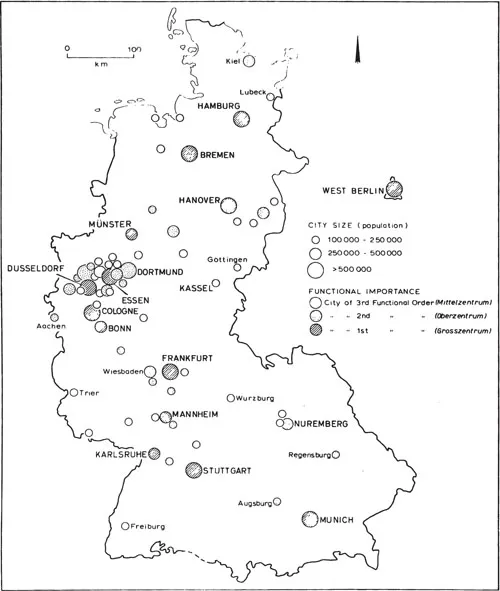
Source: The functional classification of 100,000-plus cities is based on the system which G. Kluczka defines and describes in ‘Zentrale Orte und zentralörtliche Bereiche mittlerer höherer Stufe in der BRD’, Forschungen zur deutschen Landes-kunde, vol. 194 (1970).
Moving away from the Rhine axis, the distribution of major cities becomes progressively sparcer. Indeed, east of a line drawn from Münster to Frankfurt and Stuttgart, and west of a line drawn from Aachen to Karlsruhe, the principal feature in Figure 1.1 is the occurrence of what German geographers refer to as Isoliertestädte (‘isolated’ cities). The largest examples are Hamburg, Munich, the Nuremberg conurbation, Bremen and Kassel, but the list can be extended to include centres such as Trier and Freiburg in the west and Kiel, Lübeck, Göttingen, Würzburg, Augsburg and Regensburg in the east. The wide separation of these cities means that their hinterland areas, or Umland-zonen, do not overlap (Figure 1.2). Beyond the confines of the Rhine axis and its offshoots, therefore, there are extensive parts of West Germany which, even under today’s conditions of much-improved regional road and public-transport networks, still do not have easy access to metropolitan functions and amenities. Fittingly described as ‘the peripheral regions’, in all cases their remoteness poses a severe handicap to their general economic development and enhancement of material quality of life. With ample justification, those federal and Land authorities which institute and direct policies of regional development have, since the early 1950s, consistently focused their attention and resources on tackling this problem. For more than a decade its solution (and also that of the rapid decline in the farming occupation) was seen to lie in the promotion of industrialisation. It is significant, however, that since 1969 and the introduction of the ‘Joint Task for the Improvement of Regional Economic Structures’,4 a growing emphasis has been placed on improving the central-place functions of all areas deemed to have been deficient in urban facilities. The cornerstone of this strategy is the selection of certain small to average-size towns for investment in the three crucial fields of infrastructure provision, expansion of public services and fostering of local businesses. Its full effect has yet to be seen, but given time this deliberate manipulation of the urban spatial system and extension of urbanism will most likely prove to be a major factor in reducing the inequalities between West Germany’s city-orientated areas and its rural residuals.
Figure 1.2: West Germany: Major Cities and their Umlandzonen
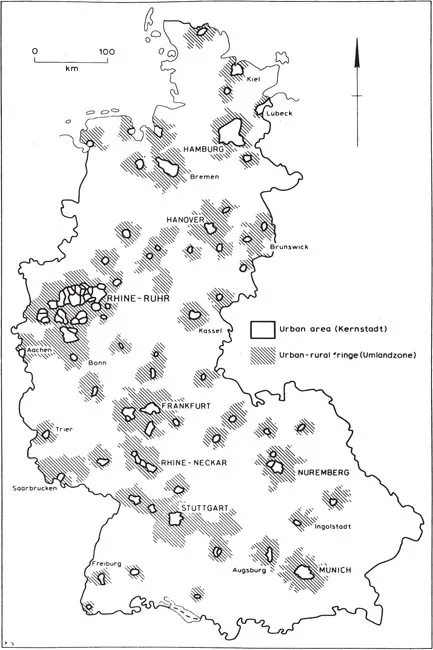
Source: Die Akademie für Raumforschung und Landesplanung...
Table of contents
- Cover
- Half Title
- Title Page
- Copyright Page
- Table of Contents
- List of Figures
- List of Tables
- Acknowledgements
- Glossary of German Words and Phrases
- Preface
- 1. Introduction: the Patterning of Cities and Rural Areas in West Germany
- 2. Postwar Development and Planning of West German Cities
- 3. Residential Environments in West German Inner Cities
- 4. Guestworkers and their Spatial Distribution
- 5. Trends in Consumer Behaviour and Retailing
- 6. Developments in Transport
- 7. The Residential Dimension to Rural Change
- 8. Social Fallow and its Impact on the Rural Landscape
- 9. Agricultural Change and its Impact in Rural Areas
- 10. Conclusion
- Notes on Contributors
- Index
Trusted by 375,005 students
Access to over 1.5 million titles for a fair monthly price.
Study more efficiently using our study tools.
Frequently asked questions
Yes, you can cancel anytime from the Subscription tab in your account settings on the Perlego website. Your subscription will stay active until the end of your current billing period. Learn how to cancel your subscription
No, books cannot be downloaded as external files, such as PDFs, for use outside of Perlego. However, you can download books within the Perlego app for offline reading on mobile or tablet. Learn how to download books offline
Perlego offers two plans: Essential and Complete
- Essential is ideal for learners and professionals who enjoy exploring a wide range of subjects. Access the Essential Library with 800,000+ trusted titles and best-sellers across business, personal growth, and the humanities. Includes unlimited reading time and Standard Read Aloud voice.
- Complete: Perfect for advanced learners and researchers needing full, unrestricted access. Unlock 1.5M+ books across hundreds of subjects, including academic and specialized titles. The Complete Plan also includes advanced features like Premium Read Aloud and Research Assistant.
We are an online textbook subscription service, where you can get access to an entire online library for less than the price of a single book per month. With over 1.5 million books across 990+ topics, we’ve got you covered! Learn about our mission
Look out for the read-aloud symbol on your next book to see if you can listen to it. The read-aloud tool reads text aloud for you, highlighting the text as it is being read. You can pause it, speed it up and slow it down. Learn more about Read Aloud
Yes! You can use the Perlego app on both iOS and Android devices to read anytime, anywhere — even offline. Perfect for commutes or when you’re on the go.
Please note we cannot support devices running on iOS 13 and Android 7 or earlier. Learn more about using the app
Please note we cannot support devices running on iOS 13 and Android 7 or earlier. Learn more about using the app
Yes, you can access Urban and Rural Change in West Germany by Trevor Wild in PDF and/or ePUB format, as well as other popular books in Social Sciences & Human Geography. We have over 1.5 million books available in our catalogue for you to explore.