First published in 1998, this volume joined the effort to understand the former German Democratic Republic, with the aim of reaching a better understanding of the psychologically painful process of German reunification following the collapse of East-German communism in 1989. While born illegitimate and artificial, the country determined the lives of millions of people, despite having now disappeared from the map. This study from Joanna McKay incorporates previously unavailable archive material and focuses on some of the most challenging, ever-present tasks for the GDR leaders. In particular, she examines how they approached explaining the division with West Germany without undermining the legitimacy of the GDR.
eBook - ePub
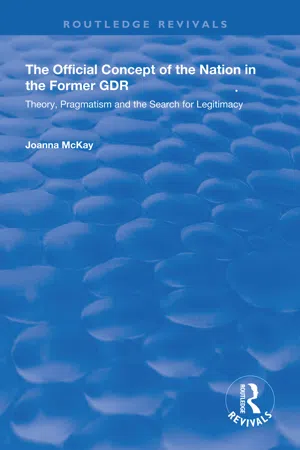
The Official Concept of the Nation in the Former GDR
Theory, Pragmatism and the Search for Legitimacy
- 176 pages
- English
- ePUB (mobile friendly)
- Available on iOS & Android
eBook - ePub
The Official Concept of the Nation in the Former GDR
Theory, Pragmatism and the Search for Legitimacy
About this book
Trusted by 375,005 students
Access to over 1.5 million titles for a fair monthly price.
Study more efficiently using our study tools.
Information
1 Introduction
For years social scientists have attempted to identify the essence of state and regime legitimacy and to find a means of assessing and comparing the legitimacy of individual states and regimes. It is generally accepted that legitimacy depends on voluntary acceptance of the state or regime by the majority of the population concerned, in spite of occasional opposition to specific policies or ventures, and that almost all rulers seek popular legitimacy. This may be on principle, as in democratic systems, or as a means to an end, as in authoritarian systems, for example, to enhance a claim to international recognition or to increase mass participation and productivity. Max Weber, Jürgen Habermas and Seymour Martin Lipset have all made significant contributions to the debate on the nature of state legitimacy,1 but the appropriateness of Western models in the assessment of the legitimacy of communist regimes is questionable.2 This is especially true in the case of the German Democratic Republic which was a truly unique state which defied categorisation and did not easily fit any theoretical models. While it could be argued that every country is unique, the GDR has rightly been described as ‘more unusual than most’3 due to the circumstances of its birth, the factors which sustained it, and the indisputable division of the German nation.
Like other ruling Marxist-Leninist parties, the Sozialistische Einheitspartei Deutschlands (SED) of the GDR went to great lengths to convince its citizens of the advantages of socialism and the legitimacy of the regime, and in this case, of the state itself, via a whole range of convoluted arguments and propaganda devices. This book focuses on the attempts made by the SED to fashion a Nationskonzept, i.e. a credible explanation of the GDR’s relationship to the German nation, which had been divided into two states in 1949, that would establish the legitimacy of the socialist German state, both in the eyes of its own population and of the international community. Initially the SED portrayed the GDR as a model for a future united socialist Germany, and then later as a complete state in its own right. However, in view of the collapse of the regime in 1989 and German reunification the following year, we can tentatively conclude that the SED failed to convince its citizens of the GDR’s right to exist, for given the choice in 1990, the majority of East Germans opted to become citizens of the Federal Republic.
In short, this work is not a theoretical study of the relationship between socialism and nationalism in general, but an examination of how one particular Marxist-Leninist regime handled the national question in practice. The aim is to compare the contrasting positions held by the party leadership at different points in time, and also to explain why policy changes occurred, and why they occurred when they did. Only in this way can one hope to make sense of the SED’s dramatic U-turns and illogical arguments. To this end certain political factors are considered in order to assess their impact on the official line on the nation in the GDR compared with other factors such as public opinion and theoretical considerations. It will be argued that even nationhood and national consciousness were regarded by the SED as objective factors which could be manipulated and transformed to suit the needs of the party, as opposed to being permanent sources of self-identification and emotional attachment, and that policy regarding the nation was always determined by political objectives, even opportunism, and not by conventional nation-building theories or popular sentiment. In addition, particular attention will be paid to the role played by East German theorists who attempted to provide theoretical arguments to support the official party line on the nation.
The East German dilemma
From its establishment in 1949 until its demise in 1990, the GDR was regarded as temporary and artificial. It was not a result of self-determination with the popular legitimacy this brings, but a product of the failure of the victors of World War II to reach an agreement on the future of Germany. While the same could also be said of the Federal Republic of Germany, there were several reasons why the latter came to be accepted as the legitimate post-war German state, both by the outside world and by the majority of Germans on both sides of the inner-German border.
The first was the fact that the GDR was a one-party state, with power in the hands of the Marxist-Leninist SED. Although other parties did exist, the intention was merely to create a facade of democracy since they were all allied to the SED in the so-called ‘National Front for a Democratic Germany’ and elections were merely a sham. Thus the SED never even attempted to give the GDR genuine democratic legitimacy due to the threat this would pose to the party’s position of dominance.
The second reason was that the GDR was a Soviet satellite, the jewel in the crown of the Eastern Bloc, and therefore had little opportunity for independent action. Indeed the SED had already abandoned the ‘German road to socialism’ in favour of the Stalinist road before the GDR was established.
The third reason was that a centrally planned, socialist economy was imposed on the East German population, with the intention of proving that it was superior to the capitalist model which in turn would enhance the GDR, since it is obvious that the legitimacy of states is always enhanced by their effectiveness in concrete terms. In fact, official emphasis on the alleged economic and material achievements of socialism was a common tactic throughout the Eastern bloc (sometimes labelled ‘goulash socialism’ in the West4). However this was a risky strategy since future economic success could not be guaranteed, as the SED was to discover. In particular the state failed miserably in the provision of quality consumer durables, cars and telephones, and East Germans were more aware of the material shortcomings of socialism than their eastern neighbours thanks to West German television and visitors.
While the same factors also undermined the legitimacy of other regimes within the Soviet bloc, they did not necessarily raise questions about other states’ very right to exist because they had featured on the map of Europe in some form for years, and some, such as Poland and Hungary, were synonymous with established nations. But the GDR was a state whose population was only a small proportion of a divided nation, hence a straight forward fusion of national consciousness and state consciousness, resulting in a strong sense of identity between the people and their state, was unlikely to occur. In short, the East German regime faced an additional task which was not shared by its Eastern allies, namely the need to prove that it was more successful and more legitimate than its Western rival, the existence of which was to undermine it throughout its 40 year lifespan. Initially however the SED did not intend to compete with the Federal Republic as a separate state. Instead the intention was to prove that the GDR was the only legitimate German state, and the rightful political embodiment of the German nation.
The only comparable case was that of Korea, where the nation was also divided into two hostile states due to outside circumstances, and whose rivalry also symbolised the international struggle for supremacy between capitalism and communism. Even so, there were significant differences between the German and Korean cases, for example regarding the relative strength and size of the two constituent parts, the importance of nationalism, and their geo-political situations.5 However, multinational states such as the former Soviet Union, Yugoslavia, and on a smaller scale, Czechoslovakia, also faced difficulties in gaining the allegiance of the entire population and provided further evidence of how communist regimes generally underestimated the strength of ethnic nationalism.
Unlike successive West German governments which took the continued unity of the German nation as given and then adapted their approach towards the GDR according to current circumstances and realistic possibilities, the SED took its ambitions for the GDR and for Germany as a whole as a starting point and then adapted its position regarding the state of the German nation accordingly. Therefore the factors which determined the SED’s policy regarding the German question in a political sense also determined the official line on the state of the German nation since the latter was always subordinate to the former. The first of these influencing factors were Moscow’s objectives regarding the future of Germany and of Europe as a whole. According to Gerhard Wettig, the Kremlin consistently viewed the GDR ‘not as a pawn or a bargaining chip but as a power position that could be used for further political advance.’6 In other words, the GDR was the Soviet Union’s prize for having won the war and the cornerstone of its security policy, hence reunification was impossible (apart from as a communist takeover of West Germany) until the East-West divide of Europe became irrelevant altogether. The second influencing factor was the West German government’s Deutschlandpolitik. The SED was constantly on the defensive due to the Federal Republic’s claim to the territory of the GDR and its emphasis on the German national bond. The party had to respond to Bonn’s initiatives because it could not prevent the population of the GDR hearing about them on their radios and television sets. As a result party propaganda portrayed West German politicians as the class enemy and their advances as threatening and imperialist, although the reception given by ordinary East Germans to Willy Brandt and Helmut Kohl suggests their claims fell on deaf ears. However, while public opinion regarding the national question was monitored closely this was purely in order to bring it into line with party policy and not because the SED was willing to be influenced by popular sentiment.
An additional factor was the obligation to produce policies which could be reconciled with the basic teaching of Marxism-Leninism. While this is not the place for a detailed account of classical Marxist thought regarding questions of nationality and nationalism7 since the focus of this work is the practical policies employed by a particular Marxist-Leninist regime, it is important to note that nationalism has always posed a theoretical problem for Marxists because it clearly contradicts and rivals socialism as the basis for the organisation of societies.8 But even Marx himself did not condemn nationalist movements where there was a strategic advantage to be gained.9 Subsequent attempts to reconcile socialism and nationalism have produced conflicting results. The Austrian Marxist, Otto Bauer, for example, developed a ‘socialist principle of nationality’ which recognised the value of national communities and cultures which he believed would continue to flourish under socialism without becoming antagonistic towards each other.10 In contrast, Stalin devised a rigid definition of what constituted a nation which aimed not to encourage nationalism and self-determination but to limit separatist claims and to encourage multinational class solidarity.11 In ‘Marxism and the National Question’, dating back to 1913, Stalin stated, ‘A nation is a stable community that has arisen historically on the basis of a common language, territory, economic system and psychological character, which is manifested in a common culture.’12 This remained the official definition in the Soviet Union and the GDR until after Stalin’s death. For Lenin, the advancement of the revolution was paramount, therefore he advocated a pragmatic approach to the national question, which could be adapted to suit specific circumstances.13 This strategy was to appeal to the leadership of the SED, a party which always put the immediate interests of the state and socialism before abstract theories.
Overall, with so many different factors to take into account it is perhaps hardly surprising that the SED’s policies regarding the state of the German nation and the GDR’s relationship to it often sounded artificial, contrived and self-contradictory.
Policy-making in the GDR
Since the collapse of the GDR it has become apparent that power was concentrated in the hands of a very small elite, in particular, the First Secretary of the SED (officially called General Secretary from 1976), and his close circle,14 and even the politburo had long ceased to be a forum for debate.15 This situation was exacerbated by the fact that individuals remained in office for decades, with most top party positions being held by only one or two people throughout the 40 years of the GDR’s existence. The authority of the First/General secretary of the par...
Table of contents
- Cover
- Half Title
- Title Page
- Copyright Page
- Table of Contents
- Preface
- Abbreviations
- 1 Introduction
- 2 The Fight to Preserve the Unity of the German Nation
- 3 The Unity of the Nation in Doubt
- 4 The ‘Socialist Nation’ in the GDR
- 5 The ‘Socialist German Nation’ - from Consolidation to Crisis
- 6 Conclusion
- Bibliography
Frequently asked questions
Yes, you can cancel anytime from the Subscription tab in your account settings on the Perlego website. Your subscription will stay active until the end of your current billing period. Learn how to cancel your subscription
No, books cannot be downloaded as external files, such as PDFs, for use outside of Perlego. However, you can download books within the Perlego app for offline reading on mobile or tablet. Learn how to download books offline
Perlego offers two plans: Essential and Complete
- Essential is ideal for learners and professionals who enjoy exploring a wide range of subjects. Access the Essential Library with 800,000+ trusted titles and best-sellers across business, personal growth, and the humanities. Includes unlimited reading time and Standard Read Aloud voice.
- Complete: Perfect for advanced learners and researchers needing full, unrestricted access. Unlock 1.5M+ books across hundreds of subjects, including academic and specialized titles. The Complete Plan also includes advanced features like Premium Read Aloud and Research Assistant.
We are an online textbook subscription service, where you can get access to an entire online library for less than the price of a single book per month. With over 1.5 million books across 990+ topics, we’ve got you covered! Learn about our mission
Look out for the read-aloud symbol on your next book to see if you can listen to it. The read-aloud tool reads text aloud for you, highlighting the text as it is being read. You can pause it, speed it up and slow it down. Learn more about Read Aloud
Yes! You can use the Perlego app on both iOS and Android devices to read anytime, anywhere — even offline. Perfect for commutes or when you’re on the go.
Please note we cannot support devices running on iOS 13 and Android 7 or earlier. Learn more about using the app
Please note we cannot support devices running on iOS 13 and Android 7 or earlier. Learn more about using the app
Yes, you can access The Official Concept of the Nation in the Former GDR by Joanna McKay in PDF and/or ePUB format, as well as other popular books in Social Sciences & Sociology. We have over 1.5 million books available in our catalogue for you to explore.