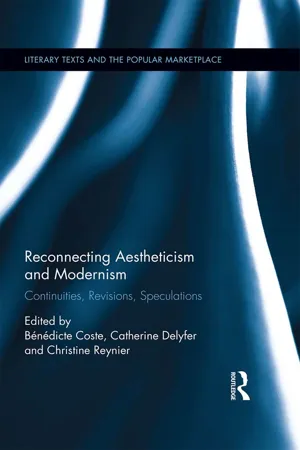
Charting the period that extends from the 1860s to the 1940s, this volume offers fresh perspectives on Aestheticism and Modernism. By acknowledging that both movements had a passion for the 'new', it goes beyond the alleged divide between Modernism and its predecessors. Rather than reading the modernist credo, 'Make it New!', as a desire to break away from the past, the authors of this book suggest reading it as a continuation and a reappropriation of the spirit of the 'New' that characterizes Aestheticism. Basing their arguments on recent reassessments of Aestheticism and Modernism and their articulation, contributors take up the challenge of interrogating the connections, continuities, and intersections between the two movements, thus revealing the working processes of cultural and aesthetic change so as to reassess the value of the new for each. Attending to well-known writers such as Waugh, Woolf, Richardson, Eliot, Pound, Ford, Symons, Wilde, and Hopkins, as well as to hitherto neglected figures such as Lucas Malet, L.S. Gibbon, Leonard Woolf, or George Egerton, they revise assumptions about Aestheticism and Modernism and their very definitions. This collection brings together international scholars specializing in Aestheticism or Modernism who push their analyses beyond their strict period of expertise and take both movements into account through exciting approaches that borrow from aesthetics, philosophy, or economics. The volume proposes a corrective to the traditional narratives of the history of Aestheticism and Modernism, revitalizing definitions of these movements and revealing new directions in aestheticist and modernist studies.
eBook - ePub
Reconnecting Aestheticism and Modernism
Continuities, Revisions, Speculations
- 210 pages
- English
- ePUB (mobile friendly)
- Available on iOS & Android
eBook - ePub
Reconnecting Aestheticism and Modernism
Continuities, Revisions, Speculations
About this book
Trusted by 375,005 students
Access to over 1.5 million titles for a fair monthly price.
Study more efficiently using our study tools.
Information
Connecting Aestheticism and Modernism
1 The New Woman Flâneuse or Streetwalker?
George Egerton’s Urban Aestheticism
In July 1894 when George Egerton [Mary Chavelita Dunne] (1859–1945) published her short story, ‘A Lost Masterpiece’, in the scandalous first issue of The Yellow Book, her literary reputation was at its height. Keynotes, her sexually bold first collection of short stories, was published by the Bodley Head in 1893; it received instant critical acclaim and sold more than 6,000 copies in its first year.1 The imbrication of Scandinavian modernist style and Nietzschean philosophy in Keynotes contributed to its identification as a decadent work, while the deployment of strong female protagonists made it consistent with New Woman writing in the 1890s.2 The title of her collection lent its name to the Bodley Head’s Keynotes Series, which included radical works by a range of well-known contemporary authors (such as Grant Allen). Moreover, Egerton’s letters to John Lane in the mid-1890s underline the publisher’s reliance on her literary acumen; she was conversant with a range of emerging intellectual discourses at that time.3 Egerton’s importance as a generative figure in British fiction of the 1890s is beyond question; her innovative early work incorporates elements of aestheticism, symbolism and naturalism. However, her later work has been critically neglected and, in particular, her 1905 collection, Flies in Amber, is rarely read today. In this essay, I read Egerton’s later work as a model for Irish modernist experimentation and argue that her radical plots contribute to a feminist ethics-in-development at the turn of the twentieth century. Furthermore, comparing these later narratives with her better-known early fiction (from her Keynotes [1893] and Discords [1894] collections, for instance) exemplifies that urban and migrant identities are abiding concerns in Egerton’s work, as I will explain.
Egerton’s writing consistently grapples with the problems posed by urban modernity, which is particularly evident in her only novel The Wheel of God (1898) and in stories such as ‘The Chessboard of Guendolen’ from Flies in Amber (1905). These fictions attend to the questions posed by mass society at the end of the nineteenth century. In an Irish context, the Great Famine of the 1840s–50s provoked massive demographic upheaval, resulting in overcrowding in the Dublin slums, as well as in Irish cities abroad like Liverpool and Manchester. Thus, new urban and migrant ways of being in the world were an integral part of Irish identity in the late nineteenth century. Egerton’s remarkable Dublin story ‘Mammy’ from Flies in Amber, which I focus on in this essay, derives from this social context. While the Famine is not specifically mentioned in ‘Mammy’, the poverty and absence of family networks in rural nineteenth-century Ireland produces its context, these new communities in the Dublin tenements, to which a young girl arrives alone in a desperate bid to avoid starvation and find a home.
In constructing ‘Mammy’, Egerton drew on her own intimate knowledge of the streetscape of contemporary Dublin. Her narratives disrupt nineteenth-century assumptions about class and gender (such as those confining women to the domestic sphere) as she deploys her women wanderers into uncharted urban territories, whether working class areas of the docklands, or Dublin’s red-light district, ‘the Monto’. This acute awareness of gender and class boundaries at street level derived from Egerton’s adolescent experiences in Dublin where, as the eldest child of a profligate father, she was forced to move her small brood of siblings from one more dismal set of lodgings to another following the death of their mother. Thus, her awareness of the impact of Dublin’s economic torpor on the lives of ordinary people and her insight into the shifts women were forced to endure in order to save their children from the workhouse came from her own lived experience in the meaner parts of Dublin.
Egerton’s migrant experiences, beginning with her childhood removal from Australia to Ireland, and continuing in later life to Germany, England, Norway and the United States, could be read as an extension of these moves across Dublin. Her unsettled life and the nomadic urban creatures we find in her fiction are quite at odds with the settled, rural protagonists we now associate with Irish literature of the period, which chiefly emanate from the Irish Revival. However, her work reveals similar subject matters and shares a locus with that of her close contemporary, George Moore; moreover, their evocation of Dublin in this period is similar to that of their later compatriot James Joyce. These three Irish writers share a common adherence to the literary experiments emerging from contemporary European movements, such as naturalism and aestheticism.
While deriving its impetus from aestheticism, on the one hand, the distinctive vision of new Irish subjectivities in Egerton’s collection Flies in Amber (1905) brings her work into dialogue with recent feminist and modernist scholarship, on the other hand. Here, a range of contemporary urban travellers – aesthetes, New Women and migrants of various kinds – encounter one another in the collective intimacy of urban life. A serial migrant herself, Egerton began her writing career in Norway; she was inspired by Knut Hamsun, the leading Norwegian modernist writer, and influenced by Swedish-German intellectuals, Ola Hansson and Laura [Mohr] Marholm-Hansson.4 These exemplars enabled her to develop highly unusual types of subjectivity in fiction, ones that departed from normative nineteenth-century codes that sought to regulate the proper place of women and men in relation to gender and sexuality, as well as class and nation.5 While scholars, notably Lyn Pykett, have compared her earlier material to that of James Joyce’s Dubliners, Flies in Amber illustrates the extent to which her later work develops these aesthetic experiments and demonstrates the importance of her work for early modernism.6 Nowhere is this clearer than in her later work, particularly in stories such as ‘Mammy’ (1905).
The comparatively late publication date of Flies in Amber meant that by the time it appeared, interest in Egerton’s experimental writing had waned. In the period of conservative backlash in London following the Wilde trials, publishers were no longer willing to take the risks her radical fiction posed. Hutchinson finally issued the collection in 1905, four years after its completion, but it had modest sales and quickly disappeared from view. Yet, this forgotten collection enables us to see the extension of Egerton’s aesthetic experiments into the late 1890s and, moreover, to realize the degree that sexual dissidence is a driving force in her fiction, in tandem with a sustained interest in class and confessional divides. The latter derives from her Irish upbringing, which is particularly apparent in stories such as ‘The Marriage of Mary Ascension’, which boldly tackles the subject of sectarianism in an Irish country town. Despite this investment in Irish cultural contexts, with one or two notable exceptions, scholars have only recently described Egerton as an expressly Irish writer.7
Egerton’s Irish protagonists are urban creatures who experience the shock of metropolitan existence and anomie on several levels; spatial and temporal shifts are a recurring feature in her fiction. For instance, in her 1898 novel The Wheel of God, the fictional migrant, Mary Desmond, contends with the unnerving mechanized modernity of New York City:
Life seemed less concrete, less inside the houses and warehouses; it was everywhere, pounding like a gigantic steam-hammer, full speed, in the air, in the streets – insistent, noisy, attention-compelling. Trains above one’s head, one caught glimpses of domestic interiors, intimate bedroom scenes, as one whizzed past second stories in the early cars … Mary Desmond felt that the clocks in America must surely give two ticks to the one of the sedate old timepieces at home.8
Highlighting the adverse effects of modernity, Egerton underlines the detrimental impact of this ‘monstrous international sifting sieve’, the loss of a private life and of intimate relations when domestic interiors are thus on display. In contrast, the urban sophisticates we encounter in her European short fiction have made their own accommodations with urban experience. In ‘A Lost Masterpiece’ (The Yellow Book, 1894), for instance, she demonstrates their strategies for doing so, the social networks constructed by urbanites and their carefully maintained mental distance from others in the crowd. She shows how the flâneur carefully establishes his mastery over those he comes into contact with by scanning the scene, assessing the visual and aural information he takes in, all the while maintaining his distance and thereby insulating himself from cognitive overload. The flâneur is a constant in fin de siècle narratives, so well known as an avatar of modernity by then, at least to readers of The Yellow Book, that Egerton’s satire would have readily found its mark. In the story, she pokes fun at the flâneur’s narcissism and challenges his self-absorption by having his banal aestheticizing of the urban scene constantly interrupted by a New Woman who keeps getting in his way.
This story critiques the gendering of cosmopolitan space and the sexism of the flâneur and, as such, accords with Scott McCracken’s description of modernist fiction, where ‘the urban scene is the site for the reconfiguration of gender relations’.9 Male domination of the public sphere was further challenged by the flâneuse, as Deborah Parsons and others observe; they posit flânerie as a possibility for women by the 1890s, as women increasingly made their mark on the urban outdoors.10 Egerton’s short stories document this shift: in ‘A Psychological Moment at Three Periods’ (Discords, 1894), for instance, she describes a New Woman who takes refuge from mass society in a different public space, the Reading Room at the British Library: ‘She has a kind of affectionate feeling for the great room; it has been her oasis in a vast desert’.11 This refuge might be compared with the department stores Anne Friedman’s work discusses, or the late nineteenth-century Dublin shopping streets described by Stephanie Rains; these new business ventures provided safe women-identified places in the city, giving women leave to move abroad albeit within the confines of particular roles as consumers and within certain commercial areas. However, unlike these shoppers and cinema-goers, Egerton’s women protagonists were set loose in a wider public sphere. She despatches them alone on sea voyages and train journeys, for instance, and many of her short stories are situated in unfamiliar cityscapes, like Norway. A good example of this is her well-known story ‘The Spell of the White Elf’ (Keynotes, 1893) where her New Woman is clearly constructed as a flâneuse, objectifying the Norwegian ‘city pageant’ (as Kate Flint might describe it12) for her own artistic purposes.
In Egerton’s ‘The Che...
Table of contents
- Cover
- Half Title
- Title Page
- Copyright Page
- Table of Contents
- Introduction
- PART I Connecting Aestheticism and Modernism
- PART II Revising Assumptions about Aestheticism and Modernism
- PART III Speculative Orientations in Aestheticism and Modernism
- Contributors
- Index
Frequently asked questions
Yes, you can cancel anytime from the Subscription tab in your account settings on the Perlego website. Your subscription will stay active until the end of your current billing period. Learn how to cancel your subscription
No, books cannot be downloaded as external files, such as PDFs, for use outside of Perlego. However, you can download books within the Perlego app for offline reading on mobile or tablet. Learn how to download books offline
Perlego offers two plans: Essential and Complete
- Essential is ideal for learners and professionals who enjoy exploring a wide range of subjects. Access the Essential Library with 800,000+ trusted titles and best-sellers across business, personal growth, and the humanities. Includes unlimited reading time and Standard Read Aloud voice.
- Complete: Perfect for advanced learners and researchers needing full, unrestricted access. Unlock 1.5M+ books across hundreds of subjects, including academic and specialized titles. The Complete Plan also includes advanced features like Premium Read Aloud and Research Assistant.
We are an online textbook subscription service, where you can get access to an entire online library for less than the price of a single book per month. With over 1.5 million books across 990+ topics, we’ve got you covered! Learn about our mission
Look out for the read-aloud symbol on your next book to see if you can listen to it. The read-aloud tool reads text aloud for you, highlighting the text as it is being read. You can pause it, speed it up and slow it down. Learn more about Read Aloud
Yes! You can use the Perlego app on both iOS and Android devices to read anytime, anywhere — even offline. Perfect for commutes or when you’re on the go.
Please note we cannot support devices running on iOS 13 and Android 7 or earlier. Learn more about using the app
Please note we cannot support devices running on iOS 13 and Android 7 or earlier. Learn more about using the app
Yes, you can access Reconnecting Aestheticism and Modernism by Bénédicte Coste,Catherine Delyfer,Christine Reynier in PDF and/or ePUB format, as well as other popular books in Literature & English Literary Criticism. We have over 1.5 million books available in our catalogue for you to explore.