This book, first published in 1989, recounts the changing perceptions of the countryside throughout the nineteenth- and twentieth-centuries, helping us to understand more fully the issues that have influenced our view of the ideal countryside, past and present. Some of the chapters are concerned with ways in which Victorian artists, poets, and prose writers portrayed the countryside of their day; others with the landowners' impressive and costly country houses, and their prettification of 'model' villages, reflecting fashionable romantic and Gothic styles. This title will be of interest to students of history.
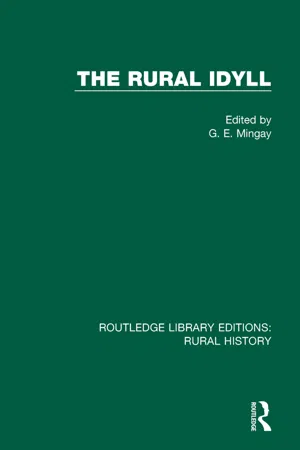
- 186 pages
- English
- ePUB (mobile friendly)
- Available on iOS & Android
eBook - ePub
The Rural Idyll
About this book
Trusted by 375,005 students
Access to over 1 million titles for a fair monthly price.
Study more efficiently using our study tools.
Information
Subtopic
19th Century HistoryIndex
History1
The Victorian country house
Jill Franklin
Victorian country houses are little known or visited, though well over a thousand are documented,1 perhaps twice as many were built, and a very large number of them survive. They are extraordinarily varied in appearance, yet all of them make use to a greater or lesser extent of architectural elements borrowed from an earlier period, just as Georgian country houses had done. Fashion in historical style changed far more rapidly in the nineteenth century than it had done in the eighteenth, moving in sixty years from Italianate classical or Tudor and Jacobean to various kinds of Gothic, then on to English vernacular and finally round again to the classical English baroque. None of the new fashions completely ousted the previous ones, so that belated Italianate overlapped with the earliest neo-Georgian, while Elizabethan remained popular throughout the reign and after.
The great variety of styles in use at one time - and by no means all of them have been named – suggests that none was as universally satisfactory as Palladian had once been. Rapid social change had left country house owners as a class uncertain and divided over the image their houses should present, and in a single decade they could house themselves like feudal, Christian lords of the manor, classic squires, French renaissance monarchs, or yeoman farmers. Yet although period styles were sometimes copied so faithfully that it can be quite difficult to distinguish fifteenth- from nineteenth-century work, more often the total effect is as unmistakably Victorian as that of Rossetti’s paintings after Dante or Tennyson’s Morte D’Arthur.
The early Victorian house, whatever its style, normally had a rectangular main block two or three stories high, with a low even roof or identical Elizabethan gables, beneath which were regularly spaced rows of large sash windows. The elevations might be symmetrical or asymmetrical, but in any case were built up on a system of balancing horizontals and verticals, often with a single tower offsetting the low bulk of the house. Abberley Hall (c. 1846) (plate 1) and Stoke Rochford Hall (1841–5) (plate 2) are in different styles, yet still have much in common. Ashlared stone was still the favourite building material, external colour was uniform, and decorative trim thin and rather meagre. With certain exceptions, such as Anthony Salvin’s Peckforton Castle or Sir Charles Barry’s Cliveden,2 houses of this period have a slightly tentative air despite their size, as though their designers had lost momentum in the gap between the fading of classical ideals and the arrival of Gothic ones.
By the 1860s, more than half of all new country houses were being built in a Gothic style,3 but it was different from the early Victorian variety for it was no longer chiefly surface decoration but had become to many architects the only possible means of expression. Yet Gothic architects faced the major difficulty in designing country houses that little medieval domestic architecture of any kind survived and even less could serve as a direct model, so that everything had to be adapted for modern use, and even then much had to be borrowed from ecclesiastical buildings. However, conviction prevailed over common sense, and neither architects nor owners saw anything incongruous in furnishing the hall with a portion of thirteenth-century nave arcade, as at the Hall in Scott’s Hafodunos House, or in lighting the gentlemen’s cloakroom with a lancet window, as was done at G. Somers Clarke’s Milton Hall in Kent.4 It was no odder, they might have said, than living behind the front of a classical temple.
The real force of Victorian Gothic came not from its church detail but from characteristics that it shared in varying degrees with other current styles. The most striking of these was a tremendous emphasis on height and a consequent narrowing and constriction of all proportions. It was accompanied by marked asymmetry and broken outline, as well as by what was called ‘truth’, which meant giving full expression on the outside to the function of the rooms inside. Consequently country houses were no longer four-square and spreading, but piled up and aspiring. Roofs became higher and more steeply pitched, the skyline more romantic than ever before in England. Fantastic spires and tourelles, wedges, pyramids, and hipped gables might be clustered together in one house over an equally varied façade, whose many kinds of windows were composed in asymmetric diagonals and triangles and in many different planes. The front door was no longer in the centre, and instead of windows matching left and right an oriel might be answered by a chimney breast or even by a blank wall; sometimes the base of the staircase window rose diagonally. Truth’ also affected the attitude to materials. Stucco was a sham and rough-textured stone often thought preferable to ashlar because of the ‘interesting variety’ it could give.5 Exposed brick was now seen as honest and might be handled with considerable virtuosity. Decoration had to be ‘structural’, that is, differently coloured, and sometimes aggressively contrasting building materials could be used to form stripes, diapers, and banded window heads. The Gothic country house looks tense and often restless; it lacks either classical magnificence or comfortable domesticity, but it has a powerful and dramatic quality all its own (plates 3, 4, and 5).
Gothic for country houses held first place for little more than twenty years. By the 1870s owners were beginning to want to incorporate a suggestion of comfort and cosiness. Norman Shaw, the greatest of Victorian country house architects, was the key figure in evolving out of Gothic a new style to answer this need.6 It was called ‘Old English’7 and took its motifs from the cottages and farmhouses of the home counties, exploiting tile-hanging, half-timbering, casement windows with small leaded panes, and tall Tudor chimneys; or red brick might be set in friendly contrast to newly rediscovered white paint. All this variety would be assembled into a deceptively casual-looking asymmetry, as though the house had grown up at random over the years. Roofs were still broken up, windows were of all shapes and sizes but the ensemble was more informal, spread out, and welcoming than in Gothic (plates 6 and 7). It was also more bourgeois, so that those who chiefly wanted to look imposing still opted for stone-built Tudor.
Old English could be delightful, especially for houses that were not too big, but after a while there was a reaction in favour of a more unified, coherent look. It could be expressed in two ways. Some architects continued to use Tudor or vernacular motifs, though with less emphasis on correct period detail, building free and asymmetric compositions that were less cluttered and more abstract than those of the previous generation. Many of Edwin Lutyens’s early country houses were designed in this so-called ‘free’ style (plate 8). However, clients who liked the style mostly wanted small to medium-sized houses: C. A. Voysey and Baillie Scott, who each developed a personal version of it, were never commissioned to design a really big house (plate 9). Where formality or grandeur was required, architects and their clients, feeling the need for strict symmetry and classical discipline, turned to the English baroque of Wren and the early eighteenth century. Norman Shaw’s flamboyant Bryanston (plate 10) of 1889–94 and Chesters of 1890–4 were influential in setting country house fashion in this direction. Ernest Newton, Shaw’s pupil, preferred a rather quieter Georgian or Queen Anne (plate 11), and Lutyens, too, added English classical to his repertoire. At the same time, Tudor and Jacobean houses became correctly symmetrical again (plate 12). So what with the various free styles, the ever-popular Tudor, and once again classical, the client of 1900 had as wide a ch...
Table of contents
- Cover
- Half Title
- Title Page
- Copyright Page
- Table of Contents
- List of plates
- The contributors
- Editor’s note
- Introduction
- 1 The Victorian country house
- 2 The model village
- 3 Country towns
- 4 The Victorian picture of the country
- 5 Landscape in nineteenth-century literature
- 6 The land in Victorian literature
- 7 A planned countryside
- 8 People in the countryside
- 9 The rural idyll defended: from preservation to conservation
- Bibliography
- Index
Frequently asked questions
Yes, you can cancel anytime from the Subscription tab in your account settings on the Perlego website. Your subscription will stay active until the end of your current billing period. Learn how to cancel your subscription
No, books cannot be downloaded as external files, such as PDFs, for use outside of Perlego. However, you can download books within the Perlego app for offline reading on mobile or tablet. Learn how to download books offline
Perlego offers two plans: Essential and Complete
- Essential is ideal for learners and professionals who enjoy exploring a wide range of subjects. Access the Essential Library with 800,000+ trusted titles and best-sellers across business, personal growth, and the humanities. Includes unlimited reading time and Standard Read Aloud voice.
- Complete: Perfect for advanced learners and researchers needing full, unrestricted access. Unlock 1.4M+ books across hundreds of subjects, including academic and specialized titles. The Complete Plan also includes advanced features like Premium Read Aloud and Research Assistant.
We are an online textbook subscription service, where you can get access to an entire online library for less than the price of a single book per month. With over 1 million books across 990+ topics, we’ve got you covered! Learn about our mission
Look out for the read-aloud symbol on your next book to see if you can listen to it. The read-aloud tool reads text aloud for you, highlighting the text as it is being read. You can pause it, speed it up and slow it down. Learn more about Read Aloud
Yes! You can use the Perlego app on both iOS and Android devices to read anytime, anywhere — even offline. Perfect for commutes or when you’re on the go.
Please note we cannot support devices running on iOS 13 and Android 7 or earlier. Learn more about using the app
Please note we cannot support devices running on iOS 13 and Android 7 or earlier. Learn more about using the app
Yes, you can access The Rural Idyll by G. E. Mingay in PDF and/or ePUB format, as well as other popular books in History & 19th Century History. We have over one million books available in our catalogue for you to explore.