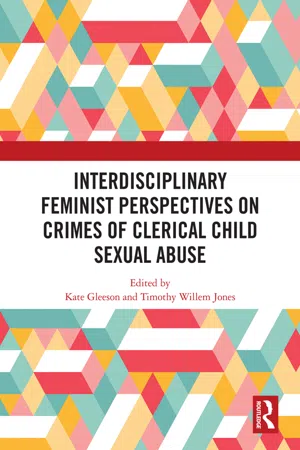
Interdisciplinary Feminist Perspectives on Crimes of Clerical Child Sexual Abuse
eBook - ePub

Interdisciplinary Feminist Perspectives on Crimes of Clerical Child Sexual Abuse

  1. 104 pages
  2. English
  3. ePUB (mobile friendly)
  4. Available on iOS & Android
eBook - ePub

Interdisciplinary Feminist Perspectives on Crimes of Clerical Child Sexual Abuse

About this book

In recent years the sexual abuse of children in religious institutions has gripped the Western world, as churches, governments and civil society attempt to come to terms with the magnitude of widespread historical abuses. Questions continue to be asked about why it is that perpetrators were able to offend repeatedly and with impunity; what is it about institutions that facilitate or foster abuse; and why have survivors of abuse often been treated inadequately by diverse national and international justice and political systems throughout the last century? This volume makes a significant contribution to international understandings of the vexed and sensitive 'wicked problem' of child sexual abuse in religious institutions. The chapters in this volume are written from a range of feminist disciplinary responses, including law, criminology, anthropology and history. Together, they provide important historical context for the current social and political interest in clerical sex crimes. They examine political and legal avenues for redress for survivors of these crimes and critically examine the ways in which church cultures position clergy and clergy offenders in relation to victims.

The chapters originally published in a special issue of the Australian Feminist Law Journal.

Trusted by 375,005 students

Access to over 1.5 million titles for a fair monthly price.

Study more efficiently using our study tools.

Information

Publisher
Routledge
Year
2020
eBook ISBN
9780429834851

‘PERHAPS SOME WRITING: AND A RECORD OF MY AGE

Lewis McCabe
Just a kid I was made a ward of state. The state removed me from my family and took on my ‘care and protection’. In my ‘best interests’ I was sent to a Christian Boys’ Home and while I was there I was subjected to emotional and physical abuse. Looking back on it I can see calling it a ‘home’ is a cruel joke. Home is a place of safety and love.
I experienced TOTAL loss of all control over my life. I was also powerless as I witnessed the abuse that other boys were subjected to. In the years since I have struggled with the aftermath of that childhood incarceration. Most importantly is my inability to trust.
In the ‘home’ I was groomed by an older male, a man of authority in the institution. He singled me out for attention, telling me I could be his ‘top boy’, and showing an interest in the poetry I wrote. This ‘special treatment’ was a relief from the general culture of abuse and denial. I was sucked in by his lies.
During my time in the home my father had a massive car accident, ‘died’ three times and was in the Intensive Care Unit at Royal Melbourne Hospital. The head screw, (who I did not realise was grooming me), told me truthfully that my father was ‘about to die’. He misled me though, saying I would be picked up and taken to the hospital by a relative. When the relative arrived the head screw had knocked off work and had not left his authority for my release. This must have been deliberate, to demonstrate his power over me. Without his authorisation I was not given permission to leave the security yard. At this time I had no idea the head screw lived on the property and could easily have been contacted. At the first opportunity I did a runner and headed for the city to see dad. Against expectations dad survived his injuries. I wrote this poem:

Number 6

… I am number 6
In their book of tricks
And I’m ready packed to go
The route is set
And the liar’s met
A more poisonous tongue than his
See, I’m not the average run o’ the mill
Kid, who — dressed to kill —
Is out for blood, sex and fun
At the price of painful persuasion
I’m a more angry one.
(1978)1
1 McCabe Lewis ‘Number 6’ unpublished poem 1978. Editorial Note: author aged 16.
Though I was an escapee for two days I knew on return I would be punished. Boss Harry, a large, dapper gentleman, advised me that: ‘We know you had a reason, for stalling2 but it is the lowest common denominator here and Justice MUST be seen to be done. Forty-Eight in the slot. Light on or light off?’.
2 Editorial Note: ‘Stalling’ is a term used for people who absconded from the Home. Once they were returned they had only ‘stalled’ their time and had to see the original time of incarceration completed. Indeed in many cases they had to spend extra time locked up as punishment.
If a boy broke the rules he could be confined in the ‘slot’. This space was an old concrete toilet block with the ceramic bowls removed leaving a number of small concrete rooms the shape of a toilet with heavy wooden doors. We were placed in solitary there with a plastic bucket for pissing and shitting. (Minimal) food was passed through a flap in the bottom of the wooden door. The only option during the days of confinement was ‘lights on the whole time or lights off’.
The next boy in the slot, caught playing chook footy3 in the henhouse, was tasked with removing my graffiti, the poem ‘Time’, from the wall of the slot. This ended our friendship, such as it was.
3 Editorial Note: ‘chook footy’ was the term used for the activity at the Home where hens were kicked in the air towards hooks on the wall designated as goal posts.

Time

I have learned time is nothing
But this men made obstacle
I reap what I sow
Am here till let go
Never knowing why
All I miss is sunshine
48 in the slot.
(March 1978)4
4 McCabe Lewis ‘Time’ unpublished poem March 1978. Editorial Note: author aged 16.
I found the solitary confinement barbaric. However some of the boys showed great courage in smuggling me, through the door slot, cigarettes and porno mags that I never knew existed. This so-called discipline in solitary added a further layer of damage as I was developing my identity as an adolescent. This is the ‘home’ the state and the Christian institution used to rescue me.
The abuse that is the hardest to confront and talk about is the sexual abuse I suffered at the hands of the man who had groomed me. He encouraged me to drink alcohol, even taking me to a local pub and buying me drinks. This was illegal as I was underage and confined in his care as award of state. He abused me on the premises of the Christian home. Vivid flashbacks take me back to that place of horror often, especially during afternoons.
I dealt with the abuse by resorting to heavy drinking, substance abuse and working seven days a week in a physically demanding job. I needed to escape from my body. The concept of self-care has been absent from my life and my choices over and over have been self-destructive ones. I find my life is chaotic. I can’t go to bed without lengthy rituals to secure the premises. I hide my wallet, keys, phone and so on so carefully that I can no longer find them when I wake.

The Dungeon

In the dungeon, I live everyday
In the dungeon, I go from ‘A’ to ‘B’
This dungeon is a very big place
You see this dungeon and
You’re in it with me
In the dungeon, there’s another
It’s specialised of course
I come from there, and with a beer
I dampen all my thoughts
It was a knackery
I’m a bi-producted horse
In the dungeon
If you don’t blend in
They even stamp your shadow — VOID.5
5 McCabe Lewis ‘The Dungeon’ unpublished poem 1980. Editorial Note: author aged 18.
My marriage broke down as a direct result of the damage I suffered while in the care of the Boys’ Home and my inability to face that damage and seek treatment. My health has been affected by my alcoholism and failure in general to care for myself.

Look

Look at me now
A thousand dreams wasted
Look at me now
Another day — I can’t fa...

Table of contents

  1. Cover
  2. Half Title
  3. Title Page
  4. Copyright Page
  5. Contents
  6. Citation Information
  7. Notes on Contributors
  8. Introduction: Feminist Contributions to Justice for Survivors of Clerical Child Sexual Abuse
  9. 1 ‘Perhaps Some Writing: And a Record of my Age’
  10. 2 The Royal Commission into Institutional Responses to Child Sexual Abuse: Learning from the Past
  11. 3 Graceful Remedies: Understanding Grace in the Catholic Church’s Treatment of Clerical Child Sexual Abuse
  12. 4 Sin, Silence and States of Denial: Canon Law and the ‘Discovery’ of Child Sexual Abuse
  13. 5 Reparation for Betrayal of Trust in Child Sexual Abuse Cases: The Christian Duty of Care, Vicarious Liability and the Church of England
  14. 6 An Unexpected Path: Bankruptcy, Justice and Intersecting Identities in the Catholic Sexual Abuse Scandals
  15. 7 Giving Voice to Narratives of Institutional Sex Abuse
  16. Index

Frequently asked questions

Yes, you can cancel anytime from the Subscription tab in your account settings on the Perlego website. Your subscription will stay active until the end of your current billing period. Learn how to cancel your subscription
No, books cannot be downloaded as external files, such as PDFs, for use outside of Perlego. However, you can download books within the Perlego app for offline reading on mobile or tablet. Learn how to download books offline
Perlego offers two plans: Essential and Complete
  • Essential is ideal for learners and professionals who enjoy exploring a wide range of subjects. Access the Essential Library with 800,000+ trusted titles and best-sellers across business, personal growth, and the humanities. Includes unlimited reading time and Standard Read Aloud voice.
  • Complete: Perfect for advanced learners and researchers needing full, unrestricted access. Unlock 1.5M+ books across hundreds of subjects, including academic and specialized titles. The Complete Plan also includes advanced features like Premium Read Aloud and Research Assistant.
Both plans are available with monthly, semester, or annual billing cycles.
We are an online textbook subscription service, where you can get access to an entire online library for less than the price of a single book per month. With over 1.5 million books across 990+ topics, we’ve got you covered! Learn about our mission
Look out for the read-aloud symbol on your next book to see if you can listen to it. The read-aloud tool reads text aloud for you, highlighting the text as it is being read. You can pause it, speed it up and slow it down. Learn more about Read Aloud
Yes! You can use the Perlego app on both iOS and Android devices to read anytime, anywhere — even offline. Perfect for commutes or when you’re on the go.
Please note we cannot support devices running on iOS 13 and Android 7 or earlier. Learn more about using the app
Yes, you can access Interdisciplinary Feminist Perspectives on Crimes of Clerical Child Sexual Abuse by Kate Gleeson, Timothy Willem Jones, Kate Gleeson,Timothy Willem Jones in PDF and/or ePUB format, as well as other popular books in Social Sciences & Law Theory & Practice. We have over 1.5 million books available in our catalogue for you to explore.