eBook - ePub
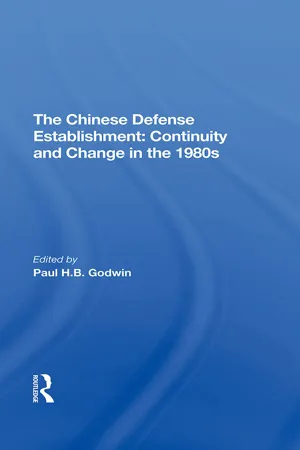
The Chinese Defense Establishment
Continuity And Change In The 1980s
- 198 pages
- English
- ePUB (mobile friendly)
- Available on iOS & Android
eBook - ePub
The Chinese Defense Establishment
Continuity And Change In The 1980s
About this book
Complex issues of national security and defense modernization continue to be a major preoccupation of the PRC leadership. In the 1970s, especially during the second half of that crucial decade, critical decisions were made that led to Beijing's alignment with the West against the USSR and a revitalization of its armed forces. This book looks at Chi
Trusted by 375,005 students
Access to over 1.5 million titles for a fair monthly price.
Study more efficiently using our study tools.
Information
Part 1
National Security and Defense Policy
1
Rebuilding China's Great Wall: Chinese Security in the 1980s
Jonathan D. Pollack
Introduction
For China's leaders and external observers alike, the issue of national security is a pivotal and fascinating topic. China's vulnerability to external pressures or outright military attack has been a vital leadership concern since the earliest months of the People's Republic of China (PRC). At times of national crisis, these concerns have commanded the attention of Beijing's ranking decision makers. Security issues have frequently been the object of leadership debate and policy conflict in the PRC. Five key questions related to the acquisition and use of modern arms—what to acquire, how much, how quickly, by what means, and for what purposes—have recurrently been the source of disputes among political and military leaders. The form and extent of political alignments with external powers (both adversaries and allies) have also provoked controversy and division at the highest policymaking levels.
With the onset of the 1980s, leadership concern with the ends and means of military power shows few signs of abating. Although the central issues on China's national security agenda remain comparable to those of the past, the strategic, political, and economic contexts of such decisions have all changed dramatically. The framework of debate over defense and security affairs has been altered; the consequences for domestic, regional, and global politics have therefore been affected as well.
Without question, the issues associated with national security are now more openly and candidly addressed than at any point in the past three decades. This phenomenon is not limited to an increased flow of discussion and debate in the Chinese press. External observers— including high officials of foreign governments—have gained access to Chinese officials and institutions that would have been unthinkable only a few years ago. The proliferation of literature on China's defense and security problems in the post-Mao era, amply indicated by the breadth and depth of research interests in this volume, has been extraordinary. Indeed, a field of Chinese security studies has begun to take shape. To make maximum use of the new research opportunities, the major analytical issues and research methods and materials require closer scrutiny.
The purpose of this chapter is to identify some of these central issues. Unlike military policy or national defense, the concept of security captures the full range of external imperatives impinging upon a state's decision-making process. As Arnold Wolfers noted in his classic essay, national security remains an "ambiguous symbol" laden with a range of objective and subjective connotations.1 China's leadership is not alone in needing to ascertain the limits of a purely military conception to China's security, the complex interaction between the need to deter war as well as to defend against actual attack, and the values and interests to be secured, at what cost, and with what degree of risk.
Yet the historical continuities of the past three decades suggest a set of recurring concerns for Chinese decision makers. From the earliest months of the new regime, Chinese elites have had to respond to major military deployments directed against China by hostile, militarily superior external powers. On repeated occasions, China's armed forces have engaged in conflict, frequently beyond territory physically controlled by the PRC. China's leaders have sought to reduce their vulnerability to outside powers, but without mortgaging Chinese sovereignty or political control to any other state. In addition, China's security needs have been one among a number of competing budgetary and manpower priorities.
For all these reasons, the range of policy choice in China's national security strategy has always been somewhat circumscribed. Leadership sentiment has therefore tended to favor political, diplomatic, and psychological approaches to security planning rather than predominantly military ones. Decisions about and policies for security have also been crucial to the allocation of political power within China. Thus, a full understanding of the policy dynamics and choices in Chinese security must be attentive to both the human dimension of such decisions (the predominant focus of this volume) and the political and institutional consequences of elite-level decision making.
China's Security Environemnt
Three issues will dominate Chinese security planning during the 1980s. The first concerns the long-term Sino-Soviet political and military rivalry and the most appropriate means of deflecting Soviet pressure directed against the PRC. The Sino-Soviet conflict has followed a tortuous course since public evidence of political and ideological cleavages between Beijing and Moscow first surfaced late in the 1950s. If the conflict could once be assessed largely in historical, racial, or personal terms, such a framework no longer suffices. Nor does a predominant focus on ideological differences serve as an adequate basis for understanding the dynamics of this competition. The Sino-Soviet rivalry is now best understood within the context of the national security perceptions and policies of both elites.2 On a public level, Chinese decision makers insist that the focus of Soviet expansion is not directed principally against the PRC. By this logic, means exist to ameliorate or limit the overall competition. Notwithstanding the self-serving view that China is the least likely target among the world's major powers for Soviet aggression, there is a core underlying logic that supports precisely this proposition.3
The increasing preoccupation in Chinese strategic assessment with the long-term trends in the growth and exercise of Soviet power bear comparison with U.S. conduct when the United States was the PRC's principal military adversary. Both the tenor of Chinese analysis and the corresponding tasks for the construction of an anti-Soviet security coalition are highly instructive.4 There is an increasingly differentiated view of Soviet power and policy that delves far more deeply into the constraints and choices in Moscow's security planning.5 Some Chinese analyses describe Soviet political-military behavior in ominous terms, deeming Moscow's conduct in various regions of instability the product of an underlying expansionist course intent upon global conquest. These views, however, are tempered in other interpretations that stress the constraints and limitations in the exercise of Soviet power. In this alternative view, the USSR is described as an increasingly beleaguered (if not enfeebled) military power faced with difficult choices in the allocation of its military forces and the application of its military power. These contrary judgments reflect disagreement within the Chinese leadership about the degree and nature of the threat of "Soviet hegemonism" to global security, the most appropriate means of deflecting such a threat, and the implications of such views for the security of China.
To what extent, for example, do international imperatives compel Beijing to pursue security arrangements with the industrialized nations of the West? Are the tasks implicit in the "international united front against hegemonism" divisible? Do these tasks presuppose active collaboration, coordination, and consultation with the West, or simply assertions of shared concerns? To what extent can Soviet preoccupations with more immediate security concerns (for example, Afghanistan and Poland) diminish the more direct Soviet threat to China? And is the Soviet threat most appropriately viewed as an immediate, frontal military challenge to the territorial integrity of China?
Despite the seemingly deterministic framework of Chinese strategic thought, these writings reveal considerable ambiguity, contradiction, and fluctuation. The task of strategic assessment concerns judgments about time, political consequence, and the virtual dialectic between short-run imperatives (the principal domain of the military planner) and long-run political, military, and economic trends. Such assessments thus reflect both China's long-standing tradition of strategic thought and the centrality of military power in both the Chinese revolution and the effort to protect Chinese security since 1949. Military leaders are central participants in this growing debate. The proliferation of Chinese research institutes on issues of global policy include the Beijing Institute for International Strategic Studies, nominally headed by Deputy Chief of Staff Wu Xiuquan and staffed principally by former active duty military personnel. Whether this institute offers a distinctively military viewpoint on issues of global and regional security remains to be seen. Undeniably, however, the emergence of such research organizations reflects the increasing awareness of a need for an intellectual and institutional framework for assessing vital security issues.
Judgments about global strategic trends possess immediate relevance to both the allocation of scarce resources within China and the distribution of internal political power. To the extent that a direct Soviet military threat to China is deemed less pressing than events in either Indochina or Afghanistan, the military component of a Chinese security strategy becomes less salient. The dominant political forces within China, beginning with Deng Xiaoping, are strongly committed to this view. The PRC's political leadership seeks to avoid the debilitating effects of a sustained military confrontation with the USSR—a confrontation that would be costly and draining in the context of China's broader developmental objectives. Nor can the PRC hope to match the capabilities of Soviet armed forces deployed against China.
These considerations suggest the second key question on China's security agenda in the 1980s: the relationship between the international environment and the tasks associated with China's effort to progress toward the front ranks of the world's agricultural, industrial, military, and scientific powers by the year 2000. When compared with the experiences of other newly industrializing societies, the choices and constraints confronting the Chinese are far from unique. Yet differences are also apparent. No matter how underdeveloped China might seem, the magnitude of the PRC's military effort dwarfs that of all but a handful of the world's states. China, although still a largely agrarian, labor intensive economy, already possesses an indigenous defense industrial system larger than that of all but the superpowers. As David Shambaugh describes in great detail in Chapter 3 of this volume, the PRC currently produces large quantities of armaments across the entire range of defense needs. Although the sophistication of both the technological and the manpower bases is not at the world's most advanced levels, breakthroughs in the realm of defense design, innovation, manufacture, and quality control remain very much the preserve of the advanced industrial states. In view of China's profound economic and political dislocations of the past two decades, it is hardly surprising that China continues to lag behind.
If this gap is to be narrowed significantly in the coming decade, the technological and economic ties that China fosters with the outside world will be critical. The nature of the international situation affects defense modernization in three significant ways: (1) the relative priority accorded national defense in relation to other budgetary, manpower, and investment needs; (2) the opportunities (political as well as budgetary) for Chinese military commanders and defense industrial managers to gain access to advanced defense systems or defense-related technology from abroad; and (3) the terms and extent of such technology transfers and managerial assistance, especially the degree of indigenous control over these processes.
The relative priority accorded defense construction as opposed to economic construction has been a recurring political issue within China. China's economic rehabilitation and societal transformation were anticipated at the end of the 1940s, but the outbreak of the Korean War and the demands on China's available resources abruptly altered such expectations. Indeed, the tranquillity of global and regional politics has been a decisive factor in determining the direction and pace of China's overall modernization effort ever since. If armed conflict involving China was deemed likely or even imminent, then preparations against war had to assume singular importance. If war was judged unlikely, attention could turn to the long-term tasks of China's agricultural, industrial, and scientific development, with defense modernization ultimately a beneficiary of progress on other levels rather than an immediate claimant of scarce resources. Chinese leaders have grappled with these questions for much of the past three decades. There has been a virtual dialectic between the short-term imperatives of the military planner, who must unavoidably prepare for war, and the broader, evolutionary trends in the international strategic system that have frequently enabled China to enhance its security through nonmilitary means.
Since the death of Mao Zedong, rival positions have been articulated by proponents of both "development first" and "defense first." For a time, military commanders (having presumably played a vital role in the arrest of the Gang of Four and the simultaneous appointment of Hua Guofeng to the Party chairmanship) took advantage of the opportunity to address the long-neglected tasks of defense modernization. Their emphasis on the urgent need to prepare for war—and the extensive and highly publicized visits of Chinese military delegations abroad—led many observers to expect a vastly expanded Chinese defense effort, including significant purchases of defense technology.6
These expectations, however, were greatly overstated, both in terms of the opportunities for a "quick-fix" solution to China's military deficiencies and in terms of the prospects for rapidly unleashing China's economy from the shackles of the previous decade. The "leftist line in economic work," which was evident in 1977 and 1978 and to which military interests were closely linked, has since been discredited.7 At the same time, the ominous talk of 1976 and 1977 about the race against time to prepare for an inevitable war has disappeared from the Chinese press. International conditions—in particular, the growing political accommodation between the PRC and the states of the West— would permit a more measured approach to defense modernization. As then-Minister of National Defense Xu Xiangqian argued in the fall of 1979:
The modernization of national defense cannot be divorced from the modernization of agriculture, industry, science and technology and, in the final analysis, is based on the national economy. . . . Blindly pursuing large-scale and high speed development in building national defense will invariably and seriously hinder the development of the national economy and harm the base of the defense industry. Subsequently, "haste makes waste."8
Since "current international conditions" enabled China to conduct "economic, scientific, and technological exchanges with other countries," and since "we believe that it is possible to delay the outbreak of war," China "should build and develop the defense industry step by step."9
The effects of these decisions find ample support in the greatly diminished visibility of "purely military viewpoints," the lower priority accorded the defense sector in China's "four modernizations," and in the still-tentative framework of security col...
Table of contents
- Cover
- Half Title
- Title
- Copyright
- Contents
- List of Tables and Figures
- Preface
- Part 1 National Security and Defense Policy
- Part 2 The Industrial Base
- Part 3 Leadership and Management
- Part 4 The Militia
- About the Contributors
- Index
- About the Book and Editor
Frequently asked questions
Yes, you can cancel anytime from the Subscription tab in your account settings on the Perlego website. Your subscription will stay active until the end of your current billing period. Learn how to cancel your subscription
No, books cannot be downloaded as external files, such as PDFs, for use outside of Perlego. However, you can download books within the Perlego app for offline reading on mobile or tablet. Learn how to download books offline
Perlego offers two plans: Essential and Complete
- Essential is ideal for learners and professionals who enjoy exploring a wide range of subjects. Access the Essential Library with 800,000+ trusted titles and best-sellers across business, personal growth, and the humanities. Includes unlimited reading time and Standard Read Aloud voice.
- Complete: Perfect for advanced learners and researchers needing full, unrestricted access. Unlock 1.5M+ books across hundreds of subjects, including academic and specialized titles. The Complete Plan also includes advanced features like Premium Read Aloud and Research Assistant.
We are an online textbook subscription service, where you can get access to an entire online library for less than the price of a single book per month. With over 1.5 million books across 990+ topics, we’ve got you covered! Learn about our mission
Look out for the read-aloud symbol on your next book to see if you can listen to it. The read-aloud tool reads text aloud for you, highlighting the text as it is being read. You can pause it, speed it up and slow it down. Learn more about Read Aloud
Yes! You can use the Perlego app on both iOS and Android devices to read anytime, anywhere — even offline. Perfect for commutes or when you’re on the go.
Please note we cannot support devices running on iOS 13 and Android 7 or earlier. Learn more about using the app
Please note we cannot support devices running on iOS 13 and Android 7 or earlier. Learn more about using the app
Yes, you can access The Chinese Defense Establishment by Paul H. B. Godwin,Paul H B Godwin in PDF and/or ePUB format, as well as other popular books in Politics & International Relations & Asian Politics. We have over 1.5 million books available in our catalogue for you to explore.