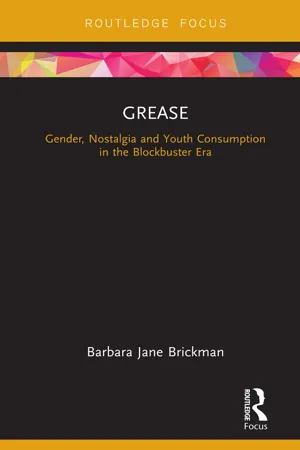
This book offers the first in-depth look at the history, social context, and industrial practices behind this teen musical phenomenon to suggest that social change, especially in terms of gender and sexuality, comes to the surface despite the film's retro setting, blockbuster business model, and apparent nostalgic tone. The vast audience for this film over the last thirty-five years and the various "hopelessly devoted" fandoms indicate that Grease exceeds both the confines of its period and the limits of any one ideological message.
eBook - ePub
Grease
Gender, Nostalgia and Youth Consumption in the Blockbuster Era
- 106 pages
- English
- ePUB (mobile friendly)
- Available on iOS & Android
eBook - ePub
About this book
Trusted by 375,005 students
Access to over 1.5 million titles for a fair monthly price.
Study more efficiently using our study tools.
Information
Subtopic
Gender Studies1
Rydell High class of ’78
The teenager in the Me Decade
Following its infectious but somewhat crudely drawn animated credit sequence, the film Grease begins its central action with a classic set of establishing shots and scenes from the teen film genre tradition. The exterior of a Depression-era high school building on the first day of the new school year becomes populated by major dramatis personae of the soon-to-unfold coming of age love story. The T-Birds capture our attention first, horsing into the picture with coarse jokes and their two central focal points established – Kenickie with his aspirational new used car and Danny with his story of summer love. Next, Sandy crosses into the frame, the poodle-skirted good girl nervous about her first day at a new school. Then, at last, the Pink Ladies arrive, led by their wise-cracking, strutting ‘leader of the pack’ Rizzo, who is put into pink relief by her all-black ensemble – a high-waisted pencil skirt topped off by an open-collared button-down black shirt, black clutch, and oversized black sunglasses – and who promises to ‘rule the school’ this year. Moving into the school hallways, the T-Birds appear to claim the film’s central focus through a series of mildly comic scenes pitting the apparently good-natured bullies against the peer objects of their aggressive ‘play,’ as well as against the cynical and/or ineffectual adults who run the school. The gang is depicted as more loveable than menacing, more companionate than antagonistic, and ultimately no match for authoritative school matriarch Principal McGee (played with tongue firmly in cheek by 1950s icon ‘Our Miss Brooks,’ Eve Arden). The T-Birds are amusing but ultimately upstaged by the announcement of the National Bandstand visit to Rydell for a live broadcast from this most ‘representative’ of high schools so that it takes a scene change to the lunchroom and a closer focus on the Pink Ladies and Sandy to begin the narrative proper.
There is no question, as the lunchroom scene begins, whose perspective we are being drawn into. Ostensibly, the scene’s purpose is to introduce Sandy and set up her principal romantic situation as an entrée into the ‘Summer Nights’ number, yet Rizzo’s centrality in the frame and authority in the dialogue and action seems for long periods to direct the scene and then undercut the messages of Sandy’s first big musical number. Rizzo, once again set off by her black attire, sits at the head of the lunchroom table, in medium close up, center of the frame, cracking jokes and even suggestively teasing Sandy, asking her how ‘things’ are ‘down under’ and glancing down into her crotch (see Figure 1.1). Surrounded by pastels, Rizzo sets herself apart as a voice of cynical wisdom, biting quips, and hard-earned experience – an antidote to the vacuous conformity and cheery hypocrisy of Patty Simcox, whom she ironically announces as the ‘bad seed of Rydell High’ upon the cheerleader’s approach. Despite Simcox’s high-energy intrusion and immediate focus on Sandy, Rizzo remains the anchor of the scene, definitely passing judgment on Sandy as ‘too pure to be pink’ with her hands folded in front of her chin in a seeming imitation of Brando’s ‘Godfather.’
As the scene cuts away from her and into the set up for ‘Summer Nights’ with the boys pressing Danny for details and the girls leaning in for Sandy’s tale of beach romance, Rizzo appears pushed to margins, yet her resistance and difference are also consistently marked. When the girls’ choreography moves to the left, Rizzo moves to the right, and when the lunchroom erupts into ‘spontaneous’ dancing on table tops, Rizzo noticeably remains seated, even kicking Sandy and Patty off the lunch table bench she has taken over in a prone, lounging position. She persists as the lone voice of critique once the irresistible allure of the scene takes hold of nearly everyone – declaring, ‘he sounds like a drag’ from her perch, behind her large black sunglasses. Finally, as the romance-defining split screen of Sandy and Danny fades, we come back again to Rizzo leading her pack out of school. The entire sequence comes full circle here, as her cat-who-ate-the-canary grin indicates a new cruel direction opened up by Sandy’s confession that her perfect summer ‘gentleman’ is none other than Danny Zuko.

Figure 1.1 Rizzo asks the new girl, Sandy, how things are ‘down under’
In sum, it becomes perfectly clear in this opening that the true ‘bad seed’ of Rydell High is Betty Rizzo, yet the film also unquestionably identifies her as a strong leader, a sympathetic (and humorous) character, and perhaps, the narrative’s only legitimate ‘rebel.’ While one might argue that Sandy’s transformation (and Rizzo’s simultaneous domestication) at the film’s conclusion foregrounds the Aussie good girl’s rebellion or newfound defiance of outmoded gender norms, her rebellious denouement feels more like a surface makeover than a metamorphosis, especially considering Sandy has remained ‘pure’ until the final frame. As for the T-Birds, aside from their occasional puerile antics, Greased Lightning bravado, and obligatory drag race, the greaser gang proves as toothless as they were in the face of Principal McGee in the opening scene: Danny ends up buttoned into a white letterman’s sweater and Kenickie ineffectually promises to make ‘an honest woman’ of Rizzo. Although she may have traded in her woman-in-black ensemble for hot pants and an apparent commitment to Kenickie in the final scene, Rizzo spends most of the film on the margins of acceptability and, even more importantly, openly critiquing or subverting the 1950s morality and hypocrisy felt most keenly by young women like herself. Despite the ending, she stands as the only true deviant amongst the film’s central players, which perhaps explains why she pairs up, if only briefly, with the film’s other certifiable j.d., the rival Scorpion gang leader Leo. The obvious question this poses, then, is what does it mean for a landmark teen film like Grease to locate rebellion not only in a female adolescent but in one who, ultimately, is not punished for her promiscuity and antagonism nor for her subversive critique of norms of gender and sexuality.
While many critics and commentators on the film, including Grease’s co-creator Jim Jacobs, have lamented its apparent betrayal of the radical challenge at the heart of the original play (Ansen 1978; Farber 1978), which at times presented a biting reproach of the 1950s in its working-class rebellion and crude defiance, I believe this criticism fails to recognize the changed nature and guise of the teenage rebel in the 1970s. Grease certainly mollifies or even makes a parody of the (male heterosexual) working-class menace that helped define an increasingly powerful and threatening American youth culture in the postwar period, but it is, after all, a film of the late 1970s, not the 1950s. Its teenager is a 1970s teenager, despite the well-oiled D.A. haircuts and bouncing poodle skirts. In between 1959 (the film’s setting) and 1978 (the film’s release), a series of cultural earthquakes occurred, and no amount of regressive nostalgic longings can change this: The pill had become widely available and contributed to a sexual revolution; the youth revolts, countercultural movements, political upheaval, and Vietnam nightmare of the 1960s had changed the country forever; the civil rights, women’s rights, and gay rights movements had worked to redefine identity and equality under the law; and the political and economic crises of the early 1970s decimated trust in traditional authorities and national mythologies. A change in the understanding of rebellion and the youthful manifestation of it, then, was inevitable. The days of the tough, virile male biker asking ‘Whadda you got?’ to the question of what he is rebelling against were surely gone, but they did not take rebellion, whole cloth, with them. Youthful defiance still runs through Grease, but it has changed its face (and gender) with the times and prefers to wield the guile of deconstructive critique instead of the violence of aggressive confrontation.
Those magic changes: the teenage rebel for a new age
Having muted any criticism of changes made to his original play in its rapid move to Broadway in 1972 and then out to blockbuster Hollywood a few short years later, by the time his and Warren Casey’s late-night party conceit had become an entertainment juggernaut for over twenty years, Jacobs felt comfortable to voice a not-unexpected complaint: The mainstreaming of their small, lightly satirical play had taken the teeth out of its bite. The original show was based largely around Jacobs’s experiences at Taft High School on the northwest side of Chicago and his and Casey’s appreciation for the rock ‘n’ roll music of their youth. However, in an interview in 2010, Jacobs bemoaned the loss of those origins and, thereby, Grease’s ‘authenticity’ with each new version or star-promoting revival (Dabkowski 2010: F3). What his interviewer describes as the ‘darker’ original play has become almost lost to Jacobs, who blames ‘an uptight conservative’ tide in the country for making each new production of the work ‘more sanitized and cleaner.’ About a year later, announcing a revival of the original play at the American Theater Company in Chicago (titled The Original Grease), Jacobs’s critique was even more pointed, locating the first major betrayal of the ‘real nitty-gritty story of the kids I went to school with and the birth of rock ‘n’ roll’ in its move to New York in 1972 where the ‘R-rated’ original was cleaned up for the Great White Way (Simonson 2011). In that move, for Jacobs, his and Casey’s work transformed from ‘an in-your-face show about delinquents’ to a ‘colorized gang of lovable people singing rock ‘n’ roll’ – from ‘black jackets to pink jackets,’ or, in a telling comparison, from ‘John Gotti’ to ‘Pee-Wee Herman’ (Simonson 2011). In other words, even before its move to sunny, risk-averse Hollywood, Grease had surrendered its ‘gritty’ authenticity and virulent, masculine, even criminal delinquency for Technicolor amusements and feminine, and not-so-subtly queer, child’s play, although the mention of Pee-Wee Herman also signals a veiled recognition of the subsequent productions’ investment in irony and even camp.
Jacobs’s criticisms, however, echo a well-established objection that has run through evaluations of the blockbuster musical since its version of 1950s nostalgia became an unexpected hit in its first few months in New York in 1972. By the time the film came out in 1978, weariness to the nostalgia craze could be felt in all the major reviews of the film, but also, from David Ansen in Newsweek to Stephen Farber in New West, the disappointment in the screen adaptation’s inoffensive superficiality was conspicuous. Labeling the screen version ‘about as potent as the Eisenhower-era aphrodisiac – aspirin and Coke,’ Ansen finds the film version stripped of the off-Broadway original’s ‘sensuality’ and anticipates Jacobs’s comments over twenty years later with the argument that his and Casey’s ‘raunch and roll paean to leather jackets, DA hair-dos, and ’50s backseat sex’ unfortunately leaves its ‘gritty urban’ roots for the film’s ‘blue skies and Metrocolor dreams of southern California’ (1978: 92). Likewise, Farber, who seems even more familiar with the original stage production, laments the loss of its ‘raunchiness,’ ‘four-letter dialogue,’ and ‘sexual appeal,’ which he views as central to Jacobs and Casey’s initial challenge to the ‘wholesomeness’ of traditional Broadway musicals, making the film’s sanitization into a ‘PG family musical’ all the more disheartening as it becomes ‘exactly the kind of pap that the play’s authors were rebelling against’ (1978: 98). In other words, the play’s grit and sex and rebellion have been tamed or, worse, turned into what several reviewers, perhaps following Ansen, term ‘kid stuff’ (Siskel 1978: B1). Not even a ‘stud’ like John Travolta, fresh off his star turn in Saturday Night Fever, could breathe enough life into the gritty masculine drive expected of his black T-Bird jacket (Schickel 1978: 78). As wholesome family entertainment, Grease might have earned a wider audience, but for Jacobs and the vast majority of critics, this came at the cost of neutering its rebellious (masculine) impulses.
Yet these laments, I would argue, ironically perform a kind of nostalgia of their own for a form of teenage rebellion that was surely a concern and fascination of the immediate postwar period but had little purchase, except as fantasy, two decades later. Actual teenage rebellion in the 1970s looked and acted quite differently, to the point that, one could argue, Jacobs and these critics were unable to recognize it. The rebellion they do recognize, and valorize, has been expertly deconstructed and tied to a particular historical moment in American culture by Leerom Medovoi’s expansive work Rebels: Youth and the Cold War Origins of Identity (2005). Tracing the ascendance of ‘identity discourse’ in the United States after the Second World War, Medovoi finds that the aggrandizement of a particular individualist youth ‘identity’ served to allay pervasive social anxieties about Cold War America’s role in global decolonization, about ‘rapid transformations of everyday life’ after the war, and about the ‘postwar culture of consumption’ that undergirded a new capitalist mode (14). Contrary to an idea of a postwar culture of consent, this argument proposes a deep ambivalence and fearful unease at the time about repressive forces represented by McCarthyism, about the rapid rise of suburbanization, and about the passivity and conformity resulting from ‘Fordist consumer culture,’ particularly for men (20). Rather than America being the ‘free world’ that its citizens fought for or a beacon of ‘freeborn sons’ (to cite Erik Erikson’s phrase) for recently decolonized peoples (20), its white collar working world, its suburbs, and its system of mass consumption were manufacturing passive, fettered, unthinking consumers, ‘depriving Americans – and most vitally men – of their hitherto distinctive autonomy, and thus diminishing the very value of freedom held to distinguish the first world from the second’ (21). A particular identity discourse emerged then, according to Medovoi, to assuage this existential doubt.
Into the postwar unease and fear about freedom and, particularly, male autonomy – an anxiety fueled by popular fiction and works of sociology, from Riesman et al.’s The Lonely Crowd and Whyte’s Organization Man to Wilson’s fictional account and then film of The Man in the Grey Flannel Suit (Johnson, 1956) – comes the redemptive figure of the teenage rebel or ‘bad boy’ of Cold War American culture. This unlikely delinquent hero offers an autonomous and defiant individual identity or what Medovoi calls a key ‘figure of psychopolitical sovereignty’ to counter apprehension about America’s changing society and economic demands (30). Aggressive and typically figured as male, the adolescent of the 1950s forms his identity, according to the likes of Erikson, through breaking rules; this rule breaking asserts an autonomy through dissent against parent culture and an insistence on increasing his own freedoms, thereby defying conformity and rejecting obedience. He is, in other words, an apparent antidote to the ‘soft tyranny’ and compliance of postwar Fordist consumer culture (20), even while his insurrection and particular identity become a major facet of or means for selling that mass culture. Certainly, this ‘bad boy’ rebel produced his own set of fears and feelings of ambivalence – particularly around the notion that his working-class roots might not be contained or domesticated, as his defiance and even criminality seemed to spread throughout middle-class white youth culture – and his image only exacerbated concerns that the mass media was interceding between parents and their children, who were being ‘influenced’ by a powerful set of bankrupt or dangerous values (Gil-bert 1986: 3). Yet, his ‘rebel metanarrative’ of identity, as Medovoi terms it (24), proved irresistible for a society desperate for a story of autonomy and freedom, and all the better for the postwar consumer culture that this story of autonomy preceded adulthood so that one could still some day, after a spurt of rebellious adolescence, grow up to be a proper, consuming suburbanite.
While it is clearly ironic that this ‘exemplary Fordist subject’ recognized predominantly through his or her consumption (36), the teenager, would work as a redemptive figure or ‘imaginative remedy’ for the contradictions of Cold War America (23), that irony is not fully recognized until the 1970s (23), at the same time that the identity discourse represented by Medovoi’s ‘bad boy’ became most prominent as a political tool. Bringing his argument forward from the midcentury, Medovoi argues that the identity discourse widely disseminated in psychological works by Erik Erikson and Robert Lindner and popularized by the ‘rebel metanarrative’ of the 1950s was taken up by a New Left ‘animated by identity politics’ and brought forward in the 1960s and 1970s by liberation movements asserting, for example, ‘black, Chicano, women’s, or gay’ autonomy (3). Similar to the ‘bad boy’ narrative, the ‘rhetoric of politicized identity,’ whether around race, gender, or sexuality, depends on a declaration of ‘the subject’s triumphant self-transformation as it detaches itself agonistically from the coerced expectations of “society,” “America,” or one’s “elders,” ’ proudly asserting a new identity as a ‘realized psychopolitical sovereignty’ with vital strategic importance (5). This rebellious identity, he ultimately argues, became for postwar social movements ‘the modality through which anti-racist, anti-sexist, and anti-homophobic struggles could be fought with considerable potency’ (47), and while he concedes that the ‘youth’ narrative is superseded by the claims for these ‘other’ identities after the 1960s, I am inclined to stress his point that these liberation movements continued to articulate their ‘political subject’ as a ‘ young self establishing its sovereignty against the forces of a racist, patriarchal, or homophobic “parent culture” ’ (3, my emphasis). Indeed, one need look no further than the Stonewall riots to see the youthful face of these liberation movements come to the fore. I would like to contend, here, then that the teen film itself in the 1970s, as represented by Grease, becomes a major articulator of this interconnectedness of the initial (white, male) ‘rebel metanarrative’ of the 1950s and the ascendant ‘identity politics’ of those liberation movements cited above, particularly those focused on gender and sexual autonomy.1 Although Jim Jacobs and the majority of critics may not recognize this new rebel, it is undeniable, as I will illustrate in the next chapter, that her or his ‘identity politics’ pervade the 1978 blockbuster musical.
A decade devoid of teenagers?
A common conceit among historians of youth culture and scholars of teen film is to dismiss the 1970s in the United States as a period of insignificance in that history or as a low point in a century progressively more invested in teen film narratives and teenage consumers (Hine 1999; Doherty 2002; Shary 2002). I would argue that a fundamental reason for this neglect or disregard of the decade is the apparent departure or retreat of the ‘bad boy’ rebel whom Medovoi finds so central to the American political, economic, and social psyche of the 1950s.
As I suggest above, this dismissal is arguably the result of a misrecognition of or even willful blindness to his changing face and, also, to a change in the tactics for subversion. As ‘other’ i...
Table of contents
- Cover
- Title
- Copyright
- Contents
- List of figures
- Series editors’ introduction
- Acknowledgements
- Introduction
- 1 Rydell High class of ’78: the teenager in the Me Decade
- 2 Exploitation and the new pop music blockbuster
- 3 ‘There are worse things I could do’: nostalgia, camp, and critique through sexual retrospection
- 4 Hopelessly devoted to Grease, or more than a little ‘Travolta Fever’
- Conclusion
- Bibliography
- Index
Frequently asked questions
Yes, you can cancel anytime from the Subscription tab in your account settings on the Perlego website. Your subscription will stay active until the end of your current billing period. Learn how to cancel your subscription
No, books cannot be downloaded as external files, such as PDFs, for use outside of Perlego. However, you can download books within the Perlego app for offline reading on mobile or tablet. Learn how to download books offline
Perlego offers two plans: Essential and Complete
- Essential is ideal for learners and professionals who enjoy exploring a wide range of subjects. Access the Essential Library with 800,000+ trusted titles and best-sellers across business, personal growth, and the humanities. Includes unlimited reading time and Standard Read Aloud voice.
- Complete: Perfect for advanced learners and researchers needing full, unrestricted access. Unlock 1.5M+ books across hundreds of subjects, including academic and specialized titles. The Complete Plan also includes advanced features like Premium Read Aloud and Research Assistant.
We are an online textbook subscription service, where you can get access to an entire online library for less than the price of a single book per month. With over 1.5 million books across 990+ topics, we’ve got you covered! Learn about our mission
Look out for the read-aloud symbol on your next book to see if you can listen to it. The read-aloud tool reads text aloud for you, highlighting the text as it is being read. You can pause it, speed it up and slow it down. Learn more about Read Aloud
Yes! You can use the Perlego app on both iOS and Android devices to read anytime, anywhere — even offline. Perfect for commutes or when you’re on the go.
Please note we cannot support devices running on iOS 13 and Android 7 or earlier. Learn more about using the app
Please note we cannot support devices running on iOS 13 and Android 7 or earlier. Learn more about using the app
Yes, you can access Grease by Barbara Jane Brickman in PDF and/or ePUB format, as well as other popular books in Media & Performing Arts & Gender Studies. We have over 1.5 million books available in our catalogue for you to explore.