eBook - ePub
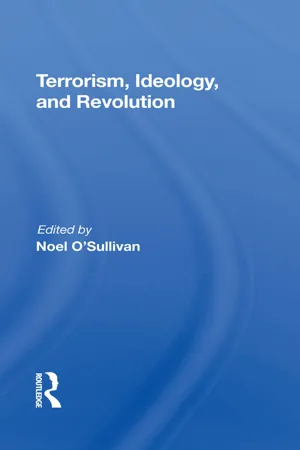
Terrorism, Ideology And Revolution
The Origins Of Modern Political Violence
- 232 pages
- English
- ePUB (mobile friendly)
- Available on iOS & Android
eBook - ePub
About this book
This book represents a concerted attempt to bring the resources of political theory, political science and history to bear on modern terrorism. It provides the general assumptions about man and society which inspire terrorist activity, focusing on the continuity of violence in human affairs.
Trusted by 375,005 students
Access to over 1.5 million titles for a fair monthly price.
Study more efficiently using our study tools.
Information
Acknowledgements
I am grateful to Dr Juliet Lodge for advice and assistance during the early stages of preparing this book, and to Professor Jack Hayward for some invaluable last minute help.
Professor Norman Hampson's comments vastly improved my own paper. I am solely responsible, of course, for the form it finally assumed.
The editor of Conflict Quarterly kindly gave permission for the inclusion of a revised version of a paper by Dr Richard Gillespie originally published there.
Part I
The Theory and Practice of Terrorism
1 Terrorism, Ideology and Democracy
Noel O'Sullivan
The contemporary study of terrorism is marked principally by continuing confusion about its general significance for modern political life, and in particular about its relationship to the democratic state. This confusion is nowhere more apparent than in the voluminous academic literature on the subject which has appeared during the post-war period. Briefly, two very different responses have characterized this literature. The initial response, as one study recently records, verged on incomprehension, mainly because 'the truth is that Europe had been taken by surprise when the hijackers, kidnappers and assassins first began to strike within its comfortable confines. Their acts were not expected in old established countries where the rule of law and constitutional practice made it possible to change governments and policies by the simple process of voting. In Europe,' it was assumed, 'there was no need for terrorism; that was the kind of unpleasantness to be expected in Latin American tyrannies rather than in London, Bonn and Paris.'1. (Predictably, the result of such an attitude was a tendency to overreact to terrorism, in ways which made it appear both more novel and more dangerous than a more considered response might have suggested.)
During the last few years, however, as terrorism has lost much of its novelty and works on the topic have proliferated, there has been a tendency for scholars to go to the opposite extreme and display a more blasé attitude in their assessment of its significance. In this vein, the study just quoted, for example, remarks at one point that 'The terrorists, like the poor, are always with us'.2 In a similar vein, another scholar concluded, on the basis of reports in The New York Times during the decade 1961-70, that terrorist incidents had occurred in sixty-three out of eighty-seven countries, with a total cost of approximately 4,600 lives. In his opinion, this loss of life was relatively minor compared with the three-quarters of a million people who lost their lives in all forms of civil strife during the same decade, or in the light of the city of Chicago's murder rate of nearly one thousand per annum.3
In the present essay, it will be suggested that neither the initial reaction of surprise nor the more blasé reaction which has superceded it has brought out the real significance of the terrorist phenomenon for an understanding of modern European political life. What both reactions have obscured, it will be argued, is the fact that the roots of terrorism lie concealed at the very heart of the modern democratic tradition itself. In the first part of the paper an attempt will be made to identify these roots, in a way which aims to build up a sort of identikit picture of the terrorist's ideological world. In the second part, the stages through which these extremist tendencies have passed will be sketched, in order to trace the evolution of the modern terrorist from the guerrilla fighter who dominated radical politics during the first half of the nineteenth century. Finally, the features of twentieth century life which are most relevant for understanding both the theory and practice of contemporary terrorism will be indicated, with a view to gauging its likely future significance for both Western and Third World politics. Before proceeding further, however, it is necessary to attempt a definition of terrorism, in order to distinguish terrorism in its modern form in particular from the long history of tyrannicide upon which the Western world has prided itself since at least the time when Brutus murdered Julius Caesar.
So far as definition is concerned, the problem is, of course, confined in the present context exclusively to political terrorism. Terrorism which is directed primarily towards criminal purposes or personal material gain, in other words, is not relevant. Excluded also is the terrorism which in various forms accompanies war, since the concept of terrorism is only intelligible in reasonably settled and stable social contexts within which it is possible to contrast the illegal practices of the terrorist with the constitutional procedures prescribed for established state representatives. Bearing these qualifications in mind, political terrorism may be said to occur when a group, whether holding governmental office or outside government, resolves to pursue a set of ideological objectives by methods which not only subvert or ignore the requirements of domestic and international law, but which rely for their success primarily upon the threat or use of violence.
It will be noted that this definition permits regimes as well as opposition groups to be described as terrorist, although the main concern of the present paper is with the latter. The definition also includes two important restrictions which require a word of explanation. The first restriction is legal, and is inserted because the frequent attempts to define terrorism in terms of threats of violence alone—that is, in psychological terms—would brand as 'terrorist' organizations like the German Social Democratic Party at the end of the last century, sinced this engaged in a lot of noisy rhetorical threats about violent revolution. The reference to legality, however, removes such a group from the terrorist fold by taking account of the fact that the party was in practice quite law-abiding, to the annoyance of a minority of its own genuinely radical members.
The second restriction in the definition lays stress on the ideological aspect of terrorism. It is this ideological aspect which is the key, in particular, to the vital distinction which must be made between 'terror' and 'terrorizing', on the one hand, and 'terrorism', on the other. Terror refers to a psychological state—the state, that is, of extreme fear and anxiety. The addition of an 'ism', however, lifts the concept out of the realm of psychology and relocates it in the sphere of beliefs and ideas. To that extent, Paul Wilkinson is perfectly correct when he observes that 'political' terrorism cannot be understood outside the context of the development of terroristic, or potentially terroristic, ideologies, beliefs and life-styles.4 Terrorism as we know it, in a word, is essentially the creation of ideological politics.
The intimate connection between terrorism and ideological politics is vital for present purposes, since it is precisely this connection which distinguishes modern terrorism from earlier forms of political violence. In The Prince, for example, Machiavelli expressed admiration for the success with which Cesare Borgia used terror in order to rule his subjects. Machiavelli admired the way, in particular, in which Borgia encouraged Remirro d'Orco to use ruthless techniques in order to tidy up Borgia's newly acquired province of Romagna, and then pacified his subjects, at the same time clearing himself of any responsibility for their sufferings, by having the wretched d'Orco laid out in a public square with stakes driven through him. This is terror, not terrorism. Even the long line of literature which defends tyrannicide by appeals to ideas like natural law and the social contract is not 'terrorist' in the modern sense, since it occurs outside the confines of ideological politics.
What must now be considered in some detail is the precise way in which ideological politics are related to the terrorist phenomenon. One familiar way consists of assuming that terrorism is a peculiarity of left or right wing fanatics, and then concentrating attention upon what are taken to be the relevant representatives of the wing in question. According to the present analysis, however, the intellectual and political assumptions which inspire terrorism completely cut across the left-right spectrum, and therefore prevent any such neat pigeon-holing of the phenomenon. A second way of proceeding appears to avoid the defects of the spectrum approach by selecting a variety of diverse figures, regardless of the political wing to which they might be conventionally assigned, and then holding them responsible for the atrocities of the contemporary period. Popular candidates for this treatment include, for example, nineteenth century thinkers like Max Stirner, Bakunin, Nechaev and Johann Most.5 This way of proceeding is unsatisfactory, not because it is wrong, but because it disconnects terrorism from the mainstream of democratic thought and practice by confining attention too narrowly to a collection of more or less romantic and egotistical continental fanatics. The result is to encourage a sense of complacency, since the causes of terrorism are dismissively pushed to the eccentric fringe of the European intellectual and political world. What will be suggested here is that terrorism is far more intimately connected with the modern liberal-democratic tradition than such a view would imply. In order to understand this connection, and to appreciate why terrorism cannot be satisfactorily analysed within the 'left-right' spectrum approach, it is necessary to begin by returning to the precise point at which ideological politics emerged in Europe. By focusing attention on this point, it is possible, in particular, to identify the main sources of instability and extremism which the new ideological style injected into the modern political tradition.
The ideological style of politics with which we are now familiar is in fact a relatively recent development. The style emerged in Europe only at the end of the eighteenth century, acquiring practical significance in 1789, at the time of the French Revolution. It was originally generated, and has subsequently been sustained, by three crucial assumptions about the nature of man and society.
The first assumption appeared when the vast programme of destruction undertaken by the French Revolution led men to believe that it lay within the power of men's will to remake society from top to bottom, and even to refashion human nature itself. Previous history contained an abundance of Utopian visions, of course; but until 1789 no one had thought it was actually possible to do very much about them. Modern ideological politics, by contrast, arose precisely when it came to be assumed that it is perfectly possible to do a great deal about such visions. Without this belief in the possibility of radical change the more ambitious aspirations of modern terrorism would be inconceivable.
The second assumption was that man is naturally good. This optimistic view found expression in the form of a new theory of evil, which was first clearly stated by Rousseau but has since come to be almost universally accepted. According to the new theory, evil is not an eternal and ineliminable part of the human condition, but originates in the structure of society, and may therefore be removed from the world by making the appropriate social changes. This meant that, from being an activity in which men merely sought a stable framework of order within which to lead their lives, politics were now elevated to the status of a quasi-religious crusade, the aim of which was to awaken 'the people' from its long historical sleep, and inspire it to throw off its oppressors. To understand politics in this way assumed, of course, that the people really did want to be 'liberated', no matter how overtly reluctant they might seem to be. Finally, the new style meant that politics acquired a very simple and potentially lethal structure, since a vital part of the crusading mentality consists in endeavouring to identify an 'out group' which could be held responsible for everything amiss with the existing social order. Having identified the out group, it is but a small step to demanding its suppression, removal, or extermination. It is hardly necessary to mention what has happened in the two centuries since 1789, as a result of the acceptance of this way of thinking about politics. Originally, the out group was identified by Robespierre and the early French democrats as consisting of kings, aristocrats and priests, and as many of these as possible were accordingly sent to the guillotine. Subsequently, Marxism added capitalists to the out group. Thereafter, the Nazis redefined the out group to mean the Jews. Finally, in our own day, ideologists like Franz Fanon have identified the out groups as all imperialist powers. It is obvious, then, that the new style of politics readily lends itself to interpretations which make the use of terror for ideological ends appear as a natural and even admirable implication of the idealistic belief in man's natural goodness.
We must now turn, in the third place, to an element in the new ideological style which has done more than any other to facilitate the appearance of modern terrorism. This was the advent of a novel doctrine of political legitimacy which has since come to be accepted, not only in the West, but throughout the whole world. This is the doctrine of popular sovereignty proclaimed by the Declaration of the Rights of Man and the Citizen. According to this doctrine, power is legitimate only if it is conferred 'from below', by the people. In the words of the Declaration, 'The principle of sovereignty resides essentially in the Nation: no body of men, no individual, can exercise authority that does not emanate expressly from it'. It is not difficult to see how this doctrine, which was supposed to liberate the masses and inaugurate an era of world harmony, might instead produce the opposite result. It could do so because the concept of 'the people' can be defined in any way at all. This means not only that an appeal tο popular sovereignty can be used to justify any government, no matter how appalling its policies may be, but that it can also be invoked by any one who wishes to defy the government, provided that he claims to be a truer representative of the popular will than the established authorities are. Needless to say, this way of legitimating their actions has been a great help to modern terrorists, all of whom claim to act in the name of the people.
The situation is made even worse in this respect by the fact that the new ideological style has deprived not only the word democracy, but also the word liberty, of any clear connection with the rule of law. Early in the nineteenth century the great French liberal thinker, Benjamin Constant, succinctly described the connection between law and liberty when he wrote that liberty is 'the right to be subject only to the laws, the assurance of being neither arrested, nor detained, not put to death, nor in any way restricted, by an arbitrary act of will of some one individual or of many'. At the very time Constant wrote, however, the idea of libe...
Table of contents
- Cover
- Half Title
- Title
- Copyright
- Contents
- List of Contributors
- Preface
- Acknowledgements
- Index
Frequently asked questions
Yes, you can cancel anytime from the Subscription tab in your account settings on the Perlego website. Your subscription will stay active until the end of your current billing period. Learn how to cancel your subscription
No, books cannot be downloaded as external files, such as PDFs, for use outside of Perlego. However, you can download books within the Perlego app for offline reading on mobile or tablet. Learn how to download books offline
Perlego offers two plans: Essential and Complete
- Essential is ideal for learners and professionals who enjoy exploring a wide range of subjects. Access the Essential Library with 800,000+ trusted titles and best-sellers across business, personal growth, and the humanities. Includes unlimited reading time and Standard Read Aloud voice.
- Complete: Perfect for advanced learners and researchers needing full, unrestricted access. Unlock 1.5M+ books across hundreds of subjects, including academic and specialized titles. The Complete Plan also includes advanced features like Premium Read Aloud and Research Assistant.
We are an online textbook subscription service, where you can get access to an entire online library for less than the price of a single book per month. With over 1.5 million books across 990+ topics, we’ve got you covered! Learn about our mission
Look out for the read-aloud symbol on your next book to see if you can listen to it. The read-aloud tool reads text aloud for you, highlighting the text as it is being read. You can pause it, speed it up and slow it down. Learn more about Read Aloud
Yes! You can use the Perlego app on both iOS and Android devices to read anytime, anywhere — even offline. Perfect for commutes or when you’re on the go.
Please note we cannot support devices running on iOS 13 and Android 7 or earlier. Learn more about using the app
Please note we cannot support devices running on iOS 13 and Android 7 or earlier. Learn more about using the app
Yes, you can access Terrorism, Ideology And Revolution by Noel O'sullivan in PDF and/or ePUB format, as well as other popular books in History & World History. We have over 1.5 million books available in our catalogue for you to explore.