eBook - ePub
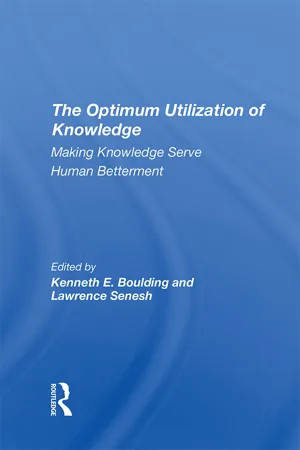
The Optimum Utilization Of Knowledge
Making Knowledge Serve Human Betterment
- 386 pages
- English
- ePUB (mobile friendly)
- Available on iOS & Android
eBook - ePub
The Optimum Utilization Of Knowledge
Making Knowledge Serve Human Betterment
About this book
We all have more knowledge than we use; even so, say the editors of this book, ignorance often governs our actions. Society continues to find ways to misuse knowledge–from manipulating information to gain political power to restricting what ideas are explored on university campuses. Thus, when some of the best minds in the country met to focus on the optimum utilization of knowledge, it was not an idle academic inquiry. In these proceedings from that conference, which was sponsored by the Academy of Independent Scholars, the contributors examine several of the key aspects of learning: the importance of knowledge in decision making, the role of our educational system and other systems in producing and disseminating knowledge, and the relationship between knowledge and the physiological, psychological, and cultural bases of the learning process. The misuse of knowledge–or the overuse of ignorance–the authors note, could threaten the existence of the entire planet, if the kind of thinking exemplified by the nuclear arms race prevails.
Trusted by 375,005 students
Access to over 1.5 million titles for a fair monthly price.
Study more efficiently using our study tools.
Information
1
The Optimum Utilization of Knowledge: Some Central Concepts
KENNETH E. BOULDING
The Nature of Knowledge
The problems of the human race do not always originate in deficiencies in human knowledge or its utilization, but the solutions to any of these problems must originate there unless they come by pure luck. If problems that could be solved fail to get solved, or if decisions made with the best of intentions turn out in fact to have been bad decisions, the reasons must lie in the structure of human knowledge and either failure to utilize this knowledge or success in misutilizing it. The search for greater success, therefore, in encouraging processes that lead to bettering rather than worsening the human condition must begin with a consideration of the nature of human knowledge and the processes by which this knowledge is utilized.
All human knowledge consists of some kind of structure in human bodies, mostly in brains. In the first instance it is a structure of information, although exactly what the physical machinery for coding this information is we still do not really know. The knowledge structure in all human bodies around the world is what the great Jesuit philosopher Pierre Teilhard de Chardin called the noosphere.1 This is an essential component of the state of the world at any one moment, and its character and the changes in it profoundly affect future changes in the state of the world as it passes through a succession of states from moment to moment in time.
Knowledge, especially in the form of know-how, is by no means confined to human beings. Conscious human knowledge is only the tip of the iceberg of knowledge-like structures that go very far down the process of evolution. In chemical valences, carbon "knows how" to combine with four hydrogen atoms to form CH4 (methane) but does not know how to combine with five, and unsatisfied CH3 is well named a "radical." With the genetic structure coded in DNA, the appropriate genes know how to make an ant or chicken or human being from a fertilized egg. All genetic structures involve know-how of some kind. Just what is included in the noosphere, therefore, is a little arbitrary. The human noosphere is a subset of the larger noosphere that includes all genetic structures and potentialities. The human noosphere, then, consists of images in the minds of all human beings; images, for instance, of physical objects in space and time, of one's own body, even of one's own mind, one's friends, buildings, towns, countries, the geography of the earth, the solar system, the universe, the chemical elements and compounds, patterns of behavior, ideas of cause and effect, the laws and limitations under which one state is transformed into another, and so on. It also goes beyond images of "fact" to those preferences and evaluations by which different images of the world are ordered, which are especially important in making decisions. It also includes emotional states of liking and disliking, hatred, anger, and fear; languages; symbols; and so on.
It is curious that there seems to be no word in the English language to describe simply the actual content of a human mind; the word "knowledge" has the almost implicit assumption that our knowledge is true. We have to admit, however, that the content of the human mind may include both error and ignorance.
Access to human knowledge takes many forms. The physiological probing of the brain gives us very little access simply because at present we cannot identify the coding that goes on within it. Nevertheless, we do have access to our own knowledge through consciousness and introspection. We constantly give ourselves examinations. I can ask myself, for instance, "Do I know the names of my senators?" If my answer is "No," I can ask someone or consult a reference book. Thus, through the instrument of language, we can probe the knowledge structures of others and deposits of knowledge in writing, print, and records. Language, indeed, plays an important part even in the probing of our own knowledge structure, though it is not the only component in this process. I can, for instance, picture the house where I was born in my mind without any words at all attached to this image. Because of language, however, I can have images of places that I have never visited and of times before my birth, as well as some idea of the images, values, and emotions of those around me. No other creature that we know can do this. The study of language, therefore, is a very important clue to the formation of knowledge structures and their transmission from one mind to another.
Knowledge structures are immensely complex and have a great many dimensions and aspects. Perhaps the most elementary is the genetic aspect of know-how, which preceded the human race. It existed long before consciousness, as in the gene or genetic structure of the fertilized egg, which knows how to make an organism. In humans much know-how is also unconscious. We know how to hit a tennis ball without having the slightest understanding of how we really do it, what physical processes are involved, and what differential equations we are solving. A male and a female know how to fertilize an egg, although they may not have the slightest idea what they are really doing or what the results will be in terms of a new organism. We know how to speak or to write a sentence that transmits structures in our minds to the minds of others, though again we do not really know the exact mechanism by which this is done. Of course, we often learn know-how consciously (as when we learn how to drive a car), but once learned, such know-how often slips back into the unconscious.
Beyond know-how is "know-what." This consists of images in our mind of objects in the world outside the mind, which in some sense, oddly enough, include the brain and the mind itself. This also involves images of processes by which objects are transformed in time, space, and structure. Know-what is by no means confined to images of material objects. It includes images of our own thoughts, feelings, and emotions, as well as images of the thoughts, feelings, and emotions of other people. It also includes images of abstractions and ideas that relate to, but do not consist of, images of particular objects. This becomes very complicated in connection with images of taxonomy—that is, classes of objects. Classification is necessary when using language, for we are incapable of accessing more than a limited number of separate words and symbols on the order of some tens of thousands, whereas we are aware of a vastly larger number of individual objects like the grains of sand on the seashore, the leaves on trees in the forests, even the four-and-a-quarter billion other human beings. Identifying a particular object often depends on our ability to place it in a series of diminishing subsets, as in the old "twenty questions" game. This is really what a postal address is: a number on a street, in a town, in a county or state, in a country, in the world.
We also perceive logical and mathematical relationships. They are independent of our experience in the world of objects, but we believe the world of objects must conform to them. Formal logic and mathematics are essentially sets of related truisms—things that cannot be different. Two plus two must be the same as three plus one, by the meaning of the words. On the other hand, we also recognize that our logic and mathematics may be a function of the human mind itself. Thus, we seem to have a capacity for transcending the obvious axioms of Euclidean mathematics, as we do, for instance, in Einstein's theory of relativity, which assumes that the larger universe is governed by a geometry and a logic that are repugnant to our common-sense experience.
Another part of our conscious knowledge structure seems to go beyond know-how and know-what into what we might call "know-why." This involves images of purposes, goals, final causes, and patterns in the processes and structures of things that we perceive as having meaning and significance. Three- and four-year-olds are constantly asking "Why?" often to the great frustration of the adults to whom the questions are addressed, perhaps because three- and four-year-olds are so newly conscious of themselves and the world around them that they tend to relate everything in their environment to how it affects them personally. The answers to "Why?" questions often serve to fit immediate experiences into some larger time scheme or framework. "Because Daddy says so" is often a surprisingly satisfactory answer to a child's awkward question Ask a biologist, "Why is grass green?" and we may get a long disquisition about photosynthesis, chlorophyll, light absorption, and survival value. The purposes of a war—like the "Four Freedoms"—are often thought up long after the war has been started, yet a young man who asks, "Why do we have to go to war?" is often treated like a three-year-old.
As we get older, "know-why" may well diminish in importance, but we never escape having to face "know-whether." This is a structure of evaluation among alternative futures that underlies all decisions. Should I accept a job that I think will increase human misery? Should I have a child that I cannot support? Should I tell a lie to save a friend's life? Moral dilemmas are as much a part of daily living as they are exercises for moral philosophers. All decisions must come from some kind of knowledge of alternative futures and at least a rank ordering of preference for those futures.
A cynic might say that one of the most important parts of knowledge is "know-whom"—that is, two persons having images of each other with some degree of richness and accuracy. The networks of know-whom are an important element in the dynamics of power. One way to get rich and powerful is to know people who are rich and powerful and be known (favorably) by them.
Within the knowledge structure a distinction is frequently drawn between images of fact and images of value. This is important in decision processes, where we distinguish between the agenda of decision (consisting of a range of images of possible expected futures) and the evaluation of these images (which involves ordering them from the most to the least preferred). The theory of maximizing behavior suggests, of course, that we always choose from our agendas the expected future we think is best at the time, but the actual process of forming agendas and evaluating them is complex and often mysterious.
Another important aspect of knowledge structures is their capabilities and reserves. These relate to the process of change in knowledge structures through learning. A fertilized egg has the know-how to produce a brain and higher nervous system by morphogenesis, which may go on to some extent throughout life, although most of it is accomplished before maturity. However, realizing the potential of this genetically produced structure for knowledge in all its forms involves a learning process. Again, we very imperfectly understand that process, but it certainly has two major aspects. One is the internal operation by which the human brain constantly produces an enormous, turbulent succession of images in a great process of mutation and internal selection The other aspect is the messages from the outside world coming in through the senses. This factor involves both mutation and selection processes. Messages from the senses criticize the images forming in the mind and may also be active in the creation of new images in a mutation process.
The role of language here is very important, as the input of language—and to some extent its output—creates new images and destroys old ones in a never-ending process, I have an image of where my friend lives; I go there and find he has moved. I inquire and learn his new address, go there, and find him. We have a conversation in which I express a certain evaluation. He criticizes this and tells me I am wrong. Because of my respect for him, I believe him and change my evaluation. This process of constant mutation of images and selection by testing is the essence of the human learning process, continually changing the content of individual minds and of the whole noosphere.
A very important concept is that of the "quality" of human knowledge—that is, of cognitive content—both in individual minds and in the whole noosphere. An image in the human mind may be true or it may be in error. The quality of truth is closely related to the concept of mapping the real world. An image is true if there is a one-to-one mapping of its structure with some structure in the real world it is supposed to represent. It is false or in error if the mapping is inaccurate or incomplete. Error is detected through testing by complex and extremely varied sets of processes. When I went to my friend's house and found he had moved, an old image was tested, found to be in error, and abandoned, or at least was perceived as erroneous. An image can be perceived as fantasy; if there is indeed no structure corresponding to it in the real world, this perception is not an error. I have an image of a unicorn, but I do not believe such an animal exists. Negative images can also be true. After I went to my friend's house and found that he did not live there, I added that address to the vast number of places where he does not live.
The problem of what constitutes "truth" in mathematics, in logic, and in deductive processes is surprisingly difficult, especially in the more sophisticated inquiries. Elementary mathematics and logic are true enough for most practical purposes. But we have to go beyond Euclidean geometry in the physical sciences, and we should go beyond Cartesian algebra in the social sciences. For in social systems, minus-minus does not make plus; not doing harm is not the same thing at all as doing good. There is need to go beyond Aristotelian logic when the reality is probabilistic. Gödel's proof that no system of deductive reasoning can be self-sufficient suggests that at least we should not take mathematics and logic for granted. There are problems, too, in quantification, where the reality of which we are trying to form an image is topological rather than quantitative. Used mechanically, without reference to the nature of the field of inquiry, quantification can be quite misleading. For instance, a consumer price index used mechanically can accelerate inflation. A single number that claims to represent multidimensional and structural reality can never be more than an approximation to truth.
"Folk" and "Scholarly" Knowledge
Knowledge structures can be divided rather loosely into "folk" knowledge and "scholarly" knowledge. Folk knowledge is what we acquire in the ordinary business of life. It is universal. It includes the image that I have of my own person, my family, my friends, my house in town, my job, my engagements next week, and so on. Folk knowledge tends to have a high quality of truth, simply because, for the most part, it is easily testable. It can, however, take pathological forms, as in the case of the paranoid or the schizophrenic. In such a case the testing process breaks down and the image within the mind becomes increasingly in error, often to the point at which the decision-making process breaks down and the person becomes incapable of participating in ordinary life. This pathological state may be in part a breakdown in the interpretation of language, as when, for instance, the schizophrenic takes metaphors literally. Part of it may be an inability to change images in the face of testing; in these circumstances a test that fails to produce the expected result is interpreted as showing a change in the real world, not requiring a change in the image. We can learn a good deal about complex systems by studying their extreme positions. A lot can be discovered about normal human learning by studying its failures in pathological cases.
Scholarly knowledge is what is acquired and transmitted by specialists in the acquisition and transmission of knowledge. Adam Smith in The Wealth of Nations describes the process delightfully:
In the progress of society, philosophy or speculation becomes like every employment the principal or sole trade and occasion of a particular class of citizens. Like every other employment, too, it is subdivided into a great number of different branches, each of which affords occupation to a peculiar tribe or class of philosophers. And this subdivision of employment in philosophy, as well as in every other business, improves dexterity and saves time. Each individual becomes expert in his own peculiar branch, more work is done upon the whole, and the quantity of science is considerably increased by it.2
Adam Smith's later denunciation of the division of labor as a destroyer of the overspecialized person might also, however, have some application to "philosophers"!
It is customary to divide the world of scholarship into the sciences and the humanities, but this distinction is rather arbitrary. Acquiring scholarly knowledge follows essentially the same processes as acquiring folk knowledge, but in more refined forms. Thus the use of language may be more important and the languages used more specialized—the most specialized of all, of course, being mathematics. Scholarly knowledge is also distinguished from folk knowledge by the greater complexity of its structures and the correspondingly greater complexity necessitated in the testing process. The famous Michelson-Morley experiment on the velocity of light involved much more complex testing processes and concepts than testing where my friend lives and required much more apparatus than a door knocker. But the essential process of the testing of images is the same in both cases. Images are produced by a combination of internal fantasy and external information. The commonest form of testing is done by devising some kind of projection of the future to predict an event that may be either realized or not realized. Testing can also be done by perceiving patterns in the record of the past, as in planetary astronomy or social and economic statistics.
Scholarly knowledge, like folk knowledge, may be true or false or may have degrees of truth, and its mapping of the real world may be more or less accurate. In all cases, testing must be indirect, for, as David Hume pointed out more than two hundred years ago, we can never directly compare an image with the reality it purports to map. We can only compare one image with another image in our minds. Testing is largely a process of comparing an image of the future as time goes on with the image of that future when it has become the past.
Scholarly knowledge, like folk knowledge, can exhibit pathologies. The possessors of scholarly knowledge may resist testing because it threatens their status or income. Ideology tends to become a pathology of scholarly knowledge. It is a set of ideas bound up so closely with the image of identity of the people who hold them that testing cannot be permitted. When ideology becomes pathological, the threat system is invoked to destroy or at least silence dissent. We have seen many examples of this in human history, from the Spanish Inquisition to Lysenkoism in the Soviet Union. A rigid ideology, indeed, easily degenerates into schizophrenia of scholarly knowledge.
A very interesting question is whether images of value can also have a quality of truth similar to that attributed to images of fact. It is certainly more difficult to say what in the "real world" corresponds to our images of value than it is to conceive of what reality corresponds to our images of objects. Nevertheless, images of value result from the same kind of process of internal mutation and selection as that by which images of fact are produced. We see this, for instance, in the way every subculture develops an ethos, a set of individual preference structures regarded as appropriate to the subculture. This ethos then is used to criticize the preferences of individuals within the subculture, usually to the point where the individual either leaves the subculture or conforms to its ethos and changes preferences accordingly. A Jesuit who preaches atheism or becomes a thief is likely either to leave the order or to be expelled from it unless he changes his mind and once more conforms to the ethos of the order.
The ethos in each subculture is similarly criticized by the ethos of the larger society in which it finds itself. This criticism may take the form of preaching or of legal sanctions. The drug culture has an ethos of its own that it imposes on its adherents, but in turn it is severely criticized by the ethos of the larger society. We see, therefore, a pattern in the f...
Table of contents
- Cover
- Half Title
- Series Page
- Title
- Copyright
- Contents
- Foreword
- 1 The Optimum Utilization of Knowledge: Some Central Concepts
- 2 What Do We Mean by the Optimum Utilization of Knowledge?
- PART ONE ◻ WHAT DO WE KNOW ABOUT HUMAN LEARNING?
- PART TWO ◻ HOW TO APPLY THE KNOWLEDGE OF LEARNING TO EDUCATION
- PART THREE ◻ APPLYING KNOWLEDGE TO DECISION MAKING
- About the Contributors
- Index
- About the Academy of Independent Scholars
- About the AIS Forum Series
- About the Book and Editors
Frequently asked questions
Yes, you can cancel anytime from the Subscription tab in your account settings on the Perlego website. Your subscription will stay active until the end of your current billing period. Learn how to cancel your subscription
No, books cannot be downloaded as external files, such as PDFs, for use outside of Perlego. However, you can download books within the Perlego app for offline reading on mobile or tablet. Learn how to download books offline
Perlego offers two plans: Essential and Complete
- Essential is ideal for learners and professionals who enjoy exploring a wide range of subjects. Access the Essential Library with 800,000+ trusted titles and best-sellers across business, personal growth, and the humanities. Includes unlimited reading time and Standard Read Aloud voice.
- Complete: Perfect for advanced learners and researchers needing full, unrestricted access. Unlock 1.5M+ books across hundreds of subjects, including academic and specialized titles. The Complete Plan also includes advanced features like Premium Read Aloud and Research Assistant.
We are an online textbook subscription service, where you can get access to an entire online library for less than the price of a single book per month. With over 1.5 million books across 990+ topics, we’ve got you covered! Learn about our mission
Look out for the read-aloud symbol on your next book to see if you can listen to it. The read-aloud tool reads text aloud for you, highlighting the text as it is being read. You can pause it, speed it up and slow it down. Learn more about Read Aloud
Yes! You can use the Perlego app on both iOS and Android devices to read anytime, anywhere — even offline. Perfect for commutes or when you’re on the go.
Please note we cannot support devices running on iOS 13 and Android 7 or earlier. Learn more about using the app
Please note we cannot support devices running on iOS 13 and Android 7 or earlier. Learn more about using the app
Yes, you can access The Optimum Utilization Of Knowledge by Kenneth E. Boulding,Lawrence Senesh in PDF and/or ePUB format, as well as other popular books in Social Sciences & Sociology. We have over 1.5 million books available in our catalogue for you to explore.