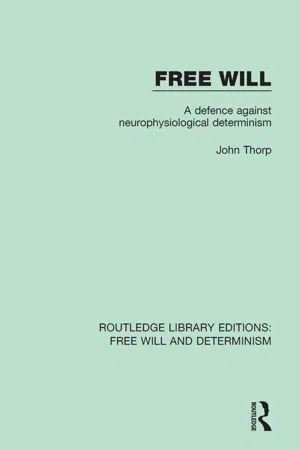
The problem of freedom and determinism is one of the most enduring, and one of the best, problems in philosophy. One of the best because it so tenaciously resists solution while yet always seeming urgent, and one of the most enduring because it has always been able to present itself in different ways to suit the preoccupations of different ages. This book, first published in 1980, sets out to defend free will: it elaborates a sober and systematic case for libertarianism in the face of the overwhelming threat that is posed by the scientific study of the brain.
- 176 pages
- English
- ePUB (mobile friendly)
- Available on iOS & Android
eBook - ePub
About this book
Trusted by 375,005 students
Access to over 1.5 million titles for a fair monthly price.
Study more efficiently using our study tools.
Information
Topic
PhilosophySubtopic
Philosophy History & TheoryI
INTRODUCTION
The problem of freedom and determinism is one of the most enduring, and one of the best, problems of philosophy; one of the best because it so tenaciously resists solution while yet always seeming urgent, and one of the most enduring because it has been able to present itself in different ways to suit the pre-occupations of different ages. At one time the problem arose because the operation of Fate seemed undeniable, at another because Divine omnipotence and human wrongdoing were the subject of great interest, at another because Divine foreknowledge seemed irrefragable, at yet another because psychological determinism was generally assumed to be true, and both first1 and lately, it arises because a deterministic physical atomism has been the prevailing scientific theory. My concern here is with the problem in this oldest and newest of its versions.
In this version the problem first presents itself as a dilemma: either we are free and therefore nature is not deterministic, or nature is deterministic and therefore we are not free. The consequent of each of these horns imports embarrassment; for on the one hand we are, for certain reasons, inclined to believe that nature is deterministic, and on the other hand we do suppose ourselves free, and some of our moral and legal institutions seem to depend upon that supposition. Neither of these beliefs is, at first glance, impossible to give up, however: freedom could be an illusion, and it seems impossible to show either a priori or a posteriori that nature is deterministic. However that may be, there are always three ways of dealing with a dilemma: to embrace one horn, to embrace the other, or to attempt to reconcile the two. To reconcile the two horns of this dilemma we should have to show that the kind of freedom we and our moral institutions require is not incompatible with natural determinism.
Most recently those who wish to assert natural determinism and pay the cost of denying freedom have not been vociferous; the field has been left to the other two: those who seek to work a reconciliation, and those who, thinking such a reconciliation cannot be effected, would wish to assert freedom and pay the cost of denying natural determinism. These are compatibilists and libertarians respectively. What they disagree about in the first instance is whether or not natural indeterminism is a necessary condition of freedom; the libertarian holds that it is, and the compatibilist that it is not – or even that it is a necessary condition of freedom that there not be natural indeterminism. I am inclined to think that on this particular issue it is the libertarians whose position is the more attractive, though the issue is not settled. However, there is more to it than this. Libertarians are typically short-sighted, and compatibilists are long-sighted. What looms in the distance for this metaphor is the question, what are the sufficient conditions of freedom? Unfortunately, libertarians always seem to go to pieces over this one; having insisted that a necessary condition of freedom is natural indeterminism it seems unconscionably difficult for them to say what the sufficient conditions may be; freedom is, after all, something more than mere randomness; when libertarians try to say what this something more is, their talk becomes at best evasive and obscure, and at worst incoherent. Compatibilists, being long-sighted, foresee this problem for libertarians and are therefore content to patch together a much less attractive position over the first question, in order to have an easier time over the second. Indeed, the best argument for compatibilism is still that libertarianism soon falls into obscurity and incoherence.
Libertarians are, however, typically dogged characters, and they cannot believe that they are wrong in their answer to the first question, namely, that natural indeterminism is a necessary condition of freedom; they prefer to hold on to that one little piece of, to them, self-evident truth, and to trust to time for the rest. What they require is an account of the sufficient conditions of freedom, given that one of the necessary conditions is natural indeterminism. It is just such an account that I attempt to provide in this essay: in a phrase, a libertarian theory of free decision.
What follows is, then, a defence of libertarianism. But it is a defence only in the rather conservative sense that it sets forth a coherent and unevasive version of that position; however, such is the sort of defence the position most needs.
If defence of a more offensive kind were requested, I should not know what to say. What could be the reasons for embracing a coherent and unevasive libertarian theory of free decision instead of a coherent and unevasive compatibilist one? The unattractiveness of the compatibilist view that what we mean by a free decision can none the less be a decision which is naturally determined would be my reason for choosing libertarianism, but I am well aware that to some that view is not unattractive: not all compatibilists are compatibilists only for want of a coherent statement of libertarianism. Perhaps the fact that libertarianism offers more freedom – freedom from more constraints – than does compatibilism would be something to be weighed in the balance; but it is not clear into which pan it should be put. One point that might be thought to weigh against libertarianism is its requirement of indeterminism in nature; but that objection is surely less weighty now than it must once have seemed: the postulation of (non-epistemic) indeterminism in physics is no longer anathema or even odd. Perhaps the choice would have to be made in the way that scientists choose between rival theories, honouring simplicity and conceptual economy, not only in the theories themselves, but also in the way in which they interlock with the ‘prevailing scientific paradigms’; history does not, however, support the view that prevalence, in metaphysical paradigms, is a virtue. In short, I am stymied by this further question and shall confine myself in what follows to the nearer one: can a coherent libertarian theory of freedom be given?
1 VARIETIES OF FREEDOM
(i) Two capital distinctions
‘Freedom’, of course, can mean many things, and before the account can proceed with sanity it will be necessary to get a pretty clear idea of just what sort of freedom it is that I want to give a libertarian theory of. Some order can be made in the crowd of meanings and uses of ‘free’ if we notice that there are (at least) two capital distinctions which serve to divide them from one another. The first is the distinction among the items to which freedom may be attributed: act, will, choice, decision, person, etc. The second is the distinction which is traditionally known as that between liberty of spontaneity and liberty of indifference. A cross-division of these distinctions will yield precisely the sort of freedom I shall be concerned with: liberty of indifference as it belongs to decisions.
About the first distinction I shall say nothing elaborative here, but only defend my interest in freedom of decision.2 The source of philosophical worry about freedom is usually the troubling issue of responsibility. In debates about free will philosophers are in general hoping to make some room in the world for whatever kind and degree of freedom it is that our practice of holding people responsible for their acts requires. They disagree about just what kind of freedom is required for this purpose, but they do in general agree about the purpose. Now, people are usually held responsible for their actions rather than for their decisions; it may therefore seem odd of me to be concerned not with freedom of action but with freedom of decision. It would be less odd if all free responsible acts were preceded by free decisions to do those acts; but even the ghost of this old idea has been effectively exorcised now: many of the acts which I should want to call free and responsible are not preceded by any recognizable mental event having the character of a decision.
Still, some of them are. And for better or worse it is these acts, which are performed as a result of a full-scale careful decision to perform them, which have been regarded as paradigms of free action. Some libertarians, C. A. Campbell for example, hold that only such acts are free;3 other libertarians, like Sartre, hold that all our acts are free. I incline to the latter view and will argue briefly for it in the final chapter. But in the meantime there is a considerable philosophical advantage in starting with full-blown decision-preceded acts. It is this: a condition of freedom in such an act is that the decision from which it results itself be free. Thus the libertarian, in order to give an account of the freedom of such an act, must give an account of freedom of decision. Now the really deep and difficult problem facing the libertarian faces him as well over free decisions as over free acts, but it faces him more squarely, with less ancillary clutter, in the case of decisions than in the case of acts. That is, the statement of sufficient conditions for a free action is likely to be more complicated and longer and more disjunctive than the statement of the sufficient conditions for a free decision – simply because there is so much room for things to go wrong between a decision and the action which embodies it. The philosophical advantage of being concerned with decisions rather than actions is that, for the moment, one can forget about those things that may go wrong. Restricting the enquiry to decisions has, if you like, the advantage of isolating the main problem. It is for this reason that what I seek to give is a libertarian account of free decision; in my last chapter I shall suggest how the account is to be extended to cover actions as well.4
The second capital distinction is that between liberty of indifference and liberty of spontaneity. The distinction is freshman stuff, but I want to explore it a little. I do this not in order to go through the philosophical ritual of making obvious distinctions, but because it often happens that libertarians, when they get to the really difficult moment in making their case, covertly give up the pursuit of liberty of indifference, and settle for a version of liberty of spontaneity. This is a shift which must be guarded against.
Liberty of spontaneity belongs to a person when he is not somehow hindered from expressing his wants in action. By extension it can be predicated of a person’s act, when that act expresses the agent’s wants, or his rational self, or his real nature, or some other psychological item. It is thus a kind of liberty which is not essentially bound up with choosing or deciding, with the presence of alternatives. But by further extension it can be predicated of a person’s choice or ...
Table of contents
- Cover
- Half Title
- Title Page
- Copyright Page
- Table of Contents
- Acknowledgments
- I Introduction
- II On the Dispute between Compatibilists and Incompatibilists
- III The Correlation Thesis
- IV Three Problems for the Libertarian
- V Hegemony
- VI The Random and the Free
- VII Paralipomena
- Notes
- Bibliography
- Index
Frequently asked questions
Yes, you can cancel anytime from the Subscription tab in your account settings on the Perlego website. Your subscription will stay active until the end of your current billing period. Learn how to cancel your subscription
No, books cannot be downloaded as external files, such as PDFs, for use outside of Perlego. However, you can download books within the Perlego app for offline reading on mobile or tablet. Learn how to download books offline
Perlego offers two plans: Essential and Complete
- Essential is ideal for learners and professionals who enjoy exploring a wide range of subjects. Access the Essential Library with 800,000+ trusted titles and best-sellers across business, personal growth, and the humanities. Includes unlimited reading time and Standard Read Aloud voice.
- Complete: Perfect for advanced learners and researchers needing full, unrestricted access. Unlock 1.5M+ books across hundreds of subjects, including academic and specialized titles. The Complete Plan also includes advanced features like Premium Read Aloud and Research Assistant.
We are an online textbook subscription service, where you can get access to an entire online library for less than the price of a single book per month. With over 1.5 million books across 990+ topics, we’ve got you covered! Learn about our mission
Look out for the read-aloud symbol on your next book to see if you can listen to it. The read-aloud tool reads text aloud for you, highlighting the text as it is being read. You can pause it, speed it up and slow it down. Learn more about Read Aloud
Yes! You can use the Perlego app on both iOS and Android devices to read anytime, anywhere — even offline. Perfect for commutes or when you’re on the go.
Please note we cannot support devices running on iOS 13 and Android 7 or earlier. Learn more about using the app
Please note we cannot support devices running on iOS 13 and Android 7 or earlier. Learn more about using the app
Yes, you can access Free Will by John Thorp in PDF and/or ePUB format, as well as other popular books in Philosophy & Philosophy History & Theory. We have over 1.5 million books available in our catalogue for you to explore.