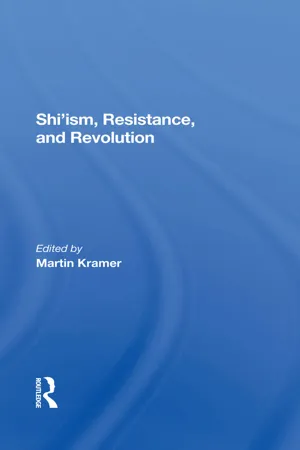
eBook - ePub
Shi'ism, Resistance, And Revolution
- 324 pages
- English
- ePUB (mobile friendly)
- Available on iOS & Android
eBook - ePub
Shi'ism, Resistance, And Revolution
About this book
The recent revival of interest in the Muslim world has generated numerous studies of modern Islam, most of them focusing on the Sunni majority. Shi'ism, an often stigmatized minority branch of Islam, has been discussed mainly in connection with Iran. Yet Shi'i movements have been extraordinarily effective in creating political strategies that have
Trusted by 375,005 students
Access to over 1.5 million titles for a fair monthly price.
Study more efficiently using our study tools.
Information
Part 1
Shi'ism, Islam, and the West
1
The Shi'a in Islamic History
Bernard Lewis
Shi'a is an Arabic word, meaning party or faction. It was originally used of the Shi'atu Ali, the party or faction of Ali; that is to say in modern language, the supporters of a candidate for political office. They formed a group with a political and, in the initial stage, largely a personal choice, as the basis for their group actions. The word came in time to represent one of the major divisions of the Islamic religious community. In accordance with a common but nevertheless misleading practice, outside observers often use words like sect and schism to describe these Islamic differences. Some go even further and use such words as orthodox and heterodox or heretical to denote Islamic divisions. This is, for two reasons, inappropriate. For one thing, it is surely presumptuous for us who are not Muslims to say what is orthodox and what is heretical. That is neither our business nor within our competence. But perhaps rather more important, it is also inappropriate in that the very idea of orthodoxy and heterodoxy is a quite specifically Christian notion. It has little or no relevance to the history of Islam, where there are no synods, churches, or councils to define orthodoxy and therefore none to define and condemn departures from orthodoxy, which we normally designate by such terms as heterodoxy and heresy. Even such words as sect and schism are not appropriate to Islamic religious divisions, neither as regards the basis on which they are defined, nor the forms of organization and action which they adopt and follow.
Some, in trying to explain the difference between Sunnis and Shi'a to Western audiences, have described them as the equivalents of Protestants and Catholics. Except in the sense that it connotes a major division with large numbers of people on each side of a particular line, this description is not very helpful. The absurdity of the comparison is shown by a very simple test. If the Shi'a and Sunnis are Protestants and Catholics, then which are the Protestants and which are the Catholics? The impossibility of answering this question will at once demonstrate the falsity of the comparison.
Western scholarship has at various times offered other explanations. In a Europe which was obsessed by race, some saw the division as one between Semites and Aryans, the Sunnis representing the Semitism of Arabian Islam, the Shi'a representing the upsurge of Aryan Iran, in a racial revolt against Semitic domination. In an age when Europe was obsessed with class war and class war ideologies, the Shi'a were seen as "representing" the dispossessed masses, while the Sunnis became the establishment, and a whole series of interpretations along these lines received currency. None of these is wholly false; none of them is wholly true. But on the whole, they are more false than true.
In earlier times, the divisions between Sunni and Shi'i and between the many groups among the Shi'a were not as rigid as they later became; they were never, even later, as rigid as the differences between Protestants and Catholics, or between the different Protestant churches in Christendom. In the earlier period especially, movement was easy from one to another. And Shi'ism, even when seen from a Sunni point of view, is not necessarily a religious aberration, a theological deviation. Sunni jurists and theologians sometimes speak of tashayyu hasan, which means adopting a pro-Shi'i point of view, but within the permitted limits of difference of opinion. There is an often repeated hadith according to which the Prophet said: "ikhtilafu ummate rahma," which might be approximately translated as, "differences of opinion within my community are one of the manifestations of God's mercy."
The idea that people may agree on essentials and differ on particulars is a deep-rooted one. It is the principle frequently cited to justify the accepted differences between the four major schools of Sunni jurisprudence, and there have always been some who were willing to recognize a form of Shi'ism as constituting a difference or departure, no greater, or not much greater, than that which separates Malikis from Hanafis. Such degree of permitted difference is called tashayyu hasan, of which there are many examples in Islamic history. Indeed, a mild tashayyu seems to have affected the intellectual life of medieval Islam in much the same way that liberal and leftist notions have affected the intellectuals of the modern West. This sort of pro-Shi'ism does not constitute a major religious division—merely a difference of opinion within mutually accepted limits.
The split between Sunni and Shi'i began as a political disagreement, a difference between two groups of people over a political question, over who should be head of the community. And the head of the community is also the head of the state since Islam, unlike the two cognate religions, is and has been since the lifetime of its founder, a political religion. Muhammad during his lifetime established a state and acted as a sovereign. Islam has a political character for which there is no equivalent in Christianity or Judaism, and which therefore has imparted a political content to religious differences throughout Islamic history.
The separation of the Shi'a began with a dispute about who was to be Caliph, head of the community and head of the state. In the earlier stages there seems to have been no more than that, no more than disagreements about what one might nowadays call nominations and candidatures. And these, as happens in other contexts and other societies, were often settled by the arbitrament of force.
But what began as a political disagreement acquired in the course of time many other characteristics. There were legal differences, which are of minor importance. There were doctrinal differences, which perhaps in the larger perspective are also of minor importance. What are probably much more important than either are the psychological and emotional differences, the differences of mood and direction resulting from the contrasting experience of those who were Sunnis and those who adhered to the Shi'a.
The Ayatollah Khomeini has been quoted as defining the distinction between Sunnis and Shi'a in this way—that the Sunnis have on the whole been quietist, teaching and practicing submission to authority however evil and however repressive, while the Shi'a have represented the principle of resistance and opposition, of seeking the overthrow of illegitimate or tyrannical rule. This is very much an oversimplification. We find both quietist and activist groups and individuals and doctrines among Sunnis and among Shi'a; the Shi'a indeed give us what is probably the extreme form of quietism in the doctrine of taqiyya—that one may not only submit to illegitimate power; one may also conform and pretend to believe if this is necessary for survival. There is, however, an important element of truth in the Ayatollah's dictum. It may be an oversimplification; it is not a falsehood. And it may be useful to spend a moment or two in considering these two aspects of Islamic tradition, the quietist and the activist.
This distinction goes back to the very beginnings of Islam. Both in the earliest reports of events in Islamic historiography and in the precepts of Islamic tradition and law, we find two contrasting principles, one activist, the other quietisi. The quietist principle has usually been the dominant one in Islamic states and societies, and for that reason, although not only for that reason, it is the better documented and therefore the better studied. But the activist tradition, one might even say the radical tradition, is no less old and deep-rooted, and is acquiring a new significance in our day, not for the first time in the fourteen centuries of Islamic history.
Any enquiry into early Islamic history at the present time, any study based on the Islamic sources which purport to preserve the record of the early formative years, must take account of two major developments which have dominated recent scholarship devoted to this period. One of them is the growing skepticism among modern scholars as to the authenticity, even as to the historicity of the early Islamic historical sources. There has been great controversy in recent years about whether early Islamic historiography is really historiography and whether the events recorded in these historical writings ever happened. The other major development is the tendency to see the advent of Islam not so much as a discontinuity, an abrupt change and a new beginning as contrasted with pre-Islam, but rather, in many respects at least, as a continuation, admittedly in new forms and to some extent even in new directions, of processes which can be traced back to a remoter past.
Obviously, any consideration of the early history of Shi'ism must take account of these developments in scholarship. But neither of these views need necessarily invalidate conclusions based on the examination of early and for that matter of later Islamic material. Scholars have argued with varying degrees of plausibility that the earliest Arabic historical sources are neither historical nor sources, but are later creations, designed and assembled, according to some, to furnish a background of case law for subsequent jurisprudence; according to others, to provide retroactive legitimization for later political structures and doctrines. But for the history of ideas and attitudes, which is our present concern, the factual accuracy of the historical narrative is of secondary importance. The narrative as preserved, as transmitted, as studied, contains what Muslims perceived to be their past. And it was this perceived past, handed down in sometimes contrasting versions, which shaped their ideas and was used by them to justify their actions. With a religion as political as Islam, in a polity as religious as the Islamic Caliphate, such questions as the source and nature of authority, the duty and limits of obedience, the definitions of legitimacy, justice and tyranny, and the manner of dealing with a tyrant or a usurper, acquired a central importance. And in formulating and answering these questions, the record of early Islamic times as transmitted to later Islamic times furnished ample if somewhat contradictory guidance, much of which, as the war propaganda of both Iran and Iraq daily demonstrate, is still very relevant. The names of Ali, of Mu'awiya, of Yazid are as contemporary as this morning's newspaper, more so than yesterday's. But even the fading memories of a more distant past—a pre-Islamic past which survived in a disguised or attenuated form after the Islamic dispensation—are still of importance.
Some of these vestiges are relevant to the evolution of Shi'ism. From the Judeo-Christian scriptures and traditions came the notion of a prophet who arises to rebuke an unjust ruler, and the belief in a Messiah who comes to establish God's order on earth. Both are rather political notions; both are obviously religious. From the Greco-Roman world, which also bequeathed a considerable heritage to Islam, came some rather interesting arguments and stories about the theory and practice of tyrannicide. From pre-Islamic Persia came distant but still dangerous memories of religiously formulated defiance of authority, of revolutionary movements which challenged at once the political, moral, and social basis of the existing order, with a religious doctrine as ideology and a religious sect as instrument. We may recall the words attributed to a medieval Islamic minister who, in contemplating the activities of the Assassins, compared them with Mazdak, the great revolutionary of Zoroastrian times, and declared: "Mazdak has become a Shi'i."
In a sense the advent of Islam itself was a revolution. It began during the early career of the Prophet as a challenge to the old leadership and the old order in Mecca. Its success overthrew and supplanted them both, the one by the Prophet and his companions, the other by Islam— not as a religion in the limited modern sense of that word, but rather in the wider Islamic sense, that is to say, a new social and political order, differing in many significant ways from the old.
The Prophet Muhammad began his career in Mecca as an opposition leader, and was for some time engaged in a struggle against authority as established among his people and in his birthplace. When his position as an opponent of the regime became untenable he moved to another place. He formed what we would nowadays call a government in exile, and from this external base he finally returned and accomplished the forcible overthrow and supersession of the old order. In this, as in all else, the Prophet is seen as the model and pattern of behavior.
In the Islamic phrase the Prophet was uswa hasana, which might be translated into the modern language of sociology as "role model." His sequence of resistance, migration and return became a paradigm for Islamic movements which sought to challenge the existing order and to establish a new one in its place. Such were the Abbasids who went east to Khorasan and then returned to the center, the Fatimids who went west to Ifriqiya, North Africa, and...
Table of contents
- Cover
- Half Title
- Series Page
- Title
- Copyright
- Contents
- Preface
- Part One Shi'ism, Islam, and the West
- Part Two Iran: Shi'ism and Revolution
- Part Three Iraq and the Gulf: Between Shi'ism and Arabism
- Part Four Lebanon and Syria: Protest of the Disinherited
- Part Five South Asia: Frontier Shi'ism
- About the Contributors
- Index
Frequently asked questions
Yes, you can cancel anytime from the Subscription tab in your account settings on the Perlego website. Your subscription will stay active until the end of your current billing period. Learn how to cancel your subscription
No, books cannot be downloaded as external files, such as PDFs, for use outside of Perlego. However, you can download books within the Perlego app for offline reading on mobile or tablet. Learn how to download books offline
Perlego offers two plans: Essential and Complete
- Essential is ideal for learners and professionals who enjoy exploring a wide range of subjects. Access the Essential Library with 800,000+ trusted titles and best-sellers across business, personal growth, and the humanities. Includes unlimited reading time and Standard Read Aloud voice.
- Complete: Perfect for advanced learners and researchers needing full, unrestricted access. Unlock 1.5M+ books across hundreds of subjects, including academic and specialized titles. The Complete Plan also includes advanced features like Premium Read Aloud and Research Assistant.
We are an online textbook subscription service, where you can get access to an entire online library for less than the price of a single book per month. With over 1.5 million books across 990+ topics, we’ve got you covered! Learn about our mission
Look out for the read-aloud symbol on your next book to see if you can listen to it. The read-aloud tool reads text aloud for you, highlighting the text as it is being read. You can pause it, speed it up and slow it down. Learn more about Read Aloud
Yes! You can use the Perlego app on both iOS and Android devices to read anytime, anywhere — even offline. Perfect for commutes or when you’re on the go.
Please note we cannot support devices running on iOS 13 and Android 7 or earlier. Learn more about using the app
Please note we cannot support devices running on iOS 13 and Android 7 or earlier. Learn more about using the app
Yes, you can access Shi'ism, Resistance, And Revolution by Martin Kramer,Shaul Bakhash,Clinton Bailey,Michael M J Fischer in PDF and/or ePUB format, as well as other popular books in Politica e relazioni internazionali & Politica mediorientale. We have over 1.5 million books available in our catalogue for you to explore.