The analysis of the various components of human work is the most important approach to a systematic study of people at work. This approach is aimed at the examination of individual activities with respect to the role they play in the conflict of humanitarian, economic, and technical aspects of work. The main objective of this title, which was first published in 1989, was to bring together researchers and practitioners from industry and academia who were interested in ergonomics and psychological aspects of job analysis. This title will be of particular interest to students of human resource management.

- 356 pages
- English
- ePUB (mobile friendly)
- Available on iOS & Android
eBook - ePub
Recent Developments in Job Analysis
About this book
Trusted by 375,005 students
Access to over 1.5 million titles for a fair monthly price.
Study more efficiently using our study tools.
Information
Subtopic
Business GeneralIndex
BusinessIDENTIFICATION OF ERGONOMIC FACTORS WHICH MAY HAVE INJUROUS EFFECTS
Kristina Kemmlert
National Institute of Occupational Health
Division of Applied Work Physiology S-171 84 Solna
Sweden
INTRODUCTION
There is a great need for simple methods identifying postural stress, awkward movements and hazardous manual handling at workplaces (Kemmlert and Kilbom, 1988).
One of the underlying problems is the difficulty of defining exposure (Wallace and Buckle, 1987), another is the lack of scientific support for a relationship between short-term fatigue or discomfort, and long-term effects as injuries (Berguqist, 1984, Hagberg, 1987).
Thus resources for epidemiological studies of relationship between working posture, workload and health are poor. In consequence, the basis for assessment of ergonomic hazards at the workplace needs to be further substantiated.
During the last few years, however, detailed and extensive laboratory research has been performed to evaluate effects of different ergonomic stressors on the musculoskeletal system (Harms-Ringdahl, 1986, Jonsson 1982).
At the same time knowledge of the impact of occupational exposure on health and well-being is accumulated through epidemiological studies of shoulder-neck disorders in different occupational groups (cf. Hagberg, 1987).
In a literature review (Kilbom et al., 1986) eleven observation methods for registration of physical stress on the human body were studied and analysed. All methods were developed for the observation of an individual worker in his working conditions. Data are sampled directly at the work place or via a videorecording.
In the review the necessity of having defined the aim of the study is pointed out, when searching for an appropriate observation method for a certain object or target group. For example epidemiological studies demand a broad description of ergonomic exposure, while for basic research at the laboratory, where in most cases detailed studies are performed focusing one joint or limb at a time, more advanced measurements are appropriate.
For the estimation of the likelihood of overexertion injuries, however, the method chosen must be able to identify situations that may be hazardous.
IDENTIFICATION OF POTENTIAL RISKS
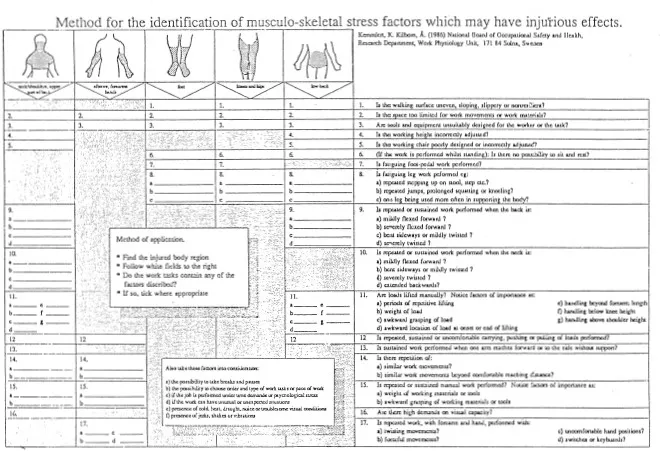
For a study of 200 work places a concentrated checklist was developed (Supplement 1). It is selectively bringing up factors documents to be potential risks for musculoskeletal injuries (Kemmlert and Kilbom, 1987).
The list of poential risk factors for stress on different body regions had been compiLed from reliable scientific documentation (Chaffin and Andersson, 1984, Gamberale et al., 1981, Grandjean, 1988, Hagberg, 1987, Harms-Ringdahl, 1986, Hunting and Grandjean 1980, Kilbom and Persson, 1987, Westgaard and Aarås, 1984, and Winkel, 1982).
Each assessment in the study was summarized using words and phrases collected from relevant parts of the flowchart. A statement could thus be given concerning ergonomic conditions that might lead to disorders.
The observer started his report by briefly establishing if there was a risk for overuse syptoms. This was followed by more specific information, opening with the most serious risks. Individual and other circumstances not mentioned in the form were taken into consideration but also factors such as stress, noise and climate, which are considered to have an additional negative effect on the exposure as well as on the possible outcome in terms of fatigue or pain. Two examples follow:
Street light electrician
The work tasks induce risks of overuse symptoms in the fore-arms and hands, as the work entails repeated twisting and forceful movements, but also unvomfortable postures for fore-arms and hands. The tools are unsuitably designed e.g. with regard to weight and handgrip. The working material is often difficult to handle. The work is sometimes performed under stress which can lead to unusual or unexpected situations. When present, cold can add to the total stress.
Telephone order clerk
The work tasks induce risks for overuse symptoms in the neck and shoulders, as similar movements beyond comfortable reach are repeated. The work place is unsuitably designed and repeated keyboard work is performed when reaching forward with one arm without support. There are high demands on the visual capacity, but the visual conditions are troublesome. The neck is therefore often held severely twisted, and extended backwards for periods. The job is periodically performed under great time demand which can add to the total stress.
Reliability
Summaries from 8 eyperienced observers were analysed to establish the inter-observer reliability. The contents of the reports showed a concordance of 80 % (Kemmlert, 1986), a percentage being acceptable according to Hartmann (1977).Validity
The set of items can be looked upon as valid as it derives from “a theoretical framework of available literature” (Carmines and Zeller, 1979).
The validity in terms of random errors in the measurement procedure was assessed (Kemmlert, 1986). Postural angles of neck and trunk were estimated by 8 observers and, for control of discrepancies, measured by means of a goniometer. As found by other authors (Harris et al., 1985, Keyserling, 1986) there was a lack of consistency among analysts. But the study also showed random discrepancies between the estimations made by observers and the registrations performed by means of a goniometer.
As a result of the inability among analysts to define boundaries between adjacent postures, the checklist classification of different neck and trunk postures was expressed by wording such as “mildly flexed”, “severely flexed” etc., wording that is regarded as comprehensible enough for establishing levels of hazards, thus forming starting points for discussions about preventive strategies.
DISCUSSION
For the purpose of work place assessments, and as starting points for corrective activities at an actual workplace, a checklist showing ergonomic hazards could probably be a sufficient tool. Taking into account the weakness of the mentioned validity tests and the inconsistency among authors in indicating the measuring points for estimation of neck and trunk postures, it seems honest not to specify numerals for postural angles in the summarizing reports. Accordingly no illusion of exactness is given.
It seems important to bring up for discussion the value of detailed and time-consuming recordings of posture and movements, considering the difficulty of getting reliable registrations. The choice of different observation methods for different purposes also needs to be established.
The method presented above has proved to be an efficient tool for assessments of ergonomic hazards, and the summarizing reports designed for personnel responsible for health and safety at a plant or firm were easy to write.
It is assumed that a similar structure of reports from different observers in a health team would result in more convincing messages. Reports containing a clear risk evaluation, supplemented by details, would probably be well received. Furthermore the repetition of defined risks for overuse symptoms in several reports would certainly have an educative effect in ergonomic matters.
REFERENCES
Bergqvist U. 0. V., 1984, Videodisplay terminals and health. Scandinavian Journal of Work, Environment and Health, suppl 2, 10; 59–62.
Carmines E. G. and Zeller R. A., 1979, In: Quantitative Applications in the Social Sciences, Sage University Paper.
Chaffin D. B. and Andersson G., 1984, Occupational Biomechanics. John Wiley and Sons.
Gamberale F., et al., 1981, Människans tolerans för lyftoch bärarbete.(Summary in English). Arbete och Hälsa 1981:16
Grandjean E., 1988, Fitting the task to the man. (4th edition). Taylor & Francis, London.
Hagberg M., 1984, Occupational musculoskeletal stress and disorders of the neck and shoulder: a review of possible pathophysiology. International Archives of Occupational and Environmental Health, 53; 269–278.
Hagberg M., 1987, Occupational Shoulder and Neck Disorders. The Swedish Work Environment Fund, Stockholm.
Hagberg M. and Wegman D. H., 1987, Prevalence rates and odds ratios of shoulder-neck diseases in different occupational groups. British Journal of Industrial Medicine, 44; 602–610.
Harris S. R. et al., 1985, Goniometric Reliability for a Child with spastic Quadriplegia. Journal of Pediatric Orthopedics, 5, 3, 348–351.
Harms-Ringdahl K., 1986, On assessment of shoulder exercise and load-elicited pain in the cervical spine. Dissertation, Karolinska Institutet, Solna, Sweden.
Hartmann D. P., 1977, Considerations in the choice of inter-observer reliability estimates. Journal of Applied Behaviour analysis, 10; 103–116.
Hunting W. and Grandjean E., 1980, Constrained postures in accounting machine operators. Applied Ergonomics, 11; 145–149.
Jonsson B., 1982, Measurement and evaluation of local muscular strain in the shoulder during constrained work. Journal of Human Ergology, 11; 73–88.
Kemmlert K., 1986, Reliabilitetstest av plan for identifiering av belastningsfaktorer som kan innebara skadlig inverkan, Karolinska Institutet, Institutionen för fysikalisk medicin, Solna, Sweden.
Kemmlert K. and Kilbom A., 1987, Method for identification of musculoskeletal stress factors which may have injurious effects. XIth World Congress on the prevention of occupational accidents and diseases, Stockholm.
Kemmlert K. and Kilbom A., 1988, Besvar i nacke/skudra och samband med arbetssituation (Summary in English). Arbete och Hälsa, 1988:17.
Keyserling W. M., 1986, Postural analysis of the trunk and shoulders in simulated real time. Ergonomics, 29, 4, 569–583.
Kilbom Å. et al., 1986, Observationsmetoder for registrering av belastningar på rörelseapparaten (Summary in English). Arbete och Hälsa, 1986:21.
Kilbom Å. and Persson J., 1987, Work technique and its consequences for musculoskeletal disorders. Ergonomics, 30; 273–279.
Wallace M. and Buckle P., 1987, Ergonomic Aspects of Neck and Upper Limb Disorders. International Reviews of Ergonoigics, 1; 173–200.
Westgaard R. H. and AArås A., 1984, Postural muscle strain as a causal factor in the development of musculoskeletal illness. Applied Ergonomics, 15.3, 162–174.
Winkel J., 1982, En ergonomisk utvärdering av fotbesvär bland serveringspersonal (Summary in English). Högskolan i Luleå. TULEA, 26.
EPIDEMIOLOGICAL ANALYSIS OF WORKLOAD DATA USING ERGONOMIC DATA BASES
R. Brauchler and K. Landau
University of Hohenheim
Federal Republic of Germany
INTRODUCTION
Problem analysis
The method of c...
Table of contents
- Cover
- Half Title
- Title Page
- Copyright Page
- Table of Contents
- Session I: :Comparison of Job Analysis Methods
- Session II: :Psychological Job Analysis Methods
- Session III: Practical Applications of Psychological Job Analysis Methods
- Session IV: Job Analysis, Occupational Health and Safety
- Session V: Job Analysis and Physiological Aspects
- Session VI: Job Analysis and Technological Change
- Session VII: Examples for Analysis in Job Design
Frequently asked questions
Yes, you can cancel anytime from the Subscription tab in your account settings on the Perlego website. Your subscription will stay active until the end of your current billing period. Learn how to cancel your subscription
No, books cannot be downloaded as external files, such as PDFs, for use outside of Perlego. However, you can download books within the Perlego app for offline reading on mobile or tablet. Learn how to download books offline
Perlego offers two plans: Essential and Complete
- Essential is ideal for learners and professionals who enjoy exploring a wide range of subjects. Access the Essential Library with 800,000+ trusted titles and best-sellers across business, personal growth, and the humanities. Includes unlimited reading time and Standard Read Aloud voice.
- Complete: Perfect for advanced learners and researchers needing full, unrestricted access. Unlock 1.5M+ books across hundreds of subjects, including academic and specialized titles. The Complete Plan also includes advanced features like Premium Read Aloud and Research Assistant.
We are an online textbook subscription service, where you can get access to an entire online library for less than the price of a single book per month. With over 1.5 million books across 990+ topics, we’ve got you covered! Learn about our mission
Look out for the read-aloud symbol on your next book to see if you can listen to it. The read-aloud tool reads text aloud for you, highlighting the text as it is being read. You can pause it, speed it up and slow it down. Learn more about Read Aloud
Yes! You can use the Perlego app on both iOS and Android devices to read anytime, anywhere — even offline. Perfect for commutes or when you’re on the go.
Please note we cannot support devices running on iOS 13 and Android 7 or earlier. Learn more about using the app
Please note we cannot support devices running on iOS 13 and Android 7 or earlier. Learn more about using the app
Yes, you can access Recent Developments in Job Analysis by Kurt Landau,Walter Rohmert in PDF and/or ePUB format, as well as other popular books in Business & Business General. We have over 1.5 million books available in our catalogue for you to explore.