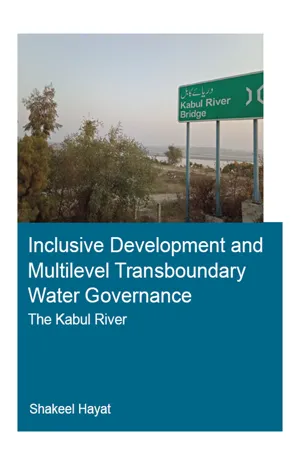
The four decades long ideological-based insurgencies and conflict in the Kabul River Basin (KRB) have seriously hampered the relations and foreign policies of both Afghanistan and Pakistan. Consequently, it restricts them to solve various bilateral issues including transboundary waters. This lack of cooperation over shared water resources is one of the barriers to achieve inclusive and sustainable development. Additionally, it has contributed to the prevailing anarchic situation where each country does what it wants. The absence of a formal water-sharing mechanism coupled with poor water management practices within both the riparian counties are resulting various flow and administration-related challenges. Moreover, these challenges are further exacerbated by regional changes in social, political, environmental and economic systems. The scholarly literature suggests that an analytical transboundary water governance framework is essential to address the challenges of water politicisation and securitisation, quality degradation and quantity reduction. Additionally, the literature rarely integrates (a) a multi-level approach, (b) an institutional approach (c) an inclusive development approach, or (d) accounts for the uses of different types of water and their varied ecosystem services for improved transboundary water governance. To enhance human wellbeing and achieve inclusive and sustainable development in the KRB this research indicates that it is essential to: (1) defrost frozen collaboration; (2) bypass border dispute; (3) use biodiversity and ecosystem services approach; (4) address existing and potential natural and anthropogenic challenges; (5) remove contradictions in the policy environment; (6) combat resource limits and dependence by promoting collaboration on long-term cost effective solutions; and (7) enhance knowledge and dialogue on inclusive development.
Trusted by 375,005 students
Access to over 1.5 million titles for a fair monthly price.
This thesis aims to understand how transboundary water governance can be improved with special reference to the Kabul River between Afghanistan and Pakistan. In this chapter, the problem definition will first be discussed including the real-life problem (see 1.2) as well as the gaps in the scientific literature (see 1.3). The real-life problem takes into account the flow and administrationrelated issues in transboundary river basins. It explains the consequences of reduction in freshwater flow or degradation of freshwater quality in Transboundary Rivers. The literature review has provided insights into various relevant approaches such as power, institutions, multilevel governance and inclusive development as well as its implication for this thesis. The gaps in knowledge have highlighted the areas that need further research leading to the main research question and sub-questions (see 1.4) with special reference to the Kabul River. Third, the focus and limits (see 1.5) of the research are discussed. Fourth, section 1.6 presents the structure of the thesis.
1.2 REAL LIFE ISSUES
Currently about 276 transboundary river basins (Barraqué 2011a; Bakker and Duncan 2017) support the production of approximately 60% of global food (Sadeqinazhad et al. 2018), supply domestic water needs of approximately 40% (Munia et al. 2016) and accommodate more than 70% of the global population (Earle and Neal 2017). With the increase in population rate, fast urbanization and commercial agriculture practices the pressure over transboundary water resources will surge which may ultimately influence both the quality and quantity of freshwater (Cosgrove and Loucks 2015a; Munia et al. 2016). These issues may lead to different intensities of conflicts among states and societies (Kasymov 2011; Munia et al. 2016). Overall, water issues can be differentiated in terms of: (1) flow-related i.e., issues of water quality (see 1.2.1), quantity (see 1.2.2) and climate change (see 1.2.3); and (2) administration-related i.e., issues of power, jurisdiction, coordination, principles and instruments at multiple levels of governance. In the sub-sections below, I explain these challenges in detail.
1.2.1 Water Quality Issues
Water is an essential resource provided by nature which is used in our lives for drinking, cleaning, bathing and other developmental purposes (Bibi et al. 2016). Clean and safe drinking water is vital for human health worldwide. However, as a universal solvent, freshwater can also transmit infections (WHO/UNICEF 2015). According to a report (WHO/UNICEF 2015), water quality in several developing countries does not meet the WHO quality standards, and this poor water quality is responsible for 80% of diseases. Furthermore, unhygienic and poor quality of water is also responsible for more than three percent of deaths (Pawari and Gawande 2015).
The release of domestic, industrial and radioactive waste, dumping of waste directly into rivers, and leakage from water tanks are some of the most important causes of water pollution (Islam and Tanaka 2004; Halder and Islam 2015). Discarded heavy metals and industrial waste in lakes, streams and rivers have proven to be harmful to humans and animals (Halder and Islam 2015). Harmful industrial and domestic waste are the key elements that contribute to causes severe poisoning, reproductive failure, and immune-suppression (Islam and Tanaka 2004). Transferrable diseases like typhoid and cholera as well as other diseases like diarrhoea, gastroenteritis, skin and kidney problems are mainly due to polluted water (Khan et al. 2013). Additionally plants and animals are also affected by poor water quality which can, in turn, affect human health (Haseena et al. 2017). Water pollutants can kill seaweeds, mollusks, seabirds, fish, crustaceans and other marine organisms that are the main sources of human food (Owa 2014). The excessive and increasing use of pesticides (e.g DDT) in agriculture is harmful for human health (ibid).
Table 1.1 shows the impacts of contaminated water on human health and the environment (see also Hunter et al. 2010). Water-borne diseases are transmitting from human to human (Halder and Islam 2015) carried by pathogens (Ashbolt 2004) that exist in specific regions or are common around the globe (Kamble 2014). Extreme weather conditions leads to heavy rainfall and floods in both underdeveloped and developed countries (McMichael, Woodruff, and Hales 2006). Contaminated water is being used in some developing countries to grow vegetables and other food items which is consumed by 10% of the global population (Corcoran 2010). Using contaminated water can lead to various chronic diseases including respiratory, cardiovascular, cancer, diarrhoea, and neurological (Ullah et al. 2014). Furthermore, Nitrogen-containing chemicals in water is one of the main reason for blue baby syndrome and cancer (Krishnan and Indu 2006). Mortality rates due to cancer is comparatively higher in rural areas than in urban areas because inhabitants of rural areas have less access to treated water (Angoua et al. 2018). Poor people face an increased risk of illness due to lack of access to improved sanitation, hygiene and supply of clean drinking water (Jabeen et al. 2011). Pregnant women are particularly vulnerable to negative impacts of contaminated water (Collier 2007).
Various factors such as dissolved oxygen, nutrients, turbidity, and water temperature contribute towards the growth of animals and plants (Kamal et al. 2007). Additionally, the chemical oxygen demand (COD) and the biological oxygen demand (BOD) specify the pollution level of a given water body (Shrestha and Kazama 2007). Each element has a specific and important role to play in the aquatic ecosystem. These ecosystems have a significant impact on the fisheries which are the main source of food for thousands of people living in coastal areas. Surface freshwater resources have a distinct role in keeping the environmental balance in the estuaries and at the mouth of the rivers (Postel and Richter 2012). Monitoring of surface water resources is essential for flood forecasting and aquatic resource management (Jacobs 2002). Contaminated water not only affect the quality of crops but also harmful for aquatic life (Khan and Ghouri 2011). The above water quality issues can affect relations between upstream and downstream countries.
Table 1.1: Risks to human health & the environment due to poor water quality
Wastewater Constituents
Parameters
Risks
Solids Dissolved inorganic substances
TSS, TDS, VSS, EC, Na, Ca, Mg, Cl, and B
Increasing soil osmotic pressure, blockage of irrigation system and increase of sludge deposits for salinity, Phytotoxicity and soil absorptivity and configuration
Other organic materials Biodegradable organic Materials Nutrients
Detergents, phenols, fat, oil, grease, pesticides, solvents, and cyanide, BOD, COD, N, P, ammonium
Poisonous effects, visual problems, grease, pesticides, solvents, bioaccumulation in the food chain, degradation in dissolved oxygen in receiving water body, decrease in fish production and increase in fish mortality, lack of oxygen, toxic effects.
Metals
Hg, Pb, Cd, Cr, Cu, Ni
Poisonous effect, bio-accumulation, can make wastewater inappropriate for irrigation, conceivable health effects
Hydrogen ion concentrations Microorganisms
Pathogenic bacteria, pH, virus and worm eggs
Possible adverse impact on plant growth due to acidity or alkalinity, cause diseases
Source: Jabeen et al. 2011; M. Khan and Ghouri 2011; Juneja and Chaudhary 2013; S. Khan et al. 2013; Owa 2014; WHO/UNICEF 2015; Pawari and Gawande 2015; Halder and Islam 2015; Bibi et al. 2016; Haseena et al. 2017
1.2.2 Impacts of Water Variability on Society & the Environment
Flow variability includes flooding as the result of higher glacial and/or snow melt rates and higher rainfall; droughts as the result of reduced contribution from glacial and/or snow melt and rainfall, low rainfall and high evaporation. Such variability can have significant consequences on social and environmental systems.
Flooding impacts include the destruction of crops, deterioration of health conditions due to waterborne diseases, loss of livestock and human lives, and damage to property (Armah et al. 2010). Additionally, communication and some economic activities can be disturbed, and people may be forcefully displaced (Corvalan et al. 2005). Floods can have long term psychological impacts on victims and their families (Doris et al. 2018). The loss of family members has a major impact on children. Forced displacements of human populations, loss of assets and disruption of social affairs and business due to floods can add to ongoing trauma (Cardoso et al. 2008). Floods in agricultural regions can damage crops and may also lead to the loss of livestock (Onifade et al. 2014). Increasing salinity in the soil, damage to the crops due to rain, and delays in harvesting are worsened by transportation problems due to flooded roads and impaired infrastructure (ibid). This may lead to reduced production in the agricultural sector and higher prices of food items due to supply shortages (Armah et al. 2010). However, on the other hand floods can have some long-term benefits for the agricultural sector in the arid and semi-arid zones as it may recharge underground aquifers. They also enhance soil fertility due to mineral and silt deposition in the soil (Dokhani and Ramezani 2017). A much larger portion of the population is affected when floods damage the roads, railways tracks and shipping ports. These damages can have a significant impacts on the GDP of both developed and developing economies (Cardoso et al. 2008).
The social impacts of low rainfall and droughts include public well-being, health, disputes among water users, concentrated value of life and disparities in the dissemination of impacts, and disaster relief. Many of the economic and environmental impacts also have social components. For instance, population migration to areas where there are better food and water supplies puts pressure on those areas (Cosgrove and Loucks 2015b). Migration usually occurs to urban areas within the stressed area or to areas outside of drought zones. Migration can even be international to neighbouring countries (Selby et al. 2017). Migrants rarely go back to their homes even after the drought passes which results in lack of valuable human resources in rural areas. Drought migrants put enormous stress on the cities’ social infrastructure, leading to an social disorder and rise in poverty level (Wilhite et al. 2007). These impacts of water variability affect relations between transboundary countries.
Environmental Impacts of Flow Variability
Floods play a distinct role in sustaining key functions of the ecosystem and biodiversity in various natural systems (Schindler et al., 2016). They connect the river with the surrounding land, rechaarge the groundwater aquifers, fill the lakes and streams with freshwater and strengthen connection between the water habitats. Flooding is one of the main sources for sediment and nutrients transport into the sea and around the landscape (Onifade et al. 2014). Floods enable reproduction, migration and dispersal for many species (ibid). Natural systems such as mangroves provides adequate resistance to the effects of all kinds of floods except the largest (Liao 2012; Onifade et al. 2014). Increase in fish production, replenishing groundwater resources and preserving the recreational environment are some of the environmental benefits of flooding (Cosgrove and Loucks 2015a; Onifade et al. 2014). Floods can further degrade ecosystems (Holman et al. 2003) by transporting sediments and nutrients, increasing soil erosion, disturbing vegetation surrounding the rivers, enrichment of channel size, dams, and floodplains (Pressey and Middleton 2009).
Similarly, low rainfall and drought have various environmental impacts including damage to plant and animal species, habitats of wildlife, degradation of air and water quality, forest loss and forest fires, degraded landscape quality, biodiversity loss and soil erosion (Acevedo-Whitehouse and Duffus 2009; Wilhite et al. 2007). Some of the impacts of drought are short-term where conditions are normalised soon after the drought while some persist for long-term and may even become permanent (Meir et al. 2018). For example, due to the degradation of lakes, wetlands, and vegetation some of the wildlife can be affected where some species recover soon from the temporary deviation while some takes longer. Deteriorating landscape quality such as increased soil erosion can lead to an enduring loss of biological productivity (see Table 1.2). Increasing understanding of the social and ecological damages of climate change can exacerbate tensions between riparian states.
Tabl...
Table of contents
Cover
Half Title
Promotiecommissie:
Title Page
Copyright Page
Dedication
Acknowledgments
Summary
Samenvatting
List of Acronyms
Table of Contents
List of Figures
List of Tables
1 Introduction
2 Methodology and Analytical Framework
3 Approaches to Transboundary Water Governance
4 Ecosystem Services and Human Well-Being
5 Global Water Institutions and its Relationship with Inclusive and Sustainable Development
6 Analysis of International Relations in the Kabul River Basin (KRB)
7 Analysis of Water Governance in Afghanistan
8 Analysis of Multilevel Freshwater Governance in Pakistan
9 Multi-Level Integrated Analysis Focusing on Issues for Re-Design
10 Conclusion
11 References
Frequently asked questions
Yes, you can cancel anytime from the Subscription tab in your account settings on the Perlego website. Your subscription will stay active until the end of your current billing period. Learn how to cancel your subscription
No, books cannot be downloaded as external files, such as PDFs, for use outside of Perlego. However, you can download books within the Perlego app for offline reading on mobile or tablet. Learn how to download books offline
Perlego offers two plans: Essential and Complete
Essential is ideal for learners and professionals who enjoy exploring a wide range of subjects. Access the Essential Library with 800,000+ trusted titles and best-sellers across business, personal growth, and the humanities. Includes unlimited reading time and Standard Read Aloud voice.
Complete: Perfect for advanced learners and researchers needing full, unrestricted access. Unlock 1.5M+ books across hundreds of subjects, including academic and specialized titles. The Complete Plan also includes advanced features like Premium Read Aloud and Research Assistant.
Both plans are available with monthly, semester, or annual billing cycles.
We are an online textbook subscription service, where you can get access to an entire online library for less than the price of a single book per month. With over 1.5 million books across 990+ topics, we’ve got you covered! Learn about our mission
Look out for the read-aloud symbol on your next book to see if you can listen to it. The read-aloud tool reads text aloud for you, highlighting the text as it is being read. You can pause it, speed it up and slow it down. Learn more about Read Aloud
Yes! You can use the Perlego app on both iOS and Android devices to read anytime, anywhere — even offline. Perfect for commutes or when you’re on the go. Please note we cannot support devices running on iOS 13 and Android 7 or earlier. Learn more about using the app
Yes, you can access Inclusive Development and Multilevel Transboundary Water Governance - The Kabul River by Shakeel Hayat in PDF and/or ePUB format, as well as other popular books in Biological Sciences & Environmental Science. We have over 1.5 million books available in our catalogue for you to explore.