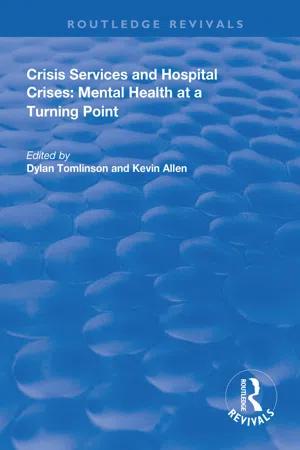
First published in 1999. This text examines the impasse in the development of alternatives to hospitals, drawing on the experience of both crisis service users and providers, and evidence of the effectiveness of such services. The book concludes that crisis services are preferred by users, are usually more cost effective and often more clinically effective than acute admissions wards. It offers a number of policy suggestions to advance the role of crisis services, including monitoring, evaluation and development centres, or programmes being established on a national basis, and joint training between crisis service and hospitals.
eBook - ePub
Crisis Services and Hospital Crises
Mental Health at a Turning Point
- 180 pages
- English
- ePUB (mobile friendly)
- Available on iOS & Android
eBook - ePub
About this book
Trusted by 375,005 students
Access to over 1.5 million titles for a fair monthly price.
Study more efficiently using our study tools.
Information
Subtopic
SociologyIndex
Social Sciences1 What are Crisis Services?
Kevin Allen
Although mental health ‘crisis services’ have become established at several sites in the United Kingdom over recent years, much of the literature that is available on these services describes a widely differing range of responses to the kinds of mental health crises that people experience. This is partly due to the fact that there has been little consensus on what is actually meant by the term ‘crisis’ and how such crises that individuals experience might be best resolved.
At the beginning of this book it is therefore appropriate to examine something of what has been said about ‘crisis’ and to briefly review the various kinds of intervention services that are currently in operation. There are two reasons for doing this: firstly, to begin to draw together what scattered literature is available; secondly, to enable those who are not already directly involved in this area, but who have an interest in mental health, to begin to make distinctions between those kinds of provision that are currently provided under the umbrella of ‘crisis services’ and those that tend to fall within the remit of generic psychiatric services.
Although the notion of ‘crisis’ has been present in discourse on mental health for more than three decades it was not until recently that forms of mental health provision that were based on ‘crisis theory’, began to be made available on a wider scale in the UK. As Wallcraft (1997) has noted ‘crisis’ is not a term that is used very much in biomedical psychiatry. The very presence of the term ‘crisis’ therefore gives rise to several important questions that we must address before we can begin to speak about crisis service provision, for example, in terms of its value or its ‘effectiveness’. We might therefore begin by reviewing what we mean by ‘crisis’. Where has this notion of ‘crisis’, as opposed to the terms ‘nervous breakdown’ or ‘mental illness’, come from? When did it appear in discourse on mental health, and why? What has been said about it and by whom? If not from within psychiatry, then what circumstances allowed it to emerge in discourse on mental health at the particular time that it did, and at no other time before?
It is also particularly important to consider what is said by the users of the mental health services about what, in their view, constitutes a ‘crisis’. It is important to do so because the implication of the use of different forms of terminology within a disciplinary area suggests a divergence in meaning and interpretation. Such differences in interpretation have wider implications for discursive practices, the ways in which mental health is perceived and regarded, the ways in which it is addressed and by whom and the ways in which it is talked about, written about, and acted upon in terms of choices made in treatment. In particular, the significance of the inclusion of service users in a disciplinary area that has, for two centuries, been dominated by a medical model raises questions about the authority of the models of mental health it proposes (Wallcraft, 1996) and about the changing status of mental health in society.
What is a ‘Crisis’?
The word ‘crisis’ has now come to be the preferred term that is chosen by present service users and by some providers, and also by those who call themselves ‘survivors’ of psychiatric services, to describe what was previously known as a ‘breakdown’ or ‘mental illness’. The literal term itself is derived from the Greek which means ‘decision’. However, it also has other more symbolic meanings according to the different traditions of language and culture. While the Latin meaning of the term is dividing-line, in Chinese the word is represented by two symbols one of which means danger and the other opportunity (Liverpool City Council, 1995). For many service providers and users the term has also come to be used in the context of its Chinese meaning to refer to a ‘turning point’. In this way, rather than viewing a ‘crisis’ within the negative contextual view of a disordered state with no meaning mental health service users and service providers are able to contextualise crisis experiences in what is considered to be a positive, meaningful and therefore helpful way.
Thus, while the one usage of the term in mental health would suggest a danger of crossing the divide to maladaptive, mentally ‘sick’ ways of behaving, the other usage of the term is taken to suggest that the event of a crisis presents an opportunity for personal growth (Waldron, 1989). The event of crisis may therefore represent ‘a point of transition, a point at which all the previous assumptions about one’s life may be open to question and radical changes, maybe for the better’ (Wallcraft, 1996, p. 190).
Gerald Caplan was one of the first writers to develop a ‘crisis approach’ to mental health. His work provided not only a model of mental health but also a design of specific responses to ‘crisis’. Caplan considered crisis to be an individual response to a set of circumstances and introduced the notion that a specific event or series of events trigger processes that can culminate in an unhealthy response. Crisis is ‘an upset in the emotional steady state which occurs when a problem is encountered which is insurmountable by customary problem solving’ (Caplan, 1964). Caplan divided crisis into three stages:
- a rise in tension as the individual becomes aware of an unresolved problem;
- the individual’s resources become exhausted. The individual attempts to seek help from others such as friends, family or professionals; and
- the crisis results in either a healthy or an unhealthy response.
He suggested that if there could be a timely intervention in stage 2 of this process the resolution of crisis would stand a greater of chance of being healthy. The key element in Caplan’s notion of a crisis service then was one of the speed of response.
Baldwin (1978) provided a pyramid model based on six levels of emotional crisis each of which demanded a different kind of response. The top layer consists of those forms of response that are considered to be a psychiatric emergency. These forms of crisis are experienced by relatively few people but typically require a highly professionalised response. Life crises, such as bereavement or traumatic stress, which appear much lower down the pyramid, are experienced by a greater number of people, but demand an increasingly less professionalised form of intervention than those forms of crisis that are higher up the pyramid.
In practice however, one individual’s reactions or stress responses to a given set of circumstances, say bereavement, will be different from the responses of another; no two individuals are alike in their response. This observation suggests that such a clear cut set of divisions that Baldwin attempted would serve only to provide a convenient nosology into which we might conveniently identify objective factors and particular symptoms. Crisis is more of an individual matter than can be objectified in psychiatric discourse. What is clear from these two models of crisis is that if a crisis service is to be effective it must not only be able to respond rapidly but that it must also be able to respond appropriately according to the needs of the individual.
When is a ‘Crisis’ an Emergency?
In order to differentiate between a ‘crisis’ and what constitutes a psychiatric emergency (see Liverpool City Council, 1995) several writers have attempted to provide an operational definition of both. Thus for Dixon (1982, p. 27), a crisis is:
a time-limited break in a person’s capacity to cope with stimuli that have temporarily exhausted all of a person’s problem-solving strategies ...
whereas an emergency refers to:
external situations requiring immediate action to prevent dire consequences.
Jacobs (1983, p. 172) defines a crisis as:
a turning point that precludes the possibility of life going on as usual ...
whereas an emergency is:
an urgent situation that can occur repeatedly, requiring immediate action without necessarily bringing about a change in the person’s life.
According to Brimblecombe (1993, p. 40) a crisis may be defined as a situation in which there is:
an internal disturbance resulting from a stressful event or a perceived threat to self, [that] arises when an individual’s usual coping mechanisms are ineffective in dealing with a threat.
This definition of crisis may be usefully contrasted with St Clair’s (1995, p. 3) definition of an emergency as:
a full psychotic episode requiring hospitalisation and intense drug therapy to reduce the danger to the individual and others.
Puryear (1980) attempts to clarify the difference by providing the following illustration. An individual enters a hospital brandishing a firearm and demands to be admitted to the psychiatric ward. Since this person clearly poses ‘dire consequences for the staff the situation is recognisable as an emergency. On the other hand, since the staff may well have been unclear as to how they should respond individually to the situation they might themselves be considered to be in a state of crisis individually.
Here it can be seen that while the term ‘crisis’ may be used to refer to a range of problems that might be loosely referred to as a ‘breakdown’, in practice its meaning and usage is very much dependent on the position of speaker. The example also further illustrates the point that what is a crisis to one individual may not appear as a crisis to another individual faced with the same set of circumstances.
Crisis is therefore a highly individualised response to a given set of circumstances. Due to the very nature of its individuality crisis will manifest itself as different levels of distress for different people. Given those two factors, the way a service responds is an important consideration.
The Emergence of Crisis Services
Until comparatively recently, when psychiatrists were ‘faced with a crisis, an emergency oran uncertainty, [they] simply admitted the patient’ (Ratna, 1996, p. 14). However, with the growing criticisms of established psychiatric services, the cost-orientated de-institutionalisation of mental health and the subsequent mass closures, on an international scale, of psychiatric hospitals, the demand grew for alternatives to hospital for people in ‘crisis’.
What prompted the emergence of crisis services was the idea that care in the community was a more desirable approach to dealing with mental health than hospitalisation. The move toward a community care approach was brought about by a wide range of factors. The theoretical basis for the emergence of crisis services was provided by the model of crisis pioneered in USA by Gerald Caplan (1964), whose work I have already mentioned above. Rather than attacking the kinds of treatment that had already been developed in mainstream psychiatry Caplan introduced an approach that complemented traditional mental health practices by emphasising the role of preventative measures. Caplan’s theories were not about treatment of psychiatric illness but about how to prevent the occurrence of such illness in the first instance. Wallcraft notes that in this way he was able to gain ‘a respectable niche for crisis theory within psychiatry’. The presence of such respectability subsequently allowed finance to be made available for projects that were focused on the theory of crisis intervention and some experimental residential crisis services (Wallcraft, 1996, p. 190).
The new models of mental illness provided by Gerald Caplan in the USA together with the contributions made by Baldwin and by Goffman (1961) and Laing (1967) disputed the value of asylum and challenged the authority of the medicalised model of institutional care. The wider provision of out-patient services fostered by the post-Second World War welfare state also coincided with the advent of treatment drugs that made it possible for those needing attention to be able to cope outside the institutional environment (Busfield, 1986). As the closure of psychiatric hospitals increased in pace in the UK, and psychiatrists continued to argue for medicalised provision, there were repeated calls from ‘survivors’ of the psychiatric services for non-medicalised forms of asylum and crisis care (Pfluger et al., 1993), and from others outside psychiatry ‘GPs, patients, carers and administrators’ (Ratna, 1996, p. 14).
The Form of Crisis Service Provision
What is not clear from any of the theoretical models however, are the specific details of what is needed and the form in which crisis provision should be established. The mental health charity MIND set about addressing these issues in consultation with its local associations and MINDLINK, it’s user network.
Following discussion at a MIND conference it was decided that a crisis service should be flexible, do no harm and be as effective as possible. It should offer anonymity, autonomy, including choice of treatment, provide opportunities to talk through underlying causes of distress, and take a holistic approach. It should safeguard resources from psychiatric hospitals for mental health services. A crisis service should be able to help people with their problems when they arise, offer safety, including safety from abuse for women and black people, and respect the support users give each other. Provision should be established in a familiar and emotionally safe environment and should ensure that people can withdraw from the service gradually and be linked into longer term support where desired.
Cobb (1995, p. 23) noted that what users wanted was
contact with people who would listen to them, not be judgmental, believe what they said and understand. People wanted confidentiality, support for withdrawal from medication, and choice. Twenty four hour access was important, as was support from other users – and payment for them. Lack of support with childcare, for example, can mean that parents in mental distress, especially mothers, struggle on until they cannot continue and are then separated from their children by hospital admission.
MIND’s 1995 research in Bradford, conducted in consultation with users, carers and workers, indicated that the most urgent need was the provision of 24-hour phonelines, a crisis house and a befriending scheme.
Elsewhere, Lothian Health Authority was keen to develop a response that was based on the needs of users rather than fitting a new service into any one theoretical model. They wished to adopt ‘a wide definition of crisis based on the experience of the individual’ (St Clair, 1995, p. 15). Crisis was subsequently defined as ‘a social or medi...
Table of contents
- Cover
- Half Title
- Title Page
- Copyright Page
- Table of Contents
- Contributors
- List of Figures and Tables
- 1 What are Crisis Services?
- 2 Crisis Intervention Theory and Method
- 3 Care, Control and Evidence in British Mental Health Policy: The Context for Crisis Services
- 4 The Wokingham MIND Crisis House
- 5 The Liverpool Mental Health Crisis Service and Its Effectiveness
- 6 West Birmingham Home Treatment Service: ‘Right at Home’
- 7 The Effectiveness of Crisis Services
- 8 Community Psychiatric Nursing’s Role in Managing Crises
- 9 Crisis Mental Health Nursing: Developments in Accident and Emergency Departments
- 10 Exemplary Crisis Services in Europe and the USA
- 11 Progress and Prospects for Crisis Services
- Index
Frequently asked questions
Yes, you can cancel anytime from the Subscription tab in your account settings on the Perlego website. Your subscription will stay active until the end of your current billing period. Learn how to cancel your subscription
No, books cannot be downloaded as external files, such as PDFs, for use outside of Perlego. However, you can download books within the Perlego app for offline reading on mobile or tablet. Learn how to download books offline
We are an online textbook subscription service, where you can get access to an entire online library for less than the price of a single book per month. With over 1.5 million books across 990+ topics, we’ve got you covered! Learn about our mission
Look out for the read-aloud symbol on your next book to see if you can listen to it. The read-aloud tool reads text aloud for you, highlighting the text as it is being read. You can pause it, speed it up and slow it down. Learn more about Read Aloud
Yes! You can use the Perlego app on both iOS and Android devices to read anytime, anywhere — even offline. Perfect for commutes or when you’re on the go.
Please note we cannot support devices running on iOS 13 and Android 7 or earlier. Learn more about using the app
Please note we cannot support devices running on iOS 13 and Android 7 or earlier. Learn more about using the app
Yes, you can access Crisis Services and Hospital Crises by Dylan Tomlinson,Kevin Allen in PDF and/or ePUB format, as well as other popular books in Social Sciences & Sociology. We have over 1.5 million books available in our catalogue for you to explore.