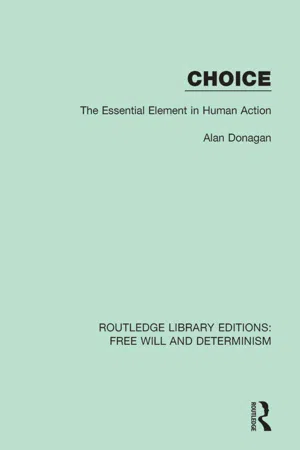
This book, first published in 1987, investigates what distinguishes the part of human behaviour that is action (praxis) from the part that is not. The distinction was clearly drawn by Socrates, and developed by Aristotle and the medievals, but key elements of their work became obscured in modern philosophy, and were not fully recovered when, under Wittgenstein's influence, the theory of action was revived in analytical philosophy. This study aims to recover those elements, and to analyse them in terms of a defensible semantics on Fregean lines. Among its conclusions: that actions are bodily or mental events that are causally explained by their doers' propositional attitudes, especially by their choices or fully specific intentions; that choice cannot be reduced to desire and belief, and hence that the traditional concept of will as intellectual appetite must be revived.
- 210 pages
- English
- ePUB (mobile friendly)
- Available on iOS & Android
eBook - ePub
About this book
Information
CHAPTER 1

RATIONAL ANIMALS AND THEIR ACTIONS
A. The Socratic tradition in the theory of human action
The philosophical theory of human action begins with Plato. In a passage in the Phaedo he presents Socrates as making fun of Anaxagoras for announcing that he would explain the structure of the universe as ordered by mind for the best, and then producing a physical theory of it.
It seemed to me [he makes Socrates say] … very much as if one should say that Socrates does with intelligence whatever he does, and then, in trying to give the causes (aitias) of the particular thing I do, should say first that I am now sitting here because my body is composed of bones and sinews …; and so, as the bones are hung loose in their ligaments, the sinews, by relaxing and contracting, make me able to bend my limbs now, and that is the cause of my sitting here with my legs bent. Or as if in the same way he should give voice and air and hearing and countless other things of the sort as causes (aitias) for our talking with each other, and should fail to mention the real causes (alethos aitias), which are, that the Athenians decided it was best to condemn me, and therefore I have decided that it was best for me to sit here, and that it is right for me to stay and undergo whatever penalty they order. For, by the dog, I fancy these bones and sinews of mine would have been in Megara or Boeotia long ago, carried thither by an opinion (doxes) of what is best, if I did not think it was better and nobler to endure any penalty the city may inflict rather than to escape and run away. But it is most absurd to call things of that sort causes (aitia). If anyone were to say that I could not have done what I thought proper if I had not bones and sinews and other things that I have, he would be right. But to say that those things are the cause of my doing what I do, and that I act with intelligence but not from the choice of what is best (tou beltistou hairesei), would be an extremely careless way of talking (98c–99a).
Two things Socrates says in this passage are pregnant. The first, which is partly implicit, is that tracing the physical chain of causation from his sitting in prison to relaxings and contractings of his sinews, and those to some other happenings in his body (as modern neurophysiology would to certain neuronal discharges in his cerebral cortex), while useful as far as it goes, does not explain the first link in the chain. And although many neurophysiologists believe that one day complete neurophysiological explanations of human behaviour will be possible, others do not. Socrates would have been an unbeliever. His second pregnant observation was that the cause of his sitting in prison was perfectly well known to all his friends: namely that he had decided that it was better to submit to the punishment to which he had been lawfully if unjustly sentenced than to escape. This explanation, although not physical, is both true and sufficient.
Yet Socrates did not reinstate, even for human actions, the doctrine he ridiculed Anaxagoras for abandoning: that things are to be explained by showing that they are for the best. The cause of his remaining in prison is that he decided that it was best to do so; but deciding that something is so is not the same as its being so, even if you are Socrates. In the Crito, Plato presents Socrates as arguing that his reasons for remaining in prison are good reasons; but his explanation would hold even if they had been bad. His friends, before the discussion reported in the Crito, believed it to be for the best that he escape; and in his position they presumably would have escaped. The falsity of their pre-Crito belief about what would be for the best would not have impaired its power to affect their conduct. At most, Socrates establishes that human actions are explained by showing, not that they are for the best, but that those who do them believe that they are for the best.
Does his conclusion hold only for human beings? Only human beings remain in prison because they believe that it is better to obey the law than to run away; yet many higher animals, rabbits for example, will risk death in order to defend their young, rather than escape to safety. Are we to say that their doings are likewise to be explained by what they believe to be for the best? Plato offered no theory of animal behaviour; but his successor Aristotle did. His development of Socrates’ teaching about the explanation of human action was part of a comprehensive biology; and the structure of that biology, as a classification of the various forms of living things, still largely stands.
According to Aristotle, all beings that are individuals, as distinct from mere parcels of stuff (drops of water, heaps of sand, and the like), are living; and the most primitive living things are plants. A plant is an organized physical object – a body – that normally develops through certain definite stages, namely, those characteristic of its species; and its life is primarily its power to develop through those stages by taking in suitable matter from its surroundings (air, food and drink) and transforming it into the kinds of material of which its body is composed at each stage.
Plants have life-histories. They sink roots, grow, sprout leaves and shed them, bring forth seeds and scatter them, and in the end die. Like plants, animals transform food, grow, reproduce and die; but they are marked off from plants by their powers of sense (even the most primitive animal has the sense of touch); and their life-histories differ from those of plants in consisting in part of responses to what they sense. Moreover, while the responses of the lower animals to what they sense, of shellfish and worms for example, are rigidly fixed, some of those of higher animals show them to be aware of others as possible. As Stephen Clark points out, ‘the macaque who found out how to separate wheat from sand by throwing handfuls of the two combined into the sea’ discerned a possibility different from that of trying to pick the wheat from the sand grain by grain (Clark, 22); and every dog lover has his tales to tell.
Aristotle nevertheless maintains that the complex activities by which the higher animals surprise and intrigue even those who do not love them can all be explained on the hypothesis that they can form images of what they have sensed, and desire to do or not to do some of the things they imagine themselves as doing. Their powers of imagining what they can do vary in effectiveness. A cat, seeing a mouse, may imagine itself both as pouncing on it and as simply watching it. If it desires to pounce more than to watch, it will pounce. Yet if its power to imagine what it can do is defective, it will not land on the mouse as it imagines itself doing; and its subsequent behaviour will betray its frustration. An imaginative capacity that elicits desire in this way was called by the medieval Aristotelians an ‘estimative power’ (Aquinas (1), I, 78, 4; cf. (2), III, lect. 6). That power is found in human animals as well as in nonhuman ones, most notably in great craftsmen, in artists working in physical media, and in athletes; but that some of their activities are exercises of that power is not what is characteristically human about them.
Part of human behaviour, according to Aristotle, cannot be explained in this way. Unlike all or most animal behaviour, it is elicited by intellectual representations, not by sensory or imaginative ones. Intellect is the power to represent possibilities, not in sensory images but in propositions that are true or false. Once a proposition has been thought of, it is possible to take various attitudes towards it: that of accepting it (or its contradictory) as true; that of hoping or fearing that it (or its contradictory) is true, and so forth. Bertrand Russell happily described the attitudes thus taken as ‘propositional attitudes’, and his locution is now common. Propositional attitudes are characteristically referred to by using ‘such words as “believe”, “desire”, “doubt”, all of which, when they occur in a sentence, must be followed by a subordinate sentence telling what it is that is believed or desired or doubted’ (Russell (2), 65; cf. 167 – 9).
In treating both sensation and imagination on one hand, and intellect on the other, as powers or capacities to represent a world of which their possessors are a part, Aristotle differed not only from his great teacher Plato, but also from many later thinkers in all periods. And in treating the propounding of propositions as the sole representative exercise of the intellectual power, so that all attitudes to intellectual representations are to propositions, that is, to representations having one of two semantic values, truth or falsity, Russell and most Aristotelians differ both from those for whom thinking is not representative, and from those for whom representation is not propositional – which includes many who would style themselves rationalists, as well as empiricists in the tradition of Locke.
One of the most original and thoroughly elaborated of contemporary theories of action, that of Hector-Neri Castaneda, is anti-Aristotelian on both counts. According to it, thinking does not represent the world, but directly presents it – the world itself consisting of proposition-like entities called guises. And attitudes to presentations are not confined to those that are true or false: there are presentations that have a semantic value other than truth or falsity, namely, legitimacy or illegitimacy. Castaneda calls them ‘practitions’ (see Castaneda (1), passim; and (2), 395-409). Obviously, intermediate lines of thought are open: for example, you might reject Castaneda’s anti-representationalism, but distinguish practitions from propositions as a second variety of representation.
If philosophical investigations of specific topics were required to go deeply into the current work in semantics and ontology on which they draw, there would be few of them. Yet any such investigation that uses the semantical and ontological results of others tests them indirectly: on one hand, if it succeeds in solving its problems, whatever faults the results it uses may have were not serious enough to invalidate it; and on the other, if it fails, its failure may be traceable to faults in them. As will appear throughout what follows, since much of the content of any theory of action has counterparts in other theories, it can make use of them, even though they draw upon different semantical and ontological positions. Some of my reasons for adhering to Aristotle and Russell in treating human actions as arising out of propositional attitudes will also appear. But readers should be aware that, at this point, investigation could take another direction.
While speaking of attitudes to propositions is intelligible in ordinary educated speech, it is hard to say exactly what propositions are. Bertrand Russell confidently declared that ‘propositions … are to be defined as psychological occurrences of certain sorts – complex images, expectations, etc. Such occurrences are “expressed” by sentences, but the sentences “assert” something else. When two sentences have the same meaning, that is because they express the same proposition’ (Russell (2), 189). In other words, when somebody utters a sentence he as a rule ‘asserts’ his belief that what his sentence ‘expresses’ is true; and what his sentence expresses is as a rule expressed by any other sentence having the same meaning. The belief he thus asserts is not the sentence in which he expresses it, because that same belief can be expressed in a language he does not know.
This ready and easy way of elucidating what propositions are is not final. If propositions are identified as what is expressed by sets of sentences having the same sense, and if sentences having the same sense are identified as those that correctly translate one another, it would be viciously circular to identify a correct translation of a given sentence as one that expresses the same proposition or preserves the same sense. But how otherwise is a correct translation to be identified?
All contemporary work on this question begins with W.V. Quine’s classic exploration in Word and Object. Quine began by inquiring how a field linguist, say a sixteenth-century Portuguese Jesuit, might construct a manual for translating into a tongue familiar to him, say Latin, utterances in one that was utterly unfamiliar, say Japanese. Assuming that the utterances of the Japanese were linguistic, and that most of them, like most of ours, express propositional attitudes, he would try to learn their language by imitating suitable speakers of it and attending to their responses. And, since propositions are true or false, he would begin by trying to pick out those that express beliefs, because an utterance expressing a belief must consist wholly or in large part of an expression of the proposition believed. Simple beliefs about objects both he and his Japanese interlocutors could see and touch would be best.
If the linguist can assume that an utterance by a Japanese interlocutor who is pointing to something expresses a true belief about it, he can reflect on the beliefs he himself might express in the same situation, and test whether expressions of any of them will do as translations. His method would be simple, if laborious. He would provisionally suppose that the Japanese speaker’s utterance resembles his proposed Latin translation in structure, and observing what further utterances with some of the same elements, whether by him or them, his Japanese interlocutors also seem to believe, he would propose translations of those further utterances in which any elements occurring in the earlier ones would be translated in the same way. If, by amending some proposals that do not work, and discarding others, he arrives at a scheme by which all the utterances in Japanese he has heard or made can be rendered, their number being large, and by which few or none that express something the Japanese seem to believe are translated into Latin sentences which he disbelieves, he has modest reason to be confident that his scheme is on sound lines.
Of course, he may be ludicrously wrong. That an uttered sentence and an uttered would-be translation of it are believed by speaker and translator alike are very thin evidence that the one translates the other correctly. This is most obvious when, without being aware of it, the translator disbelieves what the native speaker is saying, and desperately tries to render it into something he believes. In setting out on their enterprise, translators cannot be assured of success. However, if a linguist arrives at a position in which he himself can produce an extensive array of utterances, in a language formerly unknown to him, to which native speakers of it respond in such a way that his utterances and their responses, when rendered into one of his languages according to his translation scheme, constitute an intelligible exchange of opinion, it is unlikely that his and their beliefs and interests so diverge that his scheme is wholly astray. As Davidson has observed, ‘very thin evidence in support of a each of a potential infinity of points can yield rich results, even with respect to the points’ (Davidson (2), 137).
If you cling to the popular intuitive notion that the Japanese sentences thus translated must each express a proposition that is expressed by members of at most one set of more or less synonymous Latin sentences, you cannot escape concluding that the Japanese learn their mother tongue in some other way than by observing how their fellows use it and how they react to the utterances of those learning it. Frege, for example, because he speaks of the senses of sentences and their parts as belonging to a third realm, alongside the physical realm and the realm of sensation and feeling, and directly accessible to us, is commonly held to have believed that we have access to that world otherwise than by reflecting on evidence about linguistic usage.
It is more charitable, and not less intelligent, to treat the Fregean sense of a sentence as what is captured by any rendering of it into another language that accords with a translation scheme that satisfies all the available tests. That this is less determinate than Frege thought, because there are several such schemes, should not trouble us: it is determinate enough for communication. As Davidson has remarked, ‘Indeterminacy of meaning or translation does not represent a failure to capture significant distinctions; it marks the fact that certain apparent distinctions are not significant’ (Davidson (2), 154). Over and above what can be learned by speakers of a language in interpreting one another’s utterances, there is no fact of the matter about what their utterances mean.
Quine went on to declare that the concept of a proposition, and a fortiori that of a propositional attitude, have no place in serious philosophy (Quine (1), 218–21). It is true that, when meaning is the ‘object of philosophical and scientific clarification and analysis’, as it is in Word and Object, it and its relatives are for that very reason ‘ill-suited for use as … instrument[s]’ of that analysis (Quine (2), 185). But it does not follow that the ‘worthy object’ of one philosophical analysis may not be a proper instrument in the analysis of some quite different object, say human action.
Nothing in Quine’s investigation shows that the propositions to which human beings take attitudes are not determinate enough for their attitudes to them to explain their actions (Davidson (2), 239–41). Nor does anything in it show that those propositions, or the senses of their constituents, do not belong to a third realm, distinct both from that of physical happenings and from that of sensation and feeling, as long as that realm is acknowledged to be collaboratively created by human beings in communicating with one another linguistically. Propositions, as they will be understood in what follows, cannot exist without beings who communicate linguistically, and there is no access to them except by way of that communication.
B. Should the Socratic tradition be jettisoned as folk psychology?
Philosopher-psychologists such as Myles Brand, Paul Churchland and Stephen Stich disparage research on Socratic lines...
Table of contents
- Cover
- Half Title
- Title Page
- Copyright Page
- Table of Contents
- PREFACE
- 1 RATIONAL ANIMALS AND THEIR ACTIONS
- 2 ACTIONS AS INDIVIDUAL EVENTS
- 3 OREXIS AND DOXA
- 4 PROPOSITIONAL ATTITUDES: FREGE’S SEMANTICS REVISED
- 5 CHOOSING AND DOING
- 6 INTENDING
- 7 RATIONALIZING AND EXPLAINING
- 8 WILL AND INTELLECT
- 9 AGENCY
- 10 FREEDOM OF CHOICE
- BIBLIOGRAPHY
- INDEX
Trusted by 375,005 students
Access to over 1.5 million titles for a fair monthly price.
Study more efficiently using our study tools.
Frequently asked questions
Yes, you can cancel anytime from the Subscription tab in your account settings on the Perlego website. Your subscription will stay active until the end of your current billing period. Learn how to cancel your subscription
No, books cannot be downloaded as external files, such as PDFs, for use outside of Perlego. However, you can download books within the Perlego app for offline reading on mobile or tablet. Learn how to download books offline
Perlego offers two plans: Essential and Complete
- Essential is ideal for learners and professionals who enjoy exploring a wide range of subjects. Access the Essential Library with 800,000+ trusted titles and best-sellers across business, personal growth, and the humanities. Includes unlimited reading time and Standard Read Aloud voice.
- Complete: Perfect for advanced learners and researchers needing full, unrestricted access. Unlock 1.5M+ books across hundreds of subjects, including academic and specialized titles. The Complete Plan also includes advanced features like Premium Read Aloud and Research Assistant.
We are an online textbook subscription service, where you can get access to an entire online library for less than the price of a single book per month. With over 1.5 million books across 990+ topics, we’ve got you covered! Learn about our mission
Look out for the read-aloud symbol on your next book to see if you can listen to it. The read-aloud tool reads text aloud for you, highlighting the text as it is being read. You can pause it, speed it up and slow it down. Learn more about Read Aloud
Yes! You can use the Perlego app on both iOS and Android devices to read anytime, anywhere — even offline. Perfect for commutes or when you’re on the go.
Please note we cannot support devices running on iOS 13 and Android 7 or earlier. Learn more about using the app
Please note we cannot support devices running on iOS 13 and Android 7 or earlier. Learn more about using the app
Yes, you can access Choice by Alan Donagan in PDF and/or ePUB format, as well as other popular books in Philosophy & Philosophy History & Theory. We have over 1.5 million books available in our catalogue for you to explore.