Originally published in 1990, this title attempts to provide for the educational practitioner an overview of a field that responded in the 1980s to a major educational agenda. This innovative 'agenda' called for teaching students in ways that dramatically improved the quality of their thinking. Its context is a variety of changes in education that brought the explicit teaching of thinking to the consciousness of more and more teachers and administrators.
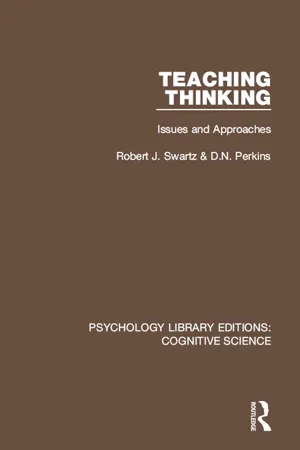
- 266 pages
- English
- ePUB (mobile friendly)
- Available on iOS & Android
eBook - ePub
About this book
Information
CHAPTER ONE
PROMISE AND POSSIBILITIES
Education designed to develop thinking has become exciting and challenging for many practitioners and others concerned with schooling. The historical reasons for this turn of events will be explored a little later, but one certainly must honor the boldness of those who feel drawn to this mission. After all, of the many human activities that we value—athletic, artistic, diplomatic, economic, and so on—good thinking viewed as a general skill seems one of the vaguest and least amenable to schooling. Yet the prospects for education designed to improve students’ thinking are very real and worth careful consideration by any educator who feels drawn to the promise and possibilities of this mission.
As we face the prospect for developing students’ thinking, many questions inevitably arise. Our healthy internal skeptic alerts us to a number of concerns. What is meant by “thinking” and what would “better thinking” mean? Why is the teaching of thinking popular today? Is this yet another educational bandwagon that will eventually falter and fail? Good schools and teachers have always taught thinking, have they not? Is there any evidence that people can learn to think better? What about the barriers of IQ and limits on the pace of human development? In this first chapter of the overview, we examine such questions and offer some optimistic answers that add up to good prospects for the development of students’ thinking.
What Is Meant by Thinking?
The short answer here is, “What you would think.” While this answer is a little flippant, it carries an important message. People interested in efforts to teach thinking have some natural concerns about what this might entail. For instance, some programs designed to teach thinking emerge from university research and might involve abstruse and obscure conceptions of thought. Fortunately, as we view the field as a whole, thinking really does mean “what you would think.” The teaching of thinking as it occurs today includes virtually all of those diverse mental acts we ordinarily consider to be thinking.
For example, when we speak of thinking we often have in mind the problem-solving performances common in school: working math problems, reading to answer questions, writing an essay, and so on. These are common focal points in efforts to develop thinking. Sometimes we have in mind more ambitious sorts of thinking that regrettably do not appear in school settings as often as we would like: for instance, creative thinking that yields new ideas and critical thinking that seeks penetrating insights and assessments. These, too, receive direct attention from a number of programs and approaches to developing students’ thinking. We may have in mind the sorts of thinking called for in everyday life: prudent decision making, forecasting possibilities, good judgment in practical matters. These receive attention from some approaches and programs. Without belaboring the matter further, let us make a generalization. The conception of thinking broadly apparent in the field of teaching thinking is just our everyday common-sense conception of thinking in all its diversity.
There is some reassurance in that answer. It implies that we need not fear that the movement to develop thinking includes a narrow or overly technical notion of its target. To be sure, one needs to look carefully at individual approaches and programs, asking whether they foster the sorts of thinking one wants, but such a concern does not arise regarding the overall enterprise.
We should confess that there is a harder version of the question, “What do we mean by thinking?” It might read, “What are the mechanisms of thinking?” This is an issue for psychologists, philosophers, and others probing the nature of the mind, and inevitably different answers emerge from different experts. Some approaches and programs designed to develop thinking do not involve a very technical conception of thinking; others do, and often rather different conceptions. So, while the harder version of the question is a good one, no answer generally acceptable to everyone in the field can be given. We can, however, offer a systematic and fairly eclectic framework. In the next two chapters, we will examine the nature of thinking in terms of such psychological elements as component processes, strategies, and attitudes. Meanwhile, we can be comforted that while experts sometimes disagree about how thinking works, they and the rest of us are talking about the same full range of human activities—what we ordinarily mean when we speak of thinking in its many guises.
What Is Meant by Better Thinking?
If we would like people to think better, we need to understand the nature of better thinking. In fact, the response to this question parallels the response to the previous question: taking the field as a whole, better thinking means by and large what it means in common-sense terms. No special or esoteric conception of better thinking enters. There is, however, some value in distinguishing between our everyday ideas about better thinking outcome and better thinking processes.
Often we conceptualize better thinking in terms of outcomes. Better thinking yields, for example:
• more reliable conclusions,
• deeper insights,
• sounder decisions,
• more finely crafted products,
• more creative inventions, and
• keener critical assessments.
Not only is this sensible and even commonplace, but it has immediate implications for schooling. Students cannot develop better thinking as gauged in terms of outcomes unless they engage in activities with those outcomes. For instance, students cannot hone their decision-making capabilities unless they engage in significant decision making. Yet schools typically afford little opportunity for students to confront and explore decisions as a routine part of the curriculum. Likewise, the visual arts and creative writing aside, schools offer little opportunity for students to produce creative outcomes. How, then, can they be expected to develop skills for creativity? To generalize, our everyday and commonplace notion of better thinking outcomes plainly goes far beyond what school settings usually accommodate.
Besides conceiving better thinking in terms of outcomes, we also speak of it in process terms. Better thinking, for example:
• considers more possibilities,
• explores farther and wider,
• exercises keener judgment,
• marshals more data,
• challenges assumptions,
• exercises precision,
• checks for errors,
• maintains objectivity and balance.
Indeed, these rough characterizations of process can be taken as informal theories of the origins of the outcomes of better thinking: better thinking is the result of better thinking processes. The processes, like the outcomes, carry an important message. If students are to develop their thinking, they must have opportunities to engage in the sorts of processes that make up better thinking. Conventional schooling does afford ample opportunities to exercise some of these processes, such as checking or maintaining precision; others, such as maintaining objectivity and balance, challenging assumptions, or exploring something deeply, are opportunities seldom found.
Why Is the Teaching of Thinking A Popular Endeavor Today?
Certainly the ebb and flow of enthusiasm for different educational agendas should surprise no one. It has long been a characteristic of the educational world. Because teaching thinking over the past half-decade has become a popular mission for many educators, we need to ask why this has happened. Is it just ebb and flow—a natural cycle in the goals that engage the attention of the public concerned with education—or does something more substantive underlie the present enthusiasm?
The question particularly calls for attention since the teaching of thinking itself—never mind other educational innovations—has occupied the spotlight before. Many will recall the curriculum reform movement that recruited a number of scholars from diverse disciplines during the late 60’s and early 70’s. A number of projects that focussed on mathematics, the hard and social sciences, and certain of the humanities sought to introduce students to the processes of thought important in those subject matters—processes that all too often received little attention as students waded through pages of factual content. There were differences between then and now, to be sure. For one, this prior subject matter focus on the teaching of thinking yielded few stand-alone courses specifically for thinking such as those that now occupy a prominent position in the field. Nonetheless, a cautious educator remembering those times might well say, “Here we go again.”
Then let us consider the key questions. Why again? Why now? Are we in a position to do any better this time around? When we think about the first question, it is important to remember that concern with developing students’ thinking, far from being a fad, is one of the most persistent and ambitious aspirations of education, with a tradition stretching back at least to Plato. To be sure, this objective has not always been pursued, but it has been recurrently sought after in one form or another. There can be no question that, if current efforts to develop students’ thinking succeed by contemporary standards, education will have taken another major step in a venerable quest.
But why now? Two intertwined historical trends deserve recognition. The first of these concerns the “back-to-basics” movement of the 70’s. In part, this was a reaction to the ambitious curriculum reform attempts that came before; in part it was a response to other factors, including the documented difficulties many students were encountering with basic skills of reading, writing, and arithmetic. Even in the heyday of the “back-to-basics” movement, some voices in the wilderness were warning that more than the sturdy trio of the three R’s was basic. The reality of this prophecy gradually became clear in the ensuing years. Testing conducted by the National Assessment of Educational Progress and other agencies disclosed that in due course the basics were not faring too badly. Unfortunately, performance on “higher-order skills,” as they were often called, left much to be desired.
Perhaps the greatest public alarm resulted from the observation that students performed worse on certain higher-order tasks than their peers of a decade before, for instance on certain sorts of mathematical problem solving. It seemed that some knack for rigor and reason had slipped away with the previous generation of students and teachers. But what was it? Student discipline? Sufficient challenge? Student ambition? The decline of teaching as an honored profession? In our view the heart of the problem lies not in the minor ups and downs of average scores over the years, but in the general level of performance then and now. The fact is that, today and a decade ago, students were performing far below what one would like to see in such areas as mathematical problem solving, critical and creative writing, and interpretive reading. This shortfall has come to the attention of the public not only through national testing programs but also through the several recent reports on the quality of primary and secondary education in the United States. While these reports did not particularly single out the teaching of thinking as a separate topic (and indeed, whether it should be a separate topic is controversial, as we shall see), they certainly did emphasize the imperative need for more attention to intellectual development.
A second strand from more academic sources also contributes to the current concern with development of thinking in classrooms. Numerous representatives of the disciplines of psychology and philosophy have found the arena of public education a new laboratory for exploration and occasion for contribution to society. Over the past decade and more, psychologists have turned somewhat away from animal experimentation and the technical nuances of isolated bits of human behavior and turned toward the kinds of complex contextual conduct that have significance in the real world. Learning, problem solving, writing, and other performances important in academic settings have been among their favorite concerns. Many have spoken of educational settings as natural and fruitful meeting grounds for practical and theoretical interests. Moreover, consequent upon their efforts have been important advances in the contemporary understanding of mind. These advances put us in a better position today to plan intelligent approaches to developing students’ intellect than was the case during the last swing of the pendulum.
Philosophy, too, has come out of the ivy to meet teachers and students in the corridors of schools. While most work by psychologists has emphasized learning, problem solving, and analytical thinking with a scientific slant, most work by philosophers has concerned critical thinking. It has highlighted good grounds for belief, judicious weighing of issues, and the like, and has exhibited a humanistic slant. As psychology has focussed on building instructionally relevant and empirically confirmed models of the nature of mind, philosophy has focussed on equally important analytical and normative issues. It is perhaps unfortunate that the two camps have not met and mingled more. However, at the same time, there are benefits in the ways they contrast with and complement one another. The special perspectives and analytical armamenta of two distinct academic disciplines now provision contemporary efforts to teach thinking. We exist in a time of fortunate confluence between the need as perceived by a concerned public and educational leaders, and new and powerful ideas about ways and means to improve and further education emerging from the disciplines of psychology, philosophy, and, of course, education itself.
Do Not Schools and Good Teachers Already Develop Thinking?
Certainly, to some extent they do. Plentiful experimental evidence shows that formal schooling has a marked impact on the cognitive functioning of many students. They learn to think in ways characteristic of literate industrialized cultures, and since such cultures call for such thinking, this is important. (It is worth recalling that individuals growing up in other kinds of cultures may not benefit from the same patterns of thought, but this is not of direct concern to us.) There is no question that conventional schooling empowers many learners not only with a knowledge base but also with patterns of thinking appropriate to our culture.
Good teachers also do things that enhance their students’ thinking. They may, for instance, ask more provocative questions, choose assignments better matched to the intellectual level of their students, and avoid dominating class discussion with their own opinions. These are only three among a host of factors that may foster the development of thinking abilities.
So what is all the fuss about? Partly, it is a search for replicability. To be sure, there are schools and teachers that plainly stimulate students’ intellectual development, but just what is the nature of their flair and how can others get similar results? We all recognize that the conspicuous success stories are the exception, not the rule. Partly, it is a searc...
Table of contents
- Cover
- Half Title
- Title Page
- Copyright Page
- Table of Contents
- Foreword
- Preface
- 1. Promise and Possibilities
- 2. Thinking and Its Improvement
- 3. Kinds of Thinking
- 4. Infusing Teaching Thinking into Regular Subject-area Instruction
- 5. Choosing and Using Separate Instructional Programs Designed to Teach Thinking
- 6. Constructing a Program for Teaching Thinking in Classroom or School: Choices about Thinking Goals
- 7. How Teachers Relate to Teaching Thinking: Lesson Design and Instructional Strategies
- 8. Support Systems for Teachers and Schools to Teach Thinking Effectively
- 9. Approaches to Evaluation
- 10 Types of Tests
Trusted by 375,005 students
Access to over 1.5 million titles for a fair monthly price.
Study more efficiently using our study tools.
Frequently asked questions
Yes, you can cancel anytime from the Subscription tab in your account settings on the Perlego website. Your subscription will stay active until the end of your current billing period. Learn how to cancel your subscription
No, books cannot be downloaded as external files, such as PDFs, for use outside of Perlego. However, you can download books within the Perlego app for offline reading on mobile or tablet. Learn how to download books offline
We are an online textbook subscription service, where you can get access to an entire online library for less than the price of a single book per month. With over 1.5 million books across 990+ topics, we’ve got you covered! Learn about our mission
Look out for the read-aloud symbol on your next book to see if you can listen to it. The read-aloud tool reads text aloud for you, highlighting the text as it is being read. You can pause it, speed it up and slow it down. Learn more about Read Aloud
Yes! You can use the Perlego app on both iOS and Android devices to read anytime, anywhere — even offline. Perfect for commutes or when you’re on the go.
Please note we cannot support devices running on iOS 13 and Android 7 or earlier. Learn more about using the app
Please note we cannot support devices running on iOS 13 and Android 7 or earlier. Learn more about using the app
Yes, you can access Teaching Thinking by Robert J. Swartz,D.N. Perkins in PDF and/or ePUB format, as well as other popular books in Psychology & Cognitive Psychology & Cognition. We have over 1.5 million books available in our catalogue for you to explore.