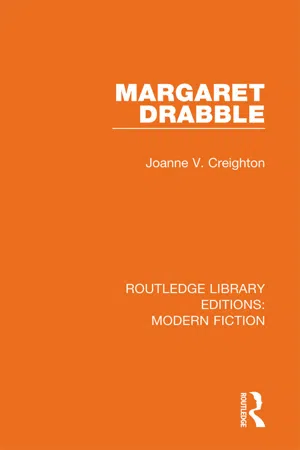
Margaret Drabble is a writer who plays a lively role in both popular and literary culture. Widely read and studied throughout the world her novels attract both the general reader and the literary critic. Originally published in 1985, Joanne Creighton examines this phenomenon and places particular emphasis on her "Englishness", her role as a woman writing credibly about modern women and her ability to mediate between the traditional and the modern. She argues that the resonances of Drabble's work grow put of her strong sense of the powers and resources of existing literary traditions coupled with her intelligent portrayal of the familiar problems of people in modern society, and that is precisely this mediating position which makes Drabble an important voice in contemporary fiction and links her with other writers of her generation. Challenging those critics who see Drabble as a fiction traditionalist. Creighton finds her work open-ended, inquiring, equivocal and unquestionably contemporary in spirit.
- 126 pages
- English
- ePUB (mobile friendly)
- Available on iOS & Android
eBook - ePub
Margaret Drabble
About this book
Information
1
INTRODUCTION
Margaret Drabble is an ambitious writer with broad social concerns who plays a lively role in both popular and literary culture. Varied and considerable, her writing grows out of a genuine engagement with contemporary issues and an engrained sense of literary historicism. Besides her nine novels to date, she has written several stories and screenplays, a biography of Arnold Bennett and other literary books, and has edited several texts on literary subjects. She has written scores of reviews and other pieces – from short notes to extended essays – for literary and popular journals, newspapers, and magazines. Comfortably attuned to audience, she writes for both school children and adults, both scholars and laymen. She is seemingly equally at home writing about disciplining children or travelling abroad, sexual mores or public policy, current television shows or the Victorian age. Evident throughout her career is her concern with the social problems concomitant with historical change, a concern brought increasingly into the foreground in her more recent, broadly based social realism. Not at all reclusive or personally disengaged, she has appeared on televised literary programs and participated in governmental councils, Arts Council committees, and British Council lecture tours, and for years taught adult education one day a week at Morley College in south London. She has just completed an ambitious five-year project, the re-editing of the Oxford Companion to English Literature. Unworried about this disruption of her novelistic career, Margaret Drabble has a disingenuous lack of professional earnestness, an openness to contingency, to the changing phases and opportunities of her life, to the varying contexts in which she lives. She seeks to be an “inquiring mind” rather than a professional bound and labelled, committed and obligated, predictable and steady. This attitude underlies her insistence that she is a writer who writes on literary topics rather than a literary critic. She has chosen deliberately, she says, the freedom of an unaffiliated writer, untied to an academy, an ideology, or a methodology. It is a choice with literary, political, and ethical implications, affecting how and what she writes.
Her critical writing is confident, engaged with the subject, engagingly personal, disarmingly “non-scholarly” in posture: she does not hesitate, for example, to interject personal commentary into her discussions. Her biography of Arnold Bennett, one could argue, is as interesting for what she says about herself as for what she says about him. Her novels, too, are personal in tone – lucid, seemingly confessional, eminently readable. Their protagonists have generally followed the course and concerns of her own life: young women leaving university, getting married and separated, birthing children, having affairs, raising progressively older children, reaching midlife, wondering what next. In fact, one commentator has claimed that Drabble’s work might be thought of as an English Passages for a particular generation of middle-class women. Now, as her work has broadened, she has been called a central chronicler of contemporary urban middle-class life.
Neither ivory tower artist nor academician, Margaret Drabble seems attuned to herself and to ordinary experience, vividly rendering the ordinary with intelligence and learning, insight and humor. This lack of intellectual pretension has contributed to her accessibility and popularity – and, in some quarters, an underestimation of her qualities. One recurrent view is that she has had an extraordinarily lucky sense of timing rather than talent:
Her fame and significance have been treated in a way that is out of proportion both to the quantity and quality of her output. In retrospective assessment of the nineteen-sixties, it may well appear that Margaret Drabble’s greatest gift lay in her sense of timing; she was historically fortunate enough to appear on the literary scene as the first English woman to give voice to the delusive promise of college life, followed by the cold douche of matrimony and child-bearing.1
It is easy but erroneous to confuse Drabble’s lucidity and her focus on the ordinary – particularly ordinary women’s lives – with ordinary work. Her attempt to come to terms with women’s changing role in modern society is serious, searching and important, as women around the globe have recognized. Fundamentally liberal and humanistic, Margaret Drabble is committed to the idea that novels should be about common human experiences and should be “available to a fairly large reading public, by which I don’t mean popular novels, I mean novels that aren’t esoteric or hermetically sealed,” or exclusively “a clever array of symbolic patterning for the scholarly mind.”2
Her works are lucidly contemporary, and yet informed with a sophisticated sense of literary history and tradition. Because she attracts, like few writers can, both general readers and literary critics, her work draws together middlebrow and serious fiction, helping to resynthesize a readership split by modernist élitism. Actively participating both in ordinary, middle-class British life and in intellectual and literary circles, she is one of those seminal writers who writes out of deep engagement with the culture in which she lives. Assimilating, creating, pronouncing judgment upon literary form and value, she also gives voice to common problems, to communal concerns. The danger in playing this role too strenuously is that she will see herself and be seen as a public personage with opinions to peddle. Aware of these dangers, she claims she is tired of appearing on television panels and of voicing in a variety of settings her opinion on a wide range of political, social, and literary questions. Similarly, her fiction is most successful when it is questioning, equivocal, open to possibility rather than rhetorical or committed to a particular view. She has also been accused of being too responsive to what’s happening around her, of being, in other words, a little too up-to-date, trendy, and glib, rather than intellectually serious. This, in some senses, seems to me patently untrue. In spite of her disarming disingenuousness, Margaret Drabble is undeniably an erudite and serious person, deeply – even stolidly – based in tradition, genuinely engaged with her subject matter. It is true, however, that she is not a philosophical writer – a Saul Bellow or a George Eliot – capable of memorably and profoundly articulating the human issues implicit in her work, even though she admires and strives to emulate these writers. She has yet to find the right voice for the omnisciently narrated, broadly based social realism she is determined to write these days, a direction that I think may not be the most productive path for her. Her real strength as a writer – and her popularity – have grown out of the more modest scope of her earlier fiction: the psychological resonance, the vivid particularization and credible voices of her characters, the acute observation of the details of ordinary life.
*
Frequently interviewed and photographed, the subject of several feature articles, including an hour-long BBC documentary “One Pair of Eyes,” Margaret Drabble is more personally knowable than more reclusive writers. She told me she is both “very diffident and very gregarious,” a combination borne out in her interviews and conversation, which are often a curious blend of disclosure and circumspection. Looking back now after the recent deaths of her father in 1982 and her mother in 1984, she is thoughtful and candid about the childhood and family background which have had such a determining effect upon her fiction.3
Born on 5 June 1939, in Sheffield, Yorkshire, she is the daughter of John Frederick and Marie Bloor Drabble. Her father was a barrister, then a circuit judge for Suffolk and Essex, and later, in retirement, a novelist. Her mother was an English teacher at The Mount in York, a Quaker school her daughters were later to attend. The first in their families to go to university, both parents graduated from Cambridge. While Drabble has characterized her rearing as “very tolerant, liberal, middle class, professional,” she none the less feels close to her working-class roots, and is especially conscious of her mother’s difficult transition into the middle class. Her father worked in his family’s business, a small sweet factory, to save money before reading law at Cambridge. Her mother’s family were potters from the Potteries in Staffordshire. Indeed, Drabble comments in her biography of Bennett:
His childhood and origins … are very similar to my own. My mother’s family came from the Potteries, and the Bennett novels seem to me to portray a way of life that still existed when I was a child, and indeed persists in certain areas. My own attitudes to life and work were coloured by many of the same beliefs and rituals, though they were further in the past for me, but as Bennett knew all too well they were attitudes that die hard. He might have been surprised to find how closely I identify with them, after two or three generations of startling change. (Arnold Bennett, p. xii)
In particular she isolates Bennett’s resentment of the “joylessness of life in provincial towns,” his “disdain for conventional Sunday school religion,” and his “need to escape” which was felt throughout her family, particularly by her mother.
One of the most graphic depictions of this need for escape from provincial limitations is Jerusalem the Golden (1967), set in Northam, a fictionalized Sheffield, a novel which Drabble readily acknowledges in her biography was “profoundly affected” by Bennett’s attitudes as well as her own background: “I can’t quite distinguish what came from where” (p. 48). Clara Maugham’s “escape” from the North is problematic, as is Simon Camish’s in The Needle’s Eye (1972), Frances Wingate’s in The Realms of Gold (1975) – and Margaret Drabble’s. Her northern origins, she admits, are an indelible part of her being. More than many writers she believes in the profound “effect of landscape upon the soul.” In fact, she has written a literary topology, A Writer’s Britain (1979), an eloquent testimony to her belief in the paramount importance of place in shaping both character and literature. In her own fiction houses and landscapes become metaphors of the body and of the self. Houses are intimately expressive of their inhabitants; landscapes can be read as “electrocardiograms of childhood.” Her characters are rooted and circumscribed within a particular mind and body, house and geography, family and history, language and culture, time and place. The Realms of Gold, for example, is a study of a family encumbered with what is called the “midland sickness,” and it records Frances Wingate’s rediscovery of her northern past and the re-rooting of her identity in a sense of family and place.
Equally important in Drabble’s work is social class; she portrays with poignancy and credibility the debilitating effects of class consciousness on middle-class aspiration – a particularly vivid example of this is Simon Camish in The Needle’s Eye. Her novels expose the emptiness, the waste, the aimlessness of middle-class lives. Her later works are a powerful criticism of the spiritual paucity of contemporary materialistic goals, and the lack of connection between humanistic values and changing ordinary life. Deeply influenced as a young girl by Pilgrim’s Progress, Drabble creates characters, like Bunyan’s, who are wending their way through an uncharted “moral landscape,” a world where old values are no longer tacitly accepted and new views are unclear. Knowing only too well that they have been shaped and maimed by forces larger than the self, they question whether they can impose a shape upon their lives at all. “There’s nothing I can do about my nature, is there?” asks Rosamund at the end of The Millstone (1965, p. 144), hoping she’s wrong, hoping psychological determinism had not “got its claws” into her to the extent that Simon Camish of The Needle’s Eye depressingly fears it has into him. While insistently moral in focus, her work both demonstrates the difficulty of applying moral standards to the multifarious situations of modern life and examines the deterministic effects of geography, social class, family, economic status, politics, religious training and the decidedly English context of her characters’ lives.
Her own religious views were shaped by her parents’ liberal attitudes and her Quaker schooling at The Mount in York. The Drabbles were not Quakers at the time – Mr Drabble took the children to the Anglican church; Mrs Drabble was an atheist – but they were sympathetic to Quaker values and in later years joined the Society of Friends. Margaret Drabble was infused both at boarding school and at home with the belief that God “was in every man, making him equal and worthy of respect.” She recalls that as children they would discuss and puzzle over the implications of this concept. Was there the light of God in Hitler? In Genghis Khan? They were also taught to live their lives not to their own satisfaction, but in contribution to the general good. She says that the Quakers are “more liberal in their social values than the conventional girls’ public school. They don’t have rules. They believe in moral pressure, not punishment,” and adds that “the moral pressures from my parents were probably very strong, too.”4
The belief taught at Margaret Drabble’s Quaker school in a “light of God” in everyone, in the efficacy of good works, is undercut in Drabble’s thinking by a residue of Calvinistic belief in a deterministic universe where some are blessed and others damned. Such a world is intolerable, especially if one is forced to conclude, as she herself must, that one is of the elect: “fate has really given me a wonderful deal, a magnificent hand of cards. … I’m really egalitarian at heart. I think everyone should have the same hand of cards when they’re born.”5 One of the most recurrent themes in her work and commentary is her puzzlement over the interrelationship of free will and determinism: “Fate and character are irreconcilable. That’s why I write the books. The whole point of writing a novel, for me, is to try to work out the balance between these two, and there is no answer.”6 While not doctrinally religious, she readily acknowledges belief in something larger than the finite, the individual, and the material: “I don’t believe that this material world is all. I can’t bring myself to think that there’s even a sensible way of looking at things.”7 And certainly she subscribes to a religious consciousness, an ethical commitment to play a responsible part in the human community. Her participation – in addition to her writing – consists largely of her active committee work for various progressive causes. She is moved occasionally, but reluctantly, to political activism such as her participation in a demonstration at the Foreign Office (1971) against the Rhodesian settlement and, more recently, the World Disarmament Campaign protest (June 1981) outside the House of Commons.
“One’s relationships with one’s siblings and parents is something that you’re going to write about again and again, in different forms,” admits Margaret Drabble.8 A central generating tension in many of her novels resides in mother–daughter (and, in The Needle’s Eye, mother–son) relationships. Father figures, in contrast, are shadowy and comparatively unimportant. She has said that her own father was away for the war, very busy during periods of her childhood, and rather “remote,” although she also points out that he was loving and supportive. Her relationship with her mother was, obviously, more intense and more complicated. Mrs Drabble recalls in an interview for People magazine (13 October 1980) that Maggie “was a fiery child with a hyperactive mind. She gave me many sleepless nights.” Maggie remembers particularly and painfully her mother’s neurotic insecurity and depression – rooted in “class reasons” – which cast an inhibiting cloud over the family’s home life and social interaction. While her father made a “perfect transition to the middle-class barrister life; he spoke very good English; he had a very good presence and a very social manner; he was very easy and affable and people thought him charming,” her mother “continued to speak broad Yorkshire and was the reverse of charming: she was aggressive, ...
Table of contents
- Cover
- Half Title
- Title Page
- Copyright Page
- Dedication
- Table of Contents
- General Editors’ Preface
- Preface and acknowledgements
- A Note on the Texts
- 1 Introduction
- 2 Bird-cages
- 3 Golden realms
- 4 Urban ground
- Notes
- Bibliography
Trusted by 375,005 students
Access to over 1.5 million titles for a fair monthly price.
Study more efficiently using our study tools.
Frequently asked questions
Yes, you can cancel anytime from the Subscription tab in your account settings on the Perlego website. Your subscription will stay active until the end of your current billing period. Learn how to cancel your subscription
No, books cannot be downloaded as external files, such as PDFs, for use outside of Perlego. However, you can download books within the Perlego app for offline reading on mobile or tablet. Learn how to download books offline
Perlego offers two plans: Essential and Complete
- Essential is ideal for learners and professionals who enjoy exploring a wide range of subjects. Access the Essential Library with 800,000+ trusted titles and best-sellers across business, personal growth, and the humanities. Includes unlimited reading time and Standard Read Aloud voice.
- Complete: Perfect for advanced learners and researchers needing full, unrestricted access. Unlock 1.5M+ books across hundreds of subjects, including academic and specialized titles. The Complete Plan also includes advanced features like Premium Read Aloud and Research Assistant.
We are an online textbook subscription service, where you can get access to an entire online library for less than the price of a single book per month. With over 1.5 million books across 990+ topics, we’ve got you covered! Learn about our mission
Look out for the read-aloud symbol on your next book to see if you can listen to it. The read-aloud tool reads text aloud for you, highlighting the text as it is being read. You can pause it, speed it up and slow it down. Learn more about Read Aloud
Yes! You can use the Perlego app on both iOS and Android devices to read anytime, anywhere — even offline. Perfect for commutes or when you’re on the go.
Please note we cannot support devices running on iOS 13 and Android 7 or earlier. Learn more about using the app
Please note we cannot support devices running on iOS 13 and Android 7 or earlier. Learn more about using the app
Yes, you can access Margaret Drabble by Joanne V. Creighton in PDF and/or ePUB format, as well as other popular books in Literature & Literary Criticism. We have over 1.5 million books available in our catalogue for you to explore.