Progress in the Analysis and Design of Marine Structures
eBook - ePub

Progress in the Analysis and Design of Marine Structures

Proceedings of the 6th International Conference on Marine Structures (MARSTRUCT 2017), May 8-10, 2017, Lisbon, Portugal

  1. 952 pages
  2. English
  3. ePUB (mobile friendly)
  4. Available on iOS & Android
eBook - ePub

Progress in the Analysis and Design of Marine Structures

Proceedings of the 6th International Conference on Marine Structures (MARSTRUCT 2017), May 8-10, 2017, Lisbon, Portugal

About this book

Progress in the Analysis and Design of Marine Structures collects the contributions presented at MARSTRUCT 2017, the 6th International Conference on Marine Structures (Lisbon, Portugal, 8-10 May 2017).

The MARSTRUCT series of Conferences started in Glasgow, UK in 2007, the second event of the series having taken place in Lisbon, Portugal in March 2009, the third in Hamburg, Germany in March 2011, the fourth in Espoo, Finland in March 2013, and the fifth in Southampton, UK in March 2015. This Conference series deals with Ship and Offshore Structures, addressing topics in the areas of:

- Methods and Tools for Loads and Load Effects
- Methods and Tools for Strength Assessment
- Experimental Analysis of Structures
- Materials and Fabrication of Structures
- Methods and Tools for Structural Design and Optimisation, and
- Structural Reliability, Safety and Environmental Protection

Progress in the Analysis and Design of Marine Structures is essential reading for academics, engineers and all professionals involved in the design of marine and offshore structures.
Trusted by 375,005 students

Access to over 1.5 million titles for a fair monthly price.

Study more efficiently using our study tools.

Information

Publisher
CRC Press
Year
2017
Print ISBN
9781138069077
eBook ISBN
9781351653404

Collision and grounding

A simplified method to assess the damage of an immersed cylinder subjected to underwater explosion

K. Brochard & H. Le Sourne
GeM Institute, ICAM Nantes Campus, France
G. Barras
Direction Générale de l’Armement—Techniques Navales, Toulon, France
ABSTRACT: This paper presents a simplified method for assessing the damage of an immersed cylinder subjected to the primary shock wave produced by an underwater explosion. The interaction between the water and the cylinder is divided into two phases for simplicity. In the first phase, a kinetic energy transmitted to the cylinder by the shock wave is calculated. In the second phase, the cylinder deforms and the related shell displacements create an additional pressure loading. A simplified mechanical model of the shell is proposed. Closed-form expressions for evaluating the final deflection profile of the shell are presented and compared to finite element results. The presented method is in quite good agreement with numerical results. Further developments are needed for improving the modelling of the cylindrical shell mechanical behavior.

1 INTRODUCTION

The design of a submarine’s hull is crucial for its operability and crew’s safety, but also complex. Indeed, engineers need to balance lightness, acoustic discretion and resistance to both immersion pressure and environmental attacks. Submarine explosions represent a first-rate threat for the integrity of the hull, whose behavior needs to be properly analyzed. In the design process of submarines, numerous calculations must be performed to minimize the amount of damage produced by underwater explosions, with various characteristics of shell, material and scenarios of explosion.
Experimental analysis are extremely expensive, time-consuming, as shown by Brett (2008) and are not to be used for design analysis, even though, they provide precious understanding of the physics of the problem. In recent decades, numerical methods have been developed for simulating the dynamic response of a submerged structures to an underwater explosion, and have been applied to cylindrical shell and ring-stiffened cylinder by Hung (2009) and Li (2012). However, numerical simulation are also time-consuming and not well-suited at design stage. Hence, present research aims at developing a simplified method that allows to perform quick resolution of the problem of an immersed cylinder subjected to an underwater explosion.
The presented work relies on a methodology developed by Wierzbicki & Hoo Fatt (1993), the so-called plastic string-on-foundation method, which enables to obtain closed-form solutions for the deformation and velocity profiles of a cylindrical shell when subjected to impact or explosive loading. However, this method is inappropriate when shell is immersed, because fluid-structures interactions are not considered. The work presented here focuses on coupling this method with an approximate formulation of the fluid-structure interaction. In order to obtain closed-form expression of an immersed cylinder’s final deflection when it is impacted by an underwater explosion primary shock wave.

2 EXPLOSIVE LOADING

2.1 Theoretical foundations

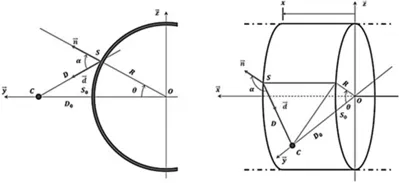
Consider a cylindrical shell of length L, radius R and thickness h, clamped at both ends. It is filled with air and fully immersed in water. An explosive charge of mass C detonates at a distance D0 from the stand-off point S0, located at the intersection of cylinder’s planes of symmetry, as shown in Figure 1.
On a current point S of the shell, shock wave’s amplitude may be calculated with the following expressions proposed by Cole (1965):
pI(S|t)=pset/Ts(1)
Images
Figure 1. Initial configuration of an immersed cylinder subjected to an underwater explosion.
With,
Ps=Kp(C1/3/D)APTs=KTC1/3(C1/3/D)AT(2)
Here, D is the distance between S and the charge’s location and KP, KT, AP and AT are characteristic parameters of the explosive. In the following developments, the fluid is supposed to be infinite, inviscid and incompressible so that a potential flow can be assumed. In a point far enough from the charge, pressure field in the fluid also verifies Bernoulli linear equation. When the shockwave generated by the underwater explosion impacts the shell, fluid-structure interactions lead to a pressure field in the fluid of the following form:
p(P|t)=pI(P|t)+ps(P|t)(3)
where pS is the so-called scattered pressure, i.e. the sum of the reflected wave on the cylinder fixed and rigid and of the radiated wave from shell’s deformatin. It constitutes the unknown of the problem.

2.2 Retarded Potential Formula applied to a cylinder

For a structure immersed in an infinite fluid medium, pressure field and its components must satisfy the Helmholtz equation, which is expressed from the velocity potential φ:
Δφ1cf22φt2=0(4)
where cf is the speed of sound in the fluid. At the fluid-cylinder interface, in the case where cylinder’s spe...

Table of contents

  1. Cover
  2. Half Title
  3. Title Page
  4. Copyright Page
  5. Table of Contents
  6. Preface
  7. Organisation
  8. Fluid-structure interaction
  9. Vibrations
  10. Structural analysis
  11. Structural design
  12. Ultimate strength
  13. Fatigue and fracture
  14. Collision and grounding
  15. Plate dynamics
  16. Welded structures
  17. Corrosion
  18. Ice conditions
  19. Damaged structures
  20. Offshore structures
  21. Subsea structures
  22. Composite structures
  23. Renewable energy devices
  24. Safety and reliability
  25. Author index

Frequently asked questions

Yes, you can cancel anytime from the Subscription tab in your account settings on the Perlego website. Your subscription will stay active until the end of your current billing period. Learn how to cancel your subscription
No, books cannot be downloaded as external files, such as PDFs, for use outside of Perlego. However, you can download books within the Perlego app for offline reading on mobile or tablet. Learn how to download books offline
Perlego offers two plans: Essential and Complete
  • Essential is ideal for learners and professionals who enjoy exploring a wide range of subjects. Access the Essential Library with 800,000+ trusted titles and best-sellers across business, personal growth, and the humanities. Includes unlimited reading time and Standard Read Aloud voice.
  • Complete: Perfect for advanced learners and researchers needing full, unrestricted access. Unlock 1.5M+ books across hundreds of subjects, including academic and specialized titles. The Complete Plan also includes advanced features like Premium Read Aloud and Research Assistant.
Both plans are available with monthly, semester, or annual billing cycles.
We are an online textbook subscription service, where you can get access to an entire online library for less than the price of a single book per month. With over 1.5 million books across 990+ topics, we’ve got you covered! Learn about our mission
Look out for the read-aloud symbol on your next book to see if you can listen to it. The read-aloud tool reads text aloud for you, highlighting the text as it is being read. You can pause it, speed it up and slow it down. Learn more about Read Aloud
Yes! You can use the Perlego app on both iOS and Android devices to read anytime, anywhere — even offline. Perfect for commutes or when you’re on the go.
Please note we cannot support devices running on iOS 13 and Android 7 or earlier. Learn more about using the app
Yes, you can access Progress in the Analysis and Design of Marine Structures by Carlos Guedes Soares,Y. Garbatov in PDF and/or ePUB format, as well as other popular books in Technology & Engineering & Civil Engineering. We have over 1.5 million books available in our catalogue for you to explore.