The concept of formal Lie group was derived in a natural way from classical Lie theory by S. Bochner in 1946, for fields of characteristic 0. Its study over fields of characteristic p > 0 began in the early 1950's, when it was realized, through the work of Chevalley, that the familiar "dictionary" between Lie groups and Lie algebras completely broke down for Lie algebras of algebraic groups over such a field. This volume, starts with the concept of C-group for any category C (with products and final object), but the author's do not exploit it in its full generality. The book is meant to be introductory to the theory, and therefore the necessary background to its minimum possible level is minimised: no algebraic geometry and very little commutative algebra is required in chapters I to III, and the algebraic geometry used in chapter IV is limited to the Serre- Chevalley type (varieties over an algebraically closed field).
- 288 pages
- English
- ePUB (mobile friendly)
- Available on iOS & Android
eBook - ePub
Introduction to the Theory of Formal Groups
About this book
Information
CHAPTER I
Definition of Formal Groups
§1. C-groups and C-cogroups
1. The notion of C-group. Let C be a category which has a final object e and in which the product of any two objects is defined. A C-group consists in a quadruplet (G, m, η, i) where G is an object of C, m: G × G → G, η : e → G, and i: G → G three morphisms of C, with the following axioms:
1) The diagram
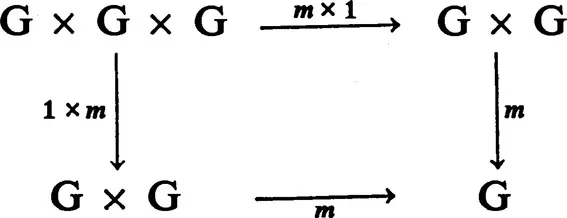
is commutative.
2) The two diagrams
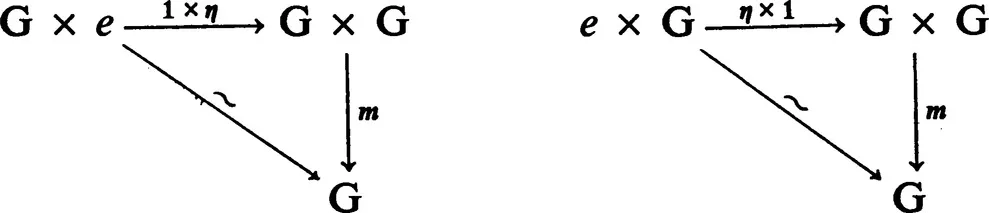
are commutative (the oblique arrow is the natural isomorphism).
3) The two diagrams
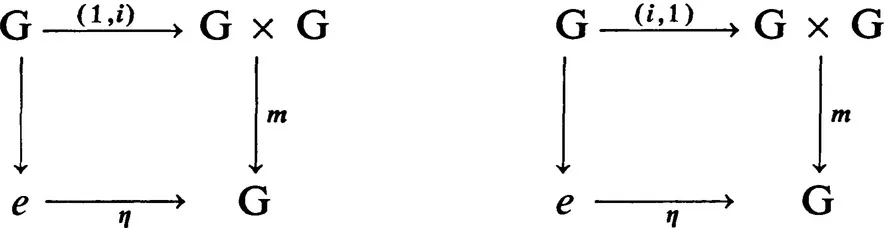
are commutative.
When one takes as C the category of sets, the morphisms being arbitrary mappings, one obtains the usual definition of groups (also called “abstract” or “set-theoretic” groups). When one takes for C the category of topological spaces, the morphisms being continuous mappings, one obtains the topological groups (in that category, products are just the usual products of topological spaces, and the final object a space having only one point).
2. It is well-known that there is another way of defining C-groups. For each object X in C, consider the set of morphisms Mor(X, G) (or Morc(X, G)) of all morphisms (of C) of X into G; the mapping X ⟼ Mor(X, G) is a functor from the dual category C0 of C into the category of sets: to each morphism u: X → X′ in C is associated the mapping f ⟼ f ∘ u of Mor(X′, G) into Mor(X, G). This is valid for an arbitrary object Gin C, but if G is a C-group, it is possible to define on Mor(X, G) a group structure in a natural way, such that, for any morphism u: X → X′, the mapping f ⟼ f ∘ u of Mor(X′, G) into Mor(X, G) is a group homomorphism. To define the group law on Mor(X, G), observe that
is naturally identified with Mor(X, G × G) by definition of the product in C; the group law is then simply
The associativity results from property 1); the neutral element is just the composite morphism , the fact that it is a neutral element following from property 2); finally the inverse is the mapping f ⟼ i ∘ f, its properties following from property 3). We may thus say that a C-group G defines in a natural way a functor X ⟼ Mor(X, G) from C0 to the category of (abstract) groups Gr.
3. Conversely, if an object G of C is such that X ↦ Mor (X, G) is a functor from C0 to Gr, then there is a unique ...
Table of contents
- Cover
- Half Title
- Pure and Applied Mathematics
- Title Page
- Copyright Page
- Table of Contents
- Foreword
- Notations
- Original Half Title
- Chapter I Definition of Formal Groups
- Chapter II Infinitesimal Formal Groups
- Chapter III Infinitesimal Commutative Groups
- Chapter IV Representable Reduced Infinitesimal Groups
- Bibliography
- Index
Trusted by 375,005 students
Access to over 1.5 million titles for a fair monthly price.
Study more efficiently using our study tools.
Frequently asked questions
Yes, you can cancel anytime from the Subscription tab in your account settings on the Perlego website. Your subscription will stay active until the end of your current billing period. Learn how to cancel your subscription
No, books cannot be downloaded as external files, such as PDFs, for use outside of Perlego. However, you can download books within the Perlego app for offline reading on mobile or tablet. Learn how to download books offline
Perlego offers two plans: Essential and Complete
- Essential is ideal for learners and professionals who enjoy exploring a wide range of subjects. Access the Essential Library with 800,000+ trusted titles and best-sellers across business, personal growth, and the humanities. Includes unlimited reading time and Standard Read Aloud voice.
- Complete: Perfect for advanced learners and researchers needing full, unrestricted access. Unlock 1.5M+ books across hundreds of subjects, including academic and specialized titles. The Complete Plan also includes advanced features like Premium Read Aloud and Research Assistant.
We are an online textbook subscription service, where you can get access to an entire online library for less than the price of a single book per month. With over 1.5 million books across 990+ topics, we’ve got you covered! Learn about our mission
Look out for the read-aloud symbol on your next book to see if you can listen to it. The read-aloud tool reads text aloud for you, highlighting the text as it is being read. You can pause it, speed it up and slow it down. Learn more about Read Aloud
Yes! You can use the Perlego app on both iOS and Android devices to read anytime, anywhere — even offline. Perfect for commutes or when you’re on the go.
Please note we cannot support devices running on iOS 13 and Android 7 or earlier. Learn more about using the app
Please note we cannot support devices running on iOS 13 and Android 7 or earlier. Learn more about using the app
Yes, you can access Introduction to the Theory of Formal Groups by Jean A. Dieudonne in PDF and/or ePUB format, as well as other popular books in Mathematics & Algebra. We have over 1.5 million books available in our catalogue for you to explore.