Originally published in 1967. The common aim of all logical enquiry is to discover and analyse correctly the forms of valid argument. In this book concise expositions of traditional, Aristotelian logic and of modern systems of propositional and predicative logic show how far that aim has been achieved.
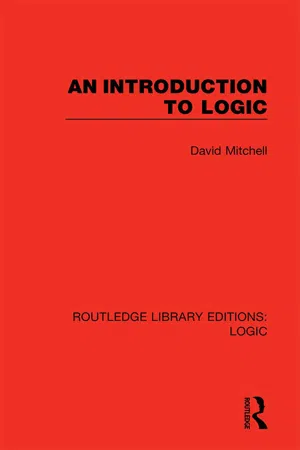
- 190 pages
- English
- ePUB (mobile friendly)
- Available on iOS & Android
eBook - ePub
An Introduction to Logic
About this book
Information
1
LOGICAL FORM
Elementary logic is the study of the forms of valid argument and, more widely, of the different types of proposition which are logically true. Valid arguments usually consist of one set of propositions called ‘premisses’ and another set called ‘conclusions’; and one of the logician’s tasks is to make clear the conditions under which premisses ‘entail’ (or ‘imply’) conclusions, or, to put it in different words, conclusions ‘follow logically’ from premisses. He is concerned with logical truth, not with the ‘material’ truth or falsity of propositions. This distinction between logical and material truth is one that educated people make in ordinary language, whether or not they have studied logic. For we draw the distinction, consciously or unconsciously, when we use correctly such words as ‘logic’ and ‘logical’, which belong to common speech as well as to the vocabulary of a special study. It is a distinction which may easily be illustrated, however difficult it may be to explain fully.
It is true, as a matter of fact, that Eisenhower was in 1960 President of the United States of America, that King Charles I was beheaded, that common salt dissolves in water. It is true as a matter of logic, or ‘logically true’, that if no Protestant acknowledges the supremacy of the Pope, no one who acknowledges the supremacy of the Pope is a Protestant; that if Smith is a Marxist and if all Marxists are materialists, then Smith is a materialist; that if John always tells the truth, it is false that he ever tells lies. Some of the respects in which the first set of propositions differs from the second are apparent. If doubt were cast on any of the first set, we should know how to set about supporting them; we should appeal to observation and experiments, to the evidence of our senses. But we should not think of supporting any of the second set of propositions in the same way. Indeed we might well be puzzled if we were told that they were questioned at all, for, unlike the others, they seem to guarantee their own truth. We are tempted to say that the propositions of the first set happen to be true, while those in the second set must be true, or, in more technical language, that the first set consists of ‘contingent’, the second of ‘necessary’ propositions.
But here we must introduce a refinement. If we are to avoid the possibility of being misunderstood we should speak not of ‘necessary’ but of ‘logically necessary’ propositions. For all that logic can tell us, there may be other kinds of necessity than logical necessity, which is the notion which we are concerned to elucidate. That certain organisms die when deprived of oxygen might seem to be not something that just happens to be true but something that, in some sense, is necessarily true. But if this is so, the necessity is not logical but biological and, from the point of view of logic, the proposition is a contingent one. To contradict it might be to commit a mistake in biology; it would not be to make a logical error.
It is not difficult to list further respects in which the propositions of logic differ from ‘factual’ propositions. If we consider relatively uncomplicated logically true propositions, we notice that we do not need to be informed of their truth. Nor, if someone failed (or appeared to fail) to recognise their truth, should we feel any confidence that any instruction or information that we could give would dissolve his ‘ignorance’. It seems inappropriate to say that we learn or remember or forget what propositions of logic are true, as we learn, remember and forget contingent propositions. Rather we acknowledge or recognise their truth, and failure to do so we attribute not to ignorance but to lack of comprehension. Logical truths are often both obvious and, so far as ordinary discourse is concerned, trivial. That the door of my college room is white is contingently true; that the door of my college room either is white or is not white is logically true but uninformative. It tells us no more than we knew already and what it does tell us seems for ordinary purposes to be not worth saying. At the same time, we are not inclined to dismiss all the propositions of logic as trivial tautologies, in the everyday sense of that word. Some we find worth saying even in ordinary life. “If John was the last person to visit my room and if the last visitor to my room left the electric fire switched on, John must have left the fire on” expresses a logically true proposition; but the conclusion expressed by the consequent of this conditional sentence is one that a man might fail to draw even though he had accepted the propositions expressed by the antecedent as true. At least, the conclusion does not seem to be a mere restatement of the premiss, as is the case in “If the door of my room is white, the door of my room is white”. Whether there is any important distinction in kind between this pair of propositions need not concern us here. It is enough that we should identify both as examples of logically necessary, as opposed to contingent, propositions. But to say all this is not to provide an infallible criterion for the identification of the propositions of logic; and perhaps the most reliable rough indication that sentences are being used to express logical statements is the occurrence in them of such words as ‘so’, ‘therefore’, ‘consequently’, ‘it follows that’, ‘if … then …’—particularly when they are used in conjunction with words that convey the notion of necessity, such as ‘must’, ‘cannot’, ‘necessarily’ and ‘impossible’.
Logicians in the past have commonly defined logic as the study of the forms of valid inference. It would be better to define it as the study of the forms of true implication-propositions. To infer, in the sense in which formal logicians are accustomed to use the word, is to recognise what is implied.1 We infer a valid conclusion from premisses when we recognise that the premisses imply (or ‘entail’) the conclusion. An inference, then, is an event in the life-history of a rational being and as such may be of interest to a psychologist. But logic is not psychology and is not a study of mental states, events or activities: it is not concerned with my inference or yours from premisses to conclusions but, in so far as it considers particular arguments at all, with the validity of the steps and with the question of whether or not the premisses entail the conclusions. To assert that implication is the central topic of logic is to keep logic distinct from psychology, which is the systematic study of the workings of the mind.
1 On this point, see also p. 58.
A further advantage is gained too. When we say that premisses imply a conclusion we do not commit ourselves to accepting either premisses or conclusion as true; but when we claim to infer a certain conclusion from given premisses, we commit ourselves to accepting both premisses and conclusion as true. As we have seen already, the truth or falsity of particular non-logical propositions is no more the concern of pure logic than is the mental state of a participant in an argument. We infer a conclusion when we say, “All men are mortal and Socrates is a man; therefore Socrates is mortal”. But the truth of the conclusion is not guaranteed by logic alone. For our inference to be a sound inference and for our argument to be a proof, the premisses must be true; and that they are true cannot be established by logic. But it is a truth of logic that if all men are mortal and if Socrates is a man, then Socrates is mortal. If we restrict our attention to such statements as these, i.e. to true statements of implication, we exclude what is logically irrelevant, namely the truth or falsity of particular contingent statements.
Thus the central topic of logic is implication. But in saying this I do not intend to limit consideration only to those propositions in the expression of which the word ‘imply’ or its synonym ‘entail’ occurs. The relation of implication is expressed in many different ways and perhaps most commonly in sentences of the form ‘if … then (necessarily) …’; and the reader is asked to understand the word ‘implication’ as intended to designate the relation in which one proposition or set of propositions stands to another proposition or set of propositions in those cases where the first cannot be true without the second also being true on logical grounds alone.
So far it has been said that logic is not concerned with the truth or falsity of the contingent propositions that constitute the premisses and conclusions of particular arguments. There is a special reason for this. Logic is not concerned with the truth of individual arguments since it is not concerned, except for the purpose of illustrating general logical principles, with individual arguments at all. For logic, as was said at the beginning of this chapter, is the study of the forms, as opposed to the subject-matter, of logically true propositions. So let us examine this distinction between form and matter and see how it applies to logic.
Form and content
A school teacher fills in a child’s report form with information about the child’s progress. Until it is filled in, the form is blank and gives no factual information; it prescribes not what information shall be given but how it is to be presented. In the same way, we speak of forms of government (which determine not what laws are made but how they are made), the form of a sonnet (which is the framework within which a poet expresses himself). ‘Shape’, ‘structure’, ‘frame’, ‘mould’, ‘pattern’ suggest themselves as synonyms or near-synonyms of ‘form’. The sentences, “Has he come?”, “Is it raining?”, “Where is the Post Office?” have different meanings but they are all alike in being questions. This likeness is a likeness of form and in distinguishing questions from commands, exhortations, assertions and expostulations we distinguish forms of utterance or forms of communication. If, however, we are to understand the forms with which the logician is concerned, we must draw a distinction that is not clearly marked in our ordinary language, namely that between a sentence and a proposition.
The question, “What did John say on that occasion?”, is ambiguous. It can be an enquiry either about the exact words that John used on the occasion in question or about the substance or purport of what he said; in terms of our present distinction, it can ask either what the sentence was that John uttered or what the proposition was that he asserted. Sentences are grammatical or ungrammatical and consist of spoken or written words. Propositions are characterised as true or false and do not consist of words although they are expressed in words. The same proposition can be expressed in different sentences (e.g. “The King is dead”, “Le roi est mort”, “Der König ist tot”), while the same sentence can be used to express different propositions (as when you and I each say “I was born in London”). So a proposition is that which is (or could be) asserted to be the case, while sentences are the sets of words in which we express propositions. Not all sentences express propositions but only those of which it would be intelligible to say that their purport or sense was either true or false. Thus, for example, if one were to distinguish between the words that one uses when issuing a command and that which is commanded—and we do not need to decide if this is a useful or even a possible distinction—the distinction drawn would not be that between a sentence and a proposition. The word ‘proposition’ is restricted to that which can be asserted and can be true or false.
The distinction between sentences and propositions raises problems to which we shall return in a later chapter. But it is not an artificial distinction or one that, without absurdity, we could ignore or deny. If that which is asserted were not distinguishable from the words in which the assertion was expressed, it would be impossible for men who spoke in different languages to be aware of and consider the same truths. The Frenchman who says “Hitler est mort” would assert not the same but a different truth from that which the Englishman who says “Hitler is dead” asserts. But although the distinction belongs to common sense, common language is not equipped to express it unambiguously, and in order to mark it and prevent confusion I shall adopt an artificial device. When misunderstanding is likely to occur, I shall use sentences enclosed by double inverted commas to record the sentences themselves and sentences enclosed by single inverted commas to refer to the propositions which the quoted sentences would, according to standard usage, be used to express. Sometimes a more cumbersome but less artificial procedure will be followed; quoted words will be prefixed by the words ‘the sentence’ or ‘the proposition’. But, where it is not stylistically awkward to do so, I shall avoid using quoted sentences to refer to propositions altogether and adopt such a locution as ‘the proposition that Hitler is dead’. Thus “Hitler is dead” ‘the proposition ‘Hitler is dead’’ and ‘the proposition that Hitler is dead’ might be used as different ways of expressing the same thing.
It is with the forms of propositions and not the forms of sentences that logic is concerned. What in propositions is formal and what material may most readily be distinguished if we consider examples. Let us, then, first consider the pair of propositions
- ‘Tom is Australian’
- ‘Tom is not Australian’
2. is the contradictory of 1. If 1. is true, then, as a matter of logic, 2. must be false and vice versa. They cannot both be true together; they are inconsistent with each other. But what is there about them that makes them inconsistent? What explains the inconsistency is not the fact that it is Tom who is in question or that he is, or is not, Australian. Exactly the same sort of inconsistency would result if the subject of the proposition were not Tom but Dick or Harry, and if it were his being Austrian or Armenian that was affirmed or denied. In other words the inconsistency is not to be explained by reference to the subject-matter of the propositions.
If we replace ‘Tom’ by S and ‘Australian’ by P and lay it down that S and P are to stand for any subject and any predicate whatsoever, we are left with two prepositional frameworks or forms, ‘S is P’ and ‘S is not P’. We can at once recognise that any pair of propositions of these forms will be inconsistent, provided that the letters S and P (which we may call ‘term-variables’) are taken to stand for the same subject and the same predicate when they occur in the same context. We can now say that any proposition of the form ‘S is P’ is inconsistent with the corresponding proposition of the form ‘S is not P’ or, in words that involve no special symbolism, any proposition in which a predicate is asserted of a subject is necessarily inconsistent with the corresponding proposition in which the same predicate is denied of the subject. Whether we express our conclusions in the first way or in the second, we assert the same truth, that the inconsistency of the two propositions is to be explained by reference not to their content but to their forms. What the two forms of propositions are, we can express either in a terminology which involves no special signs or, less cumbersomely, in a special notation.
But though the proposition ‘Tom is Australian’ is correctly analysed as of th...
Table of contents
- Cover
- Half Title
- Title Page
- Copyright Page
- Original Title Page
- Original Copyright Page
- Contents
- Introduction
- 1 Logical form
- 2 The traditional logic of terms
- 3 The logic of propositions
- 4 Existence, predication and identity
- 5 Propositions and facts
- 6 Logic and language: I
- 7 Logic and language: II
- 8 Logical necessity
- 9 Generalisations and theories
- A short bibliography
- Index
Trusted by 375,005 students
Access to over 1.5 million titles for a fair monthly price.
Study more efficiently using our study tools.
Frequently asked questions
Yes, you can cancel anytime from the Subscription tab in your account settings on the Perlego website. Your subscription will stay active until the end of your current billing period. Learn how to cancel your subscription
No, books cannot be downloaded as external files, such as PDFs, for use outside of Perlego. However, you can download books within the Perlego app for offline reading on mobile or tablet. Learn how to download books offline
Perlego offers two plans: Essential and Complete
- Essential is ideal for learners and professionals who enjoy exploring a wide range of subjects. Access the Essential Library with 800,000+ trusted titles and best-sellers across business, personal growth, and the humanities. Includes unlimited reading time and Standard Read Aloud voice.
- Complete: Perfect for advanced learners and researchers needing full, unrestricted access. Unlock 1.5M+ books across hundreds of subjects, including academic and specialized titles. The Complete Plan also includes advanced features like Premium Read Aloud and Research Assistant.
We are an online textbook subscription service, where you can get access to an entire online library for less than the price of a single book per month. With over 1.5 million books across 990+ topics, we’ve got you covered! Learn about our mission
Look out for the read-aloud symbol on your next book to see if you can listen to it. The read-aloud tool reads text aloud for you, highlighting the text as it is being read. You can pause it, speed it up and slow it down. Learn more about Read Aloud
Yes! You can use the Perlego app on both iOS and Android devices to read anytime, anywhere — even offline. Perfect for commutes or when you’re on the go.
Please note we cannot support devices running on iOS 13 and Android 7 or earlier. Learn more about using the app
Please note we cannot support devices running on iOS 13 and Android 7 or earlier. Learn more about using the app
Yes, you can access An Introduction to Logic by David Mitchell in PDF and/or ePUB format, as well as other popular books in Filosofia & Business generale. We have over 1.5 million books available in our catalogue for you to explore.