![]()
Chapter 1
The Competence Lemon – Different Dimensions of Competence
1.1 What Is Competence?
I have been impressed with the urgency of doing. Knowing is not enough; we must apply. Being willing is not enough; we must do.
—Leonardo da Vinci
In many cases, we use the word competence when we mean knowledge—we refer to a person with specific knowledge and experience in a subject matter area that is useful to perform some kind of work as “competent.” Competence is in many cases used interchangeably with competency (Teodorescu, 2006). Generally, competency refers to behavioral areas, whereas competence is related to functional areas, but the usage can be inconsistent (Le Deist and Winterton, 2005). In general, competency is a set of behaviors a person must have, and it has a worker-orientation perspective, whereas competence is needed to perform tasks required in a job and has a work-orientation perspective (Chen and Chang, 2010). But competency and competence are two sides of the same coin, and both words can be used synonymously.
1.1.1 Types of Knowledge
Knowledge and experience form the basis for competence; without them we can hardly be competent in any area. In 1958, Polyani coined the term tacit knowledge to distinguish knowledge that is embodied in practice from knowledge that can be encoded and stored—namely, explicit knowledge. Explicit knowledge is built into working processes, documentation, information, etc., whereas tacit knowledge is implicit—it is what we have in our subconscious minds. Many of us learned to ride a bicycle when we were young, and we have that knowledge in our minds, but we cannot really explain how we ride the bicycle. Nonaka (1994) further developed the concept of tacit and explicit knowledge by arguing that the different types of knowledge could be placed along a continuum. He also proposed four different modes of knowledge conversion that pertain to the interaction between tacit and explicit knowledge:
1. Socialization, wherein tacit knowledge is converted into other tacit knowledge based on interactions between individuals. Sharing of knowledge is, according to Nonaka (1994), extensively dependent on people’s shared experience, even if it is difficult to share each other’s thinking processes without having shared experience. This mode could be connected to organizational culture. Moreover, this knowledge conversion mode is applied in daily work when we have working meetings, discuss problems with colleagues, and share our findings with others. One person transfers his or her knowledge to another.
2. Combination, wherein individuals combine and exchange explicit knowledge through meetings, presentations, and other similar mechanisms. This way of exchanging knowledge involves documented knowledge that is shared in the meeting or through a presentation. The knowledge is documented, and the receiver can take it in by watching the presentation and/or by receiving some kind of documentation.
3. Externalization, wherein tacit knowledge is converted into explicit knowledge. Within a project, we acquire new knowledge that we codify by documenting the findings. Documentation of a product or service is a typical example of externalization.
4. Internalization, wherein explicit knowledge is transferred into tacit knowledge. This could be considered as the traditional view of learning by training or courses. In the training, the teacher shows presentations and the students have books and other literature from which they draw conclusions. In this way, they acquire new tacit knowledge based on explicit knowledge from the literature and from the presentations.
The four knowledge conversion modes could be seen as different learning activities during which an individual’s knowledge base grows. We use socialization when we share ideas with each other, combination when we show a PowerPoint presentation in a meeting, externalization when we document lessons learned in a project, and, finally, internationalization when we attend a course.
Starbuck (1992) makes a similar distinction between esoteric and common knowledge. Expertise is based on esoteric knowledge, which in turn gives rise to power. When knowledge is less esoteric, its ability to give rise to power diminishes. Looking at Starbuck’s viewpoint, the experts have power as long as they have unique knowledge that they have to maintain. From this perspective, specialization is preferable to spreading knowledge to the team level or to other organizational levels.
Interest in the power effect of knowledge has to some extent been overshadowed by the interest in the distinction between explicit and tacit knowledge (Kärreman, 2010). The reason behind Kärreman’s argument is probably that Polyani’s and Nonaka’s explicit and tacit knowledge concepts are easier to take in and use in our daily life. Another reason is that it is important to renew our knowledge and work together with others. Specialization is for the few and knowledge sharing for the many!
1.1.2 Knowledge and Competence
Something more than knowledge and experience is needed to be able to use these in a way that adds value and makes us able to perform some kind of work. According to Wright, Dunford, and Snell (2001), competence is held by individuals and refers to work-related knowledge and skills and the ability to use them. Eden and Ackermann (2010) emphasize that a statement prefaced with the phrase “ability to” describes competence.
The ability to do something is linked to performance, which for Sanford (1989) means just the ability to apply knowledge and skills. Spencer, McClelland, and Kelner (1994) also emphasize that competence is based on knowledge and skills, but they add the attitudes required for performance in a designed role and setting. The latter view is closely related to that of Turner and Müller (2006), who argue that, aside from knowledge and skills, personal characteristics are also a part of competence.
In line with the above, the Project Management Institute (PMI, 2007) mentions the following major components as parts of competence: abilities, attitudes, behavior, knowledge, personality, and skills. It defines competence as “a cluster of related knowledge, attitudes, skills, and other personal characteristics that affect a major part of one’s job” (PMI, 2007, p. 73). The framework also states that competence can be measured against predefined standards and improved by training and development. In addition, PMI distinguishes between knowledge, as knowing something, and skills—namely, the ability to use knowledge and a developed aptitude.
1.1.3 Input and Output Competence
PMI’s definition of competence is in line with Crawford’s (2005), in which competence is divided into three components: input competences, personal competences, and output competences. By input competences, Crawford means a person’s knowledge and skills, whereas personal competences are core personality characteristics that a person needs to do a job. In Crawford’s model, output competences are related to performance and the individual’s ability to perform activities in relation to expected performance.
Eden and Ackermann (2010) emphasize that it is important to distinguish between competence and its outcomes, but it is easier to define the outcomes. A competence outcome cannot be managed directly, solely through the competences that create the outcome, although it is the competence outcome that supports a goal. Furthermore, a distinctive competence is considered as a manageable resource, whereas competence outcomes are results of the management of resources (Eden and Ackermann, 2010). In addition, Teodorescu (2006) emphasizes that competence itself cannot be measured; it is, rather, results and outcomes that have measurable attributes. Managers of companies are in general interested in the activities and behaviors that add value to their organizations, which are the results of activities—that is, the outcomes of competence (Gilbert and Cordey-Hayes, 1995; Teodorescu, 2006).
1.1.4 Knowledge- and Social-Based Competence
Koskinen (2015) has a similar approach that divides competence into knowledge-and social-based competence, wherein an individual’s tacit and explicit knowledge form knowledge-based competence, and social-based competence consists of the ability to combine feeling, thinking, and acting in order to achieve results through social activities valued in the organizational context and culture. By using Koskinen’s view, we extend the competence definition to include interaction with others, and not only what a person is able to do or perform.
But is competence an asset, or does competence exist only when a person is performing a task in a specific context?
1.1.5 A New View of Competence
The traditional view described above is based on the view of competence as an asset. However, Von Krogh and Roos (1996) brought forward a different view, emphasizing that competence means the intersection between a specific task and the knowledge and skills of the person or the team. Competence only exists when knowledge and skills are used and meet the task. A conclusion of this reasoning could be that the context and the task have an impact on competence independent of whether we see competence as an asset or an event. This is in line with Le Deist and Winterton (2005), who also emphasize that competences are centered on the individual, but that people do not have competences independent of the context. Also, Koskinen (2015) drew a connection between competence and context. Is a competent person in one context also competent in another? We will go further into this question in Chapter 6, in which the application of competence will be analyzed in different contexts.
Based on the above reasoning, it can be concluded that competence is based on knowledge, skills, personal characteristics, and social interactions, but that it is also related to a person’s demonstrable performance, which can be measurable.
The limitation of, and maybe the problem with, this definition is that it gives a static view of competence. We have knowledge and skills and can apply them, which has a measurable outcome. But competence is also related to acquiring new knowledge—a dynamic and sustainable perspective on competence. Sustainable competence is needed to adapt to new conditions and new ways of working.
1.1.6 The Knowledge-Intensive Company
Looking at organizations in general, we can see that they are becoming more knowledge intensive, meaning that knowledge has more importance than other inputs and that human capital dominates (Starbuck, 1992). All organizations are to some extent built on knowledge, but a knowledge-intensive organization also tends to be ambiguity intensive in the sense that these kinds of organizations work with a higher degree of uncertainty (Alvesson, 2011). The knowledge-intensive economy is increasingly growing (Sinha and Van de Ven, 2005), and the successful companies will be the ones that manage their knowledge development and consider what knowledge means in their organizations (Von Krogh and Roos, 1996). Furthermore, Alvesson (2000) mentions different kinds of knowledge-intensive organizations, such as R&D, consultancy, etc., whereas organizations such as manufacturing firms are considered to be less knowledge intensive.
Based on this argument, it can be concluded that a company can have different levels of knowledge intensity in different parts of the organization, meaning that not all parts within a company need to have the same level of knowledge intensity; for instance, in a manufacturing firm, some parts of the organization, such as R&D, are more knowledge intensive than other parts, such as working at a production line.
As stated earlier, there needs to be a more dynamic view of competence. As previously concluded, human performance is related to the application of knowledge, which leads to some kind of outcome or result. Personal characteristics facilitate the application of knowledge. In addition, competence in a knowledge-intensive context not only means how a person can apply the knowledge and experience, but also how able they are to acquire new knowledge. The latter part changes the view of competence as something static to competence as something that constantly needs to be renewed, or maybe to something that facilitates renewal of knowledge. Renewal of knowledge lifts our view of competence to look at it from different perspectives and define it as sustainable competence, in which focus is on both application and renewal of knowledge.
Combining the traditional static view of competence with the dynamic and sustainable view, the next section will look at different dimensions of competence.
1.2 Six Dimensions of Competence
Nothing will work unless you do.
—Maya Angelou
In the last section, we concluded that competence is built on knowledge and experience, but also that there are other dimensions of competence facilitating application of knowledge and experience and the ability to acquire new knowledge, and in this way make competence sustainable.
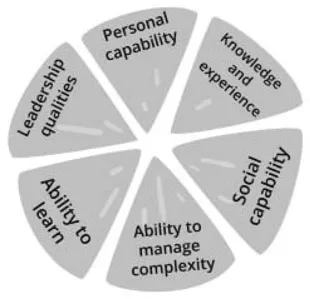
Figure 1.1 Six dimensions of competence.
What are those other dimensions of competence?
Based on an extensive review of the literature combined with empirical data from case studies, six dimensions of competence emerged—namely, knowledge and experience, personal capability, social capability, leadership qualities, ability to learn, and ability to manage complexity, which can be seen in Figure 1.1. Before going into each of these dimensions, it is worth emphasizing that the dimensions differ depending on in which context the person acts, which will be further discussed in Chapter 3 and Chapter 6.
1.2.1 Knowledge and Experience...