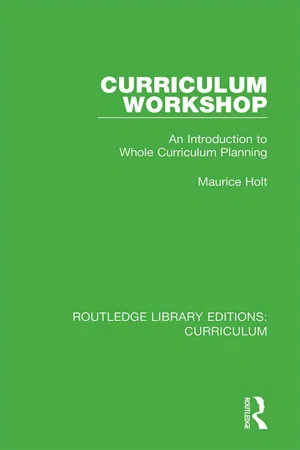
Originally published in 1983. Written by an experienced headteacher and curriculum consultant, this book was written to help schools with the task of planning their whole curriculum - teachers, governors, administrators and students. It provides information on national educational policies of the time, approaches to curriculum planning, and the structures of actual schools. The Department of Education and Science had just issued Circular 6 of 1981, which called upon education authorities, governing bodies, heads and the staffs of schools 'to secure a planned and coherent curriculum within the schools'. The book describes the background to this development; spells out the tasks involved; provides a series of exercises for planning and discussion; and offers ideas, questions and methods. It recognises the diversity of school circumstances, and talks about the vital transition from theory to practice.
- 202 pages
- English
- ePUB (mobile friendly)
- Available on iOS & Android
eBook - ePub
About this book
Information
Chapter 1
Problems and prescriptions: the curriculum context
In a number of schools, headteachers, staff and governors have begun to consider questions like these:
Does the curriculum give adequate weight for all pupils to ‘performance’ subjects like art, music and drama?
Are the specialist skills of the staff effectively deployed, so that all pupils have access to them?
How does the proportion of resources devoted to the teaching of option groups relate to that devoted to the core curriculum?
Is the curriculum broad, balanced and coherent for all pupils?
It is no longer taken for granted that the curriculum of primary or secondary schools is a matter to be left to the professionals, whether they be teachers or curriculum developers; and the professionals themselves no longer assume that the curriculum as it is must represent the best that can be done. It is recognised that the school curriculum expresses educational policy, and that what a pupil takes away from school is a matter of curriculum decisions.
The curriculum, in short, will attract increasing attention from press, public and the profession. Teachers will be required to justify curriculum decisions, both to themselves and to lay observers. These decisions will not get easier, as the world becomes more complex and uncertain. New technology will change the nature of work and leisure, and our views of education itself will change in response to new patterns in society.
This current of doubt and inquiry will be felt in other professions. Doctors, for example, may now find their judgment of a patient’s condition challenged in the courts. Just as the concept of education is under review, so also is the concept of health. But the work of teachers is much closer to the parent, politician and industrialist than that of the doctor. The immediate results of teaching are instantly visible in the home and in the classroom. And there seems to be no limit to the tasks society places on the schools; social, political, health and moral education are all seen as matters for the school curriculum to tackle, at a time when the traditional family unit can no longer be taken for granted, and when we recognise that schools must also respond to the multi-cultural community in which we all live.
The nature of curriculum problems
The professional role of the teacher will, therefore, have to extend to take account of these pressures. In a word, we must recognise that what teachers do is solve curriculum problems.1 All the questions listed above define curriculum problems. Here are some more:
1 What shall I teach 3L on Monday morning?
2 Should we use file paper or exercise books in first year history?
3 Ought we to spend the science capitation on more circuit boards for the third years, or start introducing new textbooks?
4 Should we drop the lunchtime computer club, and spend the time planning a new O level option in computer studies?
5 Is there a case for linking art and craft in a new five-year design course for all pupils?
6 Is it right to exclude pupils from the school during morning break and after lunch?
The conventional view of teacher professionalism assumes that most of these questions are matters for the head of department, or even the headteacher. The first question has to be solved all the time, and yet it is no less important than the others. And to the able, aware teacher, the answer is never obvious. It is not simply a matter of content; content and method are interlinked, and the answer must take account of the resources available, the pupils themselves, and the broad aims of the particular department as well as of the school.
The second question may seem a private matter for the first year history staff. But pupils will go on to the second year, and filed work might be a good basis for what is to follow. So the history department as a whole ought to examine the matter. But perhaps there is a proposal to link history and geography in the first two or three years. In that case, the geographers ought to be brought in. In any event, which is cheaper? Is next year’s capitation likely to run to the provision of a file for every pupil? It would be wise to talk to the co-ordinator for resources, or to the deputy head with this responsibility.
In the same way, the fourth question turns out not to be a private issue for the mathematics staff. The computer club means that all interested pupils can get access to computing. If it becomes an examination option, only those who can fit it into their choices – and who have the requisite ability – can do it. And where will the teaching time come from to staff the option? In any case, is computing merely to do with mathematics?
The next question clearly raises the matter of co-operation between the art and craft departments, and possibly home economics and fabric as well. So it points towards discussion on a faculty basis. But it also raises a fundamental question to do with the whole curriculum: is there a case for requiring all pupils to engage in a design course, from 11 to 16? Does this represent worthwhile curriculum experience for everyone?
The last question looks, at first sight, like one for the head to resolve. But if pupils are free to go in and out of the school during breaks, they will need to be supervised. Are the staff prepared to do this at lunchtime? What are the supposed benefits? Will the pupils be better off? Will their morale be enhanced, but at the price of an additional load on staff?
None of these problems, it turns out, has an obvious answer. Yet they will not go away. Some action is called for: they are practical problems to which some sort of answer must be found.2 By contrast, much educational research is devoted to the pursuit of theoretical problems, which we may or may not find interesting. For example, the problem of why a particular form of pupil grouping gives better results than another may appeal to the university researcher, who may eventually write a paper about it and then leave it for good. His work may, possibly, be of interest to teachers in due course – perhaps even of some value. But the practical problems faced all day long by teachers are of a quite different, and infinitely more urgent, nature from the theoretical problems pursued by most academics.
Moreover, practical curriculum problems are not capable of solution by following a set of rules: we cannot determine the right solution by some ineluctable sequence of instructions. If the overhead projector won’t work, we can adopt a procedural solution to find the answer; we can check the fuse, the plug, the bulb and so on. But if a teacher finds a particular mathematics exercise has been badly done, there is no prescription which will tell him why this is; he can only look again at the work and its context, reflect upon his intentions and actions, perhaps discuss the matter with his colleagues, and then arrive at a defensible course of action. And, at the end of the day, this course of action may not produce the desired effect: curriculum problems are both practical and uncertain.
There is a further important characteristic of the uncertain, practical problems which underline curriculum action. They are also moral problems. In solving them, we must consider not merely our own good, but rather the good of the pupils whom we ultimately serve. It may, for example, be more convenient to teachers if pupils use file paper, since it is easier to carry around a bundle of papers to mark for homework than a pile of exercise books. Buying more science apparatus may make the task of setting up the lessons easier. Running O level computer studies will look good when a teacher applies for another job. Keeping craft as a separate department makes life easier. Turning pupils out at lunchtime guarantees a quiet half hour for everyone in the staff room. But, in practice, teachers respond as professionals to a recognition that the education of their pupils gives them a moral responsibility.
There is, of course, nothing new about this part of the job. But what is new is the recognition that the job cannot be isolated within one’s own particular classroom, or one’s own subject boundary. The decisions that must be taken transcend these boundaries. So every teacher is not just a teacher of some subject; he is professionally part of the whole curriculum of the school. How has this enlargement of professionalism come about?
The cause is simply the fact that society requires all pupils to be offered not any old education, but a good education; and a good education can no longer be seen as a more or less haphazard collection of subjects. A good education has to prepare every pupil for the business of living, in a world where adaptability and personal qualities are as important as specialist knowledge. If, as adults, they will need to look at the world in a coherent and balanced way, then as pupils they will need a curriculum which takes a coherent and balanced view of our culture.
For the moment, the interpretation of coherence and balance will not be taken further. But already this relatively mild observation has challenged the kind of secondary curriculum on offer in the schools studied in the HMI secondary survey Aspects of Secondary Education (1979). The survey shows that an emphasis on separate subjects pursued for their own sake, and on free choice between subjects in option systems, has led to incoherence and imbalance. Already we are in conflict with the grammar school model of the curriculum which our secondary schools inherited from the nineteenth-century public schools.
Once we begin to challenge received practice by identifying curriculum problems – by recognising that the curriculum is problematic – we need ways of handling these problems and seeing them as a characteristic of school activity. Hence the value of the classification outlined above. Solving them then becomes a matter of practical reasoning – which is built up by reflection upon actions and the way they can be justified. It owes much to common sense, but it is more than that: it is to do with fostering a professional tradition by looking at practice in a critical way, generating new insights and trying out fresh possibilities. In this deliberative way, we transcend common sense to create knowledge about practice. Theory and practice inform each other.3
On this critical view, the reorganisation of secondary education into comprehensive schools is not a matter of political doctrine, but merely an acknowledgment of the need to provide for all pupils a common curriculum in common schools. The challenge of living a full and happy life in a complicated industrial society means that it is not enough to offer this pupil an education that is good for university entrance, that pupil one that is good for the building site round the corner; all pupils need an education that is, in its own terms, good.
We are therefore confronting the task of establishing a comprehensive curriculum; and it is something which schools have not in general begun to do. And it clearly is a matter which involves not only judgments about the organisation of learning and the contributions of subjects: it also must take account of a school’s constituency, and of the national context. So it is not really so surprising that the school curriculum has become a major focus of attention.4
Curriculum planning in perspective
Yet it amounts to a significant shift of emphasis from the climate within which, until recently, schools operated. Until 1976 curriculum questions were seen chiefly as matters best left to schools themselves. In the post-war years a low priority was generally given to whole curriculum issues. During the 1950s, the need was to build new schools to meet the demands of the baby boom. In the 1960s, growing affluence and a mood of release from austerity led to comprehensive schools and less rigid teaching in primary schools. But few questions were asked about what the curriculum should be; appropriate forms of organisation were seen as of prior importance. This is not a new phenomenon: the 1944 Norwood Report said little about the curriculum of its proposed secondary modern...
Table of contents
- Cover
- Half Title
- Title Page
- Copyright Page
- Original Title Page
- Original Copyright Page
- Contents
- Preface
- Acknowledgments
- 1 Problems and prescriptions: the curriculum context
- 2 Strategies and structures: approaches to curriculum change
- 3 Case studies and school decisions: the curriculum in practice
- Appendix A Abbreviations and subject codes
- Appendix B Curriculum notation
- Notes
- Bibliography
- Index
Trusted by 375,005 students
Access to over 1.5 million titles for a fair monthly price.
Study more efficiently using our study tools.
Frequently asked questions
Yes, you can cancel anytime from the Subscription tab in your account settings on the Perlego website. Your subscription will stay active until the end of your current billing period. Learn how to cancel your subscription
No, books cannot be downloaded as external files, such as PDFs, for use outside of Perlego. However, you can download books within the Perlego app for offline reading on mobile or tablet. Learn how to download books offline
Perlego offers two plans: Essential and Complete
- Essential is ideal for learners and professionals who enjoy exploring a wide range of subjects. Access the Essential Library with 800,000+ trusted titles and best-sellers across business, personal growth, and the humanities. Includes unlimited reading time and Standard Read Aloud voice.
- Complete: Perfect for advanced learners and researchers needing full, unrestricted access. Unlock 1.5M+ books across hundreds of subjects, including academic and specialized titles. The Complete Plan also includes advanced features like Premium Read Aloud and Research Assistant.
We are an online textbook subscription service, where you can get access to an entire online library for less than the price of a single book per month. With over 1.5 million books across 990+ topics, we’ve got you covered! Learn about our mission
Look out for the read-aloud symbol on your next book to see if you can listen to it. The read-aloud tool reads text aloud for you, highlighting the text as it is being read. You can pause it, speed it up and slow it down. Learn more about Read Aloud
Yes! You can use the Perlego app on both iOS and Android devices to read anytime, anywhere — even offline. Perfect for commutes or when you’re on the go.
Please note we cannot support devices running on iOS 13 and Android 7 or earlier. Learn more about using the app
Please note we cannot support devices running on iOS 13 and Android 7 or earlier. Learn more about using the app
Yes, you can access Curriculum Workshop by Maurice Holt in PDF and/or ePUB format, as well as other popular books in Education & Education General. We have over 1.5 million books available in our catalogue for you to explore.