Students often think of science as disconnected pieces of information rather than a narrative that challenges their thinking, requires them to develop evidence-based explanations for the phenomena under investigation, and communicate their ideas in discipline-specific language as to why certain solutions to a problem work. The author provides teachers in primary and junior secondary school with different evidence-based strategies they can use to teach inquiry science in their classrooms. The research and theoretical perspectives that underpin the strategies are discussed as are examples of how different ones areimplemented in science classrooms to affect student engagement and learning.
Key Features:
Presents processes involved in teaching inquiry-based science
Discusses importance of multi-modal representations in teaching inquiry based-science
Covers ways to develop scientifically literacy
Uses the Structure of Observed learning Outcomes (SOLO) Taxonomy to assess student reasoning, problem-solving and learning
Presents ways to promote scientific discourse, including teacher-student interactions, student-student interactions, and meta-cognitive thinking
This chapter provides an introduction to inquiry teaching in science, models for teaching inquiry, and approaches to evaluating the inquiry process. In recent years, emphasis has been on teaching science using an inquiry approach where students are actively involved in scientific investigations that challenge their curiosity, encourage them to ask questions, explore possible solutions to problems, use evidence to explain phenomena, elaborate on possible effects, evaluate findings, and predict potential outcomes if different variables are changed. This chapter also presents examples of how students are cognitively challenged to make sense of the phenomena under investigation, develop evidence-based explanations, and communicate their ideas and understandings in discipline-specific language as to why solutions to problems work and others do not.
Background
Over the last two decades, emphasis has been on teaching science through inquiry. Inquiry-based science adopts an investigative approach to teaching and learning where students are provided with opportunities to scrutinise a problem, search for possible solutions, make observations, ask questions, test out ideas, and think creatively, and in so doing, learn to reconcile their developing understandings with previous knowledge and experience. Inquiry has many potential benefits. When students are involved in inquiry-based science, they are doing science where they are learning the processes communities of scientists employ to investigate phenomena. In so doing, they learn to explore possible solutions, develop explanations for the topic under investigation, elaborate on concepts and processes, and evaluate or assess their understandings in the light of the evidence available to them. This approach to teaching relies on teachers recognising the importance of presenting problems to students that will challenge their current conceptual understandings so they are forced to reconcile anomalous thinking and construct new conceptual understandings.
Cultivating students’ scientific habits of mind, developing their capabilities to engage in scientific inquiry, and teaching them how to reason in the scientific context is one of the principal goals of science education (National Research Council, 2012, p. 41). In fact, the essential elements in any science education programme must include: (a) the development of conceptual understanding; (b) the improvement of cognitive reasoning; (c) the improvement of students’ understanding of the epistemic nature of science; and (d) the affordance of effective experiences that are both positive and engaging (Osborne, 2006). Furthermore, this needs to occur within the context of social practices and values that both promote and sustain the scientific enterprise and lead to the production of reliable knowledge.
When students have opportunities to engage with their peers in collaborative scientific inquiries, they learn to ask questions about different phenomena, plan investigations, use a variety of tools and artefacts to collect and analyse data, and use evidence to develop claims and propose possible explanations for the phenomena they have observed (Bell et al., 2010; Llewellyn, 2014). In inquiry-based science, students not only learn the relevant content but also learn the discipline-specific reasoning skills and practices by collaboratively engaging in authentic problems or questions with their peers. In so doing, students are cognitively challenged to make sense of the phenomena under investigation, develop explanations that are based on evidence, and communicate their findings in discipline-specific language as to why certain solutions to a problem work and others do not.
When you have finished this chapter, you will know:
What inquiry-based science is.
How inquiry-based science challenges students’ thinking.
Strategies teachers can use to promote inquiry-based science in their classrooms.
Challenges teachers face when implementing inquiry-based science in their classrooms.
Inquiry-Based Science
Inquiry-based science is an investigative approach to teaching and learning where students are provided with opportunities to investigate a problem, search for possible solutions, make observations, ask questions, test out ideas, think creatively, and use their intuition. The inquiry process is complex as it involves students reconciling their current understandings with both the evidence obtained from an inquiry and the ability to communicate their newly acquired knowledge in a way that will be accepted as well-reasoned and logical. Such a process is challenging, requiring teachers to play an active role in helping students learn the steps in the inquiry process.
Scientific inquiry recognises the diverse ways in which scientists study the natural world and propose explanations based on the evidence derived from their work. It also refers to “the activities through which students develop knowledge and understanding of scientific ideas, as well as an understanding of how scientists study the natural world” (National Science Teachers Association, 2004, p. 1). When students have opportunities to engage in scientific inquiry, they learn to use their ideas and, in so doing, deepen their conceptual understanding of scientific content as well as their understanding of how to do science. “This science-as-practice perspective brings together content knowledge and process skills in a manner that highlights their interconnected nature” (Harris & Rooks, 2010, p. 229), facilitating student engagement with complex science ideas and participation in scientific activities. In effect, students gradually learn to understand the practices that scientists engage in when confronting various scientific problems (Herrenkohl et al., 2011).
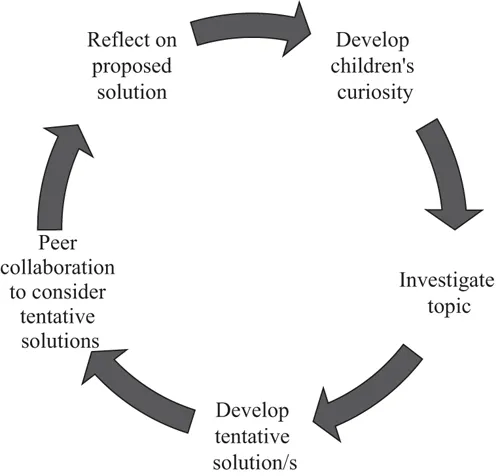
Inquiry is the process of investigating a problem issue that requires critical thinking, observing, asking questions, testing out ideas and hypotheses, and engaging in collaborative discussions to communicate scientific knowledge and develop explanations or solutions on the topic under discussion (Lee et al., 2004; Metz, 2008). While children often demonstrate a natural curiosity about the world in which they live, research indicates that they rarely ask questions about what they have seen and heard. Helping students to understand the inquiry process where they learn to ask questions about phenomena that challenge their current understandings, propose possible explanations for what they see, and reconcile understandings with their current knowledge to create new knowledge and understandings takes a concerted effort on the part of the teacher. While there are many approaches to teaching students how to engage in inquiry, Figure 1.1 represents generally agreed steps in the process.
FIGURE 1.1 Steps in the inquiry process.
Inquiry learning is seen as critically important to helping students engage in science, yet teachers continue to struggle with what inquiry should look like and how it should be taught. Zuckerman et al. (1998) identified three factors that they considered crucial for teaching inquiry science to primary and middle years students. These factors are
1. Arousing students’ imagination by presenting new and awe-inspiring phenomena that are already within students’ current level of development so the child has the capacity to recognise the new elements in the phenomena and to connect these new elements to the context and structure of existing background knowledge and experience.
2. Teachers need to provide opportunities for students to work with others to investigate, discuss, and resolve challenging problems.
3. Students need to be encouraged to participate in asking questions to help them test out their ideas and eventually verify their hypotheses.
The promotion of inquiry is highly dependent on the teachers’ efforts to guide and scaffold students’ learning as they engage in the inquiry process, so they understand how to think as they participate in tasks, as well as acquire the procedural knowledge of how to complete these tasks (Duschl & Duncan, 2009; Veermans et al....
Table of contents
Cover
Half-Title
Series
Title
Copyright
Contents
1 Inquiry-Based Science
2 Visual, Embodied, and Language Representations in Teaching Inquiry-Based Science: A Case Study
3 Developing Scientific Literacy
4 Promoting Scientific Discourse
5 Structuring Cooperative Learning to Promote Social and Academic Learning
6 The Structure of Observed Learning Outcomes (SOLO) Taxonomy: Assessing Students’ Reasoning, Problem-Solving, and Learning
References
Index
Trusted by 375,005 students
Access to over 1.5 million titles for a fair monthly price.
Study more efficiently using our study tools.
Frequently asked questions
Yes, you can cancel anytime from the Subscription tab in your account settings on the Perlego website. Your subscription will stay active until the end of your current billing period. Learn how to cancel your subscription
No, books cannot be downloaded as external files, such as PDFs, for use outside of Perlego. However, you can download books within the Perlego app for offline reading on mobile or tablet. Learn how to download books offline
Perlego offers two plans: Essential and Complete
Essential is ideal for learners and professionals who enjoy exploring a wide range of subjects. Access the Essential Library with 800,000+ trusted titles and best-sellers across business, personal growth, and the humanities. Includes unlimited reading time and Standard Read Aloud voice.
Complete: Perfect for advanced learners and researchers needing full, unrestricted access. Unlock 1.5M+ books across hundreds of subjects, including academic and specialized titles. The Complete Plan also includes advanced features like Premium Read Aloud and Research Assistant.
Both plans are available with monthly, semester, or annual billing cycles.
We are an online textbook subscription service, where you can get access to an entire online library for less than the price of a single book per month. With over 1.5 million books across 990+ topics, we’ve got you covered! Learn about our mission
Look out for the read-aloud symbol on your next book to see if you can listen to it. The read-aloud tool reads text aloud for you, highlighting the text as it is being read. You can pause it, speed it up and slow it down. Learn more about Read Aloud
Yes! You can use the Perlego app on both iOS and Android devices to read anytime, anywhere — even offline. Perfect for commutes or when you’re on the go. Please note we cannot support devices running on iOS 13 and Android 7 or earlier. Learn more about using the app
Yes, you can access Inquiry-based Science Education by Robyn M. Gillies in PDF and/or ePUB format, as well as other popular books in Education & Education General. We have over 1.5 million books available in our catalogue for you to explore.