This book presents a broad overview of pollution issues facing climatic, economic, and legal globalization. Topics include changes in oceans from ancient times to the present, the importance of marine currents and changing climates, marine pollution linked to climate change (fossil fuels, global carbon dioxide, heavy metals, pesticides, plastics, emerging pollutants, and marine debris), global shipping and species invasion, global climate change in the Arctic and Antarctic environments, and regulatory responses to mitigate pollution and climate change in oceans.
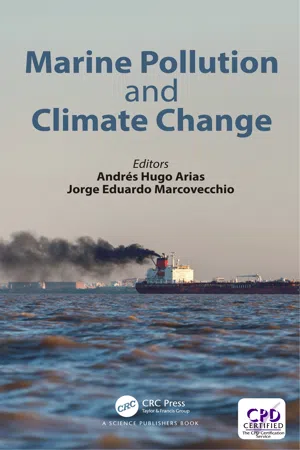
eBook - ePub
Marine Pollution and Climate Change
- 336 pages
- English
- ePUB (mobile friendly)
- Available on iOS & Android
eBook - ePub
Marine Pollution and Climate Change
About this book
Information
Contents
Preface
1. Ancient vs. modern oceans: Perspectives in a climate change scenario
Jorge E. Marcovecchio, Silvia G. De Marco and Walter D. Melo
2. South atlantic circulation and variability from a data assimilating model
Elbio D. Palma and Ricardo P. Matano
3. The issue of fossil fuels at the ocean: Emissions to the sea and contribution to global co2
A.V. Botello, G. Ponce-Velez, L.A. Soto and S.F. Villanueva
4. Continent derived metal pollution through time Challenges of the global ocean
Luiz Drude de Lacerda and Jorge Eduardo Marcovecchio
5. Emerging pollutants in the global change scenario
Bernd Markert, Stefan Fränzle, Simone Wünschmann and Peter Menke-Glückert
6. Marine debris
H.B. Jayasiri
7. Global Shipping, ballast water and invasive Species
Sami Souissi, Olivier Glippa and Hans-Uwe Dahms
8. High Seas Deep-Sea Fisheries under the Global Changing Trends
Gui Manuel Machado Menezes1 and Eva Giacomello
9. Globalization of the antarctic seas pollution and climate change perspectives
Rosalinda Carmela Montone, César de Castro Martins, Marcos Henrique Maruch Tonelli, Tailisi Hoppe Trevizani, Marcia Caruso Bícego, Rubens Cesar Lopes Figueira, Ilana Elazari Klein Coaracy Wainer and Jorge E. Marcovecchio
10. International regulatory responses to global challenges in marine pollution and climate change
Yubing Shi and Dazhen Zhang
Index
Preface
As stated by the IPCC, human influence on the climate system is clear, and recent anthropogenic emissions of greenhouse gases are the highest in history. The atmosphere and oceans have warmed, the amounts of snow and ice have diminished, and sea levels have risen. The same sources of greenhouse gases have also generated a variety of pollutants which after releasing and circulating in the air, water streams, soils and organisms eventually end up in the oceans. These concomitant pollutants are driving rapid changes such as decline in sea ice, receding of glaciers and permafrost, increased snow melt and runoff, shifted ranges for plants and animals, changes in populations, timing of many life-cycle events—such as blooms and migration, decoupling of species interactions, damages due to droughts and floods, etc. This book aims to cover the main groups of pollutants impacting the oceans and their effects in the light of the greenhouse gases induced changes.
Marine Pollution and Climate Change presents a comprehensive analysis of marine pollution including contributions from an impressive group of international oceanographers.
The book begins with a look at the state of oceans as they were earlier: what were the environmental and oceanographic conditions of the primitive oceans and what are the main differences/similarities with the modern ocean? Chapter 2 delves into the South Atlantic circulation, throwing light on “El niño” and “La niña” interactions. Chapter 3 tackles the first big family of ocean pollutants: hydrocarbons and greenhouse emissions. In this chapter, there is a review on the state and consequences of the present main energy paradigm: the petroleum combustion. Chapter 4 explores the interaction between the continents and the ocean harbors processes that originate the flux of metals, energy and organisms across those interfaces. Chapter 5 covers the general aspects and features of emerging pollutants in the global change scenario, highlighting the strong need of sustainable developments as the primary goal for reaching healthy ecosystems and environments. Chapter 6 addresses the issue of marine debris: man-made items of debris are now found in marine habitats throughout the world, from the poles to the equator, from shorelines and estuaries to remote areas of the high seas, and from the sea surface to the ocean floor. Chapter 7 combines the study of two ocean hazards: biological pollution and climate change. As the global ship networking is expected to increase in the future, a reduction in natural barriers for the dispersal of aquatic species is expected. This gets worse in the framework of global climate change. Chapter 8 gives to the readers an outstanding view of high-seas fisheries (demersal fishes), covering historical and present trends, vulnerability and actual threats posed by climate change to this activity. Chapter 9 innovatively studies the scarcely covered issue of the Antarctic sea’s pollution and the incoming climate changes, giving an updated and accurate overview about climate system, hydrocarbons, metals, sewage and occurrence of persistent organic pollutants in the area. Finally, examines, international laws pertaining to marine pollution and changes in the oceans and gives a precise overview of the protected and unprotected boundaries of the ocean.
The preparation of this book was significantly facilitated by the collaborative efforts of each of the authors. We are indebted to them, main players in the realization of this book, and the many other colleagues who provided valuable suggestions and support during the entire process of development of the book. An acknowledgement is also given to the main editorial board and all the editorial staff who provided us with the confidence and help to accomplish this project which started in late 2014.
Last but not least, the editors and everyone close to Dr. Peter Menke- Glückert wish to dedicate this book to him in memoriam. Peter suddenly passed away during preparation of the first version of Chapter 5 in September 2016. Peter was a totally exceptional person with enormous knowledge paired with an excellent education, rational intelligence and emphatic and human breakthroughs. From scientific, political as well as human point of view, he was one of the most influential person in Germany, Europe and worldwide. For instance, he developed under the leadership of the German former Minister of Foreign Affairs, Hans Dietrich Genscher, the Green and Sustainable developments in the 60s, 70s, 80s and 90s of the past century. In addition, Peter was one of the front men of the Liberal Party in Germany (FDP). To him, our most heartfelt remembrance.
October 2016
Editors
Instituto Argentino de Oceanografía (IADO), CONICET Universidad Nacional del Sur (UNS)
Argentina
1
Ancient vs. modern oceans: Perspectives in a climate change scenario
Abstract
The Ocean has historically been recognized as an essential regulator of climate within Earth planet, taking significant roles in different processes like generation of wind fields and storms, changes in biogeochemical balances, global circulation and heat fluxes. Changes in the ocean conditions can directly affect the climate system, not only due to its role on the energy fluxes of the planet, but also by regulating the running and performance of numerous biogeochemical cycles. Marine ecosystems provide numerous services, including food production, wastes discharge and degradation, protection of shorelines against storms, climate and atmosphere dynamics regulation, tourism development, among others.
Had the ocean always played these environmental roles along the history of the planet?... How were the environmental and oceanographic conditions of the primitive oceans?... Which are the main differences and similarities between ancient and modern oceans?...
The sequence of scenarios: The Archean Ocean - The Proterozoic Ocean - The Paleozoic Ocean - The Mesozoic Ocean - The Cenozoic Ocean - The Modern Ocean: from Pleistocene and up to now.
The future evolution of the oceans is underway, and certainly in the next few million years the planet will have a different image, and changes the oceans generate will determine how life should continue on Earth…
Introduction
The history, origin and environmental properties and characteristics of the Oceans, not only the present but also the primitive ones, are an excellent framework which allows to re-build old stages of our planet, as well as the processes which have governed changes between each of them. This step is quite significant considering the Earth is continuously evolving, and the historical sightseeing could be a nice starting point to understand the future of our planet.
The role of the oceans in the present day
The Ocean has historically been recognized as an essential regulator of climate in our planet, playing a significant role in different processes like generation of wind fields and storms, changes in biogeochemical balances, global circulation and heat fluxes (Ganachaud and Wunsch 2000). It is well known that the exchange of latent heat, sensible heat and radiative fluxes between the ocean and the atmosphere represents a significant source for Ocean/Atmosphere interactions, including processes of warming due to increases within atmospheric CO2 concentration (or other greenhouse causing gases) (Ramanathan 1981).
The Oceans contains about fifty times more carbon than the atmosphere; this fact has been extensively explained through the concept of biological pump, which is a mechanism involving either physical or biological processes directed to produce an oceanic carbon sink, balancing CO2 concentration within the atmosphere (Hernández-León et al. 2010; Lam et al. 2011; Karl et al. 2012). The decrease of pH in seawater responding to absorption of anthropogenic CO2 has been defined as ocean acidification (i.e., Doney et al. 2004; 2007), and can significantly impact marine ecosystems (Bates and Peters 2007).
Changes in the ocean conditions can directly affect the climate system, not only due to its role on the energy fluxes of the planet, but also by regulating the running and performance of numerous biogeochemical cycles (Rahmstorf 2002). ...
Table of contents
- Cover
- Halftitle
- Title
- Copyright
- Table of Contents
Trusted by 375,005 students
Access to over 1.5 million titles for a fair monthly price.
Study more efficiently using our study tools.
Frequently asked questions
Yes, you can cancel anytime from the Subscription tab in your account settings on the Perlego website. Your subscription will stay active until the end of your current billing period. Learn how to cancel your subscription
No, books cannot be downloaded as external files, such as PDFs, for use outside of Perlego. However, you can download books within the Perlego app for offline reading on mobile or tablet. Learn how to download books offline
Perlego offers two plans: Essential and Complete
- Essential is ideal for learners and professionals who enjoy exploring a wide range of subjects. Access the Essential Library with 800,000+ trusted titles and best-sellers across business, personal growth, and the humanities. Includes unlimited reading time and Standard Read Aloud voice.
- Complete: Perfect for advanced learners and researchers needing full, unrestricted access. Unlock 1.5M+ books across hundreds of subjects, including academic and specialized titles. The Complete Plan also includes advanced features like Premium Read Aloud and Research Assistant.
We are an online textbook subscription service, where you can get access to an entire online library for less than the price of a single book per month. With over 1.5 million books across 990+ topics, we’ve got you covered! Learn about our mission
Look out for the read-aloud symbol on your next book to see if you can listen to it. The read-aloud tool reads text aloud for you, highlighting the text as it is being read. You can pause it, speed it up and slow it down. Learn more about Read Aloud
Yes! You can use the Perlego app on both iOS and Android devices to read anytime, anywhere — even offline. Perfect for commutes or when you’re on the go.
Please note we cannot support devices running on iOS 13 and Android 7 or earlier. Learn more about using the app
Please note we cannot support devices running on iOS 13 and Android 7 or earlier. Learn more about using the app
Yes, you can access Marine Pollution and Climate Change by Andres Hugo Arias, Jorge Eduardo Marcovecchio, Andres Hugo Arias,Jorge Eduardo Marcovecchio in PDF and/or ePUB format, as well as other popular books in Physical Sciences & Biology. We have over 1.5 million books available in our catalogue for you to explore.