"The political and economic changes that occurred in the Soviet Union in the six and one-half years of Mikhail Gorbachev's tenure as General Secretary were breathtaking in their scope and rapidity, going far beyond most observeiS' expectatiom. Certainly, the process of refonn which we call perestroilal transfonned the ossified one-party socialist state that had prevailed underGorbachev's predecessors. The reasons for embarking on such a coume of reform were varied-eamomic aism and a decline in the Soviet state's ability to provide social welfare services for its citizens, an increasingly
apathetic population, and a tense international environment-all of
these factoiS convinced the Soviet leadeiShip of the necessity of drastic
change. The policies of Gorbachev set refonn in motion: freeing public
expression (glllsnost); encouraging economic decentralization and private
initiative; and creating a more cooperative relationship with the West."
eBook - ePub
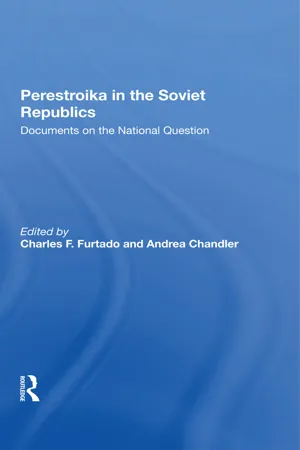
Perestroika In The Soviet Republics
Documents On The National Question
- 646 pages
- English
- ePUB (mobile friendly)
- Available on iOS & Android
eBook - ePub
Perestroika In The Soviet Republics
Documents On The National Question
About this book
Information
1
Introduction
The political and economic changes that occurred in the Soviet Union in the six and one-half years of Mikhail Gorbachev’s tenure as General Secretary were breathtaking in their scope and rapidity, going for beyond most observers’ expectations. Certainly, the process of reform which we call perestroika transformed the ossified one-party socialist state that had prevailed under Gorbachev’s predecessors. The reasons for embarking on such a course of reform were varied—economic crisis and a decline in the Soviet state’s ability to provide social welfare services for its citizens, an increasingly apathetic population, and a tense international environment—all of these factors convinced the Soviet leadership of the necessity of drastic change.1 The policies of Gorbachev set reform in motion: freeing public expression (glasnost); encouraging economic decentralization and private initiative; and creating a more cooperative relationship with the West.
But perhaps the most striking political by-product of reform was entirely unintended: the emergence of politically assertive national movements in the Soviet Union’s fifteen Union republics.2 Over the past six years, dozens of ethnic groups burst onto the political scene, producing a complicated series of nationality-related events that took most observers, including the Soviet leadership, by surprise. Indeed, what was unthinkable at the time of Gorbachev’s ascension to power—the dissolution of the Soviet Union, itself—has now occurred. The purpose of this book is to place these dramatic events in perspective by gathering together primary source material on events within the republics from 1985 to 1991.
Background
Prior to Gorbachev’s accession to power, Soviet leaders believed that nationality differences would fade away under the modernizing influence of socialism. In the Brezhnev era, Soviet theoreticians spoke of the dual processes of sblizhenie and sliyanie (meaning drawing together and fusion, respectively) by which it was assumed that the various Soviet peoples, once granted equal rights under socialism, would merge ever closer, finally fusing into one internationalist Soviet people.3 The fifteen major Union republics and indigenous peoples that made up the Soviet Union were joined in what was called a federation of sovereign republics. Yet this federation was actually a highly centralized and hierarchical political system—its centrally planned economy directed from Moscow and its political life dominated by a Communist Party that sought to suppress alternative political thinking. In this multinational state, Russians were the dominant ethnic group, holding the vast preponderance of positions in central Party, state, and military institutions.4 As for the republics, their autonomy was increasingly circumscribed—the center keeping a watchful eye on manifestations of “local nationalism,” facilitating its control through the placement of non-indigenous (read Russian) elites among national cadres.
Scholars and observers differed in their assessments of the success of these efforts at “national integration.” In some sense, their equivocal opinions mirrored the mixed record of Soviet achievements regarding the nationalities. To its credit, the regime did invest heavily in the economic development of the republics, creating social welfare systems and opportunities for the upward social mobility of national groups. On the other hand, the system contained a built-in contradiction between its centralized structures and its formal recognition of the republics’ national sovereignty, a flaw that held the potential for ethnic conflict, particularly if socioeconomic conditions were to decline.5 Moreover, the record of Soviet treatment of the nationalities was also fatally compromised by the use of violence, particularly during Stalin’s reign, when national elites were crushed and entire groups, such as the Crimean Tatars and Volga Germans, were deported from their historic homelands.
The less than total success of Soviet nationality policy meant that ethnic problems predated perestroika. In fact, they served as an important organizing focus for the dissident movement of the post-Stalin era. For example, the Helsinki Watch groups, formed in the mid-1970s in a number of republics including Ukraine, Latvia, and Georgia, constituted a remarkable amalgam of political movements demanding human rights on behalf of various ethnic and political movements6 Yet this key trend in Soviet politics was often overlooked or downplayed by Soviets and Westerners alike.
This, of course, was partly due to the logistical difficulties involved in comprehensively studying the existence of nationality problems. Not only was there the problem of determining just what was going on in the republics, but what significance to ascribe to it. For example, how important a phenomenon was national dissent? Obtaining a satisfactory answer to this question was further complicated by the tactics of the regime, itself. Its harsh punishment of individuals for even the slightest demonstration of political independence caused criticism of the regime (outside of dissident circles) to be expressed in veiled and cautious terms. The certainty of suppression guaranteed that few people would be willing to risk involvement in nationalist movements—a practice that made the detection of national dissent and its key sources of social support exceedingly difficult7
Early Political Reforms: The Opening
Over twenty years ago, Zbigniew Brzezinski argued that the fear of nationality unrest was a conservative force, preventing the Soviet leadership from undertaking broad political reform.8 While it is now almost commonplace to say that glasnost fostered the growth of nationalism by allowing the articulation of long-repressed national tensions, it is certainly true that this policy provided for an unprecedented freedom of expression, which included an airing of nationalist views and an increased tolerance for demonstrations of national sentiments. Its counterpart, demokratizatsiia, further propelled the growth of national movements by providing them with legal rights including the opportunity to nominate candidates to elective office.
Placing such developments in perspective, some scholars argue that it is natural for a formerly authoritarian society to experience a dramatic outburst of political expression in order to release pressures that have built up over decades. They argue that, during a transition from a repressive system, one must expect that people will seek recognition and redress of past ills perpetrated by the old regime.9 Such conflict need not be fatal; managed successfully, it can subside. In the Soviet context, such issues were at the heart of mass nationalist mobilization. Focusing on the “blank pages” of Soviet history, national movements pressed the Soviet regime to own up more fully to the “crimes of the Stalin era.” This trend was most apparent in the Baltic states, where national movements called upon the regime to admit its illegal incorporation of Estonia, Latvia, and Lithuania in 1940 under the so-called Molotov-Ribbentrop Pact Yet it emerged in other republics as well—the Ukrainian terror-famine, the massacre in the Kuropaty Woods in Byelorussia, the illegal annexation of Moldavia, the center’s “duplicity” in the territorial designation of Nagorno-Karabakh—Soviet history became a battleground of passionate ethnic mobilization.
Yet Soviet political reform amounted to more than efforts at political liberalization, the regime also sought to rationalize its methods of rule. And these too had a profound effect on the development of national relations in the Gorbachev era. This was most dramatically demonstrated in Gorbachev’s battle against corruption. Under Brezhnev, republican parties were allowed a degree of autonomy in determining their own affairs, which enabled republican leaders to subvert the economic plan and corrupt local networks to emerge.10 By the time Gorbachev came to power, the situation had run so rampant that one of his first moves was to attempt to remove the corrupt officials who were seen as a burden on the system.
However, such moves aroused national feelings as the center was viewed as dismissing local, non-Russian authorities with a heavy hand, especially when those officials were replaced by Russians. Such perceptions led to the first major national incident under Gorbachev: the riots that erupted in Alma-Ata, Kazakhstan, over the replacement of the republic’s Communist Party First Secretary, Dinmukhamed A. Kunayev, with an ethnic Russian, Gennady V. Kolbin. This event not only revealed the continuing delicate nature of the national question, but the ease with which Soviet citizens could see measures of central fiat as acts of Russian domination.11
Local hostility was also engendered by the cultural policy of Russification; in particular, by central pressure to use the Russian language rather than that of the native inhabitants in education and in public life. The issue of language rights has been a significant component of contemporary ethnic conflicts in general, and of nationality conflicts in the Soviet Union, in particular.12 While the regime always officially encouraged the development of non-Russian languages and cultures, it also promoted Russian as the “interethnic means of communication.”13 In practice, as Ivan Dzyuba wrote more than twenty years ago, this meant the imposition of Russian.14 While opposition to Russification was suppressed under Brezhnev, public protests did occasionally occur.15 Under glasnost, this policy was one of the first to be challenged, with national movements becoming increasingly assertive in both the defense of the native language and the rejection of Russian. This eventually led to the adoption of laws in every non-Russian republic that bestowed upon the indigenous tongue the status of “official language.”
Economic Reform: Republican Khozraschet and the Republics
Yet nationalist mobilization in the Gorbachev era was not only concerned with political and cultural issues, economic reform was also a focus of intense debate between the center and periphery. In this connection, a number of points should be addressed. First, the concept of economic decentralization of the centrally planned economy presumed that the republics would be given more economic autonomy and initiative. That this coincided with the growth of demands for republican autonomy was clearly no accident.16 Second, the drive for republican khozraschet—i.e., to make the republics more responsible for balancing their own expenditures—was problematic, as republics began to be more sensitive to the ways in which they were being economically “exploited” and, in this connection, to question the center’s allocation of their budgetary resources.17 With Moscow largely in control of their economies, where the balance of power should lie between center and republic, became a very thorny issue on the political agenda.
Those republics that were relatively resource-rich began to see economic self-sufficiency as a viable possibility and sovereignty as in their best interests. Leaders, first in the Baltic states, and later in Georgia, Ukraine, and the RSFSR, came to envisage a wealthier future for their republics—a future in which resources would not be drained off by Moscow. The Central Asian republics, standing to lose valuable investment from the center, did not view the prospect of greater political and economic sovereignty in as sanguine a manner. In fact, Uzbekistan met such proposals for economic reform with the accusation that the Soviet regime had deliberately fostered its cotton economy, in effect transforming the republic into a colony.18
The reform’s removal of selected central economic controls enhanced the tendency for national groups to become immersed in a competition for their own interests. Taken together with the removal of the old police controls, and the party’s toleration of national demonstrations and expression, these moves facilitated the rapid buildup of nationalist movements, allowing people to imagine new political possibilities, and to see the pursuit of greater sovereignty, even secession, as a strategy that maximized their interests.19
The Momentum in the Republics
The freedom of expression that glasnost allowed, as well as the confusion unleashed by perestroika generally, was used to call for the secession of republics from the Soviet Union. The Baltic republics, which as independent states in the interwar period were forcibly incorporated into the Soviet Union in 1940, were the first to assert their national independence. The populations of these republics, ethnically quite different from Slavs and enjoying a relatively high standard of living, saw few benefits in remaining a province of the Soviet Union. In 1989 the political climate of the country made secession seem possible. An increase in calls for independence in the Baltic republics and Georgia contributed to an escalation in other republics’ sovereignty demands.
Eventually, with the Lithuanian crisis of 1990, Gorbachev agreed that the Soviet federal system would have to be changed. By the summer of that year, virtually all the republics had passed sovereignty declarations. The first of t...
Table of contents
- Cover
- Half Title
- Title
- Copyright
- Contents
- Acknowledgments
- 1 Introduction
- 2 Documents from the Center
- 3 Documents from the Baltic Republics
- 4 Documents from the Soviet West
- 5 Documents from the Russian Soviet Federated
- 6 Documents from the Caucasus
- 7 Documents from Central Asia
- Appendix: A Chronology of Nationality-Related Events 1985–1991
Trusted by 375,005 students
Access to over 1.5 million titles for a fair monthly price.
Study more efficiently using our study tools.
Frequently asked questions
Yes, you can cancel anytime from the Subscription tab in your account settings on the Perlego website. Your subscription will stay active until the end of your current billing period. Learn how to cancel your subscription
No, books cannot be downloaded as external files, such as PDFs, for use outside of Perlego. However, you can download books within the Perlego app for offline reading on mobile or tablet. Learn how to download books offline
Perlego offers two plans: Essential and Complete
- Essential is ideal for learners and professionals who enjoy exploring a wide range of subjects. Access the Essential Library with 800,000+ trusted titles and best-sellers across business, personal growth, and the humanities. Includes unlimited reading time and Standard Read Aloud voice.
- Complete: Perfect for advanced learners and researchers needing full, unrestricted access. Unlock 1.5M+ books across hundreds of subjects, including academic and specialized titles. The Complete Plan also includes advanced features like Premium Read Aloud and Research Assistant.
We are an online textbook subscription service, where you can get access to an entire online library for less than the price of a single book per month. With over 1.5 million books across 990+ topics, we’ve got you covered! Learn about our mission
Look out for the read-aloud symbol on your next book to see if you can listen to it. The read-aloud tool reads text aloud for you, highlighting the text as it is being read. You can pause it, speed it up and slow it down. Learn more about Read Aloud
Yes! You can use the Perlego app on both iOS and Android devices to read anytime, anywhere — even offline. Perfect for commutes or when you’re on the go.
Please note we cannot support devices running on iOS 13 and Android 7 or earlier. Learn more about using the app
Please note we cannot support devices running on iOS 13 and Android 7 or earlier. Learn more about using the app
Yes, you can access Perestroika In The Soviet Republics by Charles F Furtado,Andrea Chandler in PDF and/or ePUB format, as well as other popular books in Storia & Storia mondiale. We have over 1.5 million books available in our catalogue for you to explore.