The turn of the twentieth century witnessed the birth of two distinct philosophical schools in Europe: analytic philosophy and phenomenology. The history of 20th-century philosophy is often written as an account of the development of one or both of these schools, as well as their overt or covert mutual hostility. What is often left out of this history, however, is the relationship between the two European schools and a third significant philosophical event: the birth and development of pragmatism, the indigenous philosophical movement of the United States. Through a careful analysis of seminal figures and central texts, this book explores the mutual intellectual influences, convergences, and differences between these three revolutionary philosophical traditions. The essays in this volume aim to show the central role that pragmatism played in the development of philosophical thought at the turn of the twentieth century, widen our understanding of a seminal point in the history of philosophy, and shed light on the ways in which these three schools of thought continue to shape the theoretical agenda of contemporary philosophy.
eBook - ePub
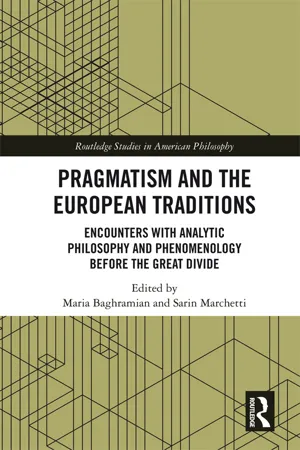
Pragmatism and the European Traditions
Encounters with Analytic Philosophy and Phenomenology before the Great Divide
- 294 pages
- English
- ePUB (mobile friendly)
- Available on iOS & Android
eBook - ePub
Pragmatism and the European Traditions
Encounters with Analytic Philosophy and Phenomenology before the Great Divide
About this book
Information
Part I
Early Encounters
1 Husserl and Wittgenstein
Two Very Different, but Potentially Complementary Readings of William James
In his Origins of Analytical Philosophy, Michael Dummett (1993: ix–xi) remarks that the most effective way to enrich communication between the philosophical traditions of analytic philosophy and phenomenology is to pay closer attention to the histories of their development and gradual divergence. He adds that he regrets that he had taken a basically unhistorical approach in his earlier books on Frege. He further suggests that the traditions initiated by Frege and Husserl may be traced to their common sources in Brentano’s account of intentionality and Bolzano’s critique of psychologism, and he concludes that interest in the philosophical past is “the pre-condition of mutual comprehension” (Dummett 1993: xi).
In the same spirit, Jitendra Mohanty, in his earlier Husserl and Frege (1982: 1–17) pointed out that Husserl and Frege had themselves engaged in extensive and amicable debate, particularly on how better to refute the claims of psychologism. However, as Mohanty also noted, such exchanges unfortunately became increasingly rare among their followers, who have tended in general to ignore one another’s works.
In recent years, considerable progress has been made in restoring a climate conducive to renewed dialogue. The conciliatory approaches of Mohanty and Dummett were thus steps in the right direction, but I do not think that their analyses adequately explain the breakdown in communication between these two philosophical traditions. In what follows, I propose to focus on the more proximate and, I think, more enduring influence of William James on these two traditions. My thesis is that the different readings of William James’s The Principles of Psychology by Husserl and Wittgenstein have contributed more significantly to the differing methodologies of the founding works of Phenomenology and Analytic Philosophy than the debate about psychologism between Frege and Husserl.
In preparing to teach a course on Frege and Husserl several years ago, I happened upon two comments that first inclined me to look in the direction of William James for clues to the differences between the methodologies of analytic philosophy and phenomenology. The first comment was a word of thanks by Husserl in Logical Investigations (1970: 420n) for James’s help in avoiding the pitfalls of psychologism:
It will be apparent from the present work that James’ genius-like observations in the field of descriptive psychology are far from making psychologism inevitable. For the help and progress that I owe to this excellent investigator in the field of descriptive analysis have only aided my emancipation from the psychologistic position.
The second comment occurs in “The Theory of Meaning” an essay by Gilbert Ryle (1957). Commenting on the anti-psychologism of many philosophers and logicians at the turn of the twentieth century, Ryle first notes that Meinong and Husserl, both students of Brentano, derived their critiques of psychologism from Brentano’s principle of intentionality, arguing that the British empiricists, Locke, Hume, and Mill, fail to distinguish properly between our private, momentary, and repeatable mental processes and their intentional accusatives—namely, the concepts and propositions that constitute their objective correlates. He then describes the difference between Husserl and Frege as follows: Husserl finds the conditions of meaning in the realm of interiority, even though he distinguishes between private intentional acts and their publicly expressed meanings. Frege, on the other hand, rejects the psychologistic mentality more decisively and completely by detaching semantics, the study of meanings, entirely from the description of psychological processes. In summary, Ryle (1957: 261) observes, “Where Frege attacked psychologistic accounts thinking from the outside, they [Meinong and Husserl] attacked them from the inside.” In Frege: Philosophy of Language, Dummett (1981: xxiii) points out in addition that Wittgenstein later completed and perfected Frege’s revolution. He notes that Wittgenstein’s interpretation of meanings as conventional rules governing linguistic usage “eventually provoked the collapse of the post-Cartesian notion that genetic questions about the acquisition of concepts have priority over semantic questions about the relationship between propositions and their truth-values.”
What intrigued me most about these perceptive comments was Ryle’s distinction between Husserl’s critique of psychologistic thinking “from the inside” and Frege’s critique “from the outside.” I propose to develop this theme by focusing on specific passages from James’s Principles whose interpretations by Husserl and Wittgenstein have had significant influence on the subsequent development of phenomenology and analytic philosophy. In Part I, devoted to a consideration Husserl’s reading of the Principles, I shall focus on James’s methodology in his accounts of time-consciousness and self-awareness, emphasizing how his approach to these topics has influenced the predominantly “first-person” methodology of Husserl and the subsequent phenomenological tradition. In Part II, devoted to Wittgenstein’s reading of the Principles, I shall focus on Wittgenstein’s emphasis on conceptual analysis rather than first-person description, an approach that gives a Kantian tone to his methodology and eventually yields the priority given to the “third-person” approach of the subsequent analytic tradition. In particular, I shall consider Wittgenstein’s account in The Brown Book of how linguistic competence, rather than first-person experience, provides the key to our sense of time. Finally, a brief concluding section will be devoted to an analysis of the complementarity of Husserl’s and Wittgenstein’s readings of James. In developing the latter thesis, I will be guided by Thomas Nagel (1986: 20), who contends that “the reconciliation of first-person and third-person points of view within a general account of rationality is a primary philosophical task of human life.”
1 Husserl’s Reading of William James’s The Principles of Psychology
In his history of the phenomenological movement, Herbert Spiegelberg (1960: 113–14) recounts that on several occasions Husserl told his colleagues and students that he had abandoned his original project of writing a work on psychology on the premise that William James had already said what he wanted to say. Spiegelberg also notes that, in addition to Husserl’s remarks about how a reading of James’s Principles of Psychology had helped him to avoid the errors of psychologism, Husserl (1970: 420n) also explicitly refers to the influence on his work of James’s discussion in the Principles of the “fringes” that accompany all of our perceptual presentations of objects.
According to James (1981a: 249–50), our perceptual experience presents us from the outset with complex wholes rather than unconnected bits of sensory data. We are most often presented with objects surrounded by accompanying “fringes.” These include foregrounds and horizons, objects dimly perceived in the background, and various “transitional relationships.”
James’s emphasis on the fringes within our perceptual world is intimately connected to two key themes in the development of his methodology in the Principles: his criticism of the role of sense-data in British empiricism and his rejection of Kant’s account of the relationship between percepts and concepts. In one of the opening chapters of the Principles entitled “The Methods and Snares of Psychology,” James (1981a: 195) warns psychologists and philosophers about what he calls the “Psychologist’s Fallacy.” This fallacy occurs whenever the investigating psychologist confuses “his own standpoint with that of the mental fact about which he is making his report.” We do not experience our mental states in the same way that we experience their objects. From the point of view of the subject having a perception or a thought, “the mental state is aware of itself from within.” The perception or thought does not, however, take itself as an object: “What the thought sees is only its own object.” From the outside point of view of the investigator, however, both the thought and its object are objects of investigation. Hence, the fallacy may occur when the investigator ascribes the same sort of objective status to the mental state under investigation as he does to its object. In the same passage, James also observes that avoidance of this fallacy makes it possible to resolve the “so called question of presentative or representative perception, of whether an object is present to the thought that thinks it by a counterfeit image of itself, or directly and without any intervening image at all.” James’s reference to such representative images as “counterfeit” makes it clear that he holds the alternative position that our perceptions and thoughts are presentative rather than representative. James (1981a: 234) confirms this impression when he later suggests that the British empiricists were guilty of this fallacy because they claimed that we are initially aware only of sense-data that are assembled into clusters whose configuration is determined by association based upon their contiguity within the mind’s representational space. On this interpretation, the primary objects of our consciousness are sense-data, which we must somehow interpret as representatives of the real entities in the world that we only seem to know directly. Referring to the later versions of this representational account in the works of Taine and Helmholtz, James makes the following forceful commentary:
The supposition that a sensation primitively feels itself or its object to be in the same place with the brain is absolutely groundless, and neither an a priori probability nor facts from experience can be adduced to show that such a deliverance forms any part of the original cognitive function of our sensibility.
(James 1981b: 680–1)
James’s critique of the psychologist’s fallacy is remarkably similar to Husserl’s critique of philosophies that remain captive to what he calls the natural attitude, as opposed to the phenomenological attitude. The natural attitude is the viewpoint of everyday life in all of its richness and variety. Included within the natural attitude are the various perspectives of the natural sciences. According to Husserl, what distinguishes a properly philosophical perspective is its attitude of wonder at our dual status as entities within the world and as beings capable of rational knowledge of the world. What distinguishes phenomenology from other philosophical approaches is its emphasis on the manifold ways of the world’s appearing to us. Phenomenology focuses on the world as experienced. Husserl claims that access to the phenomenological attitude requires a “bracketing” of the natural attitude of everyday life. In the natural attitude, we experience ourselves as having direct acquaintance of a world and also of belonging to that world, but we do not ordinarily pay attention to the appearing of that world. As Robert Sokolowski (2000: 50) puts it, “We go right through the appearing of the world to the world itself.” As a result, when we do consider questions about how the world appears to us, we tend to consider modes of causality within the world or consider products of human ingenuity such as pictures or computing devices as models for understanding how the world appears to us. By bracketing the natural attitude and adopting the phenomenological attitude, we look at what we normally look through. We focus on the manifold ways in which things in the world and the world itself appear to us. Hence we do not fall victim to the kind of fallacy described by William James. When we see the world itself as a phenomenon, we do not attribute the same ontological status to things and the app...
Table of contents
- Cover
- Title
- Copyright
- Dedication
- Contents
- Acknowledgments
- Philosophy in the Twentieth Century: The Mingled Story of Three Revolutions
- Part I Early Encounters
- Part II Later Encounters
- Contributors
- Index
Trusted by 375,005 students
Access to over 1.5 million titles for a fair monthly price.
Study more efficiently using our study tools.
Frequently asked questions
Yes, you can cancel anytime from the Subscription tab in your account settings on the Perlego website. Your subscription will stay active until the end of your current billing period. Learn how to cancel your subscription
No, books cannot be downloaded as external files, such as PDFs, for use outside of Perlego. However, you can download books within the Perlego app for offline reading on mobile or tablet. Learn how to download books offline
We are an online textbook subscription service, where you can get access to an entire online library for less than the price of a single book per month. With over 1.5 million books across 990+ topics, we’ve got you covered! Learn about our mission
Look out for the read-aloud symbol on your next book to see if you can listen to it. The read-aloud tool reads text aloud for you, highlighting the text as it is being read. You can pause it, speed it up and slow it down. Learn more about Read Aloud
Yes! You can use the Perlego app on both iOS and Android devices to read anytime, anywhere — even offline. Perfect for commutes or when you’re on the go.
Please note we cannot support devices running on iOS 13 and Android 7 or earlier. Learn more about using the app
Please note we cannot support devices running on iOS 13 and Android 7 or earlier. Learn more about using the app
Yes, you can access Pragmatism and the European Traditions by Maria Baghramian, Sarin Marchetti, Maria Baghramian,Sarin Marchetti in PDF and/or ePUB format, as well as other popular books in Philosophy & Analytic Philosophy. We have over 1.5 million books available in our catalogue for you to explore.