- 140 pages
- English
- ePUB (mobile friendly)
- Available on iOS & Android
eBook - ePub
About this book
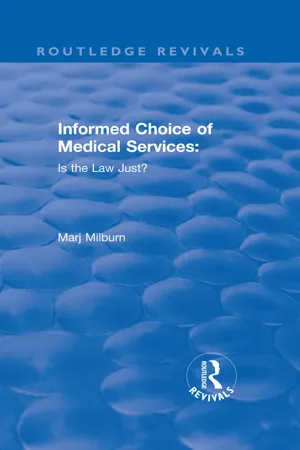
This title was first published in 2001. This work is a uniquely multi-disciplinary contribution to the existing bioethical literature on the topic of informed choice of medical services. It is also the first comprehensive bioethical text to confront the central issue of power in the clinical encounter and to argue for statutory protection of the right to informed choice. While the majority of bioethicists argue for a conciliatory, rather than adversarial, approach to the chronic problem of uninformed consent, the author of this work argues that the external regulation of medicine is essential if the right to informed choice is to be protected. This argument is based upon an extensive review of the bioethical, legal, political, medical, sociological and philosophical literature, as well as a wide range of empirical and anecdotal evidence, evolving from a detailed exploration of power and the limits of rationality in the clinical encounter.
Information
1
Informed Choice of Medical Services: Still a Problem?
Introduction
Atrocities committed by German medical scientists experimenting on concentration camp inmates and prisoners of war in the 1940s were the grim stimulus for the development of the concept of ‘informed consent’.1 However, evidence suggests that exposing people to possible harm without their knowledge remains endemic within the medical research community. Researchers claim that this is justified because it serves ‘the greater good of society’. There is also evidence that placing people at risk without their consent is part of the culture of clinical medical practice, where practitioners take it upon themselves to weigh up the balance of risks and benefits on behalf of their clients ‘for their own good’. Surprisingly, many medical practitioners sincerely believe that these human rights violations are justifiable. This lack of insight is dangerous. And it is particularly dangerous for the disempowered in societies where the privileges of class, wealth, education, patriarchy and power are jealously guarded.
In general, bioethicists have not confronted the problem of power abuse in medical research and clinical practice, despite the extensive literature on ‘informed consent’.2 Nor have they been prepared to acknowledge that informed and voluntary choice of medical services is a basic human right (Annas, 1998, pp.256-259). And yet, self-determination is the inalienable right of every human being.3 Every person has the right to make their own life choices. This includes the right to make an informed choice about what is done, or not done, to their own body.
Nazi Germany and the Ethical Concept of’Informed Consent’
Nazi medical scientists subjected concentration camp inmates and prisoners of war to horrific experimentation during the Second World War. The Nuremberg Medical Trial, conducted by the allied forces at the end of the war, found 23 German medical scientists guilty of crimes against humanity. People were put into low pressure chambers so that the way in which they died could be ‘scientifically’ observed, others were exposed to freezing air and water, infected with typhus and malaria, sterilised and castrated, and murdered for anatomical specimens. Methods of producing rapid death were developed in order to exterminate ‘unwanted groups’. The Nuremberg judges measured the culpability of the accused against a set of 10 principles, the most important being an absolute requirement for consent. This set of ethical principles became known as the Nuremberg Code (McNeill, 1993, pp.21-23).
And yet, German medical scientists were actively working on ‘racial hygiene’ practices well before the establishment of the Nazi Party. This included large scale sterilisation of ‘unwanted’ members of society. The Nazi exterminations were simply an extension of the mass killing of the mentally ill and retarded that took place in Germany prior to the war. Robert Proctor (1992) concludes that, given this background, it is hardly surprising that medical scientists exploited concentration camp inmates as subjects ‘available’ for human experimentation.4 The Nazis did not force medical scientists to carry out these experiments. They were more than willing (pp. 18-26).
Medical scientists also prospered under the Nazis. One of many was the Director of the Institute of Anatomy at Berlin University, Hermann Stieve, who studied the effect of awareness of impending execution on the menstrual cycle of women in concentration camps. At autopsy he established that the irregular bleeding suffered by these women was stress-induced.5 Stieve published his results after the war as the leading German specialist in gynaecological anatomy at East Berlin’s Humboldt University. Stieve, and many like him, were not indicted at Nuremberg (Pross, 1992, pp.37-38). In fact, several Nazi defendants from the Nuremberg Medical Trial were employed by the United States military after the war (Annas and Grodin, 1992, p. 106).
Abuse of Research Subjects Beyond Nazi Germany
Abuses by medical scientists during the Second World War extended well beyond Nazi Germany. Similar atrocities were committed by Japanese researchers, although the United States agreed to give the Japanese immunity from prosecution in exchange for information about biological warfare. At least 15 of these Japanese medical scientists were subsequently appointed to senior positions in Japanese medical schools and research facilities. Many received high honours for their ‘contribution to society’.
At the same time, medical research also became an extensive, well-funded project in the United States as a means to furthering the war effort. But, again, there was no concern for the welfare of research subjects. Prisoners and residents in mental asylums were deliberately infected with malaria, and then given experimental antidotes to test for efficacy and side effects. Consent was not considered necessary. Research subjects were seen as serving ‘the greater good of society’ (McNeill, pp.20-25).
Nor were the abuses of the Second World War an isolated aberration. Modem medicine developed in the hospitals of Eighteenth Century Paris as the result of experimentation on large numbers of impoverished people who provided a captured population of research subjects. Many studies involved infecting people with syphilis or gonorrhoea without their knowledge. There is also sufficient evidence to suggest that these practices continued throughout the Nineteenth Century6 and into the early Twentieth Century (McNeill, pp. 18-19).
Was the Nuremberg Code Effective?
The Nuremberg Code of 1946 was a pivotal statement of the ethical principles that ought to apply to research involving humans. As Jay Katz (1992) points out, the Code was remarkable in its uncompromising approach to absolute protection of the well-being of research subjects (p.226). Consent was the first and major principle of the Code and the only absolute principle of the new research ethics (Perley, Fluss, Bankowski and Simon, 1992, p. 157).
However, George Annas (1992) claims that the Code has been largely ignored by the medical community (pp.204-205). According to Annas, the World Medical Association’s Declaration of Helsinki, adopted by the World Medical Assembly in 1964, and the most frequently referred to ethical code, has always placed the researcher’s choice and the interests of the research enterprise ahead of the well-being of research subjects (1998, p.251). David Rothman (1991) also claims that neither the horrors described at the Nuremberg trial, nor the ethical principles that emerged from it, had any significant impact on the medical research establishment in the United States (pp.70-77).
Disturbing Revelations
In 1966, Henry Beecher, a Harvard Professor of Anaesthetics, published an article in the New England Journal of Medicine pointing out that 22 research studies recently published in reputable medical journals were highly unethical. One of the constant problems with these studies was the lack of informed and voluntary consent. A year later, in 1967, M. H. Pappworth published a book entitled Human Guinea Pigs, which contained similar allegations of unethical research by British medical scientists (cited in McNeill, p.66).
One of the studies referred to in Beecher’s article involved the Jewish Chronic Disease Hospital in New York. In this immunological study, which began in 1963, 22 frail and debilitated hospital residents were injected with live cancer cells without their knowledge. The principal investigator, Chester Southam, was a highly reputable medical scientist associated with a highly reputable academic institution. Southam stated at the subsequent inquiry that he simply did not wish to frighten patients by mentioning the word ‘cancer’, and insisted that he had done nothing wrong. Southam attempted to justify his actions by claiming that: ‘An experimental relation has some elements of a therapeutic relationship … The patients still think of you as a doctor, and I react to them as a doctor, and want to avoid frightening them unnecessarily’.
However, the Regents of the University of the State of New York, who were conducting the inquiry, disagreed, stating that the clinician, when acting as medical researcher, has no claim to the client-clinician relationship. The Regents concluded: ‘No person can be said to have volunteered for an experiment unless he [sic] had first understood what he was volunteering for … Deliberate non-disclosure of the material fact is no different from deliberate misrepresentation of such a fact’ (Langer, 1992, P-147).
This raises the question as to whether informed and voluntary consent to participation in research is at all possible when the researcher is also clinician to the potential research subjects. Even if clinician-researchers are able to make a distinction between their clinical and research roles, it seems that Southam was right in claiming that patients ‘still think of you as a doctor’. A study conducted in the United States in 1996 surveyed 1,900 outpatients in an attempt to determine their attitudes towards research. The results showed that a recommendation from a clinician to participate in research was interpreted by many as an endorsement of that project. People completely trusted their medical practitioner not to expose them to any harm (cited in Walton, 1998, pp.81-82).
Another study referred to by Beecher was carried out at the Willowbrook State School for intellectually disabled children from 1956 until 1970. This was an immunological experiment involving viral hepatitis. Children newly admitted to the institution were deliberately infected. The researchers, once again highly respected in their field, stated at a subsequent inquiry that they had obtained parental consent to involve the children in the research program. They also argued that the experimental work was justified by the potential benefits to society (Krugman and Giles, 1976). But, how could ‘consent’ be meaningful when the study was essentially unethical? And, exactly what information did the parents receive?
The Tuskegee Syphilis Study was another example of total disregard for the well-being of subjects. This 40 year project, carried out under the auspices of the Public Health Service, began in Alabama in the 1930s, with the aim of following the ‘natural course’ of syphilis. The subjects were 400 poor, black, male rural workers with the disease. The research project involved periodic blood tests and clinical examinations. Subjects were not told that they had syphilis and were not given the available treatment. However, they were told that the research procedures were special ‘free treatments’. Results were periodically reported in the scientific literature without provoking any protests about the highly unethical nature of the project (Gillespie, 1989). Again, at no point did the researchers appear to develop any insight into the immorality of their activities (Jones, 1981).
Peer Review: Ethics Committees
As a result of these revelations, guidelines requiring ethics committee review of medical research involving humans were introduced in the United States and Canada in 1966, the United Kingdom in 1967, New Zealand in 1972 and Australia in 1973 (McNeill, p.66). Even so, there is ample evidence that people involved in medical research continue to be exposed to possible harm without their knowledge. It has been suggested that ethics committees have generally been ineffective in enforcing the requirements for informed and voluntary consent because they are ‘captive’ to their organisations, as well as the medical establishment. Nor are there any legal sanctions that would enable ethics committees to take action against offending researchers (Annas, 1998, pp. 15-16).
More Disturbing Revelations
In 1970 a Federal Ethics Board in the United States held hearings related to in vitro fertilisation, concluding that there had been insufficient controlled animal experimentation to determine the long term effects of this procedure. Robyn Rowland points out that it is highly unlikely that the women involved in what was essentially experimentation were advised of this prior to giving their ‘consent’ to ‘treatment’ (cited in Scutt 1990, pp. 190-191).
In 1976 the United States Senate examined several unethical research studies, including one in which Mexican-American women were led to believe that they had been prescribed contraceptive pills, while they were actually subjects in an experiment testing the effectiveness of a new contraceptive. Some of these women were given a placebo, that is, no contraception at all. Again, researchers protested that the potential benefits to society outweighed the risks to individual subjects (McNeill, p.62).
In the early 1980s the Linda Loma Institutional Review Board in the United States gave approval for the implantation of a baboon’s heart into the body of an infant with a fatal heart condition (McNeill, p.4). This was only one of many experimental organ transplants7 that took place in ...
Table of contents
- Cover
- Half Title
- Dedication
- Title
- Copyright
- Contents
- Table of Cases
- Preface
- Acknowledgments
- Introduction
- 1 Informed Choice of Medical Services: Still a Problem?
- 2 Informed Choice: Legal Doctrine or Ethical Concept?
- 3 Medicine: Beneficence or Enlightened Self-Interest?
- 4 The Clinical Encounter: Protecting Power and Privilege?
- 5 Human Rights: A Problem for Political Rationalism?
- 6 Beyond Legalism: A Feminist Jurisprudence as a Guide to Law Reform?
- 7 Changing the Balance of Power
- Bibliography
- Index
Trusted by 375,005 students
Access to over 1.5 million titles for a fair monthly price.
Study more efficiently using our study tools.
Frequently asked questions
Yes, you can cancel anytime from the Subscription tab in your account settings on the Perlego website. Your subscription will stay active until the end of your current billing period. Learn how to cancel your subscription
No, books cannot be downloaded as external files, such as PDFs, for use outside of Perlego. However, you can download books within the Perlego app for offline reading on mobile or tablet. Learn how to download books offline
Perlego offers two plans: Essential and Complete
- Essential is ideal for learners and professionals who enjoy exploring a wide range of subjects. Access the Essential Library with 800,000+ trusted titles and best-sellers across business, personal growth, and the humanities. Includes unlimited reading time and Standard Read Aloud voice.
- Complete: Perfect for advanced learners and researchers needing full, unrestricted access. Unlock 1.5M+ books across hundreds of subjects, including academic and specialized titles. The Complete Plan also includes advanced features like Premium Read Aloud and Research Assistant.
We are an online textbook subscription service, where you can get access to an entire online library for less than the price of a single book per month. With over 1.5 million books across 990+ topics, we’ve got you covered! Learn about our mission
Look out for the read-aloud symbol on your next book to see if you can listen to it. The read-aloud tool reads text aloud for you, highlighting the text as it is being read. You can pause it, speed it up and slow it down. Learn more about Read Aloud
Yes! You can use the Perlego app on both iOS and Android devices to read anytime, anywhere — even offline. Perfect for commutes or when you’re on the go.
Please note we cannot support devices running on iOS 13 and Android 7 or earlier. Learn more about using the app
Please note we cannot support devices running on iOS 13 and Android 7 or earlier. Learn more about using the app
Yes, you can access Informed Choice of Medical Services: Is the Law Just? by Marj Milburn in PDF and/or ePUB format, as well as other popular books in Social Sciences & Social Work. We have over 1.5 million books available in our catalogue for you to explore.