- 282 pages
- English
- ePUB (mobile friendly)
- Available on iOS & Android
eBook - ePub
About this book
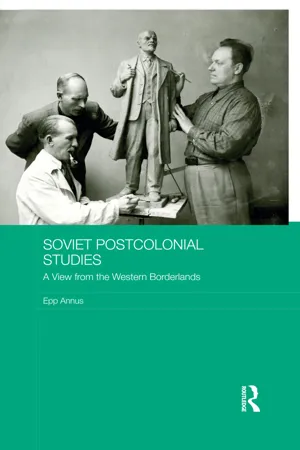
Postcolonial studies is a well-established academic field, rich in theory, but it is based mostly on postcolonial experiences in former West European colonial empires. This book takes a different approach, considering postcolonial theory in relation to the former Soviet bloc. It both applies existing postcolonial theory to this different setting, and also uses the experiences of former Soviet bloc countries to refine and advance theory. Drawing on a wide range of sources, and presenting insights and material of relevance to scholars in a wide range of subjects, the book explores topics such as Soviet colonality as co-constituted with Soviet modernity, the affective structure of identity-creation in national and imperial subjects, and the way in which cultural imaginaries and everyday materialities were formative of Soviet everyday experience.
Information
1
Methodological theses about the Soviet empire
This chapter will proceed through a succession of methodological theses, postulated about the Soviet empire. Empire is here understood as a great world power that employs authoritarian, discriminatory control over its ethnically dissimilar borderlands or colonies. All empires resemble each other by family resemblance, notwithstanding the fact that there remain significant differences between various strategies of rule within an empire and between different empires. I argue that Soviet Union did not start out as an empire, but gradually developed into one over the course of its first two decades.
As an empire, the Soviet Union deployed colonial strategies of rule at the political, economic, and cultural levels; it did not necessarily govern its borderlands through non-consensual control, but it instead manufactured consent through complex strategies of rule, including various kinds of systemic violence. An imperial situation will generate new stereotypes and essentialist ‘us‒them’ distinctions, as the borderlands’ cultures make an effort to fend off newcomers from the imaginary zones of national intimacy. The distinction between pedagogical and performative aspects of political communities allows us to draw attention to a crucial failure of Soviet imperial polities: their inability to co-opt and mobilize the borderlands’ populations at an affective level.
To begin with some methodological remarks, I will argue for the need to dismantle the opposition between subjective and objective approaches to the Soviet empire. I also argue against a disciplinary aversion to “what is” questions (e.g., “What is a nation?”): a fastidious over-concern for not (re)producing essentialism1 should not stand in the way of scholarly inquiry.
Empire is neither a category of subjective perception nor a substantial entity
A 2004 review article “Interpreting Russia’s Imperial Dimension” by Serhy Yekelchyk gives a succinct summary of some general developments in the field of Soviet studies: early scholars of the Soviet Union such as Walter Kolarz and Richard Pipes saw the Soviet Union as suppressing the ‘natural nationalism’ of non-Russian nationalities. The 1980s witnessed the constructivist turn in nationalism studies and consequently the emergence of a new understanding of nation-building as a modern phenomenon.2 By the early 1990s, scholars with a postcolonial orientation (notably Dipesh Chakrabarty) started to draw attention to the ways that modern empires encouraged ethnic differentiation to gain colonialist advantage. “With the notions of ‘nationality’ and ‘empire’ both problematized, the field of Russian Studies was poised for paradigm change,” argues Yekelchyk.3
In concluding his survey, Yekelchyk foregrounds Terry Martin’s approach to empire as a subjective category of practice. “Overall, the new understanding of ‘empire’ as a subjective category of practice and analysis holds a clear promise of reuniting within a single conceptual framework modern scholarship on Imperial Russia, the Soviet Union, and present-day Russia,” suggests Yekelchyk.4
A closer look at Terry Martin’s lucid and engaging article “The Soviet Union as Empire: Salvaging a Dubious Analytical Category” (2002) can serve here as an introduction to central conceptual questions raised in response to the notion of a Soviet empire5—especially since we find echoes of Martin’s approach in other critical writings.6 Martin’s preferred emphasis on empire as a subjective category, together with its fundamental opposition of subjective and objective categories, will be here subjected to a closer consideration, in order to address the subjective‒objective dichotomy in scholarship about the Soviet empire.7 Here, the ‘objective’ approach most typically declares that, if we limit consideration to only ‘objective’ categories, then the Soviet Union cannot be considered an empire.8 The ‘subjective’ approach, by contrast, claims that Soviet Union can be called an empire not in the sense of having practiced actual exploitation of the borderlands, but in the sense of being interpreted, perhaps in retrospect and in light of its later collapse, as having been an empire. Graham Smith extends this approach to questions of postcoloniality: “the borderland post-Soviet states can be considered as post-colonial in the sense that they are constructed and labeled as such by their nation-builders.”9 This chapter will take its analysis of Terry Martin’s argument as an occasion to dismantle the objective‒subjective dichotomy. It is very true, of course, that not all contemporary scholarship on Soviet empire relies on such dichotomy. Yet the interests of methodological clarity argue for laying out the potential dangers of scholarly binarisms.
Terry Martin registers his dissatisfaction with common scholarly notions of the ‘Soviet empire.’ From his perspective, according to ‘objective categories,’ the Soviet Union was not an empire. According to Martin, peripheral non-Russian subjects “were not subjected to legal discrimination, nor indeed to different laws; they were not discriminated against economically due to their ‘peripheral’ status; they were ruled like ‘core’ subjects. […] In other words, the core/periphery distinction does not work well in a unitary state like the Soviet Union.”10
Yet, we might ask, how is one to understand ‘legal discrimination’? And what if a state or an empire discriminates against its peripheral ethnic groups in contravention of its own laws? We might recall that the father of the Russian pravozashchitniki movement, Aleksandr Esenin-Vol’pin, built his project of resistance precisely upon the demand that the Soviet government obey its own laws—a position daring enough to grant him the status of a dissident. Vladimir Bukovskii remembers Vol’pin as “the first person in our life who spoke seriously about Soviet laws. […] We laughed at him: ‘what kind of laws can there be in this country?’”11 Can we seriously support arguments about the Soviet Union with references to its legal system, when it was commonly understood that official Soviet law had a merely approximate, evidently “laughable,” relation to actual Soviet practices?
We might refer here to Martin’s earlier highly illuminating work describing ethnically based oppressive strategies in the Soviet Union, in which official progressive ‘soft-line” resolutions of the Soviet of Nationalities coexisted with “hard-line” practices of ethnic cleansing and the mass arrest of diaspora nationalities.12 Martin writes, for example, about the ambivalent treatment of Korean nationalities in the Soviet Far East in 1926:
On the one hand, smaller Korean national territories were authorized: one Korean national region and 171 Korean village soviets. Korean-language schools and newspapers were established. A far eastern national minorities bureaucracy was formed with a plenipotentiary on Korean affairs. Koreans were systematically promoted into the far eastern bureaucracy. This policy line presented Koreans as a model Soviet national minority to be poignantly and publicly contrasted with the wretched Koreans living under Japanese colonial occupation.
On the other hand, at the exact same time this policy line was being implemented, the central government issued a December 6, 1926 secret decree confirming a plan to resettle most Koreans north of the 48.5th parallel (north of Khabarovsk).13
Martin provides a rather detailed description of different aspects of ethnic cleansing in the 1930s, when, he calculates, “approximately 800,000 individuals were arrested, deported, or executed in the ethnic cleansing and mass national operations from 1935 to 1938.”14 At the same time, he adds, “there was also a revival of a rather virulent state-sponsored Russian nationalist rhetoric” and an ever greater identification of the state with its “Russian core.”15 The imperial oppression of national cultures in the Soviet Union might not have been visible at all levels of its legal system; however, in actual practice, accompanied by legal decrees (not all of them public), we can clearly perceive empire-like discrimination against peripheral ethnicities.
Terry Martin does, however, support the important turn towards constructivist theories of nationalism as a source of inspiration for empire studies—yet one can hardly agree with his effort to use constructivist ideas to set up an opposition between objective and subjective understandings of empire. Presumably, nationalism studies have ‘long since’ moved on to subjectivism; so, in Martin’s rendering of Benedict Anderson’s concept, “a nation is a group of people who subjectively believe they are a nation, an ‘imagined community.’”16
But, in fact, Anderson does not speak about subjectivity or beliefs. A nation, according to Anderson, is indeed imagined—no one can ‘see’ a whole nation, “the members of even the smallest nations will never know most of their fellow-members, meet them, or even hear of them, yet in the minds of each lives the image of their communion.”17 Imagining nation, however, is neither a purely subjective act nor simply a belief: it is a mixture of beliefs, understandings, and feelings experienced personally as these stand in relation to the body of national knowledge elaborated in textbooks, artworks, museums, and monuments. The constructivist turn in nationalism studies indeed signified a paradigm shift, a dramatic change in our understanding of the functioning of national categories. However, neither a nation nor an empire can be limited to subjective experience only. We can, of course, speak about the subjective, personal experience of belonging to a nation or being part of an empire and analyze nations and empires as categories of practice. Yet, as Anderson has stressed, a nation also belongs to the public domain and is constructed through rituals, national artifacts, museums, and public discourse in newspapers and politics. Consider the complex building-work elaborated in poems, monuments, songs and school-day recitations of a pledge of allegiance—to call this often programmatic, sometimes ridiculous, sometimes heroic construction work ‘subjective’ would seriously understate its scope and perhaps also its danger.
The constructivist turn in nationalism studies, like the cultural turn more generally, conveys a message that is much harder to accommodate than a simple foregrounding of subjective perception: truths and categories, whether labelled as ‘subjective’ or ‘objective’, are constructed discursively, through legitimizing certain interpretive models over the others. Instead of opposing subjective approaches to objective approaches, it might be more fruitful to overcome the binarism of objective versus subjective. Here, it is crucial to understand how discursive constructions work: one cannot separate discourses from reality, nor personal experience from the field of common discursive practices. Reality is shaped into existence by ways of legitimizing certain modes of talking about it. Democratic governance can serve as an example: a new law is born out of public discussion and with the help of expert opinion. Ideas written down on paper turn into law after an act of voting: a combination of subjective positions and opinions has changed into a form of objective reality called the legal system—until perhaps the next government, that is, a new combinat...
Table of contents
- Cover
- Title
- Copyright
- Dedication
- Contents
- List of illustrations
- Acknowledgments
- Introduction: colonialism in camouflage
- 1 Methodological theses about the Soviet empire
- 2 The location of knowledge: Soviet area studies facing the postcolonial question
- 3 Can a modern nation-state be colonized? Reformulating the framework of postcolonial studies
- 4 Modernity with a smiley face: Soviet modernity, Soviet coloniality
- 5 Colonial layers and hybridization of the past: layers of national modernity in the Baltics
- 6 From colonial fear to decolonizing laughter: deconstructing the colonial binarisms of ‘us’ and ‘them’, ‘the colonizer’ and ‘the colonized’
- 7 Cultural imaginaries and everyday materialities: living in a Soviet home
- 8 Consequences: everyday dissensus and the end of empire
- Bibliography
- Index
Trusted by 375,005 students
Access to over 1.5 million titles for a fair monthly price.
Study more efficiently using our study tools.
Frequently asked questions
Yes, you can cancel anytime from the Subscription tab in your account settings on the Perlego website. Your subscription will stay active until the end of your current billing period. Learn how to cancel your subscription
No, books cannot be downloaded as external files, such as PDFs, for use outside of Perlego. However, you can download books within the Perlego app for offline reading on mobile or tablet. Learn how to download books offline
Perlego offers two plans: Essential and Complete
- Essential is ideal for learners and professionals who enjoy exploring a wide range of subjects. Access the Essential Library with 800,000+ trusted titles and best-sellers across business, personal growth, and the humanities. Includes unlimited reading time and Standard Read Aloud voice.
- Complete: Perfect for advanced learners and researchers needing full, unrestricted access. Unlock 1.5M+ books across hundreds of subjects, including academic and specialized titles. The Complete Plan also includes advanced features like Premium Read Aloud and Research Assistant.
We are an online textbook subscription service, where you can get access to an entire online library for less than the price of a single book per month. With over 1.5 million books across 990+ topics, we’ve got you covered! Learn about our mission
Look out for the read-aloud symbol on your next book to see if you can listen to it. The read-aloud tool reads text aloud for you, highlighting the text as it is being read. You can pause it, speed it up and slow it down. Learn more about Read Aloud
Yes! You can use the Perlego app on both iOS and Android devices to read anytime, anywhere — even offline. Perfect for commutes or when you’re on the go.
Please note we cannot support devices running on iOS 13 and Android 7 or earlier. Learn more about using the app
Please note we cannot support devices running on iOS 13 and Android 7 or earlier. Learn more about using the app
Yes, you can access Soviet Postcolonial Studies by Epp Annus in PDF and/or ePUB format, as well as other popular books in Social Sciences & Ethnic Studies. We have over 1.5 million books available in our catalogue for you to explore.