- 450 pages
- English
- ePUB (mobile friendly)
- Available on iOS & Android
eBook - ePub
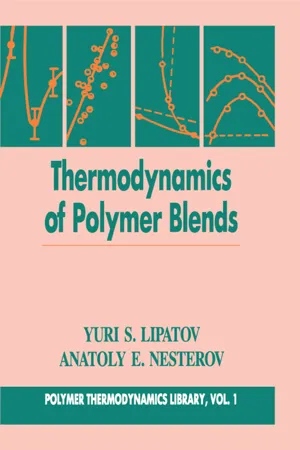
Thermodynamics of Polymer Blends, Volume I
About this book
Thermodynamics is an indispensable tool for developing a large and growing fraction of new polymers and polymer blends.
These two volumes show the researcher how thermodynamics can be used to rank polymer pairs in order of immiscibility, including the search for suitable chemical structure of compatibilizers.
Because of the great current commercial interest in this most dynamic sector of the polymer industry, there is high interest in studying their physical and mechanical properties, their structures, and the processes of their formation and manufacture.
These Books are dedicated to Analysis of the Thermodynamics of Polymer Blends. Thermodynamic behavior of blends determines the compatibility of the components, their morphological features, rheological behavior, and microphase structures. As a result, the most important physical and mechanical characteristics of blends can be identified.
The information in these two volumes will be useful to all those involved in polymer research, development, analysis and advanced process engineering.
Chapter 1
BASIC PRINCIPLES OF THERMODYNAMICS OF POLYMER SOLUTIONS
1.1 THE MAIN THERMODYNAMIC CHARACTERISTICS OF SOLUTION
The main thermodynamic functions of any solution are the changes in enthalpy of its formation, ΔH, entropy changes, ΔS, and Gibbs free energy, . At constant temperature and pressure, the dissolution is a spontaneous process proceeding in the direction of diminishing Gibbs free energy of mixing. The solution has lower free energy as compared with the sum of free energies of solution components (polymer and solvent):
[1.1] |
where G0 is the free energy of i-th component.
The excess free energy determined as
[1.2] |
by spontaneous dissolution is negative. Correspondingly, the chemical potential of a component in solution, μi, should be lower than its value before dissolution, i.e., Δμi < 0. Values ΔG < 0, Δμi < 0 are the criteria of the affinity between components. Their values are determined by the absolute magnitude of the differences ΔG or Δμi.
The solution in which all molecules of components equally interact with each other are considered as ideal solutions. Their properties are the additive sum of the properties of components. Such solutions obey the Henry and Raul laws:
[1.3] |
[1.4] |
where p1 and p2 are partial pressure of components, x is the molar fraction of component in solution. Because
[1.5] |
we find that
[1.6] |
It means that the chemical potential of any component is only determined by its molar fraction in solution. In the majority of cases, solutions do not obey Eqs 1.3 to 1.6. They are thus considered non-ideal. The deviations from the ideality () may be positive () or negative (). To estimate the degree of deviation from the ideality, the concept of excess quantities is introduced as an excess of properties in comparison with the ideal magnitude. These are:
[1.7] |
[1.8] |
[1.9] |
Table of contents
- Cover
- Half Title
- Title Page
- Copyright Page
- Table of Contents
- Preface
- 1 Basic Principles of Thermodynamics of Polymer Solutions
- 2 Statistical Theories of Polymer Solutions
- 3 Thermodynamics of Polymer Mixing
- 4 Homopolymer-copolymer and Copolymer-copolymer Blends
- 5 Mechanism and Kinetics of Phase Separation in Polymer Solutions and Blends
- 6 Interface in Demixing Solutions and Polymer Mixtures
- Nomenclature
- Index
Trusted by 375,005 students
Access to over 1.5 million titles for a fair monthly price.
Study more efficiently using our study tools.
Frequently asked questions
Yes, you can cancel anytime from the Subscription tab in your account settings on the Perlego website. Your subscription will stay active until the end of your current billing period. Learn how to cancel your subscription
No, books cannot be downloaded as external files, such as PDFs, for use outside of Perlego. However, you can download books within the Perlego app for offline reading on mobile or tablet. Learn how to download books offline
Perlego offers two plans: Essential and Complete
- Essential is ideal for learners and professionals who enjoy exploring a wide range of subjects. Access the Essential Library with 800,000+ trusted titles and best-sellers across business, personal growth, and the humanities. Includes unlimited reading time and Standard Read Aloud voice.
- Complete: Perfect for advanced learners and researchers needing full, unrestricted access. Unlock 1.5M+ books across hundreds of subjects, including academic and specialized titles. The Complete Plan also includes advanced features like Premium Read Aloud and Research Assistant.
We are an online textbook subscription service, where you can get access to an entire online library for less than the price of a single book per month. With over 1.5 million books across 990+ topics, we’ve got you covered! Learn about our mission
Look out for the read-aloud symbol on your next book to see if you can listen to it. The read-aloud tool reads text aloud for you, highlighting the text as it is being read. You can pause it, speed it up and slow it down. Learn more about Read Aloud
Yes! You can use the Perlego app on both iOS and Android devices to read anytime, anywhere — even offline. Perfect for commutes or when you’re on the go.
Please note we cannot support devices running on iOS 13 and Android 7 or earlier. Learn more about using the app
Please note we cannot support devices running on iOS 13 and Android 7 or earlier. Learn more about using the app
Yes, you can access Thermodynamics of Polymer Blends, Volume I by Anatoly E. Nesterov,Yuri S. Lipatov in PDF and/or ePUB format, as well as other popular books in Physical Sciences & Physics. We have over 1.5 million books available in our catalogue for you to explore.