eBook - ePub
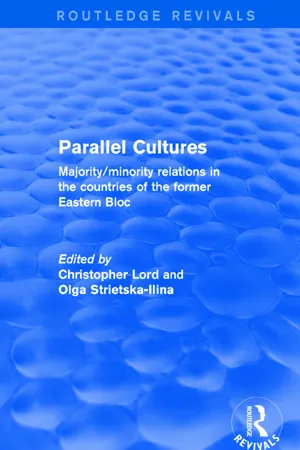
Parallel Cultures
Majority/Minority Relations in the Countries of the Former Eastern Bloc
- 308 pages
- English
- ePUB (mobile friendly)
- Available on iOS & Android
eBook - ePub
Parallel Cultures
Majority/Minority Relations in the Countries of the Former Eastern Bloc
About this book
This title was first published in 2001. This stimulating and well-written text is particularly suitable as a subsidiary text for courses in politics, sociology and ethnic studies.
Trusted by 375,005 students
Access to over 1.5 million titles for a fair monthly price.
Study more efficiently using our study tools.
Information
Subtopic
Política1 Parallel Cultures
I. The Problem
The history of Europe can be interpreted from two points of view: as the history of Christianity, and as the history of the European states. These two points of view are not mutually exclusive: the European states have until recently also represented themselves as Christian bodies, and so the two histories can form an organic whole. At moments of great crisis – the Reformation is the obvious example – the link between the political and the ‘spiritual’ appears at the surface of events, but in the normal run of things these two histories of Europe would seem to go at different speeds. If we take the long view, the religious history, with its deep changes in morality and cosmology, would seem to have the profounder effect on the life of people (and not just ‘religious’ people; we are all religious, in the sense that we accept moral and cosmological traditions that have no other basis or claim to legitimacy than their historical acceptance by various organised religions; and we can also argue, following Weber, that modern social structures such as capitalism have themselves been produced through a transformation of religion); but at the beginning of the twenty-first century, we are biased in the other direction, and will tend to give the greater importance in our histories of the past to the kind of questions which present themselves to us in everyday life today: questions of politics, and of national politics in particular.
Since it is a theme which we will pick up again later in this study, let us make it clear at the outset that national politics (and nationalism in politics too) is inextricably linked with religion. In the European states this is explicit, since monarchs have often (up until the French Revolution, anyway) claimed divine authority for their wars, treaties and indeed all their other actions too; and since all the other nation states of the world have more or less been created in the image of a few European countries, this kind of image of state authority has become established as the global norm. Even if the modern state is not necessarily Christian in its imagery and orientation, it still characteristically represents itself as standing for a definite moral order, in a local or national variant. Let us look briefly at the reasons for this peculiar development in the West.
The Romans took the political category of ‘citizen’ from the Greek city-states and adapted it, as the Greeks never did, to the purpose of imperial organisation; and this is the direct and explicit source of the equivalent concept in later European political culture. ‘Citizen’ still meant ‘of the city’, but now the city in question was Rome, whether the citizen actually lived in Italy, Africa or Britain. Most lived in northern and central Italy; but the citizens of Rome, whether culturally Latin or not, also provided a unified military and administrative ruling caste throughout the Empire.2
Although Athens, Sparta and other cities of the Greek-speaking Eastern Mediterranean world had at different times enjoyed a certain degree of political, military or cultural pre-eminence, the Greek system of city-states was inherently competitive, and leagues and alliances came and went as the monarchs and tyrants who led them rose and fell. Alexander’s conquests the amazing zenith of this struggle for pre-eminence among the Hellenic or Hellenised states – did unite a huge territory under his own personal rule, and under a more or less Greek cultural and political idea, but there was still no secure state concept – no legal or moral order – behind this domination, and the political unification achieved by his conquests did not survive Alexander himself. The Greek language and cultural idea also had a profound effect on the societies where Alexander’s troops had taken over; but this can be seen as a demonstration that cultural imperialism is not enough to guarantee actual empire.
After Alexander’s death, the Greek habit of rivalry and hunger for kudos re-asserted itself, and the different regions of his new empire at once began an internal struggle for power that reflected the competitive Greek political tradition on a new and larger scale. It was not until the rise and consolidation of Roman power that a single administrative centre was seen to be able to dominate a large and culturally diverse area, under a state concept which provided for stable, long-lasting and unified legal and political mechanisms.
Rome did not rely on ephemeral personality cults or mystical religions (though it was big enough to accommodate these): the short sword was enough. For centuries, the legions guaranteed a peace and stability which rested on the rock of superior military organisation and technique, and which remains the pattern for state organisation today. The Empire, though, as military states will, eventually outgrew itself: over-stretching its resources at its frontiers as it softened internally; and, in an attempt to make the state administration more manageable, was permanently divided into a Western and an Eastern part during the reign of Diocletian (284–305). This corresponded to a cultural division between Greek-speakers and Latin-speakers (although this was not directly the reason for the division), and therefore introduced the idea – and demonstrated the fact – that the eternal-seeming and monolithic Empire could in principle be sub-divided in this way. The innovation was an immediate success: the two halves of the Empire rapidly ceased to be mere administrative units, and took on political and cultural lives of their own – became separate actors in history, indeed, reading their parts from different scripts.
It seems sometimes to be assumed that the further sub-division of the territories of the Empire into national units was the next logical step in this process, and just a matter of time. But it is important to realise that this further division into nation states (or rather into proto-nation states) only took place in the Western part of the Empire. The Western Roman provinces of Spain, Italy, Britain and Gaul formed the administrative basis for the modern countries of Spain, Italy, Britain and France. The other Western nation states, along with some Central European states not originally falling into either camp (Poland, Bohemia and Hungary), were formed later on in imitation of these basic units; although we should remember that there were also other important defining differences between the East and the West – the most important perhaps being the effect on the West of assimilating successive waves of non-Romanised Germanic populations. Another important difference, with a directly political impact, is that after the fall of Rome itself, the relationship of Church and State developed quite differently in the West and the East. The Catholic Church in the West took on an active and ‘international’ political function quite different from that of the Orthodox Church, which continued to see itself as sharing the legitimacy of the Empire and its institutions, and which therefore had no direct interest in challenging that legitimacy. Specifically, the rise of the Popes in the West had no immediate analogue in the East, where ‘the patriarch of Constantinople never acquired either that independence of secular authority or that superiority to other ecclesiastics that was achieved by the Pope.’ (Russell, 1975, p. 387) 3 The Eastern Empire, in any event, was subject to different forces, and did not follow the same line of development. Rather, the Eastern or Byzantine Empire continued to function for about a thousand years, still basically on the Roman pattern of managing a polycultural Empire with a monocultural, Greek-speaking, state administration, backed up by an official state religion; and when it did eventually break up, the smaller units as a rule continued to claim for themselves the dignity of Empire, still seeking to continue the imperial Roman system on a smaller physical scale.
The cultural divergence of East and West did not neatly follow the old Roman geographical and administrative divisions, though, since these soon broke down under the stresses of the new situation (and especially after the sack of Rome in 455 and the fall of the West); and in particular we can see that the old provinces of Illyria (nominally Western) and Dacia (nominally Eastern) fell in between the two large-scale cultural blocks. Illyria and Dacia ceased to function as effective administrative or cultural units, and their territory is still disputed by different religious, national and political forces today. The identity and boundaries of Gaul were similarly disputed, with the Latinised Gauls having to assimilate an important influx of Germans from the East, but in this case the basic state idea did eventually re-surface as the Empire of the Franks. This in turn provided for a long intermediary phase, before the component peoples and territories separated out into ‘national’ French and German parts.
The different state-political histories of the Eastern and the Western Christian states are somewhat obscured by the fact that their modern successors share a similar ‘nation state’ profile in international politics and law. But in fact it is the Western nation state idea – meaning that which developed in the successor states of the Western Empire – that has won. The Byzantine Empire itself fizzled out in the end, losing its territory and its power under the influence of the new forces of Islam and the House of Osman. The Orthodox empires (attempts to continue the Eastern Roman dignity on a smaller scale) of Russia and Bulgaria – the latter much reduced in size and importance – are now officially national states on the Western pattern, and the same is true of Turkey, which is the successor state to a polycultural empire, the Ottoman, which was organised according to quite a different (Islamic/dynastic) plan. Other successor states temporarily established on the territory of the old Eastern Empire at one time or another, such as the Empires of Trebizond or Nicaea, or the Latin Empire set up after the Crusaders sacked Constantinople in 1204, have vanished without trace, defeated in the end by the national state system of the West.4 Leaving Europe for a moment, we see that even the explicitly Islamic states of the Middle East, though looking back to the theocratic state idea of the Caliphate, have no alternative today but to conform to the Western nation-state pattern, even though this is a Western Christian pattern at root which in fact keeps them in a position of subordination to their fellow monotheists at an international level.
Now, in Europe we see that the Western nation state model rests on one fundamental principle: that the inhabitants share a common nationality, typically demonstrated by their use of a national language. This is the basis of their citizenship. It is only in a few marginal states (Iceland, for instance, or Armenia) where this is completely true; and in some other states (Belgium, Switzerland) this principle is completely compromised. But still, language and nationality are inextricably linked, with state bureaucracy in particular characteristically using a single standard language. In the countries where this is not true, such as Belgium, Switzerland, or now Britain, Spain and to some extent France (where local languages have recently achieved a degree of recognition, even or especially where state bureaucracy is concerned), we see this as a further evolution of the nation-state idea, and not as a non-national alternative system. In Belgium, for instance, it is the Catholic religious identity (opposed to the Calvinism of the Netherlands) which provides the historical basis of ‘national’ solidarity. The Swiss, despite their linguistic and in this case also religious divisions, do still have a strong sense of national identity. There are also some pluralistic European states that have dropped out of the picture. Finland before independence was an organic part of Sweden; Poland-Lithuania also functioned quite well without a unified national culture. This demonstrates immediately that the nationalist’s self-image is a false one: his ideology, which seems so pure and a-political to him, in fact represents a powerful political programme: for the nationalisation of politics leads to the nationalisation of culture. The Swiss version of national feeling, which is a relic from an earlier phase of the process of nation-building in Europe, shows us that loyalty to a state does not always mean loyalty to a monocultural national idea. Unusually, but for quite ordinary and simply-explicable reasons, the success of Switzerland as a political and military unit did not produce the characteristic West European Christian cultural homogenisation of its population; and the various denominations of Swiss seem to be able to coexist without putting too much strain on their Volksgeister.
Switzerland, though, is an exception, for Western European countries are usually differentiated by language; and if we look for the origin of this principle, we at once realise that the Western and Eastern Empires were differentiated by language, with the Western Empire (and Rome) using Latin, and the Eastern Empire (and Constantinople and Alexandria) using Greek. The Greek-speaking states failed in one way or another; were divided and invaded and re-made according to different plans. Only Greece itself, an Orthodox imperial remnant where a very mixed population (actually an Ottoman remnant population more than anything) speaks a reconstructed and modernised version of the old imperial tongue, still reminds us directly of the Eastern state and its system of government. Western countries imitate the Western Empire. Russia, a state which was set up to imitate the Eastern system, but with Old Church Slavonic used instead of written Greek as the language of religion and government, offers another historical mirror. As in Greece, the ‘native’ population (the ‘Russians’) comprises an artificially homogenised imperial population: a mix of Slays, Finno-Ugrians, Turks, Armenians and others, united by the imposition of the Russian language and the domination of the imperial culture – though this imitation of the Roman imperial system, too, is perceived today as a national culture and tradition.
The characteristic cultural pattern of the Western nation states was formed by a movement in the reverse direction: the consolidation of local cultural patterns, to the point that they became continuous with the administration of state power. What this meant in practice was that the Latin of church and state administration failed to establish itself as the normal language of the people. Instead, local languages arose. In some cases, these were simply the local variants of Latin, isolated and regularised according to a local norm (Italian, French and Spanish, approximately, but with islands of other Gallo-Roman dialects also surviving, especially in rural areas); and in others, a different literary standard in the end prevailed (German and the languages of Britain). Some mediævalists argue that it was Britain which provided the model for this rebellion against the use of Latin. One reason for this was that, as in what was to become Germany, the language of the people had a distinctive and non-Latinate structure, and another (often overlooked) reason was that in the court cultures of Ireland and Wales, the British Isles already had a native high culture, with poetry, law and so on, which could provide a real alternative to the Roman model and tradition (with Welsh poets, for instance, performing in the castles of the Norman overlords after the invasion of 1066). Anyway, we can see that there were basically two cultural trajectories, defined by the use and spread of literacy. In the Roman Empire, both West and East, there had been a sharp diglossia, with the Empire and its functionaries using Latin or Greek, both very highly-developed literary languages, and the illiterate rabble using various peasant dialects (i.e. non-standard, un-standardised, and un-standardisable variants and hybrids of these and other languages). In the East, the successor states continued to use Greek for their state administration, but these states failed although they did leave their imitators, Bulgaria and Russia, behind them as a reminder of what might have been. (What would become the First Bulgarian Empire was Christianised by the conversion of Khan Boris in 864, and what would become Russia by the conversion of Prince Saint Vladimir of Kiev in 988.) In the West, though, Latin became the language of the Church more than that of state power. This is basically because a unified religious identity survived in the ecclesiastical structures of Western Europe, even when state power was at its lowest ebb. In Italy, Latin was closer to the language of the people, it is true, but a careful look at the modern national language of Italy reveals that modern Italian, like modern French, represents on the one hand a middle course between two diverging dialect areas (Northern French versus Occitain, and the Gallo-Roman Northern Italian dialects versus the language of Rome itself), and on the other hand the acceptance of an arbitrary local standard (Ile-de-France French; Florentine Italian) more or less conforming in its general phonology to the arising consensus in the linguistic community as a whole: and so we see that the same processes of social renewal, and the corresponding generation of new social structures, took place in Italy too.
But the sad truth is that the middle ages were a period of decline and collapse in Western Europe. While the Church preserved the language of Rome in its monasteries, its liturgy, and its documents, power passed into the hands of the illiterate, and the imperial political system collapsed. However, the idea of such a system survived in people’s minds, and this in the end proved decisive. When the Frankish warrior king Charlemagne accepted the dignity of Roman Emperor on Christmas Day 800, re-starting (Western) European history by founding a large, centralised state authority, securely founded on military power on the one hand and an organised religious base on the other, the submission to the authority of the written word implicit in this gesture was only partial. While Latin had continued in use as an ecclesiastical language, and now once again became the official bureaucratic language of an ‘imperial’ state organisation, Western Europe had become a place of creoles and contact languages; and the babble of the rabble was gradually re-organising itself according to a different kind of system: a system of regional spoken norms that would in time result in stable national languages. These verbal and mental badges of nationality more than anything else succeed in dividing Europe: since the Frenchman and the Spaniard actually cannot understand one another, even though their languages are both transformations of imperial Latin.5
It is worth noting in passing that the isolation and establishment of single standard forms of national languages – both Latinate and non-Latinate – is something which in a sense runs counter to the natural flow of things. Given a minimally stable political background, so that the linguistic situation is not disrupted by large flows of people, the normal thing is for the divisions between dialect areas to become deeper. This, indeed, is the reason for the break-up of Latin in the first place. In places where the same language has been left to itself for a very long time (and a low level of literacy will help the process along too), we see that the division into local dialects (idiolects, more technically) can continue to the level of individual streets in villages. Welsh, for instance, is very highly fragmented in this way, as is Chinese (on a much larger scale). But the national language idea represents a change of course. Looking at French again, we see that it was the economic success of Paris which established Ile-de-France French as the high prestige varian...
Table of contents
- Cover
- Half Title
- Title Page
- Copyright Page
- Table of Contents
- Foreword
- List of Contributors
- Note from the Editors
- 1 Parallel Cultures
- 2 Competing Cultures, Conflicting Identities: the Case of Transylvania
- 3 Transformations of Ethnic Identity: the Case of the Bulgarian Pomaks
- 4 The Identity Crisis and Emergence of Alternative Ethnic Identities among the Eastern Slavs: the Case of the Poleshuks
- 5 Inter-Ethnic Coexistence and Cultural Autonomy in Ukraine: the Case of the Donetsk Region
- 6 Quo Vadis? The Case of Russia
- Index
Frequently asked questions
Yes, you can cancel anytime from the Subscription tab in your account settings on the Perlego website. Your subscription will stay active until the end of your current billing period. Learn how to cancel your subscription
No, books cannot be downloaded as external files, such as PDFs, for use outside of Perlego. However, you can download books within the Perlego app for offline reading on mobile or tablet. Learn how to download books offline
Perlego offers two plans: Essential and Complete
- Essential is ideal for learners and professionals who enjoy exploring a wide range of subjects. Access the Essential Library with 800,000+ trusted titles and best-sellers across business, personal growth, and the humanities. Includes unlimited reading time and Standard Read Aloud voice.
- Complete: Perfect for advanced learners and researchers needing full, unrestricted access. Unlock 1.5M+ books across hundreds of subjects, including academic and specialized titles. The Complete Plan also includes advanced features like Premium Read Aloud and Research Assistant.
We are an online textbook subscription service, where you can get access to an entire online library for less than the price of a single book per month. With over 1.5 million books across 990+ topics, we’ve got you covered! Learn about our mission
Look out for the read-aloud symbol on your next book to see if you can listen to it. The read-aloud tool reads text aloud for you, highlighting the text as it is being read. You can pause it, speed it up and slow it down. Learn more about Read Aloud
Yes! You can use the Perlego app on both iOS and Android devices to read anytime, anywhere — even offline. Perfect for commutes or when you’re on the go.
Please note we cannot support devices running on iOS 13 and Android 7 or earlier. Learn more about using the app
Please note we cannot support devices running on iOS 13 and Android 7 or earlier. Learn more about using the app
Yes, you can access Parallel Cultures by Christopher Lord,Olga Strietska-Ilina in PDF and/or ePUB format, as well as other popular books in Política y relaciones internacionales & Política. We have over 1.5 million books available in our catalogue for you to explore.