- 248 pages
- English
- ePUB (mobile friendly)
- Available on iOS & Android
eBook - ePub
About this book
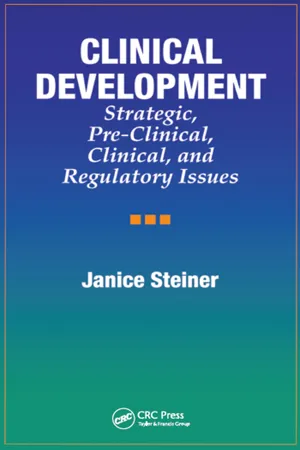
Everyone involved in pre-clinical, clinical, formulation, development and regulatory affairs will find Clinical Development a valuable resource. The book provides expert advice on ways to reduce delays and lost market opportunities, minimize development time, better understand the process and regulatory requirements, and plan and analyze clinical development and testing programs. The author combines text, graphs, and charts to show how a company moves a product through the complex process from discovery to market. The result is a complete analysis of the drug development process in easy-to-understand language and easy-to-implement action steps.
1

Strategy
This book will discuss the issues involved in drug development, which can be examined from several viewpoints: scientific, commercial, regulatory, medical, or manufacturing. Frequently, these aspects are intertwined and affect each other profoundly. Certainly, no pharmaceutical development can, nor should, neglect any of these parts for long.
Given these complexities, all drug development should have a strategy or overall direction. The tactics for achieving that strategy should be worked out in advance. This coordinated set of tactical steps is known as a strategic or development plan.
WHAT IS A DEVELOPMENT PLAN?
A plan is a set of pre-arranged steps, logically ordered and coordinated, that is undertaken to achieve a desired and explicit goal. However, the fundamental questions, “Where are we going?” and “Why are we going there?” must first be raised and answered. Other issues, such as requirements for resources and “what ifs”, can be derived from but cannot logically precede this plan.
Further, it helps to be clear about the difference between research and development—for different they are. To quote the Oxford English Dictionary (OED), “research and development (in industry etc.) is work directed towards the innovation, introduction and improvement of products and processes.”
While this definition is true overall, certain subtleties are lost. Consider the OED definition of research: “the systematic investigation into and study of materials, sources etc. in order to establish facts and reach new conclusions; an endeavour to discover new or collate old facts etc. by the scientific study of a subject or by a course of critical investigation.” By contrast, “develop” is associated with “progress, evolution, amplification and bringing to maturity.”
For the research worker, the ideal is the discovery and affirmation of new knowledge. It may involve the creation of a hypothesis and the movement from hypothesis to theory. It is a creative process, but because the discovery is new and crosses uncharted territory, it may be difficult to quantify in terms of finances, timelines, and manpower. How long until the next breakthrough discovery? How long is a piece of string?
On the other hand, developers take new discoveries and translate them into full-grown commercial products. This is a different approach. Pharmaceuticals require proof beyond reasonable doubt of the safety, efficacy, and quality of new medicines. Developers require that these proofs be commercially relevant. Even to contemplate this effort, there ought to be some level of confidence that theory will translate into fact; that is, a thing that is proven, not supposed, to be true.
There is no doubt that the discovery and affirmation of new knowledge is difficult. It is hard to be creative and to establish the truth. It involves problem solving. It requires deep, logical thought and know-how. It requires clarity, objectivity, and ruthless appraisal. Even with the best will in the world, mistakes and errors of judgement occur, for judgement may be all there is. Although surrounded by rules, it is not limited, or even helped by them, for the rules talk mostly to the quality standard of a proof, not the nature of the proof itself. They make the proof more credible but do not create it in the first place. By the time that the rules can really solve a problem, the problem is generally passé.
Research and development frequently do not understand each other. One seems incredibly fly by night, the other obsessively fussy. The two cultures are different. This is true, one suspects, in every R&D based company. These disciplines may not think alike, but they are both essential and they do need to respect each other.
When does hypothesis translate into fact? When are facts commercially and medically relevant? That depends. It has been shown that diuretics can alleviate symptoms in heart failure. A diuretic active in a rat or a dog has obvious potential as a symptomatic treatment in heart failure. Does the world need another diuretic? The answer is, “probably not.”
In sepsis, a variety of factors may be important, such as tissue necrosis factor, various cytokines and complement components, and parts of the clotting cascade. The animal models are deceptive. Individually, each molecule that has so far failed in clinical trials—Centoxin™, Antril™, steroids, heparin—was a hypothesis failing to translate into fact. Does the world need a cure for sepsis? It most certainly does, but as yet, we do not know exactly how to get to it.
This proof of fact is the essential of development. Sometimes, the proof may come sooner than a phase III clinical trial. It may be a relative certainty in preclinical development, although such instances are rare with novel compounds. However, Genentech (South San Francisco, CA, USA) was able to show that Pulmozyme™ dissolved mucus in the test tube. On the basis of what was well known about cystic fibrosis lung disease, Genentech was able to make a lot of assumptions about Pulmozyme’s potential efficacy that happened to work out.
So research is the transformation of hypothesis into theory. Development is the proof of the theorem. The proof, in a commercial outfit, is only relevant if it meets the needs of the people who will buy it. Anything else is a waste of time. Thus, any development plan should begin with an appreciation and an assessment of the potential market. If a market is not clear, then the drug may be looking for a disease. Perhaps, when this happens, development of the drug should then be considered research—hypothesis generation—rather than development. In the end, what is wrong with a research programme, even if it happens to occur in the clinic, so long as it is understood for what it is?
DRIVERS AND GOALS
Traditionally, research and development and marketing groups have stood at arm’s length. This has never made much sense, but it is even more questionable now. Not every company will want the same things out of its products, and a single company may have different objectives for the various potential products in its portfolio. A $50 million a year drug may be uninteresting for a major multinational, but that same drug may be a completely different story to a smaller company. A company may be willing to take a great deal of risk—or not. Just what upside that risk should imply needs to be judged and spelled out.
What should be evident, just from these few examples, is that development planning should not be an isolated exercise. It must be considered in the light of the company’s culture and overall strategic goals. During development planning, critical decisions need to be made about
• whether to accept a project,
• how to prioritise it, and
• whether and when to kill or promote it.
If a development programme can be seen to subserve a company’s marketing strategy as a whole, other problems can normally be dealt with later.
The key drivers and goals will vary from one company to the next and must be thought through carefully. Some of the most common, however, might be as follows and, in context, are all equally legitimate:
1. Size of market—nothing less than $500 million turnover will do
2. Spread of market—global product (or just in Europe or U.S. or Pacific Rim)
3. Only leading edge novel (or generic or slight improvement) product will do
4. Only certain product areas considered
5. Want to use products to spread into foreign markets
6. Want to use products to form basis of alliance
7. Want to develop products for licensing out
8. Must be cheaper than the competition
9. Must be in more convenient dosing form than the competition
10. Must be safer than the competition
11. Must be much more efficacious than the competition
What this list is really talking about could be the objectives of very different corporations or different parts of the life cycle of a single product. The drivers and goals toward the top of the list belong more (although by no means exclusively) to the multinational, while the latter reflect the aspirations of newer, smaller biopharmaceutical, generic, or single nation companies. Equally, they may reflect a new product at the beginning of its life cycle or further in development when new indications or line extensions are being sought.
So the question “who are we” is important. Some examples of questions that will help define “who we are” are listed below.
• Are we a global company with lots of cash or are we somewhat more restricted?
• Are we innovative or do we concentrate on incremental improvements?
• Have we the resources to do everything ourselves?
• Are we a developing company?
• In the current environment, do we aspire to the virtual organisation?
• Are we entrepreneurial or bureaucratic?
• Beyond the dictates of the “Good Practices,” what are our standards?
• Are we a primary producer or a service organisation?
This cultural and structural definition, along with a market analysis, will clarify the questions, “Where are we going” and “Why are we going there?” However, they will not answer the question, “Is it reasonable to want to go there with this product?” That is a matter of risk analysis, which will be discussed later in this book.
PURPOSE
Kerzner (1989) identifies four basic reasons for project planning as follows:
• Eliminate or reduce uncertainty
• Improve efficiency of the operation
• Obtain a better understanding of the objectives
• Provide a basis for monitoring and controlling work
While these reasons are perfectly true, they ignore one important variable, which is prevalent in pharmaceuticals, especially novel products. They do not account for the prospect that the project may turn out to be technically too difficult, or at least more difficult than expected, or that the drug may simply not work or may be too toxic. The factors mentioned above do not acknowledge the tremendous research uncertainties that frequently become entangled with development. Often, we are not building a bridge with known geology, materials, and techniques; rather, we are on the cutting edge without a map to guide us. In pharmaceutical development, a further good reason to have a plan would be to focus on determining, in the shortest possible time, whether a product is viable or not.
That, of course, is more easily said than done. The steps involved in planning include the following (Wind 1982):
• Generate alternative courses of action
• Evaluate the various courses of action
• Select a course of action
• Determine the size, allocation, and sources of required resources
• Plan for the implementation of the selected course of action
The following are useful additions:
• Be ready to implement plans B and C when A does not work
• Have clear criteria about what constitutes failure of any of the plans and be prepared to stick to them
The implication is that there is a choice.
THE ELEMENTS OF STRATEGY
Evaluating the Market
To quote Malvolio, “Some are born great, some achieve greatness, and some have greatness thrust upon them.” Some of us have a compound with an interesting action in a particular system, some of us want to get into that market, and some of us find that a compound intended for one thing is really interesting for something else.
The choice of the market may (and should) involve more than financial size. The questions below will help you determine the appropriate market for your product.
• Is there major competition or not?
• What are the profit margins likely to be?
• What is the incidence and natural history of the disease?
• Who will the customers be, be it health maintenance organisations (HMOs), family practitioners, specialists, or the general public as in over-the-counter preparations (OTC)?
• Where will the customers be in terms of global spread and community?
• Will they be ambulant or hospitalised?
• Is the condition so important that someone will be prepared to pay for it and, if so, who?
The answer to this last question may be very different in the case of an orphan drug for a rare but serious hereditary disorder to a treatment for a common but self-limiting, trivial complaint. Subsidiary questions may include, “Have we the expertise, the resources, or the desire to be in that market in the first place?” A negative answer may dictate that the project be dropped or licensed out.
Whichever the way the market is now, as well as the way it is perceived to be moving, influences product development. The following list includes questions you might ask when formulating a product development plan.
• What is the current medical practice? The answer to this question may involve not just other medicines but also other treatments, including surgery, physiotherapy, radiotherapy, and so on.
• If this is a crowded market, what would we look for to give us a competitive edge?
• How would we wish to position this product in t...
Table of contents
- Cover
- Title Page
- Copyright Page
- Table of Contents
- PREFACE
- CHAPTER 1. STRATEGY
- CHAPTER 2. THE MARKET
- CHAPTER 3. THE CLINICAL PLAN
- CHAPTER 4. THE PRECLINICAL PLAN
- CHAPTER 5. REGULATORY ISSUES
- CHAPTER 6. GOOD CLINICAL PRACTICE—INCORPORATING IT AND ITS MANAGEMENT INTO THE CLINICAL PLAN
- CHAPTER 7. PROJECT MANAGING THE PLAN
- CASE STUDY: MIRACULO CORPORATION
- Index
Trusted by 375,005 students
Access to over 1.5 million titles for a fair monthly price.
Study more efficiently using our study tools.
Frequently asked questions
Yes, you can cancel anytime from the Subscription tab in your account settings on the Perlego website. Your subscription will stay active until the end of your current billing period. Learn how to cancel your subscription
No, books cannot be downloaded as external files, such as PDFs, for use outside of Perlego. However, you can download books within the Perlego app for offline reading on mobile or tablet. Learn how to download books offline
Perlego offers two plans: Essential and Complete
- Essential is ideal for learners and professionals who enjoy exploring a wide range of subjects. Access the Essential Library with 800,000+ trusted titles and best-sellers across business, personal growth, and the humanities. Includes unlimited reading time and Standard Read Aloud voice.
- Complete: Perfect for advanced learners and researchers needing full, unrestricted access. Unlock 1.5M+ books across hundreds of subjects, including academic and specialized titles. The Complete Plan also includes advanced features like Premium Read Aloud and Research Assistant.
We are an online textbook subscription service, where you can get access to an entire online library for less than the price of a single book per month. With over 1.5 million books across 990+ topics, we’ve got you covered! Learn about our mission
Look out for the read-aloud symbol on your next book to see if you can listen to it. The read-aloud tool reads text aloud for you, highlighting the text as it is being read. You can pause it, speed it up and slow it down. Learn more about Read Aloud
Yes! You can use the Perlego app on both iOS and Android devices to read anytime, anywhere — even offline. Perfect for commutes or when you’re on the go.
Please note we cannot support devices running on iOS 13 and Android 7 or earlier. Learn more about using the app
Please note we cannot support devices running on iOS 13 and Android 7 or earlier. Learn more about using the app
Yes, you can access Clinical Development by Janice Steiner in PDF and/or ePUB format, as well as other popular books in Business & Pharmaceutical, Biotechnology & Healthcare Industry. We have over 1.5 million books available in our catalogue for you to explore.