Dioxin – Environmental Fate and Health/Ecological Consequences offers a unique, and comprehensive coverage of dioxins and their congeners once they are released to the environment. The book provides readers with a systematic understanding of past and emerging sources of dioxins, current dioxins inventories and historical trends, fate and long-range transboundary atmospheric transport, human health, and ecological risk and regulatory perspective. Providing an excellent analysis of dioxin exposure through the food chain and impact on human health, it also documents the environmental implications of dioxins on ecological flora and fauna.
The book offers readers a holistic understanding about dioxins, their atmospheric fate and transport, distribution in various environmental matrices and various routes and exposure pathways through which human beings are exposed to this persistent organic pollutant. It further offers an insight into the toxicological profile and mechanistic analysis of the onset of cancer, remediation technologies, and existing regulatory framework to deal with the problems associated with dioxins.
The book will serve as an excellent resource to environmental professionals, particularly environmental toxicologists, environmental health professionals, remediation engineers, environmental regulatory agencies, policymakers, and environmental law professionals.
Occurrence, fate, and distribution of dioxin in the environment
Chapter 1 Dioxin
History, environmental occurrence, and human health and ecological consequences
Sudarshan Kurwadkar
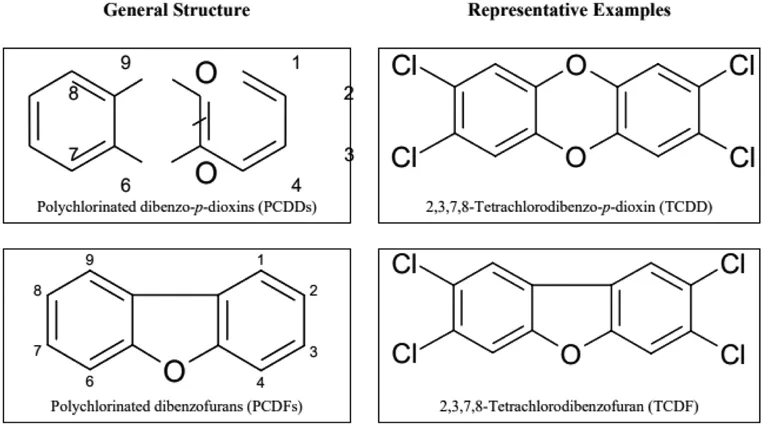
Dioxin is a general term applied to a group of compounds that are the unintentional by-product of anthropogenic activities such as incineration, combustion, industrial and manufacturing operations. These compounds are a class of structurally related halogenated aromatic hydrocarbons, including 2,3,7,8-tetrachlorodibenzo-p-dioxin (2,3,7,8-TCDD) or polychlorinated dibenzo-p-dioxins (PCDD), and polychlorinated dibenzofurans (PCDF) (Figure 1.1). One of the most common and also one of the most toxic forms of dioxin is 2,3,7,8-TCDD, which is formed during the manufacturing of 2,4,5-trichlorophenol (2,4,5-TCP). Chemical characteristics of dioxins include their low water solubility, low vapor pressure, high melting point, and are lipophilic, hydrophobic, and bioaccumulative (Srogi, 2008; Boalt et al., 2013). These properties make dioxins persistent organic pollutants POPs. Coupled with their long-range atmospheric transport (LRAT), they are ubiquitously found in all environmental matrices. Of the 75 congeners of dioxins, 2,3,7,8-TCDD has been extensively investigated due to its acute toxicity. Because of its toxicity, dioxins are included in the United Nations Environment Program’s (UNEP) list of “Dirty Dozen,” a list of persistent organic pollutants proposed to be eliminated through various global treaties. Although historical releases of dioxin have been primarily attributed to the chemical industry, other uses of chloro-organic compounds are also substantial. This chapter discusses the chronology of historical milestones that bought dioxin as a mainstream pollutant, the magnitude of pollution, current sources, toxicity, and the exposure routes and resulting human health impact. The chapter also provides a summary of the evolution of regulatory response to mitigate the risk due to exposure to dioxin and provides an insight into the current trends and status of dioxin pollution.
Figure 1.1 General molecular structure of polychlorinated dibenzo-p-dioxins (PCDDs) and polychlorinated dibenzofurans (PCDFs) and their respective representative examples.
(Source: USEPA, 2008)
1Dioxin – historical perspective
Formation of dioxin-like compounds was first reported in the late 19th century. In 1929, Monsanto started the production of polychlorinated biphenyls (PCB) in Anniston, Alabama, and dioxin-like substances were the resultant by-product of the manufacturing of PCB (Commoner et al., 1994; Earthjustice, 2019). Large scale pollution of organochlorine-based substances during the early 20th century has led to the unintentional production of dioxin and dioxin-like compounds. The earliest recognized instance (documented in 2007) of high levels of dioxin production resulting from industrial activities dates back to 1900s (Weber et al., 2008). The authors reported that a German Leblanc Soda factory that operated from 1848–1893 produced 1 to 10 kg toxic equivalent (TEQ) of dioxin (PCDFs). Note that, human beings are likely to be exposed to the mixtures of dioxins, furans, and other congeners through a variety of exposure routes and pathways, and as such accurate risk quantitation is difficult. Toxic Equivalent (TEQ) or Toxic Equivalent Factors (TEF) are used to show the relative toxicity of the compound compared to its most toxic member. These factors are essentially the relative toxicity of dioxin compounds compared to its most toxic form typically 2,3,7,8-TCDD (USEPA, 2007).
Another dioxin compound has become well known through a series of events that made dioxin a household name. With the use of “Agent Orange” during the Vietnam War, it achieved worldwide notoriety because of its long-term human health impact due to exposure to dioxin. During 1960 to 1972, The Syntex Facility in Verona, MO was operated by Hoffman-Taff, Inc. In the early 1960s, this facility was located on 180 acres and produced 2,4,5-trichlorophenoxy-acetic acid (2,4,5-T). In 1968, the company leased out part of the facility’s building to Northeastern Pharmaceutical and Chemical Company (NEPACCO) to produce the disinfectant hexachlorophene. Both the production of 2,4,5-T and hexachlorophene led to the unintentional production of 2,3,7,8-TCDD leading to the contamination of soil, groundwater, and the aquatic biota downstream in the Spring River with dioxin and other volatile organic compounds (MDNR, 2019). According to one estimate, approximately 12,000 gallons of concentrated 2,3,7,8-TCDD filter cakes were incinerated; 4,300 gallons stored onsite; and 18,000 gallons were transported (Eastern Missouri) and subsequently sprayed on the dirt roads, riding arenas, and truck lots. An additional 25,000 gallons of 2,3,7,8-TCDD was sent to Waste Management School in Neosho, MO (Powell, 1984).
Pollution due to dioxin and dioxin-like substances received widespread public attention due to the human health consequences arising from its indiscriminate use during the Vietnam War and also due to other human-made disasters, such as the Times Beach incident, Love Canal, and the industrial accident in Seveso, Italy. For example, during 1965–1971, extensive use of “Agent Orange” a defoliating phenoxy herbicide comprising a 50/50 mixture of 2,4-dichlorophenoxyacetic acid (2,4-D) and acid (2,4,5-T) led to the contamination of 2,3,7,8-TCDD. Nobody can accurately determine how much dioxin mass was actually applied – according to some estimates, the total mass of 150–680 kg of 2,3,7,8-TCDD could have been added to the environmental system of Southern Vietnam (Dwernychuk et al., 2002; Hites, 2011). Another incidence of dioxin pollution that received widespread press coverage was the magnitude of dioxin contamination at Times Beach, a site located within the flood plain of the Meramec River in Eastern Missouri. During 1972–1976, the unpaved dirt roads at this site were sprayed with waste oil containing 2,3,7,8-TCDD as a dust suppressant (Powell, 1984; Hites, 2011). Analysis of more than 5200 samples analyzed so far revealed that the highest 2,3,7,8-TCDD concentration at this site was 350 ppb, 2.2% samples with concentration greater than 100 ppb, while 22% of the has concentrations greater than 1 ppb. A similar instance of dioxin pollution was also reported at Love Canal, Niagara Falls, NY with the highest recorded concentration of 2,3,7,8-TCDD in sediments was reported as 312 ppb (Rappe, 1984). An incidence of dioxin pollution from industrial activity was also reported from Seveso, a town in Northern Italy. In 1976, an explosion at the chemical plant led to the airborne discharge of dioxin, and subsequent soil deposition resulted in massive soil contamination with concentrations in some parts higher than 50 µg/m2(Hites, 2011). According to one estimate, more than 37,500 people in the immediate vicinity could have been exposed to dioxin (Pope and Rall, 1995). Some of these instances are now recorded among the most notable environmental disasters of the 20th century.
2Sources of dioxin in the environment
Two primary sources through which dioxin enters the environment are natural sources and anthropogenic sources. Dioxin naturally exists in the environment, and some natural processes such as forest fires can also contribute to dioxin in the environment. Occasionally, uncontrolled forest fires, brush fires, landfill fires, accidental fires, building fires, and open burning of waste contribute to the emission of dioxin (USEPA, 2006). Natural sources of dioxin are few, and net mass released to the environment is relatively small compared to the dioxin releases from human activities. Dioxin is not an individual compound released directly from a source, but rather a group of compounds that are formed during the commercial production of chlorinated organic solvents, such as pesticides and herbicides, the incineration of municipal waste, and the combustion of fuels like wood, coal, diesel, or oil (Kanan and Samara, 2018) (Figure 1.2). They are also produced during a variety of industrial processes like pulp and paper production, chemical manufacturing, and metal processing (Mukherjee et al., 2016). Combustion is a broad term and includes combustion of municipal, solid waste, sewage sludge, medical waste, and hazardous waste (USEPA, 2006). In the past, chemical industries were the primary sources of dioxin in the environment. Other contemporary processes, such as metal smelting, (iron, lead, copper smelting) and steel, magnesium, and titanium dioxide production also contribute to dioxin in the environment (USEPA, 2006). Primarily emitted from a variety of anthropogenic activities, dioxins are toxic, persistent, and bioaccumulative (Liu et al., 2013). In 2012, emissions of dioxins from electricity and heat generation processes (combustion of gasoline, diesel, wood, coal, a...
Table of contents
Cover
Half Title
Title
Copyright
Contents
Preface
About the editors
Occurrence, fate, and distribution of dioxin in the environment
Toxicity of dioxin: implication for human health & the environment
Remediation of dioxin: past, present, and future
Index
Trusted by 375,005 students
Access to over 1.5 million titles for a fair monthly price.
Study more efficiently using our study tools.
Frequently asked questions
Yes, you can cancel anytime from the Subscription tab in your account settings on the Perlego website. Your subscription will stay active until the end of your current billing period. Learn how to cancel your subscription
No, books cannot be downloaded as external files, such as PDFs, for use outside of Perlego. However, you can download books within the Perlego app for offline reading on mobile or tablet. Learn how to download books offline
Perlego offers two plans: Essential and Complete
Essential is ideal for learners and professionals who enjoy exploring a wide range of subjects. Access the Essential Library with 800,000+ trusted titles and best-sellers across business, personal growth, and the humanities. Includes unlimited reading time and Standard Read Aloud voice.
Complete: Perfect for advanced learners and researchers needing full, unrestricted access. Unlock 1.5M+ books across hundreds of subjects, including academic and specialized titles. The Complete Plan also includes advanced features like Premium Read Aloud and Research Assistant.
Both plans are available with monthly, semester, or annual billing cycles.
We are an online textbook subscription service, where you can get access to an entire online library for less than the price of a single book per month. With over 1.5 million books across 990+ topics, we’ve got you covered! Learn about our mission
Look out for the read-aloud symbol on your next book to see if you can listen to it. The read-aloud tool reads text aloud for you, highlighting the text as it is being read. You can pause it, speed it up and slow it down. Learn more about Read Aloud
Yes! You can use the Perlego app on both iOS and Android devices to read anytime, anywhere — even offline. Perfect for commutes or when you’re on the go. Please note we cannot support devices running on iOS 13 and Android 7 or earlier. Learn more about using the app
Yes, you can access Dioxin by Sudarshan Kurwadkar, Prabir Mandal, Shivani Soni, Sudarshan Kurwadkar,Prabir Mandal,Shivani Soni, Sudarshan Kurwadkar, Prabir K. Mandal, Shivani Soni in PDF and/or ePUB format, as well as other popular books in Biological Sciences & Ecology. We have over 1.5 million books available in our catalogue for you to explore.