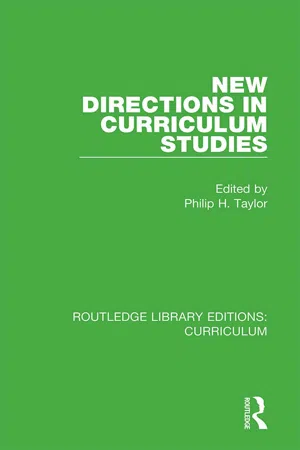
Originally published in 1979. Celebrating the tenth anniversary of the Journal of Curriculum Studies. This edited collection of ten significant papers, five of them specially commissioned to critically survey a decade of intellectual effort in selected areas of curriculum studies, not only identifies the emerging frontiers in an important field within the study of education but also provides an excellent set of teaching and learning resources in an area where the usual text book can be counter-productive.
- 190 pages
- English
- ePUB (mobile friendly)
- Available on iOS & Android
eBook - ePub
New Directions in Curriculum Studies
About this book
Information
1 The Search for New Paradigms
Introduction
Most fields of study prosper only so long as the models, metaphors and paradigms which they employ continue to be the means by which new insight and more comprehensive understanding is won. When more and more effort produces less and less knowledge it is time to turn from old paradigms and search for new ones. It is this that is happening in the field of curriculum studies which is seen more and more as the study of human practical problems and less and less as an applied technical, scientific field.
The four papers collected in this section in turn survey a trend toward judicial and quantitative enquiry that has been deepening in recent years, proffer an analysis of the several schools of ideas and thinking which have served the curriculum field and argue for curricularists to be open to conceptions of the field other than their own, clarify the characteristics of alternative assumptions about evaluation, and, finally, exemplify the development of a new paradigm.
There is a sense of urgency present in the search for new paradigms to serve the field of curriculum studies, at least as instanced in the papers of this section, and a cool confidence which promises well for the future.
Humanistic Trends and the Curriculum Field
Elliot W. Eisner
Stanford University
Stanford University
At present a major anomaly exists in the field of education both in England and in the United States. The anomaly I speak of, is the growing concern among lay people and professionals alike that schools are not doing as well as they once were and that if the educational quality of the past is to be recaptured we must emphasize the ‘basics’, we must return to what is truly fundamental in schooling, namely, teaching children to read, to write and to compute. This concern with the basics is exacerbated by information given to the public that test scores are slipping and have been for quite a few years. Since 1970 in the United States the drop in Scholastic Aptitude Test Scores has been 30 points in the verbal and 50 points in the mathematical sections of the test. To ensure that appropriate efforts are made to pay attention to these areas of performance, proficiency tests are being mandated by the States and minimum performance levels are being established that must be met by any student seeking a graduation diploma.1 ‘Back to basics’ and ‘minimum standards’ are the watchwords.
These concerns are not limited to the United States. In Calgary, Canada, recent headlines read: ‘Education Report: Go Back to 3Rs’.2 And in England a national project has been undertaken by the Department of Education and Science that would provide for the English what the National Assessment Program has provided for Americans; quantitative indices of the educational health of the nation.3
While this concern with the so-called basics and their assessment is going on, there is another movement developing simultaneously. That movement is concerned with the creation of a fundamentally different conception of education, in particular educational evaluation. It is this new movement, born and nurtured within the university that serves as the conceptual and philosophic antithesis to a conception of education limited to the three Rs and to a form of evaluation limited to quantitative description.
The movement I speak of is the growing interest among academics in the use of qualitative forms of inquiry in education. Like the so-called ‘back to basics’ movement, this interest is not limited to the United States. In England it is represented in the work of Barry McDonald, Lawrence Stenhouse and Malcolm Parlett; in Scotland by David Hamilton; in Norway by Torsten Harbo; in Germany by Hartmut von Hentig; and in the United States by Stake, Jackson, Eisner, Willis, Mann, Walker, Huebner, and a host of others. What we see emerging in the university is the epistemological and methodological opposite of what is being advocated as desirable for the schools. It is this new movement, this growing interest in the exploration of qualitative forms of inquiry in education that I wish to discuss in this paper. To my mind this growing interest represents one of the most radical and promising developments in education since the turn of the century, since it aims to explore and exploit a fundamentally different set of assumptions about the nature of knowledge than the view that has dominated in education since 1900, at least in the United States.
By qualitative forms of inquiry I mean that form of inquiry that seeks the creation of qualities that are expressively patterned, that seeks the explication of wholes as a primary aim, that emphasizes the study of configurations rather than isolated entities, that regards expressive narratives and visuals as appropriate vehicles for communication. Qualitative methods tend to emphasize the importance of context in understanding, they tend to place great emphasis on the historical conditions within which events and situations occur, and they tend to argue that pieces cannot be understood aside from their relationship to the whole in which they participate. To understand an event or situation one must perceive it as an aspect of a larger pattern, rather than as an entity whose characteristics can be isolated and reduced to quantities.
To emphasize, as I have just done, the distinctive characteristics of qualitative inquiry is not to suggest that those who use such methods reject quantitative procedures. They do not. What they do reject is the assumption that objectivity can only be secured through quantitative or scientific methods. They reject the claim—implicit or explicit—that rigour in educational inquiry requires the use of methods that result in conclusions that can be stated in terms of probabilities. Let the problem determine the method, not vice versa.4 Thus what we find are arguments for a multiple set of approaches to the ways in which educational inquiry can be pursued. The methods must be broadened.
As I see it, the motives for the development of qualitative methods in education emanate from three major sources. First, there are those whose interest stems from political motives. These individuals view the schools as an institutionalized conspiracy to keep children dependent, ill-informed and tolerant of mindless tasks so that when they become adults they will fit into the existing social order. To such individuals the feckless character of schools is not indicative of failure but of success. Schools, they believe, were and are intended to be a mindless experience for the young. Because the research establishment and the testing industry participate in this subterfuge, they are important targets to attack. Critical methods, particularly those that illuminate the kinds of experience that teachers and students have in schools, hold promise for raising the public’s level of critical awareness. In addition, such methods have a kind of emotional impact in revealing what really goes on in schools, and thus might lead the public to seek significant changes in the structure and goals of schooling. For many of those politically motivated the use of qualitative methods is more compatible with a socialistic society or a Marxist-socialistic philosophy. Qualitative methods of evaluation, they believe, might make a significant contribution to the realization of such ends.
The second motive for the development of qualitative approaches to educational inquiry is methodological. Many of those interested in the uses of such methods regard laboratory research procedures associated with educational psychology as inappropriate for the study of classroom life and desire a more flexible and naturalistic approach to inquiry. For such individuals, ethnography, for example, provides a more desirable and more appropriate alternative. By attending to the context as a whole and by observing what naturally transpires without intervention by experimenters, a more valid picture of educational life can be secured. With more valid data, the likelihood of developing theory that is useful for understanding classrooms, teaching, and schooling is increased.
It should be noted that the motives here are not necessarily political in character. What those who wish to extend the methods of inquiry in education seek is not necessarily the radical reform of school or society, but the widening of legitimate procedures for research and evaluation. They frequently find the dominant view of research parochial and the methods for evaluating what students learn superficial.
The third motive for the development of qualitative approaches to evaluation is at base epistemological. Those moved by this ideal regard scientific epistemology as inadequate by itself for articulating all that needs to be known about schools, classrooms, teaching, and learning. Scientific and quantitative methods are important utilities for describing some aspects of educational life and their consequences, but they are far too limited to be the exclusive or even the dominant set of methods. To complement these methods of evaluation, evaluators must look to the qualities that pervade classrooms, the experience that students have in schools, and the character of the work that children produce. To see these qualities requires a perceptive eye, an ability to employ theory in order to understand what is seen and a grounded set of educational values so that an appraisal of the educational significance of what has been seen can be determined.
But what is equally as important as perceiving the qualities that constitute classroom life is the ability to convey these qualities to others. For this to occur the methods used must be artistically critical. The educational critic must be able to create, render, portray, and disclose in such a way that the reader will be able to empathetically participate in the events described. The language of the critic using qualitative methods capitalizes on the role of emotion in knowing. Far from the ideal of emotional neutrality so often aspired to in the social sciences, the educational critic exploits the potential of language to further human understanding. The language she or he uses is expressive, so that the kind of understanding the reader can secure is one that reaches into the deeper levels of meaning children secure from school experience. To convey such meaning, the artistic use of language is a necessity.
The import of this orientation for education is significant for several reasons. First, it has long been recognized that the procedures used to evaluate students, teachers and schools have a profound effect on the kinds of priorities that the curriculum reflects.5 When achievement, defined in terms of standardized forms of performance within specific subject areas becomes salient, it is likely that teachers will devote attention to those areas and in the process place less emphasis or neglect entirely areas that are not defined by test performance. What is counted, counts.
For students the need to do well on the instruments that assess achievement is a necessary condition for upward mobility within the educat...
Table of contents
- Cover
- Half Title
- Title Page
- Copyright Page
- Original Title Page
- Original Copyright Page
- Contents
- Acknowledgements
- Introduction: Curriculum Studies in Retrospect and Prospect: Philip H. Taylor
- 1 THE SEARCH FOR NEW PARADIGMS
- 2 THE IDEOLOGICAL DIMENSION
- 3 NEW DIRECTIONS IN CURRICULUM RESEARCH
- The Contributors
Trusted by 375,005 students
Access to over 1.5 million titles for a fair monthly price.
Study more efficiently using our study tools.
Frequently asked questions
Yes, you can cancel anytime from the Subscription tab in your account settings on the Perlego website. Your subscription will stay active until the end of your current billing period. Learn how to cancel your subscription
No, books cannot be downloaded as external files, such as PDFs, for use outside of Perlego. However, you can download books within the Perlego app for offline reading on mobile or tablet. Learn how to download books offline
Perlego offers two plans: Essential and Complete
- Essential is ideal for learners and professionals who enjoy exploring a wide range of subjects. Access the Essential Library with 800,000+ trusted titles and best-sellers across business, personal growth, and the humanities. Includes unlimited reading time and Standard Read Aloud voice.
- Complete: Perfect for advanced learners and researchers needing full, unrestricted access. Unlock 1.5M+ books across hundreds of subjects, including academic and specialized titles. The Complete Plan also includes advanced features like Premium Read Aloud and Research Assistant.
We are an online textbook subscription service, where you can get access to an entire online library for less than the price of a single book per month. With over 1.5 million books across 990+ topics, we’ve got you covered! Learn about our mission
Look out for the read-aloud symbol on your next book to see if you can listen to it. The read-aloud tool reads text aloud for you, highlighting the text as it is being read. You can pause it, speed it up and slow it down. Learn more about Read Aloud
Yes! You can use the Perlego app on both iOS and Android devices to read anytime, anywhere — even offline. Perfect for commutes or when you’re on the go.
Please note we cannot support devices running on iOS 13 and Android 7 or earlier. Learn more about using the app
Please note we cannot support devices running on iOS 13 and Android 7 or earlier. Learn more about using the app
Yes, you can access New Directions in Curriculum Studies by Philip H. Taylor in PDF and/or ePUB format, as well as other popular books in Education & Education General. We have over 1.5 million books available in our catalogue for you to explore.