- 250 pages
- English
- ePUB (mobile friendly)
- Available on iOS & Android
eBook - ePub
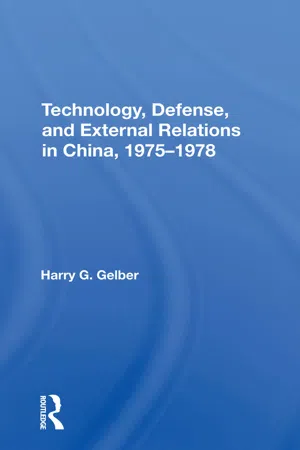
Technology, Defense, And External Relations In China, 1975-1978
About this book
This volume surveys efforts by China's post-Mao leadership to adopt modern technology in China's industrial and economic sectors while focusing new attention on an increasingly obsolescent defense structure. The author presents these efforts against the background of the external political and military environment to which the PRC must react. He outlines the foreign policy and strategic problems that faced the new administration as it came to power in Peking and examines the military, industrial, and technical resources currently at China's disposal as well as changes that have been proposed, implemented, or that may be required in the future. Finally, he suggests some of the limitations circumscribing government policy in these areas and some of the choices that lie ahead.
Information
1
Political Change and Foreign Policy
The year 1976 brought great changes to the ruling elites of the People's Republic of China. It saw the deaths of several of the Grand Old Men of the Revolution, including the three major architects of Communist China: Chou En-lai the administrator, Chu Teh the general, and Mao himself. Both as fact and as symbol it represented the disappearance of the whole first generation of revolutionary leaders, the men of the "Long March,"1 and hence a change of habits and perspective that might prove to be of great importance. Appropriately, perhaps, the land and the seasons marked the occasion by a series of natural disasters—droughts, floods, and earthquakes— which did nothing to ease the problems facing the new leadership. And the policies espoused by that new leadership seemed to underline the quality of change in the conduct of China's affairs. The death of Mao on 9 September was followed almost immediately by the coup against his widow, Chiang Ching, and her associates in the Shanghai group known as the "Gang of Four," and by the most intense and sustained campaign to achieve rapid economic modernization that China had seen for twenty years and perhaps for the whole of the twentieth century.
Yet it is possible to interpret these events as only the latest in a number of dramatic shifts in policies and priorities that have occurred in China over the last century or more, representing recurrent swings among a very small number of approaches to the problems of China's political and social development. In a highly stylized way, one can suggest that the various approaches have clustered around five themes. One has been concerned with centralism versus localism. Another has had to do with nationalist and nativist principles versus some receptivity to foreign ideas and techniques. A third has focused on pragmatism in policymaking versus political and cultural fundamentalism. A fourth has emphasized statism and law and order versus populist and Utopian principles. And the fifth has been concerned with the difficulties caused by the emergence of a new middle class of managers and technocrats for the balance between older classes of society. Political debates, and foreign analyses of them, have been greatly complicated by the fact that there have been few clear and consistent patterns about which persons or groups have supported which side and by the fact that, as always in China, the operational compromises have had to do with the interplay of personalities and the networks of personal associations derived from the politics of cities, provinces, and other groupings. Moreover, the areas of agreement often have been as important as the subjects of debate. Debates have taken place within a broad cultural and philosophical tradition ranging from the forms of Chinese language to assumptions about China's proper place in the forefront of human and cultural development. There has been broad agreement on the need for national unity and provincial and popular support for the central government as a condition for the achievement of any satisfactory set of internal and external policies. There has been no serious or lasting challenge to the role of a strong bureaucracy and the need for an extremely tight system of social controls. Nor, between 1949 and 1978, was any serious challenge allowed to arise to the dominant and all-pervasive role of the Chinese Communist Party (CCP) or to the formulation and development of the ruling political ideas within the framework of Maoist ideology.
That ideology has played a role of particular significance in several ways. In one sense ideology represents truth: unchanging, scientific, determined by history. In another, however, the interpretation of that truth and its application amid changing sets of practical circumstances can be negotiable within very broad limits. But the process of interpretation must avoid two equal and opposite dangers. Interpretation and policy formation must not decline into mere "ad hocery." Ideology provides a basic world view, a glass through which reality can be perceived, analyzed, and interpreted. It provides the concepts and the vocabulary of that interpretation. Policies, to be acceptable or even seriously debatable, must be formulated and presented in terms which accord with that vocabulary and with the main lines of that world vision. They must be defensible in ideological terms against objections deriving from other segments of currently accepted views. Ideology therefore obliges the leadership to formulate and defend policy in coherent and comprehensive philosophical terms, by close reference to basic principles. It also lends itself to distinguishing between right and wrong and to personifying that distinction in judgments on the participants in public debate at any given time. However, interpretation must also avoid rigidity and formalism, and suggest polarities of belief rather than fine boundaries. Interpretation lays down norms, but it also decides the range of permissible variations. Indeed, tactical maneuverability has been incorporated into the dogma as the dialectical unity of principle and practical flexibility. This has a variety of philosophical and practical implications.
Mao repeatedly denounced dogmatism and idealism apriorism and emphasized that theory must be subject to constant reexamination and, if necessary, revision in the light of experience. He went to some lengths to try to ensure that this "contradiction" between theory and practice, in the form of fruitful tension, would continue after his death, and, of the people around him, Chou En-laí and Chiang Ching may be said to have personified the dualism during the final period of Mao's life. On the practical level, too, the ideology not just allows but actually enjoins flexibility. Long ago Chairman Mao explained the need to use contradictions, to obtain majorities, to isolate and destroy opponents, and for such purposes to form temporary coalitions. Though the particular combination of theory and practice may be specific to the CCP, the tactics themselves are not particularly Maoist or even Chinese. Machiavelli would have felt entirely at home in such a universe of discourse. Divide et impera was a commonplace of statesmen long before the days of the Roman Empire. And in some corner of that seventh circle of the Inferno which Dante tells us, is reserved for the violent, Mao and Palmerston have doubtless exchanged sage comments on the need to have no permanent friends or permanent enemies.
The ideology also plays a central role in legitimizing the position of the CCP and, hence, in the maintenance of the hierarchical state which is China. The official dogma provides the sole permissible framework for rallying the public, in part or in whole. On it rests the position of the Party which in turn enunciates and assures the dominance and all-pervasive relevance of the ideology. No checks and balances against the Party can be allowed to exist. They might suggest, intolerably, that the dogma or the leadership were fallible. If institutionalized and maintained, they might factionalize the Party, even create alternatives to it. All representative bodies capable, however remotely, of forming an alternative to total Party control had, therefore, to be eliminated or emasculated. While this did not, of course, eliminate dispute and factionalism, it tended to confine it to the internal discussions of the Party and to permit canonization of the beliefs while at the same time rendering popular participation sterile.
It is at this point that the Party has been Janus-faced. On the one hand, its purposes and operational habits have been built on what Balasz2 has called some of China's deepest traditions, "totalitarian, state-centered, and bureaucratic." Complete control over social activities, fear through the imposition of the principle of kinship or other collective responsibility, mutual surveillance, the assumption that an accused person is guilty until proven innocent, and the invariable priority accorded to state over individual interests—all these were phenomena of Chinese life long before 1949. Similarly, the Maoist state found some aspects of the Confucian traditions of behavior helpful to it. Humility and subordination to authority on the part of the individual citizen and a quasi-sacerdotal position for the official of the omnipotent state were preferred characteristics of the post-1949 regime, much as they were for its imperial predecessors. Traditional emphases on bureaucratic authority, law and order, and an absence of public dissent were reinforced by mass organization and indoctrination and the modernized versions of Chinese legalism. It was a tradition that had many advantages, some of which were personified by Liu Shao-chi in the 1950s and 1960s and by Teng Hsiao-ping in the 1970s. It proved to be reasonably efficient and flexible. It provided a bureaucratic system which was in many ways intelligently moderate, pragmatic, and intent on faster advances toward economic and technical modernization.
Yet the system had profound flaws. It created a massive official apparatus for persuasion and coercion. This extended beyond the ubiquitous study meetings, the mutual surveillance, and kinship responsibility to the maintenance of a monopoly for official propaganda and a legal system in which there were mass arrests and unlimited pretrial detention, in which trials tended—and still tend—to be pure formalities with judgments frequently reached in advance and with no rights of appeal for the accused. There appears to have been fairly regular official use of torture,3 and the authorities maintained a massive prison camp system. This system, used both for punishment and "reeducation," may have contained several tens of millions of people.4 No less important was the large-scale loss of life. The authorities regularly resorted to exemplary executions.5 There was large-scale killing during the various campaigns from the liquidation of counterrevolutionaries in the 1949-52 period to the disturbances of the mid-1970s. The Cultural Revolution amounted in some places to a civil war. And Western estimates of the number of deaths during the famines of 1959-62 range up to 50 million.6 At the same time, the hierarchical structure of the system produced major inequalities of income and life-style amounting to nothing less than the creation of a new set of class privileges and distinctions.
The pressures for acquiescence in, and support of, the official line, supported by traditional social pressures for consensus, frequently produced a surface appearance of unanimity. The reality was otherwise. There were notable gaps between faith and practice, between the official picture and everyday reality, including its elements of fear and resentment. Cadre cynicism became common. Official condemnations of corruption, selfishness, black marketeering, official arrogance and arbitrariness, and worse crimes like theft and murder suggest that these events were far from rare. There was sporadic evidence of stealing and prostitution at times of shortage, of families hiding young people supposed to go to the countryside, of bribery, cheating, and a variety of personal "favors" to enable people to get or keep jobs, or to stay in the cities, or to mollify important cadres. Mass movements were almost invariably events of organized spontaneity.7 Even during the Cultural Revolution different Red Guard groups appear to have been organized by rival sections of the elite. But perhaps the greatest, and in some ways the most subtle, dangers for the regime arose from the difficulty of getting adequate and unbiased information on what was actually happening, for without such information the design of appropriate policies was and is impossible. Yet the very comprehensiveness of the official system of controls, combined with an absence of institutionalized constraints on official behavior, made it certain that senior officials would have difficulty in discovering what the practical realities of life were like for ordinary men. The repeated propaganda stress on "learning from the masses" was only one sign that the leaders were aware of the tendency for reports to be framed in terms of the leadership's own a priori assumptions or pronouncements, even in those areas where it might have been very willing to remedy problems if it had known about them.
It is not surprising that the Party should have had a Utopian as well as a bureaucratic face. This went beyond the notion that Party discipline should suffice to prevent bureaucratic degeneration. It involved notions, going back half a century to Sun Yat-sen and beyond, that the people should be given some powers of response or control short of rebellion. After 1949, it involved emphasis on the genuinely popular and participatory elements of the Chinese revolution. Such tendencies reappeared at irregular intervals; in the "Hundred Flowers" campaign, in the "Great Leap Forward," in the Cultural Revolution, and in some aspects of the activities of the Gang of Four in 1974-76. They were efforts to which Mao was especially sensitive, aimed at making a reality of the links between leaders and masses; of maintaining and harnessing mass enthusiasm; and of retaining the egalitarianism, brotherhood, and spirit of self-sacrifice of the revolutionary period. They were aimed at creating the "new man" on whom Maoist society would in the longer term have to depend. They aimed at the creation of a relatively decentralized, unbureaucratic China, without social stratification and class privileges. Proponents of these efforts claimed to be opposing corruption, feudalism, and bureaucratic arrogance, opportunism, formalism, and pedantry. In sum, the efforts were attempts to prevent the emergence of a Soviet-style revisionism and the consolidation of the CCP as a privileged elite and to curb the linked bureaucracies of Party and state. Though these views were in some ways romantic, they were also based on hard, pragmatic political realities. Certainly the growing gap between a sophisticated bureaucracy and an everyday reality increasingly marked by corruption and practical confusion is one of the classic dangers that have faced successive Chinese regimes.
Yet this aspect of the Party's approach had evident weaknesses also. It argued for egalitarianism, but in practice displayed a hard-nosed puritanism which led to rigidity and much discontent. It emphasized correct belief rather than effective economic action, with the result that economic activity became disorganized and many people were driven to needy desperation. It opposed bureaucracy but proved unable, most spectacularly during the Cultural Revolution, to create an alternative structure or even to develop a comprehensive theory on the basis of which one might be created. It insisted upon purity but, as so often with purveyors of secular notions of virtue, was willing to offer up hecatombs of victims in the name of abstract nouns.
A good deal of contemporary Western comment was puzzled by these various dichotomies. Confronted by the evident gap between national pretensions and pragmatically realistic policies, or by differences between ideological principle and practical compromise, many observers suggested that the pragmatism was a mere cover for revolutionary intentions or else that revolutionary slogans were a ritual disguise for policies explicable in normally pragmatic Western terms. Neither view is entirely plausible. There has been a historic tendency for Chinese administrations to maintain assertive and bombastic language even at times of obvious and conscious political and military weakness.8 Decisions to leave undisturbed the evident gap between declaratory language and the analyses on which practical policies had to be based may have served the purposes of domestic morale and cultural cohesion as well as those of maintaining external aims in principle, pending the achievement of the means to fulfill them. Similarly, the appearance of a gap between ideological principle and day-to-day policy did not of itself permit definite conclusions about whether either could be said to represent the "real" aims of the regime more than the other. Outsiders tended to divide the participants in Chinese policy debates during the 1970s into "moderates" and "radicals" along the lines suggested by the divide between pragmatists and Utopians within the Party. But this was too simple, as was any analysis in terms of straightforward dichotomies. Policy pragmatism tended to be associated with administrative centralizers and emphasis on order. But Utopians could be, and were, pragmatic on many issues. Populists could, and did, favor rapid economic modernization. Bureaucrats could be, and often were, fundamentalists. Nativismi tended to be associated with populist groups, yet it would be hard to deny centralizing bureaucrats the character of nationalists.
Approaches to policy actually concerned clusters of views and groupings, with the composition of the clusters shifting somewhat in relation to particular issues and personalities. One of these clusters may be said to have had to do with nativism and political and cultural fundamentalism. From this point of view, China's nineteenth-century conservatives and the "radical" Gang of Four were brothers and sisters under the skin. The approaches favored by such groups emphasized cultural and educational policies centered on China's own traditions and designed to maintain a political and cultural system distinctive from that of the outside world. These views stressed correct values rather than technical competence, mass participation rather than elitist excellence, domestic notions of virtue rather than responses closely attuned to external challenges, and a distrust of material values as well as foreign influences. Another cluster included views shared by the nineteenth-century innovators as well as the "moderates" of the late Mao and post-Mao periods. These groups emphasized the virtues of pragmatic adaptation to contemporary realities, economic rationality, managerial competence, and technical advance. They wanted to expand China's economic base more rapidly and were sensitive to the needs of modern planning, especially in economic matters, and to the relationships among economic, technical, and security concerns. They tended to stress the connection between domestic development and China's ability to maintain her political and cultural position vis-à-vis the outside world, let alone her ability to exercise influence abroad. They tended to seek national unity through decreased emphasis on arguments about belief and greater attention to raising the standard of living of the Chinese people; less emphasis on nativism and more on using whatever means might be available to raise China's economic, political, and military capacities. Altogether, the debate a century earlier, between conservatives who opposed opening China to the world because such action would be likely to destroy her traditions and those who favored modernization as the only feasible road to national strength and independence, had at least some interesting parallels with debates between radical conservatives and moderate modernizers of the early and middle 1970s.9
In practice, neither approach prevailed wholly or for long over the other. Practical policymaking usually concerned some form of compromise between them. The end of the Cultural Revolution heralded the reestablishment of such a complex policy compromise. It is not possible to describe the details of the debates on these...
Table of contents
- Cover
- Half Title
- Series Page
- Title
- Copyright
- Dedication
- Contents
- Preface
- 1. Political Change and Foreign Policy
- 2. Defense
- 3. The Economy
- 4. Technology
- 5. Conclusions
- Notes
- Index
Trusted by 375,005 students
Access to over 1.5 million titles for a fair monthly price.
Study more efficiently using our study tools.
Frequently asked questions
Yes, you can cancel anytime from the Subscription tab in your account settings on the Perlego website. Your subscription will stay active until the end of your current billing period. Learn how to cancel your subscription
No, books cannot be downloaded as external files, such as PDFs, for use outside of Perlego. However, you can download books within the Perlego app for offline reading on mobile or tablet. Learn how to download books offline
Perlego offers two plans: Essential and Complete
- Essential is ideal for learners and professionals who enjoy exploring a wide range of subjects. Access the Essential Library with 800,000+ trusted titles and best-sellers across business, personal growth, and the humanities. Includes unlimited reading time and Standard Read Aloud voice.
- Complete: Perfect for advanced learners and researchers needing full, unrestricted access. Unlock 1.5M+ books across hundreds of subjects, including academic and specialized titles. The Complete Plan also includes advanced features like Premium Read Aloud and Research Assistant.
We are an online textbook subscription service, where you can get access to an entire online library for less than the price of a single book per month. With over 1.5 million books across 990+ topics, we’ve got you covered! Learn about our mission
Look out for the read-aloud symbol on your next book to see if you can listen to it. The read-aloud tool reads text aloud for you, highlighting the text as it is being read. You can pause it, speed it up and slow it down. Learn more about Read Aloud
Yes! You can use the Perlego app on both iOS and Android devices to read anytime, anywhere — even offline. Perfect for commutes or when you’re on the go.
Please note we cannot support devices running on iOS 13 and Android 7 or earlier. Learn more about using the app
Please note we cannot support devices running on iOS 13 and Android 7 or earlier. Learn more about using the app
Yes, you can access Technology, Defense, And External Relations In China, 1975-1978 by Harry G. Gelber in PDF and/or ePUB format, as well as other popular books in Politics & International Relations & Asian Politics. We have over 1.5 million books available in our catalogue for you to explore.