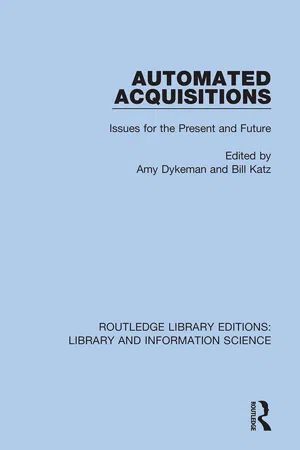
In this book, first published in 1989, practicing librarians share their hands-on experience with implementing various types of acquisitions systems and address planning considerations, the blurring of roles between acquisitions and cataloguing, staffing implications, electronic record transmission, and specialized functions of automated acquisitions systems. These librarians reveal what they wish they knew when they began to implement their systems, as well as what went right - and wrong - along the way. Acquisitions librarians, systems librarians, and any professionals planning for an automated acquisitions system in their libraries will not want the miss the underlying excitement expressed by contributors as they re-evaluate acquisitions work and redefine the role of the acquisitions librarian as a result of automated acquisitions systems.
- 298 pages
- English
- ePUB (mobile friendly)
- Available on iOS & Android
eBook - ePub
About this book
Trusted by 375,005 students
Access to over 1.5 million titles for a fair monthly price.
Study more efficiently using our study tools.
Information
GEAC
The INNOVACQ and Geac Acquisitions Systems Compared: A Large Academic Library Perspective
Carol Pitts Hawks
SUMMARY. The INNOVACQ and Geac Acquisitions Systems have been successfully implemented in several large academic libraries. All basic requirements for a full-scale acquisitions system have been met by both systems. Size, as measured by number of orders placed or number of subscriptions maintained, magnifies the problems, deficiencies, and difficulties of any system. This paper focuses on significant differences between the two systems, particularly as they relate to large academic libraries. These areas include capacity, in-house control and environmental concerns, backup procedures and printing, command structure, record structure, integration versus interfacing, password security, serials control, invoicing and fund accounting, and management reports.
INTRODUCTION
Acquisitions represents a “last bastion of manual operations in an increasingly automated library environment.”1 The acquisitions process includes many exceptions, intricacies, and subroutines which vary substantially from one library to another. Typically a library’s local requirements for acquisitions are much more individualized than for cataloging or circulation. The increased uniformity in cataloging results from universally accepted national standards such as MARC and their use in common databases, such as those maintained by RLIN and OCLC. In the area of Circulation there has been a similar convergence of approaches over the years. However, acquisitions is subject to local policies and procedures governing purchasing and financial transactions that are usually mandated by another department in the library’s parent organization. This stymied most attempts to adopt a more standardized approach to acquisition processes. By early 1982, most automated systems had overcome this difficulty by offering a range of purchase order and financial report formats.2 Nevertheless, each library’s specific procedures and policies will determine how well any system meets the needs and expectations of that individual library.
Carol Pitts Hawks is Head, Acquisition Department for the Ohio State University Libraries, 1858 Neil Avenue Mall, Columbus, OH 43210-1286. She was Head of Acquisitions at the University of Houston Libraries from 1982-1987.
Early automated systems were supported by expensive, full-size computers. Few libraries could afford to obtain their own computer; most had to rely on sharing available hardware. The 1970s and 1980s have seen dramatic developments in hardware, enabling almost any library to consider an online system.3 Although computers are often divided into three basic kinds — microcomputers, minicomputers, and mainframes —the differences between them are rarely that distinct. The power of computers at the lower end of the spectrum is rapidly eroding the differences.
Traditional distinguishing characteristics have included the number of terminals which may be supported, the number of simultaneous tasks which may be carried out, hardware capabilities (for example, the size of the memory), the kinds of storage devices supported, and the price.4
However, the best approach is to evaluate the system based upon its ability to meet the library’s requirements. The limitations of particular systems, whether hardware-or software-based, will become apparent when a thorough analysis is undertaken. This paper will analyze and compare the INNOVACQ and Geac Acquisitions Systems as they relate to large academic libraries.
BACKGROUND-GEAC COMPUTERS, LTD.
Geac was founded in 1971 with its first product being an inventory control system for municipal school boards. The company made a significant move into the retail banking world in 1974. From a computing point of view, the similarities between banking and library applications, primarily the shared need for large databases and high transaction processing levels, made the move into library applications a natural step. Geac’s integrated library system was developed in a piecemeal fashion, beginning in 1977 with the development of an online circulation system for the Universities of Guelph and Waterloo.
A circulation system is, by definition, a form of an online catalog so the logical next step was the introduction of public access capabilities. Geac’s cataloging package, known as the MARC Records Management System (MRMS), provides the data upon which the catalog is based. Acquisitions was the third of the major packages which was created in the early 1980s as a direct response to customer demands for a totally integrated system.5 The entire Geac system was purchased by the University of Houston Libraries (UH) in 1982. The online catalog was given first priority in implementation, followed closely by circulation and MRMS. The Acquisitions module was implemented in September 1984. At that time, UH was one of the largest and earliest implementations of the system in a large academic library which included the University of Waterloo and Princeton University.
BACKGROUND-INNOVATIVE INTERFACES, INC.
The Innovative Interfaces’ INNOVACQ System varies in one very significant way from the Geac system – it was developed from the ground up to deal specifically with library acquisitions tasks. Innovative Interfaces, Inc. (III) was founded in 1978 by Steve Silberstein and Jerry Kline. Both Kline and Silberstein had been instrumental in the development and implementation of a batch acquisitions system at the University of California at Berkeley. This previous experience and their own vision of what an ideal system should be formed the basis of the INNOVACQ system. III began its development with five overall goals:
- Replacement of all manual functions;
- Increased services such as reporting and analysis of data;
- Ease of use;
- Full integration both internal and external;
- Flexibility.
INNOVACQ was initially developed in 1981 to meet the specifications of the University of California at Riverside and California State University at Long Beach. The serials check-in component was first implemented in 1983 at the University of California Boalt School of Law.6 INNOVACQ was purchased by the Ohio State University Libraries (OSUL) in 1984. Implementation of the basic system began immediately and has been operational since then. The serials check-in component was implemented following introduction of an interface with the Libraries’ online catalog, LCS, to load on order records into the catalog. Although the University of Michigan Library was one of the earliest and largest academic libraries to use INNOVACQ, OSUL still represents one of the largest ongoing implementations of INNOVACQ.
SYSTEM COMPARISONS
Marlenę Clayton7 and Richard Boss8 have developed extensive checklists for evaluating online systems. Boss also conducted a survey in which he evaluated twenty acquisitions systems against over 190 criteria.9 A thorough analysis of the responses made by Geac and Innovative Interfaces to his survey reveals that all basic requirements for a full-scale acquisition system have been met by both systems. Therefore, this paper will focus on a few significant differences between the two systems, particularly as they relate to large academic libraries.
Size, as measured by number of orders place or number of subscriptions maintained, magnifies the problems, deficiencies, and difficulties of any system. What is a minor inconvenience in system design for a library with 2,000 subscriptions may become a major system flaw for a library with 24,000 subscriptions. For example, in an earlier version of the Geac system, a new bibliographic record had to be entered every time that a title was redirected to another vendor. This is a minor inconvenience to a small library or even to a larger organization which orders directly from the publisher. However, it becomes a significant problem for a library like UH which must, due to contractual obligations, order all in-print domestic titles from a single vendor. However, those titles can be redirected to another vendor as early as 90 days after placement of the original order. Geac eventually enhanced the system to provide this option, but the interim inconvenience was not inconsequential. Therefore, the requirements for any system are very susceptible to local custom and practice
Capacity
Size is also a factor in the hardware on which a system runs. Although Geac operates on a minicomputer as opposed to the INNOVACQ microcomputer system, both systems employ a multi-processer machine. The assumption is often made that a micro system lacks the power and expandability of a minicomputer. The particular configuration selected by III negates this assumption. Sandra Weaver, Vice President of Library Services (III), cites one such example. “For instance, the system … installed at the University of Michigan has 3/4 of a megabyte of main memory. This is approximately four times the main memory found in the average minicomputer in use today.”10 However, III has structured the INNOVACQ system in such a way that some files are universally limited in size. For example, the vendor and fund files were only recently expanded from 750 to 1,200 entries. For large libraries with significant gift and exchange programs, such as OSUL, these numbers are still not sufficient. In contrast, the Geac system is limited only by the space occupied by other files. For example, if a library needs to create files for 500 funds and 2,000 vendors, file size can be adjusted locally to accommodate these differences. Nevertheless, the architecture of both systems is such that few compromises in power, reliability and expandability are needed.
In-House Control and Environmental Concerns
Geac and INNOVACQ vary significantly in the area of in-house control and environmental concerns. INNOVACQ was developed as a stand-alone acquisitions and serials control system, and only recently added an online access catalog (INNOPAC). The system is usually installed in a normal office environment and requires about the same space as a desk. Because the Winchester disk drive is totally enclosed and less susceptible to dust, smoke, and other environmental hazards, the system does not require a specially designed, climate-controlled environment. This is a definite bonus for any library where space is at a premium. On the other hand, system maintenance activities such as tape loading and backups must often be handled by existing staff because no systems staff is available. An additional advantage is that this stand-alone system can insulate the acquisitions process from having to compete for priority or service with other subsystems.
Although the Geac Acquisitions System can be run on the Geac System 6000 hardware which requires no special environmental control, it is most often purchased as part of the Geac Integrated Library System which runs on System 8000 or 9000 hardware. These larger systems do require environmental protection such as climate-controlled temperature and humidity, dust-free air, and often supplemental or independent air conditioning. In addition, the load-bearing capacity of the floor cannot be overlooked.11 In the typical integrated system, such as Geac, systems staff are required to maintain the hardware thus relieving Acquisitions staff of this responsibility.
Backup Procedures and Printing
Any automated system requires the precaution of backing up the system on a periodic basis to protect the software and database against system or power failures. These backups must be done frequently enough (usually daily) so that in the event of a failure, the system can be restored with the loss of as little data as feasible. Geac and INNOVACQ are fundamentally different in their approach to backup procedures and the generation of reports. The Geac Acquisitions system must be brought offline each night in order to perform backup procedures and to run the overnight programs. Once the backups are completed, the overnight programs can be initiated and will usually run unmonitored throughout the night. These overnight programs extract data from the system, format reports, and automatically reset statuses within the system. For example, the purchase order program will run through the entire database and extract titles which have been authorized for purchase during the day. The online status of each of these records is changed from ”on order” to “on order-printed” to indicate that not only has the order been initiated online but that an actual purchase order has been printed. The next morning the online system can be brought up for staff use and the actual printing can be performed with the online system up. Programs which change information in the system must be run with the online down. Simple extract programs which only report information from the system can be run with the online up, but response time will be somewhat degraded. As the size of a database increases, the time required to perform these routine operations increases. Additional tasks such as rebuilding indexes on a weekly basis will require substantial time blocks for any system supporting a large library.
The implementation of the serials check-in module at UH introduced an entirely new factor into this equation. Prior to this implementation, the system had been brought down at 8:00 p.m. when all Acquisitions staff left for the day. With the implementation of the online serials check-in paper records were eliminated and the online system provided the only access to issue-specific receipt data. Previously, public service staff had routinely consulted the paper records after normal working hours to assist patrons; therefore, it became apparent that the Geac system would have to be available almost all of the open library hours. Since the library closed at midnight and reopened again at 7:00 a.m., the number of hours available for both circulation and acquisition backups and overnight programs was seriously reduced. As a result, more compromises were made regarding which programs would be run overnight and additional programs were run during the day or over the weekend.
Conversely, INNOVACQ can be run on a 24-hour schedule if so desired. All purchase orders, claims, cancellations, accounting and financial reports, and management reports, with few exceptions, can be run or printed at anytime. Backups can also be performed with the system up. The INNOVACQ maintenance and overnight programs are not nearly as extensive as Geac’s. However, this also has consequences. Response time is degraded to varying degrees by each of these activities. As a result, OSUL staff have organized themselves in much the same way that Geac dictates the organizational structure. For example, backups are done late in the day and index builds are done on Saturdays. The implementation of serials check-in has also decreased terminal availability. As a result, consideration is being given to batch production of management reports at night or on weekend...
Table of contents
- Cover
- Half Title
- Title Page
- Copyright Page
- Original Title Page
- Original Copyright Page
- Contents
- Preface
- Introduction
- Issues to Consider
- In-House Developed Integrated Systems
- Notis
- Innovacq
- Geac
- Dynix
- Oclc
- Microcomputer Applications
Frequently asked questions
Yes, you can cancel anytime from the Subscription tab in your account settings on the Perlego website. Your subscription will stay active until the end of your current billing period. Learn how to cancel your subscription
No, books cannot be downloaded as external files, such as PDFs, for use outside of Perlego. However, you can download books within the Perlego app for offline reading on mobile or tablet. Learn how to download books offline
Perlego offers two plans: Essential and Complete
- Essential is ideal for learners and professionals who enjoy exploring a wide range of subjects. Access the Essential Library with 800,000+ trusted titles and best-sellers across business, personal growth, and the humanities. Includes unlimited reading time and Standard Read Aloud voice.
- Complete: Perfect for advanced learners and researchers needing full, unrestricted access. Unlock 1.5M+ books across hundreds of subjects, including academic and specialized titles. The Complete Plan also includes advanced features like Premium Read Aloud and Research Assistant.
We are an online textbook subscription service, where you can get access to an entire online library for less than the price of a single book per month. With over 1.5 million books across 990+ topics, we’ve got you covered! Learn about our mission
Look out for the read-aloud symbol on your next book to see if you can listen to it. The read-aloud tool reads text aloud for you, highlighting the text as it is being read. You can pause it, speed it up and slow it down. Learn more about Read Aloud
Yes! You can use the Perlego app on both iOS and Android devices to read anytime, anywhere — even offline. Perfect for commutes or when you’re on the go.
Please note we cannot support devices running on iOS 13 and Android 7 or earlier. Learn more about using the app
Please note we cannot support devices running on iOS 13 and Android 7 or earlier. Learn more about using the app
Yes, you can access Automated Acquisitions by Amy Dykeman,Bill Katz in PDF and/or ePUB format, as well as other popular books in Languages & Linguistics & Library & Information Science. We have over 1.5 million books available in our catalogue for you to explore.