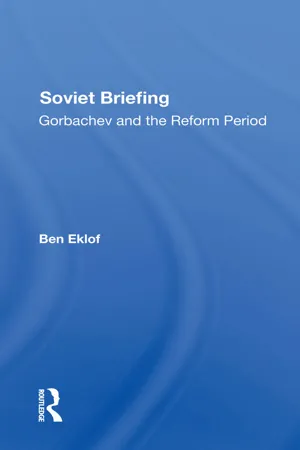
- 195 pages
- English
- ePUB (mobile friendly)
- Available on iOS & Android
eBook - ePub
About this book
In writing this book I incurred a number of debts, which I now gratefully acknowledge. During a year at the Kennan Institute for Advanced Russian Studies in the Wilson Center of the Smithsonian Institution, I attended many seminars and discussions on current events. In one way or another the ideas, information, and debates that took place during my stay contributed to my opinions and shaped the direction of my research; unfortunately I cannot list all the names of those from whom I benefited. The Kennan Institute itself provided a stimulating and supportive environment for my work. I am especially thankful to Peter Reddaway and Ted Taranovski for all they have done.
1
Introduction
The year 1987 in Soviet affairs was tumultuous and exciting in a way few could have anticipated. From the January plenum to the Washington summit, from the remarkable Shmelev assault on virtually all the canons of the Stalinist system to the Yeltsin affair, 1987 stands out in its intensity, exceeding even 1982 (the year of Andropov's accession) and 1985 (when Gorbachev came to power) as a year fraught with significance for the course of affairs in the world's largest country.
And 1988 seems to be tumbling along in even more boisterous fashion. Glasnost has unfolded with such rapidity that words spoken or written a year ago that seemed bold and outspoken then have already become tame, common wisdom. The conservative onslaught, culminating in the now infamous Andreyeva letter, and followed (after a distressing, anxiety-ridden period of silence) by a powerful refutation, then gave way to renewed and vastly expanded calls for radical changes in all areas of society and the polity. Events reached an unprecedented state of frenzy as the June Conference approached and the Central Committee presented Theses for the further reconstruction of the Soviet Union. The Conference was so fervently awaited that the May summit meeting between Mikhail S. Gorbachev and Ronald Reagan in Moscow was left in the shadows of public attention.
Gorbachev's policies have coalesced under four headings: perestroika (restructuring, transformation); glasnost (openness, "telling it like it is"); demokratizatsiia; and in foreign policy, novoe myshlenie (new political thinking).1 Not accidently, with the clarification of policy has come not only a consolidation of power, as revealed in the January and June plenums, but also a stiffening of resistance, expressed most forcefully at the October plenum (after which Gorbachev enthusiast Boris Yeltsin resigned under a cloud). In early 1988, as the momentous June Conference approached, Gorbachev seemed to have triumphed over opposition at the top and had positioned himself to push through even more radical measures at the Conference, but he had found no magic formula to overcome bureaucratic footdragging, especially at the local level. Recent events are a reminder that, as Andrei Sakharov noted, "there is a clear distinction between what Gorbachev says and what the Central Committee approves, and a still greater gap between what they approve, and what happens in real life."2
In politics and culture, reform has not yet been institutionalized, remaining, in the opinion of some, "atmospheric, cosmetic, and reversible."3 Changes have been de facto rather than de jure. Nevertheless, just as the sheer scope of glasnost has been breathtaking, so now it is difficult to imagine how any leader could fully restore what was before, under Brezhnev.
After the January and June plenums, the reforms pushed through in June 1987, and the lifting of taboos on virtually all topics, "Gorbachev has passed the point of no return."4 With the New Economic Mechanism, a plan to introduce cost-accounting and self-financing throughout the Soviet economy (beginning January 1, 1988, and scheduled to be implemented throughhout the country by 1991), an economic transformation of virtually unprecedented scope is under way.5 No less fascinating or significant is the Soviet attempt "at one and the same time ... to recover its memory and the capacity to speak with more than one voice; [the Soviet Union] is learning to remember and to debate."6
Columnist Joseph Harsch writes that Gorbachev has "reformed, even revolutionized, Soviet foreign policy."7 Novoe myshlenie8 involves assertions of global interdependence over the class perspective and, despite Gorbachev's emphasis on U.S .-Soviet relations,9 a simultaneous focus upon "multipolarity" in international relations10 and a willingness to deal with regional issues on their own merits. Proponents of New Thinking also eschew attempts to export violent revolution11 and "advocate that local and regional conflicts be more effectively insulated from the East-West rivalry."12 They condemn the "arrogance of omniscience" in relations with Soviet allies and the "presumption of infallibility" in foreign affairs and put a new emphasis on political approaches and solutions instead of military ones.13 Militarily, New Thinking has involved renunciation of the view that capitalist powers inevitably tend toward militarism and the ascendancy of a new doctrine calling for "reasonable sufficiency"14 and "mutual security" rather than parity or supremacy. It accepts asymmetrical cuts15 in conventional and nuclear forces in the interest of arms treaties. Visiting Czechoslovakia in April 1987, Gorbachev himself "implicitly admitted that the Soviet military buildup had created areas in which the Soviet forces were 'superior' and argued explicitly for eliminating these asymmetries by reducing Soviet forces rather than by permitting an American and NATO buildup."16
The Soviet Union has also been refurbishing its image at the United Nations. It has quietly complied with U.S. demands to reduce its staff;17 in October 1987 it paid off $111 million in current bills18 and promised to pay back $197 million more in peacekeeping debts dating back over 30 years. In 1988 the Soviet Union has also begun to pick up the slack left by the U.S. withdrawal of funding from UN family-planning programs. It has made an eleven-point proposal to strengthen the effectiveness of the United Nations and the powers of the Security Council. In Pravda (September 17, 1987) Gorbachev called for new efforts by the UN to reduce Third World debt, improve world health, and tackle environmental problems. The Kremlin has urged new functions for the UN, including investigating acts of international terrorism, verifying arms control agreements, and monitoring human rights across the globe. Gorbachev has called for new means to make UN resolutions "binding." Moscow may well "want a stronger United Nations to help extricate it from numerous third world conflicts with a minimum loss of face."19 Finally, the Kremlin has proposed cooperation with several Western governments in combating international terrorism, including negotiating extradition treaties for the return of terrorists.20
Previously unthinkable, too, was the idea of a party secretary rejecting the notion of infallibility in relations with Eastern Europe, reconsidering the invasion of Czechoslovakia in 1968,21 even of learning from these countries (especially the Hungarian economy). If initially Gorbachev adopted a stern line and was primarily interested in the stabilization of conditions in Eastern Europe, in the past year he has clearly been trying to enlist the leaders of Eastern Europe in his reform program, even to prod them on. (His speeches have been censored, especially in Romania, and circulate among the population in semi-clandestine manner.) The most plausible explanation for this shift in approach is that during his first year Gorbachev was engrossed in consolidating his authority, at a time when stability was highly desirable in Eastern Europe. Now that he has turned to actively promoting a reform agenda, a major component of his economic renewal will be the improvement of the quality of goods coming from Eastern Europe and a general activization of trade, which will best be served by parallel economic and political reforms.22
Skeptics point out that glasnost has not extended to foreign policy discussion in the press and that "there has been no overt repudiation of Brezhnevism in foreign relations." Is the New Thinking merely "tactical and deceptive ... the latest example of the strategy of reculer pour mieux sauter?" As Peter Reddaway argues, such an argument may well be used internally as a justification for reform made within higher circles in Moscow: "But it seems ... wiser to regard the USSR, for the time being at least, as a great power pursuing great power interests, i.e., to take Gorbachev's claim at its face value."23
The Sources and Their Limitations
Frankly, we are all too breathless from these events to fully trust our own judgment at this time. But nothing much would be ventured in asserting that events of the past eighteen months have irreversibly altered the face (and perhaps the soul) of the Soviet Union. What happens in the Soviet Union, however we interpret it, will weigh heavily in the course of world affairs. Although historians prefer to wait until time ripens a new perspective and are rightly wary of premature analysis, the task of sifting evidence and integrating events should not be left exclusively to those concerned primarily with the present. This book represents an attempt to chronicle the events of a period that will, I am sure, ultimately rank with others perhaps less monumental than the revolutionary year of 1917 (itself the most significant conjuncture of the twentieth century) but nevertheless marking real turning points in Russian and Soviet—and perhaps global—history. I have in mind 1929 (the year in which Stalin's collectivization drive was launched); 1956 (the beginning of de-Stalinization); and, reaching back, 1861 (the Emancipation and Great Reforms of Alexander II). With perhaps only a small degree of wishful thinking, Nikolai Shmelev observed in June: "In terms of the hopes that they have aroused and in terms of their depth, frankness and boldness, the past two years' discussions of our problems have constituted a genuine rebirth of our public thought and national self-awareness. The 27th Party Congress (January 1986) marked the beginning of revolutionary changes in our society."24
This work began as a personal endeavor to sort things out, to comprehend what is happening in what is surely the most interesting country in the world right now. I aim for a measure of clarity and accuracy rather than originality— though I do assert my own opinions. I build upon the research and observations of others, including journalists and specialists here and in the Soviet Union. I also base my own observations upon nearly five years spent in the USSR, three of them working for a Soviet publishing firm, and upon the ongoing research I carry out for a course on contemporary Soviet society taught at Indiana University. Undoubtedly, some of what I say here will come unraveled in the near future, but I believe the situation I depict reflects both immediate events and some of the deeper forces at work.
Why not begin with the 27th Party Congress, or with Gorbachev's coming to power on March 10, 1985, or with Yuri Andropov, or with the death of Brezhnev? The reader will detect a note of inconsistency in my approach, for one of the themes elaborated below is that the new periodization imposed on recent history by proponents of perestroika—contrasting the time of zastoi, or stagnation, with the new era of uskorenie, or acceleration—is self-serving and inaccurate. Put simply, this perspective ignores the beginnings of the reform process in education, agriculture, industry, and even culture that reach back well into the 1970s. Moreover, it improperly frames events by overlooking evolutionary processes independent of the political structure. Specifically it overlooks the emergence of a "civil society," which has recently been identified by Robert Tucker, S. Frederick Starr, and others.
My reasons for beginning in 1987 are opportunistic: There is simply no way both to keep abreast of events and to reach back far into the quickly receding past. Others have provided brilliant analyses of the "sea changes" taking place in the past generation (Moshe Lewin, Robert Tucker) and have offered cogent interpretations of the events of the first two years of Gorbachev's rule (Jerry Hough, Thane Gustafson, Seweryn Bialer, Archie Brown, Tim Colton, Peter Reddaway). Still others are interpreting developments in individual sectors: for instance, Murray Feshbach's studies of the health-care system; Louise Shelley's works on crime; Beatrice Szekely's and John Dunstan's analyses of education— to name but a few. The pages of Current History (annually, the October issue), Soviet Economy, Soviet Studies, the Harriman Institute Forum, and Problems of Communism are rich with contemporary analysis. But the published works of leading scholars lag, generally, a year or so behind events, while synopses of recent events make no attempt at interpretation.
This endeavor represents an uneasy compromise between the mission of the journalist to report and the task of the historian and social analyst to ponder, reflect, and place in perspective. I have relied heavily upon the vast, and largely reliable, Western corps of analysts who pore over the Soviet press and produce summaries, translations, and surveys in Current Digest of the Soviet Press, Foreign Broadcast Information Service, Radio Liberty Research Bulletin and on the pages of the New York Times, Le Monde, The Washington Post, Christian Science Monitor, and other periodicals.
I read Russian fluently and follow closely several Soviet publications. But, as Soviet analyst and guru Murray Feshbach has pointed out, the project of studying the Soviet Union has changed fundamentally in three short years. Instead of poring through unremittingly boring, repetitious publications looking for occasional and rare nuggets of information from which more general conclusions about the quality of Soviet life can be extrapolated, we now have a torrent of revelations on virtually every aspect of Soviet society, making it impossible for any single scholar to keep fully informed.
As a result, it will take years to fully absorb the riches now available, not to mention comprehend the complicated processes at work.25 My strategy has been to rely, in the first instance, upon available translations, abstracts, and analyses of the Soviet press. When I found an abstract or translation interesting, I went back to the original. In this way I learned of the works of Vasily Seliunin, Andrei Nuikin, Shmelev, and others cited often below.
This strategy is the o...
Table of contents
- Cover
- Half Title
- Title
- Dedication
- Contents
- Acknowledgments
- Note on Transliteration
- List of Abbreviations
- 1 Introduction
- 2 The Politics of Reform
- 3 Glasnost
- 4 Zakonnost—Toward a Lawful Society?
- 5 The Economy
- 6 Popular Mood
- 7 The Environment
- 8 Ethnicity
- 9 Conclusion
- Index
Trusted by 375,005 students
Access to over 1.5 million titles for a fair monthly price.
Study more efficiently using our study tools.
Frequently asked questions
Yes, you can cancel anytime from the Subscription tab in your account settings on the Perlego website. Your subscription will stay active until the end of your current billing period. Learn how to cancel your subscription
No, books cannot be downloaded as external files, such as PDFs, for use outside of Perlego. However, you can download books within the Perlego app for offline reading on mobile or tablet. Learn how to download books offline
Perlego offers two plans: Essential and Complete
- Essential is ideal for learners and professionals who enjoy exploring a wide range of subjects. Access the Essential Library with 800,000+ trusted titles and best-sellers across business, personal growth, and the humanities. Includes unlimited reading time and Standard Read Aloud voice.
- Complete: Perfect for advanced learners and researchers needing full, unrestricted access. Unlock 1.5M+ books across hundreds of subjects, including academic and specialized titles. The Complete Plan also includes advanced features like Premium Read Aloud and Research Assistant.
We are an online textbook subscription service, where you can get access to an entire online library for less than the price of a single book per month. With over 1.5 million books across 990+ topics, we’ve got you covered! Learn about our mission
Look out for the read-aloud symbol on your next book to see if you can listen to it. The read-aloud tool reads text aloud for you, highlighting the text as it is being read. You can pause it, speed it up and slow it down. Learn more about Read Aloud
Yes! You can use the Perlego app on both iOS and Android devices to read anytime, anywhere — even offline. Perfect for commutes or when you’re on the go.
Please note we cannot support devices running on iOS 13 and Android 7 or earlier. Learn more about using the app
Please note we cannot support devices running on iOS 13 and Android 7 or earlier. Learn more about using the app
Yes, you can access Soviet Briefing by Ben Eklof in PDF and/or ePUB format, as well as other popular books in History & World History. We have over 1.5 million books available in our catalogue for you to explore.