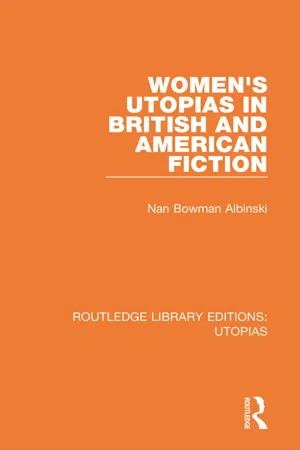
Utopian writing offers a fascinating panorama of social visions; and the related forms of dystopia and anti-utopian satire extend this into the range of social nightmares. Originally published in 1988, this comparative study of utopian fiction by British and American women writers demonstrates the continuity of a well-established, but little-known, tradition, emphasising its range and diversity, and providing ample evidence of women's aspirations and documenting the restrictions and exclusions in private and public life that their novels challenge. Historically, the growth of each national tradition is traced in relation to social and political movements, particularly the suffrage movement and contemporary feminism. Comparatively, the quite different responses of British and American women to what are in many instances the same social problems are examine in the light of changing expectations. Definitions of human nature and gender relationships are assessed on a nature/culture continuum as a means of understanding this change. Women's attitudes to their social and political roles, their working lives, to sexuality, marriage and the family are reflected in their visions of fruitful change; and so also is the impact of two world wars, socialism and fascism, the debate on peaceful uses of nuclear energy and fears of a nuclear holocaust.
- 208 pages
- English
- ePUB (mobile friendly)
- Available on iOS & Android
eBook - ePub
Women's Utopias in British and American Fiction
About this book
Information
1
A Nation Transformed
Some of the most remarkably independent women in fiction come to life in the British women’s utopias of the late nineteenth and early twentieth centuries. Forthright yet dignified women of the future, they enter traditional political institutions, and through them transform the nation. The bibliography for this chapter is comparatively short, yet its contents introduce late-Victorian feminism in a context of one of the greatest debates of the age. Most of these writers are permeated with Victorian faith in progress, particularly through the upward movement of evolution: the conflict is between science and socialism (the secular faiths) on the one hand, and religion on the other.
However, the evolutionary feminists are in the ascendancy. Their interpretation of evolutionary theory is based on emancipation from primitive stages of society when physical force ensured power, it accepts ‘biology is destiny’, inverts the acknowledged role of morality in society, and, by placing women in the unique position of guardians of the future race, turns justification for exclusion into justification for involvement by asserting women’s moral leadership. Their eutopias do not fit Showalter’s definition of
flights from the male world to a culture defined in opposition to the male tradition. Typically the feminist utopias are pastoral societies, where a population of prelapsarian Eves cultivate their organic gardens, cure water pollution, and run exemplary day care centers.1
The role model for British women utopian writers is certainly not the mythic (and guilt-laden) figure of Eve. They refuse to identify themselves with nature, and one doubts that any of these women either knew about organic gardening, or would have cared for it if she did. Typically, British women’s utopias are urban societies (usually a future Britain) where a handful of democratically inclined Boadiceas or Queen Elizabeth the Firsts are Members of Parliament, cure poverty and crime, and run exemplary social welfare legislation through the House of Commons. The ‘progressive’ role of science and technology is only challenged by religiously inclined writers, and even they are less concerned about their products than the increasing secularisation of the age, and the substitution of science for religion.
The conquest of nature is as much woman’s as man’s ideal, whether sanctioned by religious text or by Darwinian theory. Thoroughgoing products of their age, these women endorse the industrial revolution: where its defects are acknowledged, as in the air pollution caused by domestic or industrial coal burning, the cure is the use of more sophisticated technology, rather than less. Even a tentative, Morris-like medievalism is placed within a technological framework. The most medieval of these novels, Mercia, the astronomer royal; a romance (1895) set in the year 2002, suggests Trial by Champions as a means of solving international disputes, and the medieval flavour extends (tediously) into the language of the characters. Yet this is also a world of solar energy, robotised servants and flying machines, where Mercia (true Victorian that she is) looks forward to a Golden Age of Science, ‘when even the elements of Nature are tamed’, (p. 167).
For so long preached the doctrine of their ‘proper (domestic) sphere’, late-Victorian women were far more interested in asserting their right to be co-inheritors of the power structures of current male-dominated culture than in claiming versions of a domestic-based, devalued, restrictive moral guardianship as their own visionary ideal. Victorian stereotypes of women were saturated with images of childishness, irrationality, the primitive, all elements to be overcome.
Much of the anthropology in this period was given to documenting and glorifying the triumph of man over nature. Rousseau’s savage was no longer noble, rather a living testament to civilised man’s rude origins; Victorians gloried in the fact that economic, technological and cultural progress in the West had all but vanquished the remnants of natural man.2
‘Natural woman’ confined to her domestic role is equally vanquished from the sphere of culture: her mythic associations with the subconscious and irrational, while offering a view of woman as ‘other’ which is the polar opposite of the demure, self-sacrificing ‘angel in the house’, are likewise marginal to the male world of culture and power. They transcend the association with nature into the equally excluding status of myth.3
These cultural assumptions are partly shared by Victorian women utopists, who in redefining their social role scrupulously avoid identification with nature. An interest in child-care, for instance, would reinforce this association, and it is noteworthy that, in the few instances where children are discussed in these works, they are defined as ‘primitive’ creatures who must be disciplined in order to civilise them (the Amazons underwent the same treatment). Clapperton’s Margaret Dunmore; or A socialist home (1888), for instance, recommends the use of a ‘prison’ for naughty babies: she disapproves of corporal punishment, but condones isolation to curb wilfulness (p. 143). These writers’ silence on the subject of children almost matches their silence on the family generally. Although easier divorce is a constant in their eutopias, they offer no radical alternative to marriage, completely ignoring the domestic life that they were told was their ‘natural’ place in favour of an active, heroic public life.
Because women wish to enter rather than to challenge existing institutions, their utopias are more conservative than those of men. Male writers describe future worlds in which all social institutions but marriage have been radically changed; women Utopians are radical only insofar as they mention marriage only in the context of a near-unanimous interest in easier divorce. Sylvia Strauss comments on the depiction of women in men’s utopias of the period:
It must have come as a shock to many women that their vaunted allies could not entertain the thought of them as other than sex objects. These iconoclasts were ready to fling aside political traditions of a thousand years’ duration; challenge religious doctrines deeply imbedded in the collective unconscious; put to the test all accepted dogmas—except those that related to women’s proper sphere. Whatever else women might be able to do, what contributions they could make to society, would have to take a backseat to their primary function of wifehood and motherhood.4
An example (and one that Strauss quotes) is that of William Morris in his otherwise delightful News from Nowhere (1890). Morris so thoroughly rejects contemporary political institutions that he uses the Houses of Parliament as a repository for dung (as More’s Utopians had shown his contempt for gold by using golden chamber pots). Yet Morris embodies Victorian attitudes to women:
Don’t you know that it is a great pleasure to a clever woman to manage a house skilfully, and to do it so that all the house-mates about her look pleased, and are grateful to her? And then, you know, everybody likes to be ordered about by a pretty woman: why, it is one of the pleasantest forms of flirtation.5
However, Lady Florence Dixie’s Gloriana, or The revolution of 1900 (also published in 1890) has a different ideal of the ‘clever woman’: she is not interested in housework or flirting, but in emancipating her sex through education, physical exercise and discipline, and through political leadership. The only house that Gloriana aspires to manage is the House of Commons.
The difference between Morris and Dixie, and their utopias, is directly related to their circumstances. Morris, impelled by the most laudable humanitarian impulse, writes as an ‘insider’ impatient with a world of privilege; while Lady Florence, for all her aristocratic connections, remains an ‘outsider’. Oscar Wilde’s definition of utopia in ‘The soul of man under socialism’ (again, 1890) offers a useful metaphor: ‘Utopia … is the one country at which Humanity is always landing. And when Humanity lands there, it looks out, and, seeing a better country, sets sail. Progress is the realisation of Utopias.’ men, securely ensconced in traditional power structures, could discard them in favour of new forms of organisation; women, locked outside, needed to land on those islands. Thus, while it may be disappointing that women of this period did not challenge cultural assumptions and forge a radically different alternative to the world they knew, their focus is understandable. The tantalising, unreachable island was political suffrage, and it was there that the early feminists located their eutopias.
These works fall into three separate categories. Most numerous are the primarily feminist eutopias (14 of 20 titles = 70 per cent): Clapperton (1888); Swanwick (1888); Corbett (1889); Bevington (189?); Dixie (1890); Schreiner (1890); Wolstenholme-Elmy (1893); Mears (1895); Coleridge (1900); de Bury (1904); Dixie (1905); Hamilton (1908); Clyde (1909); Minnett (1911). The two smaller groups (each of three titles = 15 per cent) are related by common religious themes: the first group depicts alternative eutopias, the second, dystopias. The religious eutopists are Hearn (1892); Drane (1898); Nichol (1908). Two of the three dystopian works which share their principles, opposing scientific materialism in the name of religious orthodoxy, are Cobbe (1877) and Bramston (1893); and the third is an early anti-communist dystopia, Thomas (1873). Most, if not all, of these writers are feminists. Their eutopian societies, usually of a future and transformed Britain, reflect the feminist movement’s priorities and its values, the effect of those battles won, and those still to be fought.
The publication dates of these novels span three decades. The mid-1880s to the first decade of the twentieth century was a period of little progress towards suffrage, the main target of the women’s movement. However, although a time of feminist aspiration rather than achievement, it was a period of intense activity in the history of the utopian genre. There were many more male than female utopists during these three decades, although publication figures show an almost identical surge of interest in the genre, i.e. a burgeoning in the 1880s, which peaks in the 1890s, although thereafter women’s writing declines to almost complete silence in the years immediately preceding World War One.6 It is important to remember that these women writers were part of a flourishing literary movement, although their themes are so often different from those of men.
The classical Amazons interested many late-Victorian male writers: several feminist Utopians invoked them, but with quite different results.7 The legendary nation of women offered a desirable model of women’s autonomy, although, of course, some aspects of Amazon life were either tempered or ignored. Their warlike nature was largely unacceptable when most feminists were pacifists, their aggresssive mating with male slaves inadmissible. Amazons hardly seemed fitted for a complex, urbanised, technologically advanced future society based on social reform. However, ‘Amazonian’ was eagerly adapted to describe larger than life women characters, compounds of impressive physical size and Victorian dignity. While ‘civilising’ the Amazons meant eliminating their basest associations with sensual nature (which most attracted male writers), they offered a model of female governance, untainted by associations with domesticity. Auerbach quotes the speech of an Amazon from Herodotus’ The Persian wars: ‘To draw the bow, to hurl the javelin, to bestride the horse, these are our arts—of womanly employments we know nothing.8 Victorian feminist writers found in the Amazons raw material for their women citizens of the future, equally alien to ‘womanly employments’.
The first of these was Elizabeth Corbett in New Amazonia: a foretaste of the future (1889). Written at the height of the ‘surplus women’ debate, it provides an ingenious solution: not shipment of women to existing colonies where there were ‘surplus men’, but the government’s grant of Ireland (and £50 million) to women and their children so that they might establish their own colony. Universal suffrage is the necessary precursor to this feminist emigration (which presumably also puts paid to the ‘Irish question’), relieving pressure in a future England in which women outnumber men by three to one and are exploited as sweated labour.9 (Perhaps Corbett was familiar with Jessie Boucherett’s exasperated wish for ‘a new planet alongside for us to export our superfluous women to’.)10 Six centuries after settlement, the most notably ‘Amazonian’ feature of the women is their size (some are seven feet tall). Corbett is unusual in providing two time-travellers to her utopia, one female, one male: the woman rejoices that here her 26-inch waist is not regarded as a deformity, but the male (an effete and weedy misogynist) sees the feminist eutopia as a dystopia. ‘The men here seem to be fools. They let the women grow up as strong and healthy as themselves, and it wou...
Table of contents
- Cover
- Half Title
- Title
- Copyright
- Original Title
- Original Copyright
- Contents
- Acknowledgements
- Introduction
- 1. A Nation Transformed
- 2. Individualism and the Ties of the Community
- 3. A Crisis of the Spirit
- 4. A Widening World, a Narrowing Sphere
- 5. Living in the Ruins
- 6. ‘When it Changed’
- Bibliography
- Index
Trusted by 375,005 students
Access to over 1.5 million titles for a fair monthly price.
Study more efficiently using our study tools.
Frequently asked questions
Yes, you can cancel anytime from the Subscription tab in your account settings on the Perlego website. Your subscription will stay active until the end of your current billing period. Learn how to cancel your subscription
No, books cannot be downloaded as external files, such as PDFs, for use outside of Perlego. However, you can download books within the Perlego app for offline reading on mobile or tablet. Learn how to download books offline
Perlego offers two plans: Essential and Complete
- Essential is ideal for learners and professionals who enjoy exploring a wide range of subjects. Access the Essential Library with 800,000+ trusted titles and best-sellers across business, personal growth, and the humanities. Includes unlimited reading time and Standard Read Aloud voice.
- Complete: Perfect for advanced learners and researchers needing full, unrestricted access. Unlock 1.5M+ books across hundreds of subjects, including academic and specialized titles. The Complete Plan also includes advanced features like Premium Read Aloud and Research Assistant.
We are an online textbook subscription service, where you can get access to an entire online library for less than the price of a single book per month. With over 1.5 million books across 990+ topics, we’ve got you covered! Learn about our mission
Look out for the read-aloud symbol on your next book to see if you can listen to it. The read-aloud tool reads text aloud for you, highlighting the text as it is being read. You can pause it, speed it up and slow it down. Learn more about Read Aloud
Yes! You can use the Perlego app on both iOS and Android devices to read anytime, anywhere — even offline. Perfect for commutes or when you’re on the go.
Please note we cannot support devices running on iOS 13 and Android 7 or earlier. Learn more about using the app
Please note we cannot support devices running on iOS 13 and Android 7 or earlier. Learn more about using the app
Yes, you can access Women's Utopias in British and American Fiction by Nan Bowman Albinski in PDF and/or ePUB format, as well as other popular books in Literature & Literary Criticism. We have over 1.5 million books available in our catalogue for you to explore.