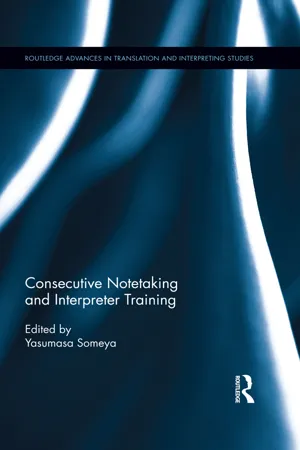
This book focuses on the theoretical foundation of notetaking (NT), an essential skill of consecutive interpreting. Explaining the "whys" pertaining to the cognitive, linguistic, and pedagogical issues surrounding NT, this book addresses this neglected aspect of notetaking discourse and brings together most updated and different, if not opposing, theoretical perspectives by leading researchers and practitioners from both the West and the East: France, Germany, Taiwan, and Japan. The book, although primarily focused on the theoretical aspects of consecutive notetaking, also covers other issues pertaining to interpreter training and pedagogy in general, and provides instructors with useful guidelines and empirically-tested pieces of advice for good pedagogical practices.
- 248 pages
- English
- ePUB (mobile friendly)
- Available on iOS & Android
eBook - ePub
Consecutive Notetaking and Interpreter Training
About this book
Information
1
A brief history of interpreting and interpreter training in Japan since the 1960s*
1 Introduction
The history of interpreting in Japan is long and colorful. The first recorded presence of an interpreter dates back to 607, when one accompanied the second Official Envoy to China. In each of 13 succeeding envoys, the last of which left Japan in 838, interpreters played an important role in Japan’s efforts to learn and import religion, technology, and administrative and legal systems from the more advanced China. During the Edo Period (1603–1868), an era of self-imposed national isolation, the contact with foreign countries was restricted (other than China) only to the Netherlands, and officially appointed Dutch-Japanese interpreters played a crucial role not only in trade but in helping and promoting modernization of the Japanese society. The first official visit to Japan by Americans, led by Commodore Perry in 1853, was also facilitated by some of those Dutch-Japanese interpreters (through relay with English.)
The period after the Meiji Restoration in 1868 had again been characterized by continuous efforts on the part of Japan to introduce culture and technology from Europe and the United States, although they were seriously disrupted in the period just before and during World War II. The first occasion where the role of interpreters attracted attention after the war was the International Military Tribunal for the Far East, which was convened in Tokyo from May 1946 to April 1948. Thirty Japanese-English interpreters were engaged, but interpreting during this tribunal, unlike in Nuremburg Trials, was basically consecutive except occasional simultaneous reading of pre-translated documents such as the final verdict (Komatsu, 2003).
Active interchange with the outside world was resumed after the war, first with the United States, then gradually involving many other countries and regions. The landmark event in this connection was the holding of the Tokyo Olympics in 1964, after which Japan has come to be recognized as a member of the international community.
The goal of this paper is to highlight the history of interpreting in post-World War II period, specifically after early 1960s, when more international meetings began to be held in this country and activities of interpreters became more widely recognized by the public. The emphasis will also be placed upon training and education aspects of interpreters. Another note: since the author is an interpreter between English and Japanese, and also since the interpreting between these two languages has consistently made up close to or more than 80% of the total interpreting market in this country, most of this paper deals with the development concerning interpreting between the two languages.
2 Rise of interpreting profession after the war
2.1 How I became an interpreter – a case study
Since the author is one of the post-World War II first-generation interpreters in Japan, and since he has unique background of having been a practicing interpreter, interpreter trainer, founder and CEO of a language services provider company and a professor of interpreting at universities, the first part of this section will take the form of a personal reflection by the author. Readers’ indulgence, therefore, is appreciated, as the author will use the first-person style in this particular section.
I, the author, was born and raised in Japan and learned English for the first time at the junior-high school. The kind of English education I received was strictly traditional adhering to the grammar-translation method, and I never learned to speak English until university. I believe I developed speaking and listening skills during university days, mostly through club activities such as the English Speaking Society and a series of side jobs. One of such jobs was to work during summer vacations as a student interpreter for the World Conference against Atomic and Hydrogen Bombs. It was a full-fledged international conference held annually with participants from more than ten countries. After a little coaching from senior interpreters, I did mostly consecutive interpreting for the conference for three consecutive summers. This is how I acquired the basic skills of interpreting. Although my English ability was admittedly quite limited, I was able to do the job mainly due to my strong interest in and knowledge about the cause of the conference, and partly because professional interpreting as such did not exist and was practically unknown in those days in Japan.
A year after finishing university, I took the test conducted in Tokyo by the State Department of the United States to recruit interpreters who would stay in Washington, D.C. to provide interpreting for the visiting groups of Japanese business and labor leaders. This was an extensive program, known as the “Productivity Program” (organized on the Japanese side by the Japan Productivity Center, a private organization affiliated with the Ministry of International Trade and Industry). The program started in 1956 and lasted for about ten years. During this period, about 6,600 people in 660 groups visited and toured the U.S. for about a month to learn business and industrial practices. Contribution that this program had made to the reconstruction of Japanese economy was substantial, and it is often compared to the epochal Envoys to China in earlier centuries. Close to 50 interpreters were recruited from Japan to serve the visiting groups throughout the period. I was one of them and stayed in Washington from the late 1960 to 1966.
A typical group of industrial leaders in the program visited a plant (auto, steel, etc.) and observed the production process in the morning, for example, where we interpreters provided consecutive interpreting. In the afternoon, the group sat in the office and received a lecture from a manager of the plant (say, on quality control) for two to three hours. During those afternoon sessions, we interpreters provided simultaneous interpreting to the members of the group using wired and vacuum-tube powered equipment. Since we had some knowledge about the subject through observation during the morning plant tours, simultaneous interpreting in the afternoon sessions was not really very difficult. It was indeed an extension of consecutive interpreting (Seleskovitch, 1968). This process was repeated almost every day for a month before the group left back to Japan. The themes for the visiting groups ranged from individual industries, business and financial practices, industrial relations and farming.
This was a very valuable experience for me, and this is how I, and many colleagues in the productivity interpreter group, acquired the skill of simultaneous interpreting. Simultaneous interpreting between Japanese and English, two languages widely disparate in structure and lexis, was once considered nearly impossible. Through repeated experience of a good number of interpreters stationed in the U.S. in this period, simultaneous interpreting between the two languages proved to be possible. During the early 60s, official conferences were also held in the U.S. with simultaneous interpreting, such as the U.S.-Japan Meetings of Economic Ministers, the North-Pacific Fishery Conferences and the U.S.-Japan Conference on Cultural Exchange, and it was mostly interpreters like us stationed in the U.S. who provided interpreting. The productivity program (a part of the U.S. economic assistance to Japan) having come to a close, many of the interpreters stationed in Washington started to return to Japan. Thus the situation was ripe for the birth and vigorous development of the interpreting profession in this country.
2.2 Setting up of language services agencies
Many of the interpreters who had returned from the U.S. in the early and mid-60s went back to their previous job, but some of them who remained free were often asked to work as interpreters for international meetings. After the Tokyo Olympics in 1964, an increasing number of international meetings began to be held in Japan. Most of them were with the United Sates, but dialogues with international organizations such as OECD were also included, and they needed reliable interpreters. There were very few people who had credible experience in interpreting in those days, so former productivity interpreters were the natural candidates, and they found themselves quite busy responding to the requests from various sectors including governmental agencies.
Anticipating increasing demand for interpreters, Muramatsu and Kunihiro who were stationed in Washington in the late 50s and early 60s as members of the group of productivity program interpreters and four other colleagues, including the author, decided to start a company to provide interpreting services. It was incorporated in 1965 and named Simul International, Inc. The name “Simul,” of course, was taken from “simultaneous.” It was not the first language services company in this country. ISS, Inc. had been founded a little earlier. It started as an agency with offices placed in major hotels in Tokyo to provide business interpreting and tourist assistance and expanded into broader language service areas including translation.
Simul International was successful as a business venture from the start because the agency knew what was needed for reliable interpreting and most of the interpreters they dispatched had enough experience. It accepted requests from clients not as individual interpreters but as an organization which then selected interpreters and dispatched them. Clients liked this mode of business because it meant more reliable transaction and simpler financial settlements. This has become the accepted norm in interpreting and translation business in this country since then. You could say it fit the business culture of Japan, which had been traditionally group-oriented. Now, more than 80% of transactions involving interpreters go through agencies like Simul International. Most of professional interpreters are registered with agencies and dispatched by them to meetings organized by clients.
Some of the unique practices that have been the norm in the interpreting market in Japan since then originated during this period. Simul set the interpreting fee at 30,000 yen a day. They took it from the then-going rate in the United States (exchange rate at the time was 360 yen to a dollar). This rate surprised the general public but was generally accepted by the market, which needed reliable interpreting for increasing number of international meetings. But when the rate was applied to young, inexperienced interpreters, very often recent university graduates, the market found it hard to go along with. So Simul proposed a reduced rate for interpreters with less experience at two-thirds of the full daily rate. This was against the rule set by AIIC at that time, but seemed to be more acceptable for clients here. This opened the way for the classification system for interpreters, another norm in the Japanese interpreting market. Those young, less-experienced interpreters were ranked Class B and remunerated accordingly. Later, Class C was added below B, with the daily rate two-thirds of that applied to Class B. Class C interpreters are generally considered to be still under training.
Another feature of the Japanese interpreting market that is now considered standard is a half-day rate. It was set at two-thirds of the full-day rate, and it was also introduced by Simul in response to the clients’ request. This was also against the rule of AIIC., i.e., “any fraction of a day counts as a day,” but seemed more appropriate in this country.
Other language services companies sprung up after ISS and Simul. Inter-Osaka (now renamed Inter-Group Corp.) and Japan Convention Services, Inc. (JCS) in the late 60s, and Congres Corp. and many others in the 70s and later. Many of them, as the name JCS suggests, are also in the business of providing organizing services for congresses, conventions and exhibitions.
Inter-Group, ISS, and Simul also run interpreter training institutions. Simul, just after it started, enlisted students and recent graduates of International Christian University (more in Section 3) to supplement the pool of veteran interpreters, but found it difficult to meet increasing demand from the market. So it established Simul Academy in 1972 by transforming internal training sessions into a formal, school-like organization to develop and strengthen its own interpreter resources. The situation with Inter-Group and ISS was more or less the same. Since their training programs were closely linked to the market, they turned out to be effective vehicles to produce interpreters. Section 4 will discuss this in greater detail.
2.3 First generation interpreters – talented L2 speakers
In Section 2.1, the author looked back on how he learned English and became an interpreter and in that process referred to his experience of working as an interpreter for the World Conference against Atomic and Hydrogen Bombs. That was his first experience as a conference interpreter, and he received practically no training before working for the Anti-Atom Conference. He simply applied to the work of interpreting the linguistic ability which he acquired through formal school education, and then acquired basic interpreting skills by practicing it and by observing and imitating his colleagues at work in the meetings. This is more or less the same with other interpreters who worked for the said conference, like H. Fukui, T. Asano and M. Mitsunobu. They were all university students at the time and had no previous experience of living abroad for any extended period of time.
All of the three people mentioned above later became university professors, but Asano and Mitsunobu worked frequently as interpreters on the side. They worked for many important international meetings in the 60s through the 80s. These people, including the author, belong to the so-called “Anti-Atom Group,” among the first-generation interpreters in this country. One notable thing is that Fukui and Asano wrote the first book on interpreting in Japan. It is Eigo Tsuyaku no Jissai (An English Interpreters’ Manual) published by Kenkyu-sha in 1961. In that book, they emphasized th...
Table of contents
- Cover
- Title
- Copyright
- Contents
- List of Figures
- List of Tables
- List of Contributors
- Introduction
- 1 A brief history of interpreting and interpreter training in Japan since the 1960s
- 2 Theory and practice of notetaking: Cognitive-psychological perspective
- 3 Notation language and notation text: A cognitive-linguistic model of consecutive interpreting
- 4 Semiology and conceptual schema in consecutive notes
- 5 A propositional representation theory of consecutive notes and notetaking
- 6 An empirical study on consecutive notes and notetaking
- Index
Trusted by 375,005 students
Access to over 1.5 million titles for a fair monthly price.
Study more efficiently using our study tools.
Frequently asked questions
Yes, you can cancel anytime from the Subscription tab in your account settings on the Perlego website. Your subscription will stay active until the end of your current billing period. Learn how to cancel your subscription
No, books cannot be downloaded as external files, such as PDFs, for use outside of Perlego. However, you can download books within the Perlego app for offline reading on mobile or tablet. Learn how to download books offline
Perlego offers two plans: Essential and Complete
- Essential is ideal for learners and professionals who enjoy exploring a wide range of subjects. Access the Essential Library with 800,000+ trusted titles and best-sellers across business, personal growth, and the humanities. Includes unlimited reading time and Standard Read Aloud voice.
- Complete: Perfect for advanced learners and researchers needing full, unrestricted access. Unlock 1.5M+ books across hundreds of subjects, including academic and specialized titles. The Complete Plan also includes advanced features like Premium Read Aloud and Research Assistant.
We are an online textbook subscription service, where you can get access to an entire online library for less than the price of a single book per month. With over 1.5 million books across 990+ topics, we’ve got you covered! Learn about our mission
Look out for the read-aloud symbol on your next book to see if you can listen to it. The read-aloud tool reads text aloud for you, highlighting the text as it is being read. You can pause it, speed it up and slow it down. Learn more about Read Aloud
Yes! You can use the Perlego app on both iOS and Android devices to read anytime, anywhere — even offline. Perfect for commutes or when you’re on the go.
Please note we cannot support devices running on iOS 13 and Android 7 or earlier. Learn more about using the app
Please note we cannot support devices running on iOS 13 and Android 7 or earlier. Learn more about using the app
Yes, you can access Consecutive Notetaking and Interpreter Training by Yasumasa Someya in PDF and/or ePUB format, as well as other popular books in Languages & Linguistics & Linguistics. We have over 1.5 million books available in our catalogue for you to explore.