This title was first published in 2001. The 1980s and 1990s were not only a period in which many developing countries adopted a series of major economic policy reforms, but also an era in which all socialist countries undertook varying degrees of radical reforms in their Soviet-style central-planning economic management systems. This volume examines the performance of China's industrial reform and open-door policy during the period of 1980-1997 through conducting a case study on one of its Special Economic Zones (SEZs), Xiamen. It adopts an analytical approach - examining Xiamen's performance from the perspective of three important interactions: between the country's general economic reform policies and the Special Policy implemented in the SEZs; between the Xiamen SEZ and the vast Chinese hinterland; and between foreign (especially Taiwanese) direct investment and local industrial transformation.
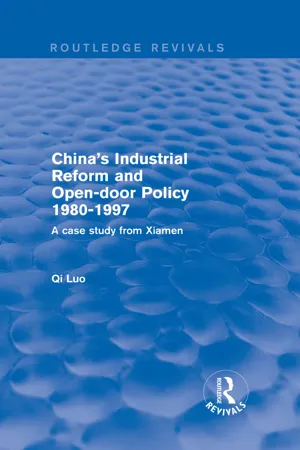
eBook - ePub
China's Industrial Reform and Open-door Policy 1980-1997: A Case Study from Xiamen
A Case Study from Xiamen
- 174 pages
- English
- ePUB (mobile friendly)
- Available on iOS & Android
eBook - ePub
China's Industrial Reform and Open-door Policy 1980-1997: A Case Study from Xiamen
A Case Study from Xiamen
About this book
Information
1 Introduction
The 1980s and 1990s were not only a period in which many developing countries adopted a series of major economic policy reforms, but also an era in which all socialist and former socialist countries, with the apparent exception of Cuba and North Korea, undertook varying degrees of radical reforms in their Soviet-style central-planning economic management systems. Emerging from nearly three decades of largely self-imposed isolation, the People's Republic of China (PRC), as both a developing and a socialist country, has so far positioned itself firmly in the forefront of the reform movement. The economic reform and open-door policy in post-Mao China, or using Deng Xiaoping's words, 'China's second revolution', has not only produced fundamental changes in its domestic economy but also created a profound impact on the world economy as well. The unique Chinese reform and opening experiences have attracted more and more attention from the international community and become one of the most important areas of contemporary Chinese studies.
This volume examines the performance of China's industrial reform and open-door policy during the period of 1980-97 through conducting a case study on one of its Special Economic Zones (SEZs), Xiamen. The Chinese government set up four SEZs, Shenzhen, Shantou, Zhuhai and Xiamen, in the early 1980s in order to provide a testing ground for implementing more radical economic reform policies, with a view to introducing some successful experiences into the rest of China.1 Since then the SEZs have become the microcosm of the present reforming China. This study will therefore provide a 'window' for the reader to understand one of the most important aspects of the reform and open-door policy - development of the SEZs. Specifically, it is to investigate the policy inconsistency displayed by the central government towards the SEZs, assess the contributions of the SEZs, as a key experiment, to the ongoing domestic economic reform and development, and analyse the impact of economic activities across the Taiwan Strait on local economic development.
Compared with other studies on the SEZs, this study has the following unique features:
- it is one of very few comprehensive and systematic studies on the Xiamen SEZ and hence will fill a big gap in the existing knowledge of China's zones;
- it adopts a new analytical approach - examining Xiamen's performance from the perspective of three important interactions: between the country's general economic reform policies and the Special Policy implemented in the SEZs; between the Xiamen SEZ and the vast Chinese hinterland, and between foreign (especially Taiwanese) direct investment and local industrial transformation;
- it is the first detailed case study on the impact of cross-Strait economic relations on a local economy of mainland China,
1-1. Why Xiamen?
While most scholars and journalists, both within and outside China, focus their attention on Shenzhen, Xiamen has escaped the glare of the academic spotlight. To date, only modest efforts have been made to study it systematically. They include a number of articles published in newspapers and journals, a conference report edited by the National Centre for Development Studies, the Australian National University (Brogan, 1988), and a chapter of a case study in a book dealing with the politics of the evolution of the open-door policy in China (Howell, 1993). But like other studies on the SEZs, they have done little in searching the reasons for the policy problem in Xiamen and the effectiveness of its experimental function.
Xiamen, located in the south of Fujian Province, is the only SEZ converted totally from the original city, which had already had more than three decades of economic and social development under the centrally planned economy. The other three city-sized SEZs were all built from scratch, either on remote, rural border areas (in the cases of Shenzhen and Zhuhai) or on the outskirts of a city (in the case of Shantou). As a result, Xiamen exhibited three unique features:
- it was a typical small- to medium-sized industrial city in China, with all its well-established political, administrative, economic and social structures in place. This meant that it inevitably had extensive and close links with the domestic economy. Not surprisingly, in 1988 the State Council designated it, together with another sixteen cities, as a 'pilot city for comprehensive urban reform' (Zhonghe chengshi gaige shidian chengshi);
- it possessed an all-round but underdeveloped industrial base containing about 590 state- and collective-owned enterprises and employing a 45,000-strong workforce. This implied that Xiamen, like many Chinese cities, faced the formidable task of transforming the old industrial enterprises;
- it was one of the five Treaty Ports opened in China in 1842 according to the Nanking Treaty and had established extensive trade links with many parts of the world, especially with Taiwan, Hong Kong, and Southeast Asia.2
The first two features indicate that Xiamen is an ideal object for the study on the reform of China's Soviet-style economic management system and the industrial system. This will enable us to explore the relationship between the general economic reform policy and the Special Policy, and the links between Xiamen and the domestic economy as a whole. The third feature suggests that Xiamen is the most appropriate place to carry out a study on the impact of foreign trade and investment, especially cross-Strait economic contacts, on local economic development. Of course, all these studies will provide an opportunity to assess the effectiveness of Xiamen as a 'laboratory' for domestic economic reform and openness.
1-2. In What Way Does This Study Build on Previous Researches?
The establishment of China's first four Special Economic Zones (SEZs) in 1980 and the fifth in 1988 and their subsequent development has resulted in a booming academic research on them both within and outside China, In China, articles, journals, books, and yearbooks on the SEZs are abundant, as indicated by the country's most comprehensive bibliographic index, Quanguo baokan suoyin. At the same time, scholars in Hong Kong and Taiwan have also produced a number of substantive works on the SEZs. All these Chinese-source studies have provided a great deal of first-hand information and stimulating analyses. As they will be used as important references throughout this study, we will not discuss them here.
The English-language literature on the SEZs, however, has been published mainly by Western scholars and increasingly by Chinese scholars residing in the West. ' According to Crane (1990), the researches have been focused on two major aspects: first, the actual economic achievements, which show, on balance, 'a sub-optimal performance'; and second, the evolution of zone policy, which has emerged as 'inconsistent', ambiguous ('never very clear'), and unpredictable ('changing unexpectedly').4 Based on these observations, most of the researchers tended to attribute the less than satisfactory economic performance to the policy problem.5 However, few of them went on to investigate the causes of the policy problem systematically. Although Crane (1990) makes some unique contributions in researching the reasons from the perspective of China's political economy, especially 'the relationship between political structures and zone problems' (p. 8), it has not made the task of investigating economic reasons any easier.
In addition, the previous researches seem to have two other major defects. First, they tend to approach the SEZs in the context of Export Processing Zones (EPZs) and pay inadequate attention to the special circumstances of China's changing economy.6 In other words, they are unable, or neglect to study the SEZs in the context of Chinese economic reform and openness, especially to investigate zone problems from the perspective of the interaction between the SEZs and the domestic economy. As a result, the analyses are concentrated mainly on the gains or losses in areas like foreign capital inflow, employment, exports, foreign exchange earnings, tax revenues, and technology transfer, but rarely on such issues as the interaction between the development of the SEZs, especially the implementation of the Special Policy in the zones, and domestic economic reform. In doing so, they have failed to explore an important function the SEZs are expected to play — serving as a 'laboratory' for the ongoing domestic economic reform.
Second, the previous researches focus in most cases on the Shenzhen SEZ, the flagship of China's SEZs, due partly to its much publicized 'spectacular success' and partly to the easier access to information. However, the SEZs are quite different in terms of socio-economic legacies, geographical conditions, resource endowments, and the level of current economic development, thus exhibiting different patterns of development. By concentrating only on Shenzhen, the researches are unlikely to represent the whole picture of China's SEZs.
In short, the previous studies provide only a basic understanding of the complexity and diversity of the SEZs. More work needs to be done to research the reasons for policy problems in the SEZs and assess the effectiveness of its experimental function as a reform 'laboratory'.
1-3. Literature Review and Historical Background
The theoretical foundation for this study is derived from the growing literature on the industrialization and economic policy reform in developing countries, especially the Neoclassical approach; the development of EPZs; and the economic reforms in the economies of the former Soviet-bloc countries. It is hoped that a brief examination of relevant views, policies and experiences in each of these areas will provide a relevant theoretical framework and historical background for the detailed discussions of China's present reform and openness and especially the development of the Xiamen SEZ in the subsequent chapters.
Alternative Theories o f Industrialization and Economic Reform in Developing Countries7
For at least three decades, industrial and trade reform has been high on the policy agenda of many developing countries striving for industrialization. Macro imbalances and micro inefficiencies have forced them to reconsider their policy towards industry and trade. In general, there are three major alternative theoretical approaches to the policy, and they are Structuralist, Radical, and Neoclassical.8
Structuralist approach The Structuralist school, seen as representing the conventional wisdom on developing countries in the 1950s and 1960s, believes that the structure of an economy, particularly the size of its industrial sector, is a key determinant of long-term growth. It contends that development is a process of major structural transformation with manufacturing industry having a crucial role to play. Central to this argument are two important concepts: externalities and linkages.9
Externalities can be defined, according to Scitovsky (1958), as the effects created by individual producers or consumers, that are incurred and received by other producers or consumers but are not taken into account by the original creators of the effects. The existence of externalities, he argues, has to a large extent justified the need for appraising investments from a broad economic perspective and for planning and co-ordinating investment activities (p. 301). To rationalize the greater potential of industry in generating external effects, however, one must rely on the concept of linkages.
Hirschman (1958) defines linkages as an inducement mechanism whereby the activity of one firm is created by the actions of another. He has also distinguished two types of production linkages — backward linkages from a particular industry to its input suppliers, and forward linkages from an industry to its output users. Both linkages, reflecting production interdependence, can be used as a mechanism to transmit externalities. In general, the activities with the highest linkage effects tend to have the greatest potential for creating externalities.10 This enables planners in developing countries to assess the consequences of different patterns of investment and thus to choose the leading industrial sector and the optimal form of expansion.
Central to the Structuralist position is the view that externalities are more significant in the manufacturing sector than in other major sectors, such as agriculture and services. This is due to the fact that manufacturing is the sector which produces the capital goods and other machinery equipment used by other sectors, thus generating much greater linkage effects both within the sector itself and upon others. It is in this sense that a strong machinery (or engineering) sector is crucial for initiating and transmitting technical and productivity changes, as its growth will raise productivity in other major sectors through their purchases of capital and intermediate goods and the transfer of knowledge between machine makers and users. That is why Kaldor (1967) sees manufacturing as an engine of growth.
Radical view The Radical school, approaching industrialization from a wider perspective of political-economy, can be described as 'that which is highly critical of capitalism, favours socialism, and often employs Marxian analysis' (Griffin and Gurley, 1985: 1089). Its most distinct and influential approach to development issues is the 'Dependency Theory', which views developing economies as part of the world capitalist economy and believes that their current economic, social and political conditions have been determined by contacts with advanced capitalist economies. Consequently, much of the Radical literature emphasises the obstacles to and limitations of industrialization in developing countries under existing international and domestic systems. Although some of these arguments, particularly those on the role of transnational corporations and their relations with the state and local capital, raise some important policy issues, the conclusion that capitalist industrialization in developing countries is deemed to be distorted or blocked appears to be unconvincing.
Neoclassical perspective The Neoclassical approach to development has become increasingly influential since the 1960s-70s. The central tenet of this school is, as defined by Ian Little, one of the foremost representatives of this school, 1) a belief in the effectiveness of the market mechanism as a means of allocating resources; and 2) an emphasis on the potential gains from participation in world trade (Little, 1982). As a result, the school's critique of the industrialization policies in developing countries focuses on two main aspects:
- government interventions have stifled the operation of the market and contributed to an economically inefficient form of industrialization;
- trade policies and patterns have reduced export growth and ignored
An economically rational industrial policy, it argues, is one that removes both of these sources of inefficiency.
In general, the Neoclassical position sees trade policy as a key component of industrial policy since it has a major influence on the pattern and pace of industrial development. As industry generally produces tradable goods, exposure to foreign competition is viewed as essential to stimulate efficiency gains. Trade reform is therefore central to the success of industrial reform. Hughes (1992) argues that market reform, including trade liberalization, will create a stronger industrial sector in developing countries. As a result, the Neoclassical school argues strongly for introducing market-oriented reforms and in particular trade liberalization.11
Neoclassical authors see market liberalization and moves towards freer trade as critical to improvement in the efficiency of industry. Liberalizing markets means, among other things,...
Table of contents
- Cover
- Half Title
- Dedication
- Title
- Copyright
- Contents
- List of Tables
- List of Figures
- Acknowledgements
- List of Abbreviations
- 1 Introduction
- 2 Economic Reform in Post-Mao China
- 3 The Xiamen Economy
- 4 Enterprise Reform in Xiamen
- 5 Foreign Direct Investment and Industrial Restructuring in Xiamen
- 6 Impacts of Cross-Strait Economic Activities and the WTO Accession
- 7 Conclusions and Policy Implications
- Bibliography
- Index
Trusted by 375,005 students
Access to over 1.5 million titles for a fair monthly price.
Study more efficiently using our study tools.
Frequently asked questions
Yes, you can cancel anytime from the Subscription tab in your account settings on the Perlego website. Your subscription will stay active until the end of your current billing period. Learn how to cancel your subscription
No, books cannot be downloaded as external files, such as PDFs, for use outside of Perlego. However, you can download books within the Perlego app for offline reading on mobile or tablet. Learn how to download books offline
Perlego offers two plans: Essential and Complete
- Essential is ideal for learners and professionals who enjoy exploring a wide range of subjects. Access the Essential Library with 800,000+ trusted titles and best-sellers across business, personal growth, and the humanities. Includes unlimited reading time and Standard Read Aloud voice.
- Complete: Perfect for advanced learners and researchers needing full, unrestricted access. Unlock 1.5M+ books across hundreds of subjects, including academic and specialized titles. The Complete Plan also includes advanced features like Premium Read Aloud and Research Assistant.
We are an online textbook subscription service, where you can get access to an entire online library for less than the price of a single book per month. With over 1.5 million books across 990+ topics, we’ve got you covered! Learn about our mission
Look out for the read-aloud symbol on your next book to see if you can listen to it. The read-aloud tool reads text aloud for you, highlighting the text as it is being read. You can pause it, speed it up and slow it down. Learn more about Read Aloud
Yes! You can use the Perlego app on both iOS and Android devices to read anytime, anywhere — even offline. Perfect for commutes or when you’re on the go.
Please note we cannot support devices running on iOS 13 and Android 7 or earlier. Learn more about using the app
Please note we cannot support devices running on iOS 13 and Android 7 or earlier. Learn more about using the app
Yes, you can access China's Industrial Reform and Open-door Policy 1980-1997: A Case Study from Xiamen by Qi Luo in PDF and/or ePUB format, as well as other popular books in Social Sciences & Sociology. We have over 1.5 million books available in our catalogue for you to explore.