eBook - ePub
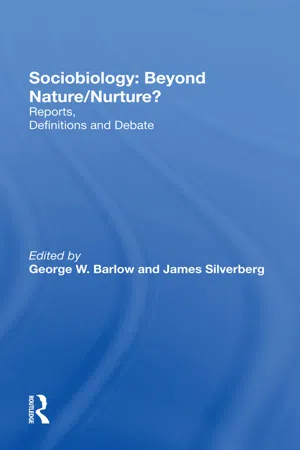
Sociobiology: Beyond Nature/nurture?
Reports, Definitions And Debate
- 656 pages
- English
- ePUB (mobile friendly)
- Available on iOS & Android
eBook - ePub
Sociobiology: Beyond Nature/nurture?
Reports, Definitions And Debate
About this book
To most biologists, sociobiology represents the concept of strict Darwinian individual selection married to an analytical application of ecological principles and brought to bear on social behavior in an unusually exciting and productive way. Joining the biologists are a small number of social scientists. But there are radically divergent views as to how the field should be delimited, and sociobiology is one of the most widely discussed fields in biology and anthropology today. The symposium on which this book is based was arranged by a biologist and an anthropologist. The participants, leaders in their fields, ably present contrasting and responsible views on current issues. This is the first collection of essays on sociobiology in which opposing views are aired. It is an exciting, timely book and an important historical document.
Information
Part 1
Introduction
1.
The Development of Sociobiology: A Biologist’s Perspective
Seldom has a field of science excited so much enthusiasm in recent years as has sociobiology while at the same time inspiring such vituperation. Part of the difficulty lies in a misconception about the very nature of the field. When critics or advocates use the word sociobiology they often mean different things. At best, there is only partial overlap in their cognitive maps of sociobiology. As we learn from Hull (this volume) such misunderstandings are common in science and are no need for alarm.
To biologists working in sociobiology the term signifies a strict application of evolutionary theory to the social behavior of animals. To its critics, however, sociobiology is just another attempt to invoke genetic determinism to explain human behavior. The most vociferous critics lump writers in sociobiology together with authors such as Ardrey (1970) and Coon (1962). Individuals from these two camps have difficulty talking to one another. They speak different scientific languages, are concerned with different research problems and therefore have no literature in common? they view one another’s positions with suspicion.
Biological Roots
The situation might be illuminated by delimiting sociobiology as a biologist regards it, that is, in the narrow sense. That can be best accomplished through an historical treatment, illustrating how certain fields of study have converged to produce sociobiology. It will necessarily reflect my own perceptions? others might well write a different account. It will also be highly selective and therefore a disservice to many who should be mentioned. Wilson (this volume) reviews the history of the term sociobiology. Sketching the development within biology will help you to appreciate the connections between the papers in this book.
There are three historical themes that have come together to produce sociobiology. The most visible of these originated in Charles Darwin’s evolutionary theory, a theory conceived in ignorance of genetic mechanisms. That theory was given a genetic algebra by Sewell Wright, J. B. S. Haldane and R. A. Fisher, though it is usually Fisher who is cited in sociobiology. I will call this population or evolutionary genetics? it provides the rules of the game. The second theme is that of ecology; it is the arena that constrains or stimulates the players. The third theme is ethology; it answers the behavioral questions of how animals cope.
Evolutionary Genetics
Fisher’s contribution (e.g., 1930) was to develop the logic of a genetic basis for natural selection. His most cited example in sociobiology is probably the explanation of the one-to-one sex ratio that characterizes so many species. He deduced that fitness is optimized by producing male and female offspring in equal numbers, assuming the general case of equal investment in each sex. (Fitness can be defined as “the contributions to the next generation of one genotype in a population relative to the contributions of other genotypes. By definition, this process of natural selection leads eventually to the prevalence of the genotype with the highest fitness” (Wilson 1975:585).)
The sex-ratio argument goes as follows: Since males can inseminate many females, while each female can produce only one (set of) young at a time, one might conclude that an animal could increase its number of grandchildren by producing only sons. The strategy’s success, however, is its own downfall. As it spreads through the population more and more males will be produced, thus making females scarcer and scarcer. Therefore, the probability of an individual’s daughter having offspring approaches one, while the probability of an individual’s son having offspring plummets. Thus the production of daughters becomes a better strategy than the production of sons, and the sex ratio will again revert to 50:50. This argument applies with equal force in the opposite direction as females become numerous and males scarce. The proposition is still being refined as more is learned about short-term and also persistent departures from a one-to-one sex ratio (e.g., Hamilton 1967; Leigh 1970; Trivers & Willard 1973).
W. D. Hamilton (1964, 1966, 1967, 1970, 1971a, b, 1972) is considered by most to be Fisher’s intellectual descendant. Indeed, some consider his papers the founding stones of sociobiology. In Hull’s lexicon (this volume) these works are exemplars of the early stages of sociobiology. It does Hamilton an injustice just to cite his key articles because he contributed so many ideas in each article.
The most pivotal of Hamilton’s (e.g., 1964) contributions was the concept of inclusive fitness, which can be summarized as “The sum of an individual’s own fitness plus all its influence on fitness in its relatives other than direct descendants; hence the total effect of kin selection with reference to an individual” (Wilson 1975:586). The corollary concept, which has gained so much attention, is that of altruism; it is said to occur when an animal behaves in such a way that it decreases its own fitness in the process of increasing the fitness of another individual. It does a “favor” for another animal but at some cost to its own well being. Hamilton argued that apparent altruism should therefore be shown only toward kin, and the less so as the relationship becomes more remote (in this volume see Sherman on kin selection, but also see Bradbury).
Hamilton came to ideas such as these while considering the paradox of sterile worker insects, which are so characteristic of the highly social wasps, ants, and bees (hymenopterous insects). Why should the worker increase the queen’s reproductive success while reducing her own to zero? That would seem to be the ultimate in altruism.
The solution lies in kin selection and inclusive fitness, all tied into the peculiar reproductive biology of these insects, haplodiploidy. In haplodiploidy, males develop from unfertilized eggs and are thus derived from one set of chromosomes (haploidy), as contrasted to females; the latter develop from fertilized eggs and therefore have two different sets of chromosomes (diploidy). Males are consequently totally homozygous.
In diploid animals each parent has 50% of its genes in common with its offspring, as do on average brothers and sisters; they are said to be related by a factor of 1/2. This results from sexual reproduction, which entails a halving of the chromosomes during the production of the male and female gametes (the ova and sperm).
In a colony of hymenopterous insects, because the haploid father is homozygous, sisters have on average a whopping 75% of genes in common, but if they reproduced they would share only the usual 50% with their daughters. Thus producing sisters, through the queen, results in a higher number of their own genes in the population than would producing their own daughters. Theory predicts that the daughters’ interests would therefore best be served by helping to produce and rear more sisters. The situation, as so often happens, is actually more complicated than this and has many ramifications (see Wilson 1975).
One has to be cautioned, however, against overextending the concept of kin selection (see also Sherman, this volume). It is probably applicable to but a small portion of animals since most species don’t live in kin groups. Those that do are most notably the social species among the hymenopterous insects, termites, birds, and mammals; humans are a good example (see Chagnon, Irons, B. J. Williams, this volume).
About the same time as Hamilton, G. C. Williams was stating remarkably similar ideas (Williams 1966; Williams and Williams 1957). Williams’s book (1966) was stimulated in part by a provocative essay of Wynne-Edwards (1962). Wynne-Edwards had put forth and amply documented the thesis that gregarious animals regulate their population density through social feedback. They assess their density during behavioral interactions. If their density is too great in relation to the carrying capacity of their environment, they behave altruistically by refraining from breeding. Williams took it upon himself to refute that “group selectionist” doctrine. He did that by demonstrating that individual selection could account for all the phenomena, and that group selection logically could not (but see B. J. Williams, this volume).
Another key concept, in whose development G. C. Williams (1966, 1975) has played a major role, is that of sexual asymmetry. It stems from the prevailing situation in higher animals that males turn out nearly limitless numbers of small sperm, whereas females either lay large eggs or gestate small ones. Thus males are said to invest little in each gamete while females invest heavily.
Gordon Orians (1969) and Robert Trivers (1972) carried the idea forward by showing how this asymmetry could explain the conflicting objectives of males and females when mating: males should favor polygyny (having many female mates), females monogamy. A further extension is that a male should try to desert the female. That leaves her to care for the offspring while he seeks new mates. This line of thought has experienced considerable modification and refinement of late (Maynard Smith 1977).
Maynard Smith (1971) and Williams (1975) have written extensively about another concept, the cost of sex. It is a tricky argument, so the reader is advised to consult Williams’s article on this subject in this book. The question behind this term is, why did sex evolve? Many species, not generally known to nonbiologists, and usually in relatively “primitive” groups, reproduce asexually. That is, they don’t produce gametes that require another gamete to make a new individual. Rather, each reproductive cell is competent to make a new individual. A parent and all its offspring are therefore genetically the same, barring the rare mutation. Williams then contrasts the advantages and disadvantages of avoiding the cost of sex through asexuality, and of increased genetic variation through sexual reproduction. Each individual produced sexually is, of course, genetically unique, though it has many genes in common with its kin.
One question that flows from this will be of interest to many readers. It concerns the extent to which natural selection works for or against inbreeding in sexually reproducing forms (see Livingstone on the incest taboo, this volume).
Related to these concepts, especially to that of parental investment, is the one of parent-offspring conflict. Trivers (1974) reasoned that caretakers and their progeny should come into conflict over the time when caretaking should cease. Weaning is an example. The parent will want the young to cease nursing before the young would like to stop. That is because, it is argued, further nursing would reduce the parent’s ability to invest in subsequent offspring.
The young’s interest comes into conflict because getting still more milk increases its individual fitness, though at some cost to its mother and to its siblings. Consequently the young has to consider, as it were, how far it should go in competing with its siblings, present and future, by diminishing its mother’s capacity to care for them. The young’s selfish interests therefore have to be weighed in relation to its inclusive fitness; the point of balance will differ from the one favored by the caretaker (see Stamps and Metcalf, this volume). Richard Alexander (1974) has treated this from a different perspective, that of parental manipulation of its own young (see Dawkins 1976b for a contrary position).
No coverage of the development of the evolutionary theory of sociobiology would be complete without mention of John Maynard Smith. His earlier writings (compilations: 1958, 1972) on the genetic basis of evolution spread across a number of topics ranging from the species problem, fossil history, the origin of sex, polymorphism, altruism, and aggression, to a sober critique of eugenics. But his most obvious contribution to sociobiology was the blending of game theory with genetic evolutionary theory. This led him first, and with the important collaboration of G. R. Price (Maynard Smith and Price 1973) to simulate postulated strategies of fighting. And that flowered into the concept of Evolutionarily Stable Strategies (see Dawkins, this volume).
The evolutionary genetic approach to explaining the social behavior of animals is growing with remarkable speed and extends well beyond the foregoing. Richard Dawkins (1976b) has recently summarized the state of this field in a succinctly written book, The Selfish Gene. As a cautionary note, however, there is the danger of circularity in arguments about fitness that derive from population genetics (MacArthur 1971). The genetic models need testing within the framework of models coming from ecology (Gould, this volume, points to a number of shortcomings commonly encountered in evolutionary theorizing).
Ecology
The ecological scene is more difficult to treat with an even hand in a few pages than was population genetics. I will, nonetheless, touch upon the central issues relevant to contemporary sociobiology and the the more restricted scope of this book.
One major line is that of demography, a subdiscipline of natural history (Stearns 1976? Warner, this volume); it is the study of the dynamics and structures of populations and how they come to be that way. A pioneering paper here was one by Robert MacArthur (1962) in which he applied the reasoning of natural selection to stable populations of animals that fully occupy their habitats. Such animals are termed K-selected. Later articles (e.g. MacArthur and Wilson 1967) treated the subject in a larger framework, contrasting K- and r-selected populations (r-selected refers to opportunistic species that disperse to exploitable but fluctuating habitats, breed there with great speed and fecundity and disperse again). It is now recognized that r- and K-selection were useful concepts in developing further theories, but that the concepts are overly simple and encounter difficulties as our knowledge grows (see Warner, this volume).
This type of thinking led to explanations of breeding schedules in terms of costs and benefits, in relation to age and frequency of breeding (Gadgil and Bossert 1970? Williams 1966). Repeated breeding, or iteroparity, is favored if either o...
Table of contents
- Cover
- Half Title
- Series Page
- Title
- Copyright
- Contents
- About the Editors and Authors
- Preface
- PART 1. INTRODUCTION
- PART 2. VIEWED FROM AFAR
- PART 3. THE ORGANISM IN ITS ENVIRONMENT
- PART 4. GENES AND THE GAMES THEY PLAY
- PART 5. SEX AND REPRODUCTIVE STRATEGIES
- PART 6. NEPOTISM AND CONFLICT
- Index
Trusted by 375,005 students
Access to over 1.5 million titles for a fair monthly price.
Study more efficiently using our study tools.
Frequently asked questions
Yes, you can cancel anytime from the Subscription tab in your account settings on the Perlego website. Your subscription will stay active until the end of your current billing period. Learn how to cancel your subscription
No, books cannot be downloaded as external files, such as PDFs, for use outside of Perlego. However, you can download books within the Perlego app for offline reading on mobile or tablet. Learn how to download books offline
Perlego offers two plans: Essential and Complete
- Essential is ideal for learners and professionals who enjoy exploring a wide range of subjects. Access the Essential Library with 800,000+ trusted titles and best-sellers across business, personal growth, and the humanities. Includes unlimited reading time and Standard Read Aloud voice.
- Complete: Perfect for advanced learners and researchers needing full, unrestricted access. Unlock 1.5M+ books across hundreds of subjects, including academic and specialized titles. The Complete Plan also includes advanced features like Premium Read Aloud and Research Assistant.
We are an online textbook subscription service, where you can get access to an entire online library for less than the price of a single book per month. With over 1.5 million books across 990+ topics, we’ve got you covered! Learn about our mission
Look out for the read-aloud symbol on your next book to see if you can listen to it. The read-aloud tool reads text aloud for you, highlighting the text as it is being read. You can pause it, speed it up and slow it down. Learn more about Read Aloud
Yes! You can use the Perlego app on both iOS and Android devices to read anytime, anywhere — even offline. Perfect for commutes or when you’re on the go.
Please note we cannot support devices running on iOS 13 and Android 7 or earlier. Learn more about using the app
Please note we cannot support devices running on iOS 13 and Android 7 or earlier. Learn more about using the app
Yes, you can access Sociobiology: Beyond Nature/nurture? by George W Barlow,James Silverberg,Frank B Livingstone in PDF and/or ePUB format, as well as other popular books in Social Sciences & Anthropology. We have over 1.5 million books available in our catalogue for you to explore.