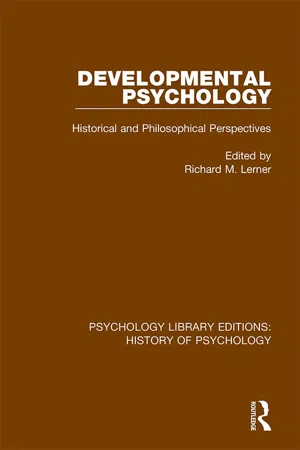
Originally published in 1983, the purpose of this book was to discuss the relations between philosophy and developmental psychology, as those relations existed over the course of the history of the discipline and as they existed at that time. Although not all portions of developmental psychology are surveyed, major proponents of several key areas are represented (e.g. organismic developmental theory, stage theory, life-span-developmental psychology, and the ecological approach to development). In addition, discussion of many currently prominent issues are included (e.g. constancy and change in human development, the use of multivariate models and methods, the role of the context in individual development, and the use of developmental theory in public policy and political arenas). The diversity of approaches and of interests present in the book are representative of the breadth of theoretical and empirical interests found in developmental psychology at the time.
- 286 pages
- English
- ePUB (mobile friendly)
- Available on iOS & Android
eBook - ePub
About this book
Information
I INTRODUCTION
| 1 | The History of Philosophy and the Philosophy of History in Developmental Psychology: A View of the Issues |
Richard M. Lerner
The Pennsylvania State University
Much of psychology’s early history is, of course, a part of philosophy … I do not hesitate to use philosophical terminology because psychology cannot be completely divorced from philosophy either in its history or in its present functioning. This state of affairs is cause for neither congratulation nor commiseration. Psychology is not the more scientific by trying to brush this sometimes embarrassing fact under the rug, as do some of our colleagues, by teaching and preaching psychology as if it had no philosophically based commitments … Denying there is need to consider philosophical questions does not solve the problem. The very denial is one form of philosophical solution [R. I. Watson, 1977].
INTRODUCTION
Today, most scientists would agree that there is a relation between philosophy and their empirical endeavors. However, disagreement would likely rapidly emerge if scientists were asked to indicate the precise features of the relation between philosophy and science. At one extreme the view might be that modern science emerged historically from philosophy, and that the chief remnant of this disciplinary heritage is the logic of scientific verification/falsification and proof. At the other extreme might lie the view that science is a social institution shaped by the cultural and historial variables influencing all human constructions; as such, scientific methodology and “truths” are always relativistic phenomena, embedded in particular constellations of social, cultural, and historial variables (Gould, 1981; Kagan, 1980; Kuhn, 1970). Views between these extremes would also certainly exist.
The diversity that exists today in science regarding views about the relation(s) between philosophy and science is no less than the variation that has been present historically. Over the course of its history, the explicitness with which developmental psychology has engaged philosophical issues has changed. The purpose of this chapter is to describe some of the major instances of this historically changing relation. Several approaches to fulfilling this purpose are reasonable. The range of choices is not unlike that available to a person who has a one month vacation period available for an ‘around-the-world’ tour (cf. Whitehurst, 1982): If one dwells too long on any one point, the intensity and depth that may be achieved may be lessened because one will cover fewer points; if one opts to cover more points, then each must be viewed in a more general way. I have chosen to cast this chapter closer to the latter alternative.
In deciding on this approach I recognize that neither I nor most of my audience are professional historians or professional philosophers; rather, we are developmental psychologists, whose primary interest with the history of the relation between philosophy and developmental psychology is its use for facilitating understanding of current scientific activity (see Blight, 1981, and Weimer, 1979, for corresponding rationales for interest in such history). Moreover, the chapters that follow this one in this book, and several other relatively recent (e.g., Dixon, in press; Robinson, 1976; Smith, 1981) and classic references (Boring, 1950; Misiak & Sexton, 1966; Roback, 1952), provide—in their combination—the in-depth treatments of many, if not all, of the points that I can only treat in overview in the space available to me.
The history of developmental psychology is, of course, not completely separate from the history of psychology in general. As such, to fulfill the purpose of this chapter it is useful to describe first some features of the history of the relation between philosophy and psychology in general. The relation between philosophy and psychology has changed repeatedly both in regard to any acknowledged role of philosophical issues in psychological theory and research and in respect to formal, academic-institutional relations between the two disciplines.
Trends in the Relations Between Philosophy and Psychology During the 18th, 19th, and 20th Centuries in America
To illustrate the historically changing relations between philosophy and psychology, we may briefly consider major features of the links between the two disciplines, as they existed across the last 200 or so years in America (as noted, more detailed discussions of these relations are found in Boring, 1950; Misiak & Sexton, 1966; Roback, 1952; Robinson, 1976; and Smith, 1981).
The bases of psychological thought in America can be traced first to theology, then to moral philosophy, and, until the work of William James, to mental philosophy. The ideas of Jonathan Edwards and of Samual Johnson are represen tative of these first two influences. For example, in 1752 Johnson published Elementa Philosophica, the first textbook of philosophy published in America; it contained discussion of topics such as sensation, cognition, and affect (Misiak & Sexton, 1966).
However, in the 100 years prior to the work of William James it was the mental philosophy of the Scottish school of realism that dominated American psychological thought. This philosophical school was founded by Thomas Reid (1710-1796), who advocated the notion of mental facilities, thus providing the basis for what has been termed faculty psychology (Misiak & Sexton, 1966). Other leading contributors to the Scottish school were Dugald Stewart (1753-1828) and Thomas Brown (1778-1820). In America an initial major promoter of the Scottish tradition was John W. Witterspoon (1722-1794) at Princeton University (then the College of New Jersey).
From the revolutionary period until the late 19th century (and the advent of James), the books of philosophers such as Reid and Stewart were the principal textbooks of moral philosophy in the United States. However, during the 19th-century textbooks written in America began to appear and find some use (e.g., Thomas Upham published Elements of Intellectual Philosophy in 1827 and Elements of Mental Philosophy in 1831, and Noah Porter published The Human Intellect in 1868 [Misiak & Sexton, 1966]). Misiak and Sexton (1966) believe that the content of these books suggested some movement in American psychology from philosophy to a scientific orientation. Nevertheless, they (Misiak & Sexton, 1966) believe these texts, and psychological academic activity in general, were merely: “dilutions of the Scottish philosophers … and were … in the interests of religious orthodoxy. Mid-nineteenth century philosophy was a kind of Protestant scholasticism which derived its psychology from theological dogma [p. 128].”
Despite its pervasive presence the influence of the Scottish school decreased precipitously with the promotion of the views of William James. The last major representatives of the Scottish school were both professors of mental philosophy, as psychology was called in 19th-century academe (Misiak & Sexton, 1966), and presidents of their respective universities: Noah Porter (1811-1882) of Yale University, and James McCosh (1818-1894) of Princeton University.
The beginning of the influence of William James (1842-1910) can be traced at least to a letter he wrote in 1875 to President Eliot of Harvard University. James said (in Misiak & Sexton, 1966) that: “A real science of man is now being built out of the theory of evolution and the facts of archeology, the nervous system, and the senses [p. 130].” James’ declaration of psychology as a science and his active publicizing of this “new” discipline began to forge for the first time in the United States a separation between philosophy and psychology; his work helped create both the academic and popular perception of psychology as an independent and scientific discipline.
James’ career at Harvard mirrors the evolving separation between philosophy and psychology in the United States. In 1875 James taught a graduate course at Harvard entitled “The relation between Physiology and Psychology” (Boring, 1950). Whereas in 1880 he had been appointed an assistant professor of philosophy at Harvard and by 1885 had risen to the rank of Professor of Philosophy, he had his title changed in 1890 to Professor of Psychology. In that same year James published The Priniciples of Psychology in two volumes. James described the book as being written from a positivistic viewpoint, and certainly its influence was to markedly promote psychology as a scientific discipline in the United States (Misiak & Sexton, 1966). Indeed, 2 years later James founded, with Hugo Müunsterberg, Harvard’s psychological laboratory, and by 1900 there were about 40 psychological laboratories in the United States.
Interestingly, and perhaps foreshadowing the waxing and waning closeness of philosophy and psychology that would characterize scientific psychology’s history, James, after doing so much to launch psychology as a science and as a discipline distinct from philosophy, changed his title once again, in 1897, to Professor of Philosophy. However, the science he had vigorously promoted continued on the trajectory he had set for it, despite the fact that James himself had withdrawn from the fray. Indeed, as presaged by James in his 1875 letter to President Eliot, by 1900 not only had the number of scientific laboratories grown enormously but the characteristics of American psychology had become well-defined. As Boring (1950) has stated: “It had inherited its physical body from German experimentalism, but had got its mind from Darwin [p. 506].”
The positivistic, experimental, and functional features of psychology continued to be characteristic of the “new” science in the 20th century (White, 1968), the number of laboratories continued to increase rapidly (e.g., the number almost doubled from 1900 to 1915; Misiak & Sexton, 1966), and the distinction between philosophy and scientific psychology was increasingly drawn more rigidly and was enforced by both intellectual argument and academic-institutional separations (Smith, 1981). As Smith (1981, p. 29) points out:
The plain fact was that experimentalists typically had no desire for philosophical intercourse, and one need look no further than Watson and Edward L. Thorndike for instances. Although both had considerable contact with important philosophers as students, both doubted the value of philosophy. Watson claimed that his extensive philosophical training “wouldn’t take hold” and that he understood neither his illustrious teachers, John Dewey and George Herbert Mead. Thorndike reacted even more negatively to philosophy, calling his teacher, Josiah Royce, “too much a performer,” and remarking that the best thing that could be said for a philosophy course was that it does not meet often.
The path of independence that most psychologists had blazed for themselves by 1910 was by and large adhered to for the next twenty-five years.
Nevertheless, however necessary or immutable the division between philosophy and psychology may have seemed, we see that by the middle portion of the 20th century events conspired to once again change the intellectual relation between philosophy and psychology (e.g., see Smith, 1981). In fact, by 1962 the first official function of a then newly organized division of the American Psychological Association—the Division of Philosophical Psychology—was held. At that function Joseph R. Royce, one of the Division’s organizers, said (in Misiak & Sexton, 1966) that the beginning of the Division was a celebration of the: “official remarriage of psychology and philosophy after almost 100 years of legal separation [p. 29].”
Events pertaining to numerous areas in psychology interacted in the first two-thirds or so of this century to recreate an acknowledged relation between philosophy and psychology. Smith (1981), for example, described those events pertinent to experimental psychology and learning theory. As noted, however, the purpose of this chapter is to highlight those events involved in the area of developmental psychology. An overview of this history thus allows us to appreciate the bases of current relations between philosophy and developmental psychology; in addition, it allows us to appreciate key issues pertinent to the major focus of this volume: the ways in which the history and nature of the relation between philosophy and developmental psychology are involved in past and current theoretical, methodological, and substantive concerns in the study of human development.
The Role of Philosophy in Developmental Psychology: An Historical Overview
Discussions of the history of developmental psychology have appeared repeatedly (Baltes, 1979a; Bronfenbrenner, 1963; Dixon, in press; Havighurst, 1973; Looft, 1972; Sears, 1975; White, 1968). We need not reiterate these presentations in the present chapter. Instead, our goal is to indicate those features of the history of developmental psychology that mark the changing relations between philosophical and scientific endeavors.
One may speculate that a factor motivating the drawing and sharpening of the distinctions between philosophy and psychology, by the early contributors to scientific psychology, was a perceived need to create disciplinary boundaries in order to establish and protect intellectual and academic-institutional domains of proprietorship (cf. Smith, 1981). Such boundaries may have thus been initially quite functional. However, we have noted earlier that in the years between the turn of the century and the early 1960s the perception of the potential role of philosophy in psychology had changed to an extent sufficient for the establishment of a division of the American Psychological Association explicitly designed to explore philosophy-psychology interrelations.
Developmental psychology changed in this period from a descriptive, normative discipline to one concerned centrally with theory and metatheory (Bronfenbrenner, 1963; Looft, 1972; Mussen, 1970). Interestingly, these meta theoretical or paradigmatic (Kuhn, 1970) concerns in part pertain...
Table of contents
- Cover
- Half Title
- Title Page
- Copyright Page
- Original Title Page
- Original Copyright Page
- Contents
- Foreword
- Preface
- Dedication
- Part I: Introduction
- Part II: Perspectives On History And Philosophy
- Part III: Commentary And Replies
- Part IV: Conclusion
- Author Index
- Subject Index
Trusted by 375,005 students
Access to over 1.5 million titles for a fair monthly price.
Study more efficiently using our study tools.
Frequently asked questions
Yes, you can cancel anytime from the Subscription tab in your account settings on the Perlego website. Your subscription will stay active until the end of your current billing period. Learn how to cancel your subscription
No, books cannot be downloaded as external files, such as PDFs, for use outside of Perlego. However, you can download books within the Perlego app for offline reading on mobile or tablet. Learn how to download books offline
Perlego offers two plans: Essential and Complete
- Essential is ideal for learners and professionals who enjoy exploring a wide range of subjects. Access the Essential Library with 800,000+ trusted titles and best-sellers across business, personal growth, and the humanities. Includes unlimited reading time and Standard Read Aloud voice.
- Complete: Perfect for advanced learners and researchers needing full, unrestricted access. Unlock 1.5M+ books across hundreds of subjects, including academic and specialized titles. The Complete Plan also includes advanced features like Premium Read Aloud and Research Assistant.
We are an online textbook subscription service, where you can get access to an entire online library for less than the price of a single book per month. With over 1.5 million books across 990+ topics, we’ve got you covered! Learn about our mission
Look out for the read-aloud symbol on your next book to see if you can listen to it. The read-aloud tool reads text aloud for you, highlighting the text as it is being read. You can pause it, speed it up and slow it down. Learn more about Read Aloud
Yes! You can use the Perlego app on both iOS and Android devices to read anytime, anywhere — even offline. Perfect for commutes or when you’re on the go.
Please note we cannot support devices running on iOS 13 and Android 7 or earlier. Learn more about using the app
Please note we cannot support devices running on iOS 13 and Android 7 or earlier. Learn more about using the app
Yes, you can access Developmental Psychology by Richard M. Lerner in PDF and/or ePUB format, as well as other popular books in Psychology & Developmental Psychology. We have over 1.5 million books available in our catalogue for you to explore.