Highlighting twenty years of U.S. scientific research conducted since the International Geophysical Year (IGY) of 1957-58, this volume marks a turning point in the history of polar investigations and provides a lucid summary of the contributions of many distinguished scientists. The authors provide an overview of major polar research programs, past and present; explore concepts derived, from highly interrelated aspects of physical and life sciences; and seek to offer a glimpse of future polar science and polar development. The introduction briefly describes major physical, biological, and interdisciplinary research programs, as well as the magnitude, extent, and international character of contemporary polar science. Twenty years of polar biological investigations are then reviewed, and subsequent chapters address principles and advances in meteorology, physical oceanography, glaciology, and the geological evidence that hears on the origin of Antarctica. These physical sciences delineate a matrix for the polar biospheres and provide a background for understanding the major categories of structure and dynamic functioning of the marine ecosystem, polar marine mammals, adaptational physiology, and terrestrial biotic adaptations.
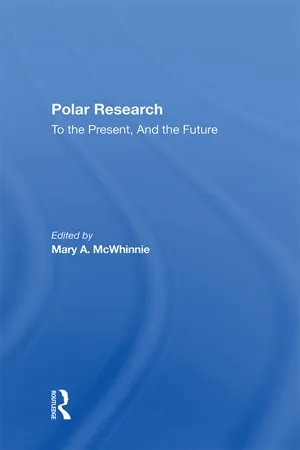
- 340 pages
- English
- ePUB (mobile friendly)
- Available on iOS & Android
eBook - ePub
About this book
Information
1
The Emergence of Antarctica
Laurence M. Gould
Introduction
Man's conception of Antarctica divides itself into three stages which parallel his own intellectual development. In the classical ages it was a myth. Then it evolved as a hypothetical continent up to the 20th century. The first third of the 20th century is commonly referred to as The Heroic Age and was characterized by the exploits of Nordenskjöld, Scott, Shackleton, Amundsen, Mawson, Byrd and others. Then came the modern age in which Antarctica has emerged as the world's greatest natural laboratory.
The two most distinctive achievements of the International Geophysical Year were the development of the space science program and the uncovering of Antarctica. When we consider the highly developed methods of transportation and communication by the middle of the twentieth century it is in some ways a source of wonder that a continent as large as the United States and Europe combined should have remained so little known so long. The major part of the continent had not yet been seen by man at the inception of the IGY on July 1, 1957.
The difficulty of access due to its "halo" of pack ice and icebergs, together with the severity of its climate helped to preserve Antarctica's secrets, especially from shipboard explorers.
Even with the development of world wide use of aircraft by our midtwentieth century air age Antarctica was largely by-passed until the International Geophysical year. There was no economic motive for its exploration. Most of the earth's most highly developed and, except for India and China, most populous regions lie about the Arctic. Ninety percent of the world's people live north of the equator, and the world's traffic continues to be largely between points in the Northern Hemisphere, The major air routes connecting the world's centers of population lie north of the equator, and many of them cross parts of the Arctic. True, in a great-circle route from Argentina or Chile to Australia one would fly over a part of Antarctica, but the commercial prospects for such a flight are slight.
The existence of a southern continent was one of geography's most ancient assumptions. During the sixth century B.C. Pythagoras postulated a spherical earth. With the Greek's love of symmetry this persuaded his followers to assume that there would be large masses of land in the southern hemisphere to balance those which formed the inhabited earth.
The most noted geographer of antiquity, the Roman Claudius Ptolemaeus or Ptolemy, who lived in Alexandria during the second century A.D., drew an immense southern landmass which he called "Terra Incognita" connecting Africa with the Malay Peninsula on the east, making the Indian Ocean a closed sea. This conception was not disproved until nearly the end of the fifteenth century.
The idea of a spherical earth was not compatible with early Christendom's dedication to a flat saucer-shaped planet. Ptolemy's ideas languished for a long time but the idea of a spherical earth and the likelihood of reaching India by sailing west from Spain was kept alive by monastic scholars. Then in the late fifteenth century stirrings of the Renaissance began. In addition to its greatness in art and science the Renaissance was man's first space age. Here was sparked the greatest era of geographical exploration in man's history -- a period of exploration during which the size of the known world was doubled and which was not equaled until the International Geophysical Year. Ptolemy's geography was revived and during the late fifteenth century many maps appeared in Europe based on his concepts, with his "Terra Incognita" changed to "Terra Australis".
Terra Australia first appeared on a world map by Orontius in 1531 and was copied by Mercator in 1538. This map was remarkable: based on pure guesswork its outline was surprisingly like that of the real Antarctica as we know it except that it was about one-third as large with a huge bulge opposite Australia. This was the smallest "Antarctica" from the time of Ptolemy's projections until the continent was finally circumnavigated in the latter part of the eighteenth century by Captain Cook.
The first major reduction in the supposed southern landmass came with the rounding of the Cape of Good Hope by Vasco de Gama in 1497 which led many geographers to believe there was no continent at all south of Africa. In a way this was offset by Magellan in 1520. Geographers immediately assumed that Tierra del Fuego, the land south of the Straits, was a part of the great southern continent.
In 1578 Queen Elizabeth sent Sir Francis Drake to find the great southern land. His ship, the Golden Hind, was blown way south of Cape Horn, proving that the Atlantic and Pacific were one ocean there. Thus another great piece of Terra Australis was cartographically sunk.
Geographers were not deterred. The discovery of the Solomons and other Pacific Islands in the late sixteenth century and of New Zealand by the Dutch in 1642 were taken as further evidences of the South Polar continent. The myth further developed that such a continent was a veritable paradise with fertile lands and happy peoples. The economic motive to find the new land became stronger than ever.
It was, of course, inevitable that every voyage south beyond the known world should reduce the size of this hypothetical landmass. When Tasman discovered New Zealand in 1642, he thought it was part of the coast of "Terra Australis". It was left to James Cook, greatest of all Antarctic explorers and, in my opinion the greatest ship explorer of all time, to erase forever the idea of a fertile populated southern continent. During his first voyage, from 1768 to 1771, he circumnavigated both islands of New Zealand and thereby took another big slice away from the unknown southern landmass. On his second voyage, from 1772 to 1775, Cook circumnavigated the continent of Antarctica without actually sighting it. He deserved to discover Antarctica for he came close to it several times and was the first explorer ever to cross the Antarctic Circle. Upon Cook's return he observed with prophetic clarity that if there was a southern continent it would be so cold and inhospitable that it could not possibly be suitable for human habitation.
After Napoleon's disastrous retreat from Moscow, Russia emerged as a world power and the expansive mood of the Kremlin stimulated expeditions to both the north and south polar regions. In 1818 Czar Alexander I dispatched a well-equipped expedition under the command of Captain Thaddeus von Bellingshausen to make discoveries "as close as possible to the South Pole". Although Bellingshausen's course shows that he was near enough the continent to have seen it, he does not record such a landfall in his log. He was much surprised to find sealers in the sub-antarctic islands.
On his triumphant return in 1775 Cook had reported an abundance of fur seals in South Georgia which stimulated a great increase in their exploitation by British and American sealers. At the height of this slaughter more than 100 vessels were operating in a single season. It would have been strange if some of them had not inadvertently discovered the continent.
Most American students of the problem believe that a youthful New England sealing captain, Nathaniel Palmer, was the first to sight the continent in November 1820. The British are equally sure that it was first sighted by an Englishman, Captain Edward Bransfield, on January 30, 1820. After an examination of the records of his voyage the All-Soviet Geographic Congress concluded in 1949 that von Bellingshausen had discovered the antarctic continent in the Palmer Land sector (northward extension of what is now called the Antarctic Peninsula).
All Of these contenders have one thing in common; the assumed achievement of the discovery of Antarctica on the part of all three rests on the interpretation of imperfect records by modern investigators. It is unlikely that the matter will ever be settled to the satisfaction of all concerned. Hopefully it will forever be an item of academic interest only.
A Continent Found
The development of steam-powered ships and the gradual replacement of modern ships with iron or iron-clad vessels put greater reliance upon the magnetic compass. The Earth's magnetism became a field of great scientific importance. Sir James Clark Ross had discovered the north magnetic pole in 1831. Sparked by the work of a great German mathematician, Karl Friedrich Gauss, who predicted that there was a south magnetic pole opposite the north one and that it would be found in latitude 66° south, longitude 146° east, three expeditions were dispatched to search for it during the years 1838 to 1843.
In January 1840, a French expedition under Dumont d'Urville sighted continental land between latitudes 120° and 160° east in the region of the magnetic pole, although d'Urville did not describe his discovery as part of a continent.
An American expedition under the command of Lieutenant Charles Wilkes was dispatched by the U.S. government in 1838 to further knowledge of the prospects for a southern whale fishery as well as to carry out scientific exploration. Like d'Urville he was thwarted in his quest for the south magnetic pole since it is well inland, but he did cruise along 1,500 miles of the coastline charting many landfalls along the coast which now bears his name. On January 30, 1840, he wrote: "I make this bay in longitude 140° thirty minutes east, latitude 66° forty-five minutes south and now that all were convinced of its existence I gave the land the name of Antarctic continent". This is the first confident statement of the reality of a continent. Since Wilkes did not land, his strong statement was something of a guess but modern mapping has shown his discoveries and assumptions to be valid.
Scientific Penetration
On August 16, 1840, Sir James Clark Ross, with the best equipped ships yet designed for navigation in sea ice, sailed southward from Australia and was able to penetrate through the belt of pack ice that surrounds the continent; this had never been done before. Although he did not reach the south magnetic pole, Ross did sail to the head of navigation of the huge embayment that bears his name, making some of the greatest geographic discoveries in the history of antarctic exploration.
Following this first scientific penetration, Antarctica was neglected for a half a century. Then in 1893 reports of the Challenger expedition, which had circumnavigated the globe from 1872 to 1875, were released and greatly influenced the thinking of the International Geographical Congress held in London in 1895. The Congress declared that investigation of Antarctica was "the greatest piece of geographical exploration still to be undertaken".
In 1898 Dr. John Murray, biologist on the Challenger expedition, described the great collection of rock fragments dredged up from the sea bottom around Antarctica, which were varied kinds of continental rocks as gneisses, granites, diorities, sandstones, limestones and shales. Murray observed that "there can be no doubt of their having been transported from land situated near the South Pole".
While Wilkes was sure he had sighted a continent in 1840, the idea continued to persist that Antarctica might be a gigantic archipelago smothered beneath the great inland ice sheet. Most geographers agreed with Murray's belief that Antarctica was indeed a major continental landmass. Yet as late as the beginning of the International Geophysical Year (1957-19581 some Russian scientists supported the belief in a great archipelago.
Actually we know now that both assumptions are valid for different parts of the continent. Seismic soundings which reveal the thickness of the inland ice show that if it were all to melt. East Antarctica would be revealed as a true continental shield. On the other hand West Antarctica would become a great archipelago. But the continent is made one by its great cover of glacial ice, for ice is just as truly a rock as gneiss or schist or granite.
The Heroic Age
The response to the plea from the International Geographical Congress of 1895 has come to be known as the "heroic age" in antarctic exploration, which lasted from the nineteenth century well into the second decade of the twentieth. This was the most extensive geographic exploration of the continent which had yet been attempted and whose results will stand for all time among the great ones in the history of geographic exploration.
While scientists had played important roles on many of the early expeditions -- especially those of Cook, Wilkes and Ross as well as some of the sealing and whaling expeditions -- it was not until the turn of the century that teams of scientists were an important integral part of the voyages. All of the expeditions of this era, except that of Amundsen, included teams of scientists who carried out extensive programs in their own fields of research, but it was in the realm of geography that the major discoveries were made. It was during this time that the real nature of Antarctica and its environment were first understood and revealed. Extensive mapping of the coastal areas, the first sighting of the inland ice, significant geological and glaciological discoveries which furnished the basis for subsequent work and conquest of both the geographic and magnetic poles are but a small part of the achievements of this age.
Postwar Interest
In the twilight of the Heroic Age, after its interruption by World War I, interest in Antarctica was revived and a new, still continuing phase in its exploration began, made possible by new advances in transportation and communication. For almost four decades a series of British, Australian, Norwegian, American, Argentine, Chilean, French and Hussian expeditions added greatly to our knowledge of Antarctica. Among them was the first continuing program of scientific research in Antarctica; it was primarily oceanographic and marine biological research, which was carried out by Scott's old ship The Discovery which made 13 voyages from 1923-39.
The most important development in the whole field of logistics during these interim years was the introduction of aircraft.
Before the advent of the airplane no part of the interior of An...
Table of contents
- Cover
- Half Title
- Series Page
- Title
- Copyright
- About the Book
- Contents
- List of Figures
- List of Tables
- Foreword
- Preface
- About the Editor and Authors
- Maps
- Introduction
- 1 The Emergence of Antarctica
- 2 Polar Research: A Synthesis with Special Reference to Biology
- 3 Antarctica and Gondwanaland
- 4 The Role of the Polar Regions in Global Climate Change
- 5 Polar Oceans: Similarities and Differences in Their Physical Oceanography
- 6 Primary Productivity and Estimates of Potential Yields of the Southern Ocean
- 7 Problems in the Conservation of Polar Marine Mammals
- 8 The Physiology and Biochemistry of Low Temperature Adaptations in Polar Marine Ectotherms
- 9 Terrestrial Adaptations in Polar Regions
- 10 Polar Logistic Support: The United States Navy
- 11 Polar Research: Status and Prospectus
- 12 Major International Polar Research Programs
- Index
Trusted by 375,005 students
Access to over 1.5 million titles for a fair monthly price.
Study more efficiently using our study tools.
Frequently asked questions
Yes, you can cancel anytime from the Subscription tab in your account settings on the Perlego website. Your subscription will stay active until the end of your current billing period. Learn how to cancel your subscription
No, books cannot be downloaded as external files, such as PDFs, for use outside of Perlego. However, you can download books within the Perlego app for offline reading on mobile or tablet. Learn how to download books offline
Perlego offers two plans: Essential and Complete
- Essential is ideal for learners and professionals who enjoy exploring a wide range of subjects. Access the Essential Library with 800,000+ trusted titles and best-sellers across business, personal growth, and the humanities. Includes unlimited reading time and Standard Read Aloud voice.
- Complete: Perfect for advanced learners and researchers needing full, unrestricted access. Unlock 1.5M+ books across hundreds of subjects, including academic and specialized titles. The Complete Plan also includes advanced features like Premium Read Aloud and Research Assistant.
We are an online textbook subscription service, where you can get access to an entire online library for less than the price of a single book per month. With over 1.5 million books across 990+ topics, we’ve got you covered! Learn about our mission
Look out for the read-aloud symbol on your next book to see if you can listen to it. The read-aloud tool reads text aloud for you, highlighting the text as it is being read. You can pause it, speed it up and slow it down. Learn more about Read Aloud
Yes! You can use the Perlego app on both iOS and Android devices to read anytime, anywhere — even offline. Perfect for commutes or when you’re on the go.
Please note we cannot support devices running on iOS 13 and Android 7 or earlier. Learn more about using the app
Please note we cannot support devices running on iOS 13 and Android 7 or earlier. Learn more about using the app
Yes, you can access Polar Research by Mary A. Mcwhinnie in PDF and/or ePUB format, as well as other popular books in Social Sciences & Sociology. We have over 1.5 million books available in our catalogue for you to explore.