- 178 pages
- English
- ePUB (mobile friendly)
- Available on iOS & Android
eBook - ePub
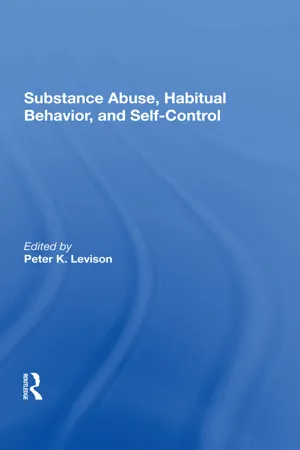
Substance Abuse, Habitual Behavior, And Selfcontrol
About this book
This collection of original essays by members of the National Academy of Sciences' Committee on Substance Abuse and Habitual Behavior offers innovative perspectives on self-control over the use of habituating substances and related types of behavior. The authors review the powerful social-psychological influences of normative rules and interpersonal circumstances in developing individual capacities for self-control in, for example, the use of heroin. They also look at experimental contingencies under which animals engage in self-harming behavior; the induction of exaggerated consumption behavior, such as massive fluid drinking by laboratory rats; and studies of environmental and genetic influences on neurophysiological sensitivity to and preference for alcohol in laboratory mouse strains. The concluding chapter presents an unorthodox perspective on ways of self-governing the consumption of cigarettes and other substances, recognizing the peculiarities of the processes of human choice. In his introduction, volume editor Peter Levison contrasts the diverse approaches reflected in the book with the common-sense notion of self-control.
Information
1
Self-Control: The Role of Environmental and Self-Generated Cues
Introduction
The notion of self-control has absorbed social scientists in the 20th Century, much as considerations of determinism and free will were debated in earlier periods. When related to the domains of substance use and habitual behavior, the issues become even more intriguing since self-control must in certain cases exist over the pharmacologically and physiologically rewarding properties of various categories of substances. In its most stringent application, the term self-control has been used to imply those processes by which persons maintain their own behavior by relying only on self-produced consequences rather than any immediate environmental support or feedback (cf. Kanfer, 1971). We believe that this definition neglects an important potential source of support for self-control of behavior — the ordering of social and environmental factors that can promote control. Adding this component enables us to consider self-control more broadly, as the process of self-regulation by which people manage their behavior in the social surrounding.
The problem of defining self-control also takes on different dimensions if approached from the perspective of the labeler instead of that of the labeled behavior (Mahoney and Arnkoff, 1978). For the most part, self-control lies in the eyes of the beholder (i.e., it is an attribution of the observer more than a characteristic of the behavior), and the context and the history of a given behavior are major factors that determine whether it is labeled self-control. For example, if two people at a party decline a drink, one of them a nondrinker and the other an alcoholic who has been trying to stop drinking, we would only describe the latter as showing self-control. Thus, self-control is not an intrinsic property of the behavior itself.
The demonstration of behavior labeled as self-control usually requires a situation where a highly valued substance or event is reasonably available and the individual fails to consume it (in the absence of a clear compelling set of concurrent controlling stimuli in the environment whose operation would account for that behavioral outcome) (Kanfer, 1970). In other words, if a person declines the offer of a rich dessert when there are several available and his host is urging his consumption, we would label his refusal as an indication of self-control. However, if the physician he was seeing for weight control was his dinner partner, we would not impute the exercise of self-control. People receive early training in some aspects of self-control behavior since part of childhood socialization involves providing instruction and reinforcement for the initiation of such self-controlling responses, especially those involved in learning resistance to temptation (cf. Aronfreed, 1968? Mischel, 1974; Skinner, 1953, 1957).
People are also seen as exercising self-control when it is they themselves who initiate interruption of the chain of responses leading to a tempting response (Kanfer, 1971). Certainly if their past experience has included many rewarding events that are associated with the undesirable behavior, the temptation is likely to be very strong. The likelihood of engaging in behaviors related and leading to the tempting response also increases when there are strong cues in the environment increasing the likelihood of such responses. A restaurant, for example, provides a multitude of cues that could trigger alcohol consumption even if the person stays out of the room where the bar is located. In this case, the person may need to develop supplementary environmental supports. For example, an alcoholic may turn over his money to a friend before going out in the evening in order to decrease the probability of buying drinks or a dieter may put a lock on the refrigerator door.
There are, then, at least two classes of events that can enhance the operation of self-control: (1) external events — which by their natural occurrence or by explicit manipulation, support the control of a particular behavior or class of behaviors, or provide cues for the expression of those behaviors, and (2) internal, self-produced stimuli. As an example of the first category, people can and do control their own consumption of various substances by referring to established norms or explicit guidance, which others supply, that regulate how much of that sort of thing people like them usually consume or ought to consume. They also control their consumption by referring to cues in the immediate context, such as external signals that symbolize restraint. It is important to highlight a crucial differ-enee in terms here. We are referring not to external controls, but to the external cues that enable self-control to take place.
The second class of self-control cues involves the processes by which people alter or maintain their behaviors even in the absence of immediate external supports. Here persons must rely primarily on internal stimuli and standards — private verbal commands, for example — and on the ability to reward themselves for appropriate behaviors. People relying on internal cues need therefore to have a repertoire of techniques for monitoring, evaluating and rewarding their own behavior.
Supported by the stimuli from these two categories, self-control is behavior that is not intended to be understood simply as the commonsense notion of willpower, conscious restraint, or ego-strength. Self-control is something a person does and not something he or she has. Indeed, there are data in the area of substance use suggesting that without establishing the specific antecedent conditions for self-control outlined above, merely employing rigid conscious restraint can make a person even more vulnerable to engaging in uncontrolled behavior under certain circumstances. For example, Herman and his colleagues (Herman and Mack, 1975; Herman and Polivy, 1975) have studied self-reported restrained eaters and note an intriguing finding. Dividing normal weight subjects on the basis of their questionnaire responses into those who reported needing conscious willpower to restrain their eating and those who did not, the investigators conducted an experiment that required participants to drink either none, one or two large milkshakes (Herman and Mack, 1975). In the next phase of the study, subjects were encouraged to “taste” as much as they wanted from a large dish of ice cream.
The results showed a fascinating turn of events. When subjects who reported using willpower were required, as part of the study, to finish two large milkshakes, they subsequently ate greater amounts of ice cream in the following period than if they had consumed no milkshake or only one. Apparently having drunk so much milkshake, and perceiving themselves as already having overeaten, they gave up their restraint on consumption. Subjects who reported that they rarely used willpower to restrain of their eating behaved in exactly the opposite fashion. For them, consuming greater amounts of milkshake suppressed subsequent ice cream consumption since they felt satiated. This study highlights a weakness in relying on conscious willpower to control eating. Once some overeating occurs, conscious self-restraint appears to be severely weakened, and an eating binge is likely to follow if tasty food is on hand. As in the study described, the initial overeating need not result from a failure of voluntary restraint for a binge to be triggered. Other kinds of binging appear to follow this patterns the “first drink” or “first cigarette” for a dependent person in an abstinent state may initiate a binge.
In this paper, we will consider the role of environmental and internal cues in the operation of self-control processes. We will examine how self-regulation can serve to bring about and maintain controlled use of those substances that are often considered harmful because they are illegal, injurious to physical and/or psychological health, or because they interfere with the individual’s normal daily functioning. The paper will use examples from a variety of substances. It should be emphasized that this wide sampling is neither casual nor random; commonalities among use of substances such as drugs, tobacco, alcohol and foods become most apparent when we look at the processes involved in self-regulation. An emphasis on the operation of cues for self-control that can exist in the environment and in the person’s own state does not deny, of course, that substances do have considerable pharmacologic effects and that there are also important individual differences influencing substance use, including differences in personality and biological susceptibility to substances.
We also choose to avoid in this paper the issue of “substance abuse” per se. The term abuse has many meanings and invariably embodies a judgment that some amount or kind of use is immoral, unwise or unhealthy. Those judgments are often debatable, whether they involve pitting the ethical system of one group or society against that of another, or judging people’s actions by the code of their own group. We prefer to deal with the process of self-control regarding the limitation of substance use and leave to the reader the problem of deciding which outcomes of substance consumption ought to be guarded against or prevented, and which ones ought to be promoted.
Unfortunately, we may also be introducing a definitional problem with the concept of “controlled use.” Its colloquial synonyms suggest that frequency is at the core of the term (e.g., “social,” “casual,” “recreational,” “chipping” (with heroin), and “occasional”). However, even frequency of use must be judged relative to some explicit criteria. For example, the physician who uses opiates very frequently might be seen as a non-controlled user by some of society’s standards (illegal use), or by a physiological measure (of physical dependency), but may be called a controlled user if his daily functioning is not impeded because the availability of opiates and sterile syringes eliminates many of the day-to-day problems experienced by street addicts. Therefore, in addition to a criterion of frequency of use (which may vary from social group to social group or even individual to individual), controlled use also implies a non-compulsive, regulated quality, even with the ingestion of presumably addictive substances such as heroin. We recommend a criterion of non-compulsiveness to be included in any determination of whether controlled use of a substance is in practice, although the specific criterion for non-compulsive use may vary from one substance to another.
External Stimuli Involved in Self-Regulation and Controlled Use
There are two major types of environmental stimuli that play a role in self-control. We will first discuss the influence on patterns of consumption of formal and informal controls that stem from, for example, legal processes and group membership. Then we will discuss a second set of external factors — the immediate setting and context in which substance use occurs. As we describe some of the factors in self-control of substance use and their operation, none will seem extraordinary since they are the familiar types of environmental stimuli that support self-control in many other aspects of behavior. Yet, they are rarely described in the context of substance use. For example, in the literature on opiates and other addictive substances, there are very few references to self-controlled use, a concept not accepted by conventional wisdom. In most cases, the public and professional discussion of drug use remains centered on one aspect — the harmful pharmacological properties of the illicit substances used habitually and compulsively by significant numbers of people. The belief that drugs can be described in terms of their chemical goodness or badness, which is reflected in social policies that regulate them, seems to have obscured the important fact that the way a drug is used, the context in which it occurs, and the person’s interpretation of its effects may all mitigate or potentiate its pharmacological as well as its behavioral properties. Social and psychological processes, in addition to biological events, change the nature of the drug experience and its outcomes.
Social Controls
The external factors that facilitate the regulation of one’s own behavior range from sociocultrual processes such as laws, norms and value systems, at one end, to elements in one’s own environment that uniquely signify control and elicit self-regulatory processes. While we have included formal cues for the control of behavior — such as laws and sanctions — their operation in the facilitation of self-control, as opposed to imposing control per se, is complex. While the ability to incarcerate or fire greatly enhances coercive power, it may not enhance the likelihood that self-control will occur, except in the presence of cues symbolizing the coercive power. For example, people typically drive slowly on the highway when a police car is in sight, but they generally speed up after it passes. Thus the legal symbol, with ability to exercise coercive power, is not enhancing generalized self-regulation at all. In an even more extreme argument, Zinberg and Fraser (1978) suggested that formal control often can be shown to work against the processes operating to promote self-regulation and the internal control of behavior. For example, they argue that the formal controls of the Prohibition era in the United States actually acted to encourage uncontrolled drinking; people went to speakeasies to get drunk rather than to drink.
On the other hand, when formal sanctions are accepted, they gain legitimate as well as coercive power (French and Raven, 1959). If people believe that heroin is “bad” for them, its illegality as a marketed or possessed substance, gains legitimacy. Then the cues symbolizing the formal sanction may elicit self-control processes that maintain themselves, even after the external control is no longer operative.
More informal social controls derive much of their effect from legitimacy and from their ability to reward those individuals who follow their prescriptions. In using the term “informal social controls,” we are referring to the informal rules and other guides to behavior created in micro-environments by groups that have no formal code or mechanisms for enforcement. Examples of these are families, friendship groups, teenage cliques, and the like. These external influences are in contrast to the operation of large-scale social institutions — the government, the industries (legal and illegal) that manufacture and distribute substances, the advertising and media industries, and the medical and legal professions (considered as corporate bodies), which can often exert formal social controls.
The discussion of legitimate reward and coercive power, as they relate to these various types of formal and informal controls, highlights another point that is critical to a discussion of self-regulatory processes. These controls have their effects on behavior by salient external symbols of their power — such as the police car, the executive lunchroom, or living in a halfway house for recovering alcoholics or addicts — and more subtle symbols of relevant norms and values, such as wearing the pin of the weight control club or the highway sign, “Speed Kills.” Both settings, per se, and learned practices associated with a particular formal or informal social control may also come to have powerful cue-functions for self-control behaviors. These are presumed to function as external cues for the exercise of self-control, rather than being external controls per se (e.g., being watched by a parent or a policeman). In addition, the possibility for internal cues to participate in the self-regulation of behavior arises. Through learning and acceptance of certain formal and informal sanctions, for example, internalization takes place. Internalization of the sanction or norm is defined as the propensity to conform to it even when one is removed in time or space from its sanctions (Scott, 1971). Thus, external cues symbolizing the various norms or sanctions may not be needed in the immediate environment to trigger relevant use patterns, but may exist instead in the thoughts, expectancies and values of the individual who is a member of a particular culture or subculture. When one considers norms and sanctions, therefore, both external and internal cues may be operative in promoting their effects on self-control.
We will begin our discussion of the social and environmental factors that provide conditions supportive of self-control by summarizing and commenting on our earlier review of the literature on informal controls and their effects on patterns of substance use (Maloff, Becker, Fonaroff and Rodin, 1980). We noted that most social groups develop a variety of cultural recipes, prescriptions describing what substances can be used in what amounts to achieve desired results. People learn to use substances in prescribed ways by learning these recipes through association with others who teach them what, when, why, how, where and with whom to use. Sumptuary rules specify who is eligible to...
Table of contents
- Cover
- Half Title
- Series Page
- Title
- Copyright
- Contents
- About the Editor and Authors
- Introduction
- 1 Self-Control: The Role of Environmental and Self-Generated Cues
- 2 Maintenance of Behavior by “Schedules”: An Unfamiliar Contributor to the Maintenance of the Abuse of Substances and the Like
- 3 Excessive Behavior and Drug-Taking: Environmental Generation and Self-Control
- 4 A Control System Approach to Alcohol Intake
- 5 The Intimate Contest for Self-Command
Trusted by 375,005 students
Access to over 1.5 million titles for a fair monthly price.
Study more efficiently using our study tools.
Frequently asked questions
Yes, you can cancel anytime from the Subscription tab in your account settings on the Perlego website. Your subscription will stay active until the end of your current billing period. Learn how to cancel your subscription
No, books cannot be downloaded as external files, such as PDFs, for use outside of Perlego. However, you can download books within the Perlego app for offline reading on mobile or tablet. Learn how to download books offline
Perlego offers two plans: Essential and Complete
- Essential is ideal for learners and professionals who enjoy exploring a wide range of subjects. Access the Essential Library with 800,000+ trusted titles and best-sellers across business, personal growth, and the humanities. Includes unlimited reading time and Standard Read Aloud voice.
- Complete: Perfect for advanced learners and researchers needing full, unrestricted access. Unlock 1.5M+ books across hundreds of subjects, including academic and specialized titles. The Complete Plan also includes advanced features like Premium Read Aloud and Research Assistant.
We are an online textbook subscription service, where you can get access to an entire online library for less than the price of a single book per month. With over 1.5 million books across 990+ topics, we’ve got you covered! Learn about our mission
Look out for the read-aloud symbol on your next book to see if you can listen to it. The read-aloud tool reads text aloud for you, highlighting the text as it is being read. You can pause it, speed it up and slow it down. Learn more about Read Aloud
Yes! You can use the Perlego app on both iOS and Android devices to read anytime, anywhere — even offline. Perfect for commutes or when you’re on the go.
Please note we cannot support devices running on iOS 13 and Android 7 or earlier. Learn more about using the app
Please note we cannot support devices running on iOS 13 and Android 7 or earlier. Learn more about using the app
Yes, you can access Substance Abuse, Habitual Behavior, And Selfcontrol by Peter K. Levison in PDF and/or ePUB format, as well as other popular books in Social Sciences & Sociology. We have over 1.5 million books available in our catalogue for you to explore.