Originally published in 1992. This book discusses the possibilities of developing the research process in social science so that it benefits the subjects as well as the researcher. The authors distinguish between 'ethical', 'advocate' and 'empowering' approaches to the relationship between researcher and researched, linking these to different ideas about the nature of knowledge, action, language, and social relations. They then use a series of empirical case studies to explore the possibilities for 'empowering research'. The book is the product of dialogue between researchers from a range of disciplines (anthropology, cultural studies, sociology and linguistics) and is for those working across the social sciences. Through combination of philosophical discussion, methodological recommendation and case-study illustration, it provides guidance that is practical without being simplistic.
eBook - ePub
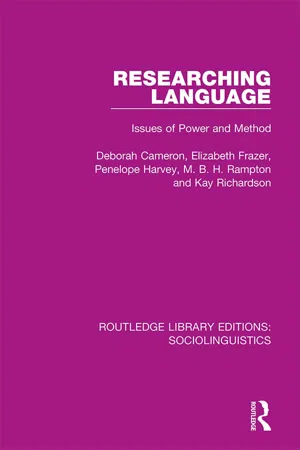
Researching Language
Issues of Power and Method
- 156 pages
- English
- ePUB (mobile friendly)
- Available on iOS & Android
eBook - ePub
Researching Language
Issues of Power and Method
About this book
Information
1
INTRODUCTION
Researching Language is a collectively written book. It is not just a set of essays connected by a common theme, but a text conceived, shaped, drafted and redrafted over a period of several years by five researchers from different disciplines (anthropology, cultural studies, sociology and sociolinguistics) working in collaboration. This is not to imply that we can speak or would want to speak with a single, authoritative voice. Indeed, it will be obvious in later chapters that we differ in important ways. Rather it means that this book has emerged from a process of discussion: it is a dialogue rather than a series of monologues. In this introductory chapter we want to establish the common assumptions, beliefs, questions and concerns that enabled us to start talking and structured our talk.
What first brought us together was an interest in the politics of language and the politics of researching it. We began to meet as a group soon after a conference in Lancaster in 1986 on linguistics and politics: an event that had highlighted issues of power which are often marginalised in sociolinguistics. The particular issue that interested us was to do with the politics of the research process itself. All of us had previously undertaken research in situations characterised by inequality, and we had therefore had occasion to ask whether research could be used to ‘empower’ actors in unequal situations.
Although the actual research projects presented in later chapters were already completed, or nearing completion, when we began to explore this question together, we decided we could use them as ‘case studies’, as material for our reflections. It follows – and this is a point we will emphasise repeatedly – that they are not intended as models or recipes for what we will refer to as ‘empowering research’. They are the concrete basis and the experiential background to our exploration of what empowering research might be.
It is important to point out that the question we asked – whether and how research could be used to the benefit of both researcher and researched – is in some ways an obvious concern for any social scientist to have, while at the same time it is a delicate matter and not at all straightforward. Some of the problems involved arise out of the history of the social sciences, and this requires more detailed comment.
POWER/KNOWLEDGE: THE POLITICS OF SOCIAL SCIENCE
As many commentators have pointed out – perhaps the fullest and most insistent statement can be found in the various works of Michel Foucault – social science is not and has never been a neutral enquiry into human behaviour and institutions. It is strongly implicated in the project of social control, whether by the state or by other agencies that ultimately serve the interests of a dominant group.
As a very obvious illustration, we may notice what an enormous proportion of all social research is conducted on populations of relatively powerless people. It is factory workers, criminals and juvenile delinquents as opposed to their bosses or victims who fill the pages of social science texts. Doubtless this is partly because members of powerful elites often refuse to submit to the probing of researchers – their time is valuable, their privacy jealously guarded. But it is also because a lot of social research is directly inspired by the need to understand and sometimes even to contain ‘social problems’ – the threats (such as crime or industrial disruption) that powerless groups are felt to pose to powerful ones.
Foucault observes, putting a new spin on the familiar saying ‘knowledge is power’, that the citizens of modern democracies are controlled less by naked violence or the economic power of the boss and the landlord than by the pronouncements of expert discourse, organised in what he calls ‘regimes of truth’ – sets of understandings which legitimate particular social attitudes and practices. Evidently, programmes of social scientific research on such subjects as ‘criminality’ or ‘sexual deviance’ or ‘teenage motherhood’ have contributed to ‘regimes of truth’. In studying and presenting the ‘facts’ about these phenomena, they have both helped to construct particular people (‘criminals’, ‘deviants’, ‘teenage mothers’) as targets for social control and influenced the form the control itself will take.
We could consider, for example, the medico-legal discourses interpreting but also, crucially, regulating the behaviour of women. Recently, some acts of aggression by women have been explained as a consequence of hormonal disturbance (‘pre-menstrual syndrome’); conversely, some instances of women drinking while pregnant have been explained (and indeed punished) as acts of conscious negligence (since they may lead to problems for the newborn, most seriously ‘foetal alcohol syndrome’). There are two things to note here. One is that although the categories ‘pre-menstrual syndrome’ and ‘foetal alcohol syndrome’ are presented as objective and value-free scientific discoveries, it is clear that these new pieces of knowledge function as forms of social control over women. The other is that although they may seem to contradict one another (since one makes women less responsible for damage they cause while the other makes them more responsible than in the past) they nevertheless complement each other at a higher level of analysis: they fit and reinforce the logic of that broader control-discourse feminists call ‘sexism’.
This interplay of power and knowledge (Foucaultians write ‘power/ knowledge’) and the historical link between social science and social control pose obvious dilemmas for the radical social scientist. We have to recognise that we are inevitably part of a tradition of knowledge, one which we may criticise, certainly, but which we cannot entirely escape. Even the most iconoclastic scholar is always in dialogue with those who went before. Our own disciplines, anthropology, sociology and linguistics, have problematic histories. Scholars of language and society may be less powerful than lawyers and doctors, but we have certainly contributed to ‘regimes of truth’ and regulatory practices which are hard to defend.
It cannot, for instance, be dismissed as coincidental or unimportant that three of the four case histories in this book involve white researchers working in non-white communities. It has been argued that historically, this structure whereby ‘we’ study ‘them’ has been institutionalised in the disciplines we represent, and that practitioners of those disciplines have been trained to perceive it as natural; they may have experienced some pressure to repeat it, in order to contribute to ‘important’ scholarly debates.
While this is a claim that must be borne in mind, we would have some reservations about the more extreme versions of it: as we will try to demonstrate later in this chapter, there is more going on in the relation between a researcher and those she researches than a simple racist or imperialistic ‘us’ versus ‘them’ opposition; and there may still be problems of power even when researcher and researched are not divided by cultural difference (as when Black researchers work in Black communities, for example).
It has also been argued that the content of the tradition is as problematic as its form. In some instances, the study of non-European languages and cultures, of creoles, and of working-class linguistic varieties, has formed a significant thread in western discourse about ‘primitive’ culture and racial inferiority, and in victim-blaming educational theories. In other instances the interventions of linguistic researchers have seriously disrupted cultural patterns among the researched.
The most notorious example of this disruption concerns the activities of the Summer Institute of Linguistics, a Christian organisation based in the USA which constructs grammars and writing systems for previously undescribed and unwritten languages. The SIL’s avowed primary aim is to translate the Bible into indigenous vernaculars and make the people literate so they can read it. But as well as introducing a coloniser’s religion, the SIL literacy campaigns serve colonialism in other ways: Peter Muehlhausler observes that the newly written language becomes a vehicle for colonial ideas rather than for recording indigenous ones. Worse still, ‘in more than a few instances [in Polynesia, Micronesia and Melanesia] one of the first uses to which literacy was put was to sign away traditional lands to a coloniser’ (Muehlhausler 1990: 190). He also points out that the long-term effect of vernacular literacy in the Pacific has been language death, since vernacular literacies tend to be transitional, and once people can read and write the circumstances are ripe for the coloniser’s language to take over completely. The SIL could with justification be accused of destroying the linguistic ecology and local traditions of the regions in which it operates, very often in the interests of the US government and other agents of colonial capitalism.
In the light of examples like this, it would be quite irresponsible to deny the real effects of research in our disciplines or to play down the contribution they have made to maintaining and legitimating unequal social arrangements. And in this light, our hopes of ‘empowering’ the subjects of linguistic research might start to look at best naive. Perhaps it would be better to stop doing social science research altogether?
The questions of how ‘empowering’ social research can hope to be, and whether in the end certain kinds of research should be undertaken at all are certainly serious ones, to which we will return directly and indirectly throughout this book: the answers, if there are any clear answers, cannot be pre-empted at this stage. For us, though, the starting point was that we had done research in situations of inequality, and we felt a need to reappraise critically the ways we had gone about it, making explicit issues of method that were not necessarily foregrounded at the time. In the following chapters, we ask questions in retrospect about why particular methods were used and to what extent they worked, or could have worked, towards empowering research subjects.
All of us were looking in our research at the ways in which particular disadvantaged groups used language, and we shared the conviction that this is, in one way or another, a politically significant area of study. Linguistic interaction is social interaction, and therefore the study of language use is fundamental to our understanding of how oppressive social relations are created and reproduced. If, as we believed, the politics of language is real politics, it is at least worth considering whether knowledge about it could be framed in a way that research subjects themselves would find relevant and useful.
THEORETICAL ISSUES: THE STATUS OF ACADEMIC KNOWLEDGE
Our early discussions of how research on language might empower its subjects raised general theoretical questions in two main areas: one was the status of academic knowledge itself and the other concerned the relation between researcher and researched in the making of knowledge. We will begin with the first area, since, in it, important philosophical issues are at stake that relate very clearly to the questions to be raised when we come to the second area. Though they are not always discussed explicitly, these issues are fundamental to all empirical research, not just linguistic research. Epistemological assumptions determine the way in which a researcher interacts with the researched: thus they influence methods and indeed research findings.
Quantitative sociolinguistics provides a clear example of epistemological assumptions affecting methods. Here we have a paradigm in which researchers want to gather data on language use from which its general rules can be induced. Accordingly, they are preoccupied with the ‘observer’s paradox’, the idea that good quality data entail careful recording by an outside investigator, who none the less should ideally be absent from the scene in case she influences or interferes with the behaviour of the speakers being recorded. This implies that, ideally, researchers would produce wholly objective representations of reality. Of course sociolinguists recognise that they will always fall short of the ideal, but still they make efforts to distance themselves as far as possible from the researched and deliberately attempt to reduce or transcend interference.
Our own case studies demonstrate that researchers cannot help being socially located persons. We inevitably bring our biographies and our subjectivities to every stage of the research process, and this influences the questions we ask and the ways in which we try to find answers. Our view is that the subjectivity of the observer should not be seen as a regrettable disturbance but as one element in the human interactions that comprise our object of study. Similarly, research subjects themselves are active and reflexive beings who have insights into their situations and experiences. They cannot be observed as if they were asteroids, inanimate lumps of matter: they have to be interacted with.
The difference between our position and the position of someone who minimises contact with her subjects to avoid ‘interference’ is ultimately a difference in epistemology, the theory of what and how we can know. The two positions need to be placed in their theoretical context before we proceed to relate them in detail to considerations of method. Therefore, we will go on to distinguish a number of approaches or ‘isms’, which differ in their conceptions of reality, the object of knowledge, and therefore in their opinions about how it can be described and explained. Initially we will distinguish two broad categories among scientists and social scientists: those who subscribe to positivism and those who do not. Among the non-positivists we will further distinguish between relativist and realist approaches.
It must be acknowledged that positivism, relativism and realism are complex positions whose definition is contested rather than fixed. Our presentation of them will simplify the picture by describing a sort of ‘ideal-typical’ position rather than the nuances of any specific theorist’s actual position. The point of simplifying is to avoid getting bogged down in disputes about the ‘real meaning’ of our three labels or in the details of their histories in the philosophy of science. We are less concerned with terminology and much more concerned to draw some fundamental distinctions among theories of knowledge as clearly as we can.1
Positivism
Positivism entails a commitment to the study of the frequency, distribution and patterning of observable phenomena, and the description, in law-like general terms, of the relationships between those phenomena. To take a well-worn example, a postivist description of a game of billiards would refer to billiard balls rolling about at different velocities, colliding with each other and with the sides of the table, taking on new directions and speeds which are predictable and can be calculated using the laws of classical mechanics. The only real entities in this scenario are the balls, cues and table; but not the forces of friction, inertia and gravity (and there never seem to be any billiards players in positivist discussions of the scene). Positivism is strongly averse to postulating the reality of entities, forces or mechanisms that human observers cannot see. Such things are myths, mere theoretical inventions which enable us to predict and explain observable events but cannot be seen as the stuff of reality itself. At the same time, positivism is strongly committed to the obviousness and unproblematic status of what we can observe: observations procured in a scientific manner have the status of value-free facts.
This distinction between fact and value is important. Though confident that there are methods which can provide a clear view of reality, positivism is very much aware of the potential for observation to be value-laden, especially in the social as opposed to natural sciences. Indeed, for many it is a mark of ‘pseudoscientific’ theories like marxism and psychoanalysis that their adherents will see what they want, or what the theory dictates they should; such theories are shot through with political bias. Nor can you set up a controlled experiment to test Marx’s hypothesis that the class in society which owns the means of production will also have control of political and cultural institutions by virtue of their economic dominance. It might well be true that there are no known counterexamples to Marx’s statement, but we still cannot say that the statement itself holds up. It would be difficult to set out to falsify this statement, as positivism requires, because so many variables are involved and there seems to be no way of isolating and manipulating the relevant one. Because it does not provide us with hypotheses that can be in principle falsified, marxism for strict positivists is a pseudoscience rather than a science.
In sociolinguistics, the problem of the observer’s paradox arises directly from the positivist emphasis on value-free observation as a possible and desirable goal.2 Of course, the distinction between fact and value is of wider concern in the social sciences. Certainly, there are examples in physical science where observation – mediated often by the use of instruments like microscopes, stains and slides – does change what is observed. But when the object of observation is human behaviour the problem is endemic. Speakers who know a phonetician wants to measure their speech-sounds modify those sounds, even without being aware of it; consumers who respond to questionnaires never ‘tell it like it really is’, but alter their answers in deference to the interviewer ...
Table of contents
- Cover
- Half Title
- Title Page
- Copyright Page
- Table of Contents
- Acknowledgements
- 1 INTRODUCTION
- 2 SCOPE FOR EMPOWERMENT IN SOCIOLINGUISTICS?: M. B. H. Rampton
- 3 BILINGUALISM IN THE PERUVIAN ANDES: Penelope Harvey
- 4 TALKING ABOUT GENDER, RACE AND CLASS: Elizabeth Frazer
- 5 ‘RESPECT, PLEASE!’: INVESTIGATING RACE, POWER AND LANGUAGE: Deborah Cameron
- 6 CONCLUSION
- References
- Index
Trusted by 375,005 students
Access to over 1.5 million titles for a fair monthly price.
Study more efficiently using our study tools.
Frequently asked questions
Yes, you can cancel anytime from the Subscription tab in your account settings on the Perlego website. Your subscription will stay active until the end of your current billing period. Learn how to cancel your subscription
No, books cannot be downloaded as external files, such as PDFs, for use outside of Perlego. However, you can download books within the Perlego app for offline reading on mobile or tablet. Learn how to download books offline
We are an online textbook subscription service, where you can get access to an entire online library for less than the price of a single book per month. With over 1.5 million books across 990+ topics, we’ve got you covered! Learn about our mission
Look out for the read-aloud symbol on your next book to see if you can listen to it. The read-aloud tool reads text aloud for you, highlighting the text as it is being read. You can pause it, speed it up and slow it down. Learn more about Read Aloud
Yes! You can use the Perlego app on both iOS and Android devices to read anytime, anywhere — even offline. Perfect for commutes or when you’re on the go.
Please note we cannot support devices running on iOS 13 and Android 7 or earlier. Learn more about using the app
Please note we cannot support devices running on iOS 13 and Android 7 or earlier. Learn more about using the app
Yes, you can access Researching Language by Deborah Cameron,Elizabeth Frazer,Penelope Harvey,M. B. H. Rampton,Kay Richardson in PDF and/or ePUB format, as well as other popular books in Languages & Linguistics & Linguistics. We have over 1.5 million books available in our catalogue for you to explore.