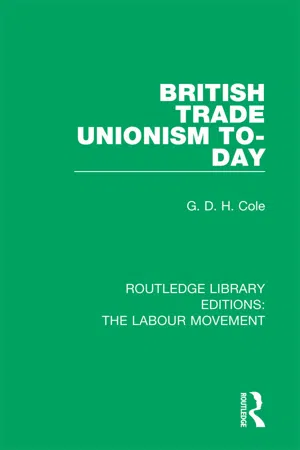
First published in 1939. This book provides a balanced picture of Trade Unionism as it was in the 1930s, both in general and in each of the principal industries and services. The study opens with a brief outline of Trade Union history, before examining Trade Unions in various industries, including mining, transport, and the postal service. British Trade Unionism To-Day will be of great interest to students and scholars of labour and political history.
- 590 pages
- English
- ePUB (mobile friendly)
- Available on iOS & Android
eBook - ePub
British Trade Unionism To-Day
PART I
TRADE UNION HISTORY
1
EARLY DAYS
THE CONTINUOUS HISTORY of Trade Unionism in Great Britain dates from the early years of the nineteenth century. There were Trade Unions long before that; but no continuous record of their activities has been preserved. Even in the sixteenth and seventeenth centuries it was becoming common for journeymen to combine for the protection of their crafts against interlopers and for the maintenance of their trade customs and standards of wages and conditions of work. In the eighteenth century we find many records of combination not only among the skilled craftsmen in the towns, but also over wider areas among the woollen weavers and other classes of textile workers, who were employed largely In their own homes or in cottage workshops, under the ‘domestic’ system. These larger combinations were necessary, especially among the weavers, because the woollen industry was already dominated by rich merchant clothiers producing for a wide market, so that no one village could easily raise its wages or conditions above those prevailing for similar work in the surrounding areas.
Very often the aim of combination among the textile workers was in the first instance not to strike, but to petition Parliament or the county justices of the peace to fix wages. The statute of Queen Elizabeth and certain later Acts relating to particular trades were then still on the statute book, and there was no doubt that the justices were empowered to fix rates of wages if they wished to do so. There was, however, already both in Parliament and among the justices a growing prejudice against interfering with the employer’s right to engage workers at what wages he chose; and for the most part the weavers’ petitions met with no favourable response.
It seems to have been regarded as lawful for the workers to combine, as long as they did so only with the object of petitioning the public authorities. But it was another matter when, having failed to secure redress by that method, they attempted by the threat of strike action to take matters into their own hands. To an increasing extent the courts of law took the view that any combination of the latter sort constituted a criminal conspiracy against public order; and the combinations formed from time to time outside the corporate towns were repeatedly broken up by the law.
The position was often not quite the same in the corporate towns, where the little local Trade Clubs of skilled craftsmen were usually let alone, and even in many cases bargained openly with the employers in their several trades. This happened because the class distinction between master and man, already very marked in the woollen trades and in a few other industries, such as mining, which were already dominated by the large-scale capitalist, was far less clear in the urban crafts. Skilled labour was scarce in face of rising demand for its products; and the small urban masters usually preferred coming to terms with their journeymen to quarrelling with them at the risk of being deprived of their supply of skilled workers. The masters, who were also often the magistrates, were therefore usually not disposed to put down the men’s combinations unless they were particularly troublesome; and it seems clear that in the latter part of the eighteenth century many of the Trade Clubs of skilled workers became very powerful, and were able effectively to enforce the strict limitation of apprentices and to secure higher wages as the prosperity of the masters increased. Their strength became greater still with the advent of steampower and the factory system; for the Industrial Revolution in its earlier phases hardly changed at all the technique of production in most of the urban crafts, but by increasing the wealth of the rich expanded the demand for skilled labour, both in the making of goods for consumption and in the construction of the new power-driven machines.
In 1799 and 1800, the Government, disposed in its fear of the French Revolution to regard all forms of working-class organisation as potential centres of rebellion, passed the Combination Acts, and thus declared every sort of Trade Union to be a criminal conspiracy. But these Acts were never at all completely enforced. The attempts of the weavers, miners, and factory workers to combine were broken up more ruthlessly than ever by the county justices; but once again the majority of urban small masters found it more convenient to negotiate with the craftsmen’s combinations than to attempt to put them down. To a considerable extent, the craftsmen’s Trade Clubs disguised themselves as friendly societies—as indeed they were, in addition to their Trade Union functions. Thus, disguised or openly, many of them continued to bargain and even on occasion to strike with impunity during the entire period for which the Combination Acts remained in force.
When the Napoleonic Wars ended in 1815, there was a sharp fall in prices, accompanied by a collapse of industry and a great growth of unemployment in many trades. These were the years in which Radical agitation, which had been almost stamped out by Pitt’s repressive measures at the end of the eighteenth century, was resumed on a large scale all over the country under the leadership of William Cobbett and ‘Orator’ Henry Hunt—to be met by fresh measures of repression from the side of the Government. In 1817 the Home Secretary, Lord Sidmouth, passed his ‘Gagging Acts’ for the suppression of Radical newspapers and seditious meetings; and when the agitation went on in spite of the law, still more drastic repressive measures were adopted. The ‘Peterloo Massacre’ of 1819, when soldiers rode into a great orderly Reform demonstration addressed by Henry Hunt in St. Peter’s Fields at Manchester, and many unarmed persons, including women and children, were trampled underfoot, was followed by the ‘Six Acts’ of the same year, giving the authorities drastic powers to prevent illegal drilling, seditious meetings and publications, and the like. But as industry began to settle down in the early ’twenties after the post-war troubles, the repression was relaxed; and in 1824–5 Combination Acts were repealed, and Trade Unions were granted at any rate a scanty measure of legal toleration.
All through the post-war years of unrest, Trade Unionism had been spreading apace, despite the repressive laws. In 1818 we hear, in both Manchester and London, of the first abortive attempt to form a ‘General Union’ of the workers in all trades, under the leadership of John Gast, of the London shipwrights, who was also largely responsible for The Gorgon, the first known Trade Union newspaper. At the same time, there were great strikes in Lancashire among the textile workers; and the miners in Durham and Northumberland also attempted to organise, only to meet with prompt and savage suppression at the hands of the great coal-owning landlords who dominated the county magistracy.
With the repeal of the Combination Laws in 1824, Trade Unionism came out much more into the open; and from this date we can trace the continuous history of quite a number of societies. We find too the Trade Clubs of London combined, under Gast’s leadership, in a Metropolitan Trades Committee—the forerunner of the London Trades Council of today. These were times of rapidly growing boom in trade, accompanied by rising prices. There were numerous strikes for higher wages and improved conditions, and many of them were successful. Then came, in 1825, the first of the great financial and business crises of the nineteenth century; and the Trade Unions found themselves no longer fighting for improved conditions, but struggling to resist drastic reductions in wages. Political Radicalism, which had ebbed during the boom, began again to grow apace; and side by side with it Trade Unionism grew also. In 1829 John Doherty, the leader of the Lancashire cotton spinners, got together a conference of Spinners’ Societies from England, Wales, Scotland and Ireland, and persuaded it to form the Grand General Union of Spinners of Great Britain and Ireland. Encouraged by this success, Doherty went on in the following year to a still more ambitious project, a revival of the idea of a ‘General Union’ of all workers. He persuaded a conference to create the National Association of United Trades for the Protection of Labour, which speedily gathered numerous adherents among the Trade Societies of the Midlands and South Wales, as well as among those of Lancashire and Yorkshire. The various building crafts, about the same time, began to organise a national Operative Builders’ Union designed to cover the whole country; and new combines arose among the miners in the northeastern counties and elsewhere. There was a great stirring of Trade Union activity in almost every trade; and at the same time Co-operative Societies sprang into existence in large numbers under the inspiration of Robert Owen’s ideas.
While this ferment was going on in industry, the agitation for the Reform of Parliament was approaching its culmination. In 1832 the great Whig Reform Act became law, disfranchising the rotten boroughs and redistributing seats in Parliament to the more populous counties and the rapidly growing industrial towns. But though the Act enfranchised the middle classes, it left the workers, who had played a leading part in the Reform struggle, wholly without votes. The Reformed Parliament did indeed pass an improved Factory Act in 1833; but, that done, it turned to the reform of the Poor Laws on principles which were soon to earn it the bitter hatred of a large section of the working class. Under the old Poor Law parish relief had been available in aid of wages in bad times to the domestic workers, including the handloom weavers, who were being gradually crushed out by the introduction of power-driven machinery, as well as to the factory workers. The system, prevalent in the agricultural South, whereby the wages of men actually in full employment had been regularly subsidised out of the poor rates, had never been much applied in the industrial districts; but poor relief had been a valuable safeguard against sheer starvation when trade was slack. The new Poor Law, however, was designed to abolish altogether any sort of outdoor relief to the able-bodied, and to offer applicants the alternative of starvation or entry into the workhouse—the hated ‘Bastille’, as the workers soon learnt to call it.
The new Poor Law had not yet become law, but the controversy over it was already raging, when the great Trade Union movement of 1832–4 reached its culminating point. Trade was again improving, after a renewed depression during the later phases of the Reform struggle; and the workers, already disillusioned at their ‘betrayal’ by their middle-class allies, came flocking into the Trade Unions in thousands.
It was at this stage that Robert Owen, already the inspirer of a rapidly-growing Co-operative movement, made his sudden incursion into the Trade Union world. Owen was a self-made man, who had become the chief owner of the most famous and successful cotton-mill in Great Britain. At his New Lanark factory he had won for himself an immense reputation as a philanthropic employer. He had refused to allow more than a limited dividend on the capital employed in the business, and had applied all surplus profits to schemes for the benefit of the workers. When production was interrupted by shortage of material during the war, he had paid the operatives their wages all the same. He had demonstrated the economic advantages of a shorter working day and healthier conditions of employment; and he had agitated hard both among his fellow-employers and by urging the Government and Parliament in favour of factory legislation.
But, long before Robert Owen became a Trade Union leader, he had gone a great way beyond this. He had become convinced at an early stage that what men were depended mainly on their environment, and that if they could begin with a good environment and a sound education vice and misery would speedily vanish out of the world. But he had also become convinced that it was impossible to give men these advantages under a competitive industrial system, which deliberately set man against man. He wanted all men, instead of trying to get the better one of another, to co-operate in making the most of the rapidly expanding power to create wealth.
When the war ended, and unemployment spread far and wide, Owen came forward with his ‘Plan’. He wanted the State and the rich, instead of doling out a niggardly relief to keep the poor from utter starvation, to provide funds for setting them to work in Co-operative Colonies, or ‘Villages of Co-operation’, in which they could produce what they needed for their own consumption, either directly, or by way of exchanges between one village and another. Owen made his appeal first of all to the Government and to Parliament, and thereafter to anyone who would listen. But his faith at this stage was not in action by the workers; for he considered them too helpless and too much in the grip of evil circumstances to be able to regenerate themselves. The governing classes, however, paid no attention to his appeals; and at length Owen turned his back on the corruptions of Europe and set out for the United States, where he hoped to establish his Villages of Co-operation in the still uncontaminated atmosphere of the New World. Already his ‘Plan’ had expanded from a means of relieving unemployment to a universal scheme for the regeneration of society by the establishment of Socialist communities; and it was to his projects that, in Great Britain, the name ‘Socialist’ was first applied. Simultaneously Fourier and his followers were advocating somewhat similar doctrines in France; and to these too the name ‘Socialist’ became attached.
In the United States Owen founded his settlement of New Harmony, which ultimately failed as a Socialist community and was reconstituted on a more individualistic basis. But while he was away in America, the working classes in Great Britain had begun to adopt his doctrines. In the 1820’s Co-operative Societies began to spring up apace, less with the object of engaging in mutual trade than in the hope of building up funds which would enable them to establish Villages of Co-operation on the lines of Owen’s Plan. At the same time the Trade Unions, spreading fast after the repeal of the Combination Acts, began to set up Co-operative Societies of their own, in the form of ‘Union Shops’, in which the workers joined together to produce goods in their own workshops without any employer to exact a profit from their labour.
Owen came back from America, after the failure of New Harmony, to find himself already acclaimed as the leader of a growing working-class crusade. After some hesitation—for he still had little belief in the power of the workers to act for themselves, and still hoped to convert the richer classes to acceptance of his Plan—he accepted the leadership which was thrust upon him. Under his influence the great Builders’ Union began to make preparations for the reorganisation of the building industry under a Grand National Guild of Builders, to be formed by the Trade Unions with the object of contracting collectively for every type of building work. Owen also set out to provide markets for the Co-operative ‘Union Shops’ by founding Equitable Labour Exchanges, at which the products of the various trades could be exchanged on the basis of the ‘labour-time’ spent it producing them. He had put forward this ‘labour-time’ theory of value as early as 1821 in his famous Report to the County of Lanark, and had thus become the forerunner of the Socialist school of political economy which was soon developed further by William Thompson and Thomas Hodgskin, and later by Karl Marx.
In 1833 Owen decided on a still more ambitious step. At a conference of supporters of his Plan, including both Trade Unions and Co-operative Societies, he launched his proposal for a Grand National Consolidated Trades Union, or more shortly, ‘the Trades Union’, of which all the Trade Societies and Clubs in Great Britain were invited to become branches or sections. Owen thus revived, on a much larger scale, John Doherty’s organisation of 1830, and once more attempted to unite the entire working class, and such other members of the ‘industrious classes’ as were prepared to throw in their lot with the workers, in a single all-embracing Union.
The struggle which followed was short and decisive. The new movement spread with extraordinary speed, and is said to have enrolled half a million members within the first few months. Some of the big Unions which had supported it at first—the Builders, Spinners, Potters, Clothiers, and the surviving Yorkshire section of Doherty’s National Association of 1830—in the end refused to range themselves in the G.N.C.T.U.; but they worked in association with it. In all the Trade Union movement in the early months of 1834 probably reached a membership of nearly a million—a total which was not regained by the Trades Union Congress until 1890. But before the new body had time to sort out its new recruits into any sort of order, it found itself involved in a whole series of strikes and lock-outs up and down the country. Some sections had no sooner joined the Union than they put forward large demands, and struck in order to secure them; and in other cases, as in the ‘Derby turn-out’, the employers promptly locked out those who joined the Trades Union, and refused to re-employ them unless they renounced membership. The Union soon found itself hard pressed for funds to support its members who were striking or locked out.
But now came a further blow. The arrest and conviction of the Tolpuddle Martyrs for ‘administering unlawful oaths’—i.e. for using a ceremony of initiation on enrolling new members in the Union—constituted a threat to every person who joined it or worked for it. Under the double pressure of this threat from the law and the constant levies for the support of strikes and lock-outs, members began to drop away. Seeing the position to be hopeless, Owen in the summer of 1834. dissolved the Grand National Consolidated Trades Union, and therewith dropped right out of the Trade Union movement, and retired to his advocacy of model Villages of Co-operation, which were to be the pioneers of the new social order. The collapse of the G.N.C.T.U. carried with it that of the Equitable Labour Exchanges and the Union Shops which had used them for marketing their produce. Some of the consumers’ Co-operative Stores survived: but Owen ceased to have any connection with them. The great wave of Trade Union activity which had followed hard upon the Reform Act was at an end. The Radical workers were swept back into political activity under Chartist leadership: the hope of speedily transforming society to a Socialist system by Trade Union action was given up.
2
THE RISE OF THE CRAFT UNIONS
THE DISSOLUTION OF the G.N.C.T.U. did not, however, involve the disappearance of the societies of which it had been composed. Trade Unionism had suffered a very severe blow, and there was a heavy loss of membership. Many societies broke up altogether, and in many cases the local Trade Clubs which had been drawn together into national associations fell apart again, and maintained a purely local existence. The Builders’ Union divided into separate craft societies, the stonemasons and carpenters forming national craft Unions, whereas the other trades returned to purely local clubs. What had remained of Doherty’s National Association broke up finally into its component parts.
But before long, even while Chartism occupied the centre of working-class attention, Trade Unionism began again to grow. The miners, under the leadership of Martin Jude, organised their first National Union in the ’forties; and the Spinners, Potters, Stonemasons, and other craft groups maintained a nearly continuous activity. Meanwhile, the continued advance of machinery was conferring more and more importance upon the machine-makers. A number of societies of Steam-Engine Makers and other classes of mechanics had been formed in the ’twenties; and by the ’forties one society, the Journeymen Steam-Engine Makers, had outdistanced the others and could make some claim to be cal...
Table of contents
- Cover
- Half Title
- Title Page
- Copyright Page
- Table of Contents
- Preface
- Introduction
- Part I Trade Union History
- 1. Early Days
- 2. The Rise of the Craft Unions
- 3. The New Unionism
- 4. The Great Unrest
- 5. Trade Unionism in War-time
- 6. Trade Unionism after the War
- 7. The General Strike and After
- Part II Collective Bargaining and State Action
- 1. The Wage System
- 2. Systems of Wage-Payment
- 3. Collective Bargaining
- 4. The State and the Wage System
- 5. The History of Trade Union Law
- 6. Trade Unions and the Law Today
- 7. Trade Boards
- 8. Hours of Labour
- 9. The Unemployed
- 10. The Shop Stewards’ Movement
- Part III Trade Unionism As A Whole
- 1. The Trades Union Congress
- 2. Trades Councils
- 3. Trade Union Finance
- 4. Trades Unions in Politics
- 5. Scottish Trade Unions and the Scottish Trades Union Congress
- 6. Trade Unionism in Scotland
- 7. Trade Unionism in Wales
- 8. Trade Union Difficulties in New Areas
- 9. Women in Trade Unions
- 10. The International Trade Union Movement
- Part IV Trade Unionism in Particular
- 1. Strength and Weakness
- 2. The Miners
- 3. The Miners’ Unions
- 4. The Railwaymen
- 5. Trade Unionism on the Railways
- 6. The Transport Workers
- 7. Transport and Trade Unionism
- 8. The Builders
- 9. Trade Unionism in the Building Industry
- 10. The Metal Workers
- 11. Trade Unionism in the Iron and Steel Industry
- 12. Engineers and Shipbuilders
- 13. Trade Unionism in the Engineering Industry
- 14. Trade Unionism in the Printing Industry
- 15. The Textile Workers
- 16. The Cotton Operatives
- 17. The Cotton Trade Unions
- 18. Trade Unionism in the Woollen and Worsted Trades
- 19. Trade Unionism among Garment Workers
- 20. The Boot and Shoe Operatives
- 21. Trade Unionism in the Potteries
- 22. Trade Unionism in Agriculture
- 23. The General Workers
- 24. The Struggle for Organisation among Shop Workers
- 25. Trade Unionism in the Co-operative Movement
- 26. Organisation among Non-Manual Workers
- 27 Civil Service Trade Unionism
- 28. Trade Unionism in the Post Office
- 29. Teachers’ Organisations
- 30. Other Groups
- Part V Conclusions
- 1. An Outline Survey
- 2. Recent Developments in France and the United States
- 3. Two Views of Trade Unionism
- Appendix
- Appendix A Summary Guide to Trade Unionism
- General Index
- General Index1
- Index of Trade Unions, etc.
Trusted by 375,005 students
Access to over 1.5 million titles for a fair monthly price.
Study more efficiently using our study tools.
Frequently asked questions
Yes, you can cancel anytime from the Subscription tab in your account settings on the Perlego website. Your subscription will stay active until the end of your current billing period. Learn how to cancel your subscription
No, books cannot be downloaded as external files, such as PDFs, for use outside of Perlego. However, you can download books within the Perlego app for offline reading on mobile or tablet. Learn how to download books offline
Perlego offers two plans: Essential and Complete
- Essential is ideal for learners and professionals who enjoy exploring a wide range of subjects. Access the Essential Library with 800,000+ trusted titles and best-sellers across business, personal growth, and the humanities. Includes unlimited reading time and Standard Read Aloud voice.
- Complete: Perfect for advanced learners and researchers needing full, unrestricted access. Unlock 1.5M+ books across hundreds of subjects, including academic and specialized titles. The Complete Plan also includes advanced features like Premium Read Aloud and Research Assistant.
We are an online textbook subscription service, where you can get access to an entire online library for less than the price of a single book per month. With over 1.5 million books across 990+ topics, we’ve got you covered! Learn about our mission
Look out for the read-aloud symbol on your next book to see if you can listen to it. The read-aloud tool reads text aloud for you, highlighting the text as it is being read. You can pause it, speed it up and slow it down. Learn more about Read Aloud
Yes! You can use the Perlego app on both iOS and Android devices to read anytime, anywhere — even offline. Perfect for commutes or when you’re on the go.
Please note we cannot support devices running on iOS 13 and Android 7 or earlier. Learn more about using the app
Please note we cannot support devices running on iOS 13 and Android 7 or earlier. Learn more about using the app
Yes, you can access British Trade Unionism To-Day by G. D. H. Cole in PDF and/or ePUB format, as well as other popular books in History & World History. We have over 1.5 million books available in our catalogue for you to explore.