- 2,496 pages
- English
- ePUB (mobile friendly)
- Available on iOS & Android
eBook - ePub
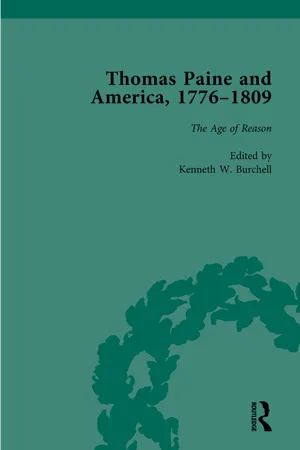
Thomas Paine and America, 1776-1809 Vol 4
About this book
From his migration to America in 1774 to his death in New York City in 1809, Thomas Paine's ideology was at the centre of American political and social debate. This six-volume facsimile edition brings together rare texts from books, periodicals and newspaper contributions to unearth the contemporary American response to Thomas Paine.
WYCHE, AN EXAMINATION OF THE EXAMINERS EXAMINED
William Wyche, An Examination of the Examiners Examined, being a Defence of Christianity. Opposed to the Age of Reason (New York: L. Wayland, 1795). Andover-Harvard Theological Library, Harvard Divinity School, Harvard University, shelfmark Tracts 533 no. 1.
Little is known about the life and works of the author of the following treatise, William Wyche (n.d.). He likely came from a prosperous family and was schooled in law at Grey's Inn, London, but he apparently did not complete the requisite five-year residence as his name does not appear on their Pension Book. However, from the quality of his later writing, it is very likely that he did study and practice in a good law firm.
The 1793 publication of his first-known work marks his appearance in New York City.1 Several of his works achieved a respected place in the history of legal practice. His Treatise on the Practice of the Supreme Court, for example, is the first work on New York legal practice and perhaps the first American manual of practice.2 An oration given at Tammany Hall and dedicated to 'moderate Democrat' and Columbia College professor Samuel L. Mitchell provides a morsel of evidence that, combined with the work before us, may tell us a bit about his political orientation.3 In Party Spirit, Wyche speaks against the passions of faction and in favour of balance and moderation in political life. Shordy thereafter, he disappears from the historical record.
The work reproduced here reflects the same moderate and gentlemanly concerns. Emory suggests Wyche held 'anti-French, pro to-Federalist sentiments', but he might equally have been a Democratic sympathizer challenged in his religious assumptions. In either case, his views place Wyche on the more conservative wing of mid-1790s American political discourse.
Wyche wrote this work in response to The Examiners Examined, published in 1794 while Paine was in Paris. Historians generally agree that this pamphlet was written by the blind deist lecturer and author Elihu Palmer (1764-1806),4 and in it he takes on seven of Paine's most prominent detractors. Like Paine, Palmer had become increasingly convinced that the social and political transformation from tyranny to liberty would be accompanied by a change in the underlying religious views of society.5 Palmer wrote that institutional religion was a structure that 'the present generation is probably destined to overthrow, and to substitute a system more simple, more pure, and more agreeable to the dictates of reason'.6 When Paine returned to America, he found a close ally and friend in Palmer and wrote for his journal, the Prospect, or View of the Moral World (New York).7 They remained close friends until Palmer's 1806 death, and Mrs Palmer helped to care for Paine in his final days.8
While Wyche's writings on jurisprudence and legal precedent enjoyed large print runs and wide distribution - especially in light of the brevity of his American career - the controversy with Palmer seems to have been local and minimally noticed. There are only three extant copies in public institutions, two at Harvard University and one at Yale University.
Notes
- 1. The research of Robert A. Emory is the only biographical treatment of Wyche to date and almost the only source for this headnote. See R. A. Emery, 'William Wyche', Law Library Journal, 93:3 (Summer 2001), pp. 469-77.
- 2. See W. Wyche, A Treatise on the Practice of the Supreme Court of Judicature of the State of New-York in Civil Actions (New Y)rk: T. and J. Swords, 1794), and An Essay on the Theory and Practice of Fines; with Precedents (New Y)rk: T. and J. Swords, 1794). See also Report of the Trial of Henry Bedlow, for Committing a Rape on Lanah Sawyer. Final Arguments of the Counsel on Each Side: In a Court of Oyer and Terminer, and Gaol Deliveryfor the City and County of New-York, held 8th October, 1793 (New^ork: by Act of Congress, 1793).
- 3. See W. Wyche, Party Spirit: An Oration, Delivered to the Horanian Literary Society, at their First Anniversary Meeting, on the 10th of May, 1794, at Tammany Hall (New Y>rk: T. and J. Swords, 1794).
- 4. See [E. Palmer], The Examiners Examined: Being a Defence of the Age of Reason (New York: Wayland & Fellows, 1794).
- 5. See Complete Writings, vol. 1, pp. 464-5.
- 6. See [Palmer], The Examiners Examined, p. 6.
- 7. See Complete Writings, vol. 2, pp. 788-830.
- 8. For Palmer and his association with Paine, see K. Walters, The American Deists: Voices of Reason in the Early Republic (Lawrence, KS: University of Kansas Press, 1992), pp. 240-77, 306-68. See also M. Brown and G. Stein, Freethought in the United States: A Descriptive Bibliography (Westport, CT: Greenwood Press, 1978), pp. 11-30; and R. French, 'Elihu Palmer, Radical Deist, Radical Republican: A Reconsideration of American Freethought', Studies in Eighteenth-Century Culture, 38 vols (Madison, WI: University of Wisconsin Press, 1979), vol. 8, pp. 87-108. For the classic text, still quite valuable if a bit dated, see H. Morais, Deism in Eighteenth-Century America (New York: Russell, I960), pp. 135-68. For Paines association with Palmer and his wife, see Complete Writings, vol. 2, pp. 788-9; and J. Keane, Tom Paine: A Political Life (Boston, MA: Little Brown, 1995), pp. 497-503,518-33.
AN
EXAMINATION
OF THE
EXAMINERS EXAMINED,
BEING A
DEFENCE OF CHRISTIANTY:
OPPOSED TO THE
AGE of REASON,
EXAMINATION
OF THE
EXAMINERS EXAMINED,
BEING A
DEFENCE OF CHRISTIANTY:
OPPOSED TO THE
AGE of REASON,
BY WILLIAM WYCHE,
AUTHOR OF SEVERAL WORKS, AND CITIZEN OF THE UNITED STATES OF AMERICA.
AUTHOR OF SEVERAL WORKS, AND CITIZEN OF THE UNITED STATES OF AMERICA.
Le tems present est gros de l'infidelite.
NOT LEIBNITZ.
NEW-YORK:
PRINTED BY
WAYLAND AND DAVIS, AND SOLD BY L.WAYLAND, NO. 151, WATER STREET -1795.
(Copyrght Seccured.)
PRINTED BY
WAYLAND AND DAVIS, AND SOLD BY L.WAYLAND, NO. 151, WATER STREET -1795.
(Copyrght Seccured.)
TO
THE REV. ISAAC LEWIS, D. D.
OF
WEST GREENWICH,
CONNECTICUT.
THIS WORK IS INSCRIBED
IN
TESTIMONY OF RESPECT,
BY
W. WYCHE.
THE REV. ISAAC LEWIS, D. D.
OF
WEST GREENWICH,
CONNECTICUT.
THIS WORK IS INSCRIBED
IN
TESTIMONY OF RESPECT,
BY
W. WYCHE.
NEW-YORK, Jan, 19,1795.
AN
EXAMINATION, &c.
To declaim against christianity, has, of late, become extremely fashionable in the literary world. The fame beaten track of pretended argument is repeatedly purfued, whilft, the vanity of writers is highly gratified in endeavoring to overturn the prevailing opinions of man-kind. For my own part, fatisfied with the doctrines of christianity, till I fee, what has never yet taken place— them overturned by invincible reason; I offer fome remarks on a pa mphlet lately published, Under the title of the " Examiners Examined," in order to oppofe the ri-fing flood of infidelity.
In the conclusion of this work, the author " folemnly declares that the happinefs of mankind are his views, in wishing to propagate deism." To promote the happiaefs of mankind is confedently a laudable desire; it were to be wished, that, with fuch a tina, the author had had recourse to means of a tendency to produce an end of this nature. Unfortunately, in the publication before us, he seems to have deviated widely from his aim, and to be like unto the " foolish man who built his house upon the fand, and the rain descended, and the winds blew, and beat upon that house and it fell but we cannot follow the test and add, "great was the fall thereof." This writer so apparently friendly to the interefts of the human race, discovers the wily fox in the external garb of the innocent lamb. In promifing felicity, he leeks its destruction. By propagating deism, he destroys every hope of salvation, lays the axe at the root of Religion, and insultingly tells us he means to Increase our happiness. By persuading us to give up the revelations and promise of God, and to adopt his pretended rational, yet fantastic, system, in the room, be would render us a cold and sceptic race of beings, ignorant of every religious principle, but thofe which the whim and fancy of each individual dictate.
* Matthew, vii. 26, 27.
To show how contrary- the author's declarations and conduct arc, we need only look a little further in the conclusion, and a few other detached palsagages. " Hwishes es not tpersecutete nor wound the feelings of any, but to convince by fair argument." How little do othesentenceses comport witthism? isuchch is the author's intent, whdoeses he wound th; feelings otheh^ author of the Folly oreasonon, and tell us that his pamphlet " was probably written fronoto other than mercenary views"? Whaoccasionon thsucceedingnsneersrs on Wakefield, as being a fellow of Jesus college? Why style him a " conceited ped ant"? Why infmuate that the Layman is " really a gentleman of the cloth"? Why style the New-York Reviewer, " a fit disant, Efquire"? "Why sarcastically style Mr. Ogden " the apostle of virtue and religion"? Arc these marks of the author's candor? of his desire not to wound the feelings of Others ? Again, when he selects a few detached paflage« from the objects of his criticism, and leaves the most material parts unanswered, does he mean to difplay his desire of convincing by fair argument? These passages ferve todemonstrate the propriety of an expression which the writer contends to be improper—the bigotry of a deist. If he define the word " bigotry," properly, in calling it " fanaticism, blind zeal, or superstition," his bigotry, in support of deism, is evinced in almost every page, aim, to use nearly his own words, " he Shows it by example more than any writer on Christianity."
When I first Saw the part of this pamphlet intitled " Thoughts 9tt the Christian Religion" I fully expected something new upon the subject; bat perusal created a miferable disappointment; nothing was to be disco-eredbuta repetition of old observations, dreOed up in a declamatory style, and even that style, in some parts, pourtrays the crow fhining in borrowed plumes. This whole division of the pamphlet, displays such poverty of original thought, frigidity of expression, and even ignorance of the character of the authors qnoted, that, through charity, we mull suppose the author entirely blinded by vanity, or such an irrational defence of the Age of Reason, would never have feen the light.
As the author himself calls nearly three of his first pages declamation, it is unnecessary to make any marks on them, I shall therefore proceed to what be calls his arguments. It does not, however, evince a desire of supporting opinion by fair argument, to commence with three pages of declamation, in which are hazarded a variety of bold, yet untrue assertions, never afterwards attempted to be proved.
We are told " that the public proofs of Christianity are no stronger than those in favor of Mahometanism. Mahomet is fold to have wrought as many miracles preached as good doctrine, converted ten times as mat ny followers, and was for more uccefsful then Jesus Christ."
The number of Mahomet's miracles, is no proof bi favor of his system—-it depends on their reality. Had Jesus Christ performed but one act cut of the common course of nature, it would have evinced his power far more than that of Mahomet, who might have produced 1000 miracles, the fallacy of which could all be traced. The miracles of our Saviour, were far different in thei.* nature from those of the Turkish chief. The Mahometan miracles, were discovered by many, at the time, to be impostures while those of Christianity slushed conviction on the minds of the beholders, and made them, with a sudden impulse, confess die divine agency. Mahomet, entertained the populace with the tricks of a juggler: great part of his miracles were transacted in the dark, and Tested folex on the evidence of'himfelf; but those of Christ were such a? must have originated in supernatural power, and were tranfac'ted in the open face of day. We know the imposture of the writer of the Koran, from the trick he played upon his followers, in requeft-ing one of his adherents to defcend to the bottom of a well, and cry " Mahomet is the prophet of God," and then immediately he persuaded the people to fill up the well with stones, as a monument of the transastion, but in reality to prevent a discovery of the impofture. The vision of his being taken into the seven heavens, has no public notoriety to support it—a vision imagined in the night unknown to the world, and its existence depend hi g on the mere word of the inventor. Were the miracles of Christ of this nature? do they, depend on the ipfe c'ixit of the performer? On the contrary, were they not ejdnhited in the pre fence of multitudes? When 5000 people were fed with a small portion of visuals, could this be an imposture? But the very nature of the Christian miracles, evince their truth. Their reality appears from the general objects on which they were employed. The benevolent Saviour of mankind himfel...
Table of contents
- Cover
- Half Title
- Title Page
- Copyright Page
- Contents
- The Age of Reason
- Editorial Notes
Trusted by 375,005 students
Access to over 1.5 million titles for a fair monthly price.
Study more efficiently using our study tools.
Frequently asked questions
Yes, you can cancel anytime from the Subscription tab in your account settings on the Perlego website. Your subscription will stay active until the end of your current billing period. Learn how to cancel your subscription
No, books cannot be downloaded as external files, such as PDFs, for use outside of Perlego. However, you can download books within the Perlego app for offline reading on mobile or tablet. Learn how to download books offline
Perlego offers two plans: Essential and Complete
- Essential is ideal for learners and professionals who enjoy exploring a wide range of subjects. Access the Essential Library with 800,000+ trusted titles and best-sellers across business, personal growth, and the humanities. Includes unlimited reading time and Standard Read Aloud voice.
- Complete: Perfect for advanced learners and researchers needing full, unrestricted access. Unlock 1.5M+ books across hundreds of subjects, including academic and specialized titles. The Complete Plan also includes advanced features like Premium Read Aloud and Research Assistant.
We are an online textbook subscription service, where you can get access to an entire online library for less than the price of a single book per month. With over 1.5 million books across 990+ topics, we’ve got you covered! Learn about our mission
Look out for the read-aloud symbol on your next book to see if you can listen to it. The read-aloud tool reads text aloud for you, highlighting the text as it is being read. You can pause it, speed it up and slow it down. Learn more about Read Aloud
Yes! You can use the Perlego app on both iOS and Android devices to read anytime, anywhere — even offline. Perfect for commutes or when you’re on the go.
Please note we cannot support devices running on iOS 13 and Android 7 or earlier. Learn more about using the app
Please note we cannot support devices running on iOS 13 and Android 7 or earlier. Learn more about using the app
Yes, you can access Thomas Paine and America, 1776-1809 Vol 4 by Kenneth W Burchell in PDF and/or ePUB format, as well as other popular books in History & Early American History. We have over 1.5 million books available in our catalogue for you to explore.