Covering all the research areas regarding Ocimum such as botany, chemistry and pharmacology, this book will be of interest to everybody involved in medicinal and aromatic plant research or related fields.
- 152 pages
- English
- ePUB (mobile friendly)
- Available on iOS & Android
eBook - ePub
About this book
Information
1.
OCIMUM: AN OVERVIEW OF CLASSIFICATION AND RELATIONSHIPS
ALAN PATON, M.R.HARLEY and M.M.HARLEY
Herbarium, Royal Botanic Gardens, Kew, Richmond, Surrey TW9 3AB, UK
SUMMARY The taxonomy and nomenclature of Ocimum are in a state of confusion. The aim of this paper is to clearly delimit Ocimum from related genera, provide an up-to-date infrageneric classification which can be used as a framework for understanding relationships within the genus, provide a list of recognised species with their correct names and common synonyms and a key to their identification. In all 64 species are recognised. A parsimony analysis was carried out which suggests Ocimum is a monophyletic group if segregate genera such as Becium and Erythrochlamys are included within it. An account of the morphological features of Ocimum is provided and the economic uses of the genus are briefly discussed in the context of the infrageneric classification.
INTRODUCTION
Ocimum L. is a member of the Labiatae family. The typical characteristics of this family are a square stem, opposite and decussate leaves with many gland dots. The flowers are strongly zygomorphic with two distinct lips. Many of the family, particularly subfamily Nepetoideae, to which Ocimum belongs, are strongly aromatic due to essential oils which consist of monoterpenes, sesquiterpenes and phenylpropanoids.
Ocimum, unlike other economically important herbs in the Labiatae such as Rosmarinus, Thymus and Salvia, belongs in tribe Ocimeae which has declinate stamens. That is the stamens lie over the lower (anterior) lip of the corolla rather than ascending under the upper (posterior) lip. The Ocimeae are essentially a tropical tribe and Ocimum occurs naturally in tropical America, Africa and Asia. Unlike several other economic Labiatae, Ocimum requires warmth for growth and should be protected from frost.
Ocimum is an important economic and medicinal herb, and yet its taxonomy and nomenclature are in a bit of a muddle. Taxonomy underpins all plant science: we must know the correct name for a plant if we are to communicate information about its uses and relationships. It is important that each species has only one correct name to avoid confusion and aid clarity. The International Code of Botanical Nomenclature (Greuter et al., 1994) ensures that names are attached by a standard set of rules. In the literature concerning Ocimum, particularly the industrial and economic papers, these rules have frequently not been applied and the same species is often referred to by more than one name.
The circumscription of Ocimum itself is also problematic. Estimates of species number vary from 30 (Paton 1992) to 160 (Pushpangadan & Bradu 1995). These differences are due partly to taxonomic reasons, for example, recent revisions such as Paton (1992) have reduced species number by placing some species in synonomy; partly for geographic reasons, in that many species are African and much Indian literature is written without knowledge of the literature pertinent to the African species; and partly because the generic description of Ocimum itself has changed. The aim of this paper is to discuss the delimitation of the genus and provide an infrageneric classification of the genus which can be used as a framework for future studies. A list of recognised species is provided which includes information on their distribution, habitats and types in order to help workers use the correct name for a particular species. Some of the more commonly found synonyms are also included under their correct name. A key to the species is provided and references to further information about the species are given.
Ocimum and Related Genera
Briquet (1897) divided Tribe Ocimeae into three sub tribes. Ocimum belongs in Sub tribe Ociminae characterised by a small, flat lower (anterior) corolla lip with the stamens and style extending over it and up towards the upper (posterior) lip of the corolla. Ryding (1992) divided subtribe Ociminae into three informal groups. Ocimum was placed in the ‘Ocimum group’ along with Becium Lindl., Erythrochlamys Gürke, Hemizygia (Benth.) Briq., Syncolostemon E.Mey. ex Benth. and Catoferia (Benth.) Benth. Orthosiphon Benth. subgen. Nautochilus (Bremek.) Codd must be added to this group as it shares several characters found in Ocimum (Paton 1992).
Becium described by Lindley in 1842 contains 35 species, found in Africa, Madagascar and Arabia with one species reaching India. As generic concepts are currently applied, e.g. Sebald (1988, 1989), Becium can be distinguished from Ocimum by having a gland which exudes nectar at the base of the cymes in the inflorescence (Figure 1.1) and by having elongated anthers with parallel thecae rather than orbicular or reniform anthers with diverging thecae. Becium usually also has truncate lateral lobes of the calyx, but these are lacking in B.irvinei (J.K.Morton) Sebald. When the New World species currently placed in Ocimum are examined, this distinction is blurred with several species having a gland at the base of the cymes and divergent anther thecae. Erythrochlamys was described in 1894 by Gürke and contains two species found in NE
Erythrochlamys was described in 1894 by Gürke and contains two species found in NE Tropical Africa. It has traditionally been separated from Ocimum by having an expanded upper lip of the calyx (Baker 1900). However, this character is also seen in O.cirdnatum A.J.Paton (Paton 1992) and O.transamazonicum Pereira (Pereira 1972). The character has already been recognized as poor evidence for generic separation with species formerly placed in Erytbrocblamys by Hedge and Miller (1977) due to the presence of an enlarged upper lip, now being placed in either Ocimum (Paton 1992) or Endostemon (Paton 1994) on account of similarities in other characters. E.fruticosus has appendiculate stamens like many species of Ocimum. This again throws doubt on the generic delimitation of Erythrochlamys.
Of the other currently recognized genera in the Ocimum-group, Hemizygia containing 32 species and Syncolostemon with 10 species are mainly southern African, but there is one species of Hemizygia in Madagascar and one in India. The genera merge into one another and good accounts can be found in Codd (1985). They differ from Ocimum by having fused anterior anther filaments. Orthosiphon subgenus Nautochilus contains 5 species and is found in Southern Africa (Codd 1964). This taxon shares many of the characters of Ocimum lamiifolium in particular. Catoferia includes 4 species and is found in Tropical America (Ramamoorthy 1986). The genus looks very different from the other species of the Ocimum group in having the cyme branches fused to the inflorescence axis, rather than spreading and free, rounded rather than subulate style branches and a bent rather than straight embryo.
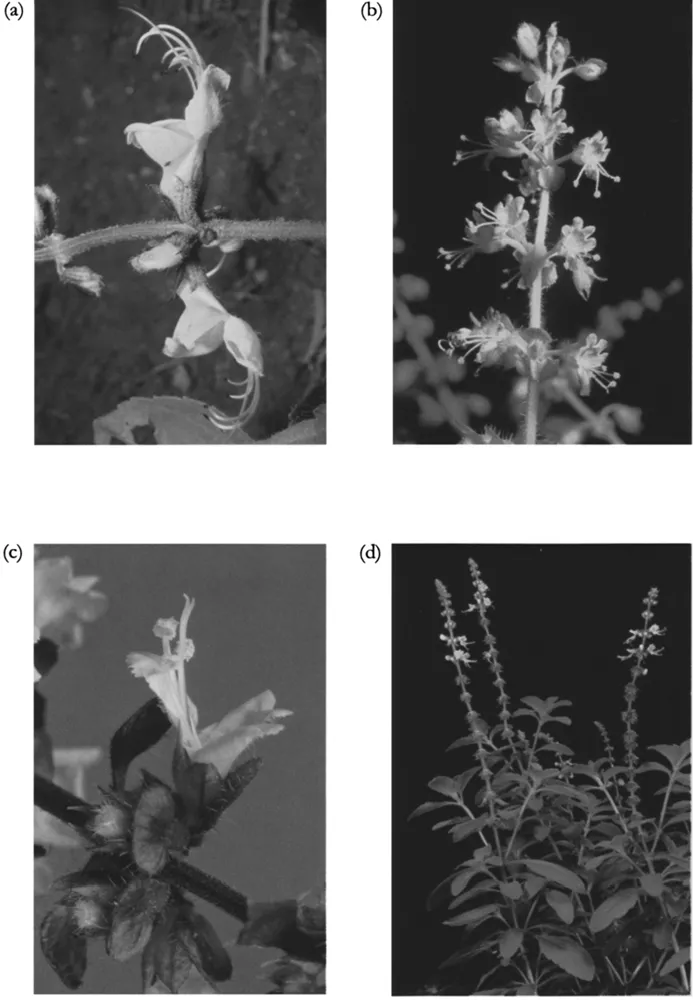
Figure 1.1 (a) Ocimum fimbriatum showing the bowl-like gland at the base of the cyme; (b) O. tenuiflorum; (c) O.basilicum; (d) O.kilimandscharicum.
Taxonomic History of Ocimum
Ocimum was described by Linnaeus in 1753 who listed 5 species. Bentham (1832) recognized Ocimum just under 40 species and divided Ocimum into 3 sections: Ocimum [Ocymodon Benth.] with appendiculate posterior stamens; Hierocymum Benth. with hairs at the base of the posterior stamens and Gymnocymum Benth. with glabrous posterior stamens. The latter two sections contained a few species which are now placed in Endostemon N.E.Br., a genus Bentham did not recognize, or Hemizygia. Bentham (1848) then subdivided section Ocimum [Ocymodon] into three subsections on the basis of calyx morphology. In subsect. Ocimum (Basilica sensu Briquet 1897) the throat of the fruiting calyx is open and bearded (Figure 1.2 e-f); in subsect. Gratissima the throat is closed by the median lobes of the lower lip being pressed against the under surface of the upper lip (Figure 1.2 c-d, g-h); subsection Hiantia Benth., with truncate lateral calyx lobes, only included species which are sometimes placed in Becium (Sebald 1988, 1989; Paton 1995; see below). Bentham (1848) also added Sect. Hemizygia Benth. which Briquet (1897) considered to be a separate genus on account of the fused anterior stamens. Paton (1992) in his revision of African species of Ocimum recognized around 30 species and used Bentham’s (1848) infrageneric classification of Ocimum, with sect. Hemizygia and subsect. Hiantia removed, preferring to consider the later as the separate genus Becium. This classification is supported by nutlet characters which Bentham did not consider and by analysis of pollen morphology (Harley et al., 1992). However, this classification is not entirely without problems, as pointed out (Paton 1992) Ocimum drdnatum A.J.Paton does not fit neatly into the existing categories. Ocimum lamiifolium is also anomalous, appearing to have a close relationship to Orthosiphon subgenus Nautochilus (Bremek.) Codd.
Pushpangadan (1974; Pushpangadan & Bradu 1995; Sobti & Pushpangadan 1979) formulated a different infrageneric classification. The ‘Basilicum’ group contains herbaceous annuals or sometimes perennials with black, ellipsoid, strongly mucilaginous seeds and with a basic chromosome number of n=12, whereas the ‘Sanctum’ group are perennial shrubs with brown globose non-mucilaginous or weakly mucilaginous seeds and a basic chromosome number of n=8. The Basilicum group contains only section Ocimum subsection Ocimum. The remainder of the genus must be placed in the Sanctum group. This classification is commonly used in the economic and industrial literature, e.g. Darrah (1980), Pushpangadan and Bradu (1995) whereas Bentham’s system is the basis for that used in taxonomic literature.
There are several problems with Pushpangadan’s infrageneric classification. It does not adequately convey the variation within the genus. New World and Old World species which differ considerably in morphology are placed together within the Sanctum group. However, within the Sanctum group there are several distinct groups of species with similar attributes and this information is lost. Pushpangadan’s system does not comply with the International Code of Botanical Nomenclature and thus should not be used as a standard.
The most recent study of New World species of Ocimum is that of Epling (1936) who recognizes 12 species 4 of which are pantropical, widely cultivated species. Epling does not refer to the infrageneric classification of the genus.
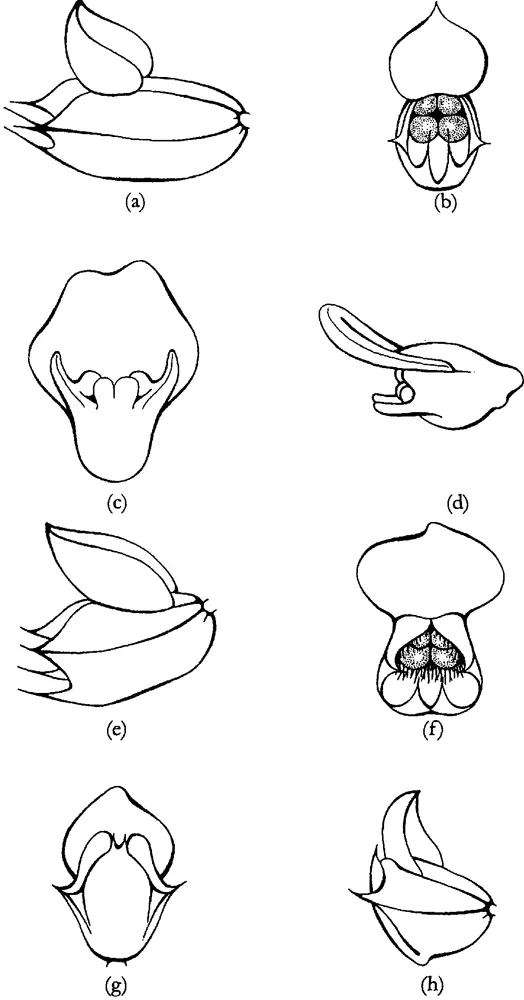
Figure 1.2 Fruiting calyx morphology in Ocimum. (a-b) Ocimum lamiifolium. (a) side view; (b) front view. (c-d). O.cufodontii. (c) view from beneath; (d) side view, (e-f) O.basilicum (e) side view, (f) front view, (g-h) O.gratissimum. (g) view from beneath; (h) side view. Drawn by Emmanuel Papadopoulos. Reproduced from Paton (1992) by permission of RBG Kew.
GENERIC AND INFRAGENERIC DELIMITATION OF OCIMUM
Currently there is no up-to-date infrageneric classification which adequately communicates the variation of Ocimum throughout its geographical range, nor clearly indicates how the genus should be delimited from its closest allies. A parsimony analysis of the genus and close relatives was carried out to try and determine the generic delimitation and infrageneric relationships and to produce a classification which could serve as a standard foundation for the further scientific and economic investigation of Ocimum. The parsimony analysis of the Ocimum-group of genera was carried out using PAUP version 3.1.1 (Swofford 1993) run on a Power MacIntosh 8100/80.
The choice of sample used for the parsimony analysis was based on a herbarium study of the whole of Ocimum, Becium, Erythrochlamys and Orthosiphon subgenus Nautochilus. Although this group contains some 64 species many of the species were similar when only conservative characters were examined. For example within subsect. Ocimum, Paton (1992) recognized 6 species. However, they differ only in habit and leaf shape, characters which are very variable phylogenetically. A similar situation applies in Becium. This may indicate that speciation within the currently recognized Ocimum and Becium in Africa has been fairly recent. In all, a representative sample of 20 taxa were chosen to represent the variation in Ocimum, Becium, Erythrochlamys, and Orthosiphon subgenus Nautochilus. All Bentham’s (1848) sections and subsections of Ocimum were represented as follows:
- Sect Ocimum subsect. Ocimum. This section contains 7 species and is represented in the analysis by O.americanum. The other species in the group only differ in leaf morphology and habit.
- Sect. Ocimum subsect. Gratissima. This section contains 6 species and is represented in the analysis by O.gratissimum, O.jamesii, O.cufod...
Table of contents
- COVER PAGE
- TITLE PAGE
- COPYRIGHT PAGE
- PREFACE TO THE SERIES
- PREFACE
- CONTRIBUTORS
- 1: OCIMUM: AN OVERVIEW OF CLASSIFICATION AND RELATIONSHIPS
- 2: PRODUCTION SYSTEMS OF SWEET BASIL
- 3: CHEMICAL COMPOSITION OF OCIMUM SPECIES
- 4: ESSENTIAL OIL OF OCIMUM
- 5: BIOACTIVITY OF BASIL
- 6: PROCESSING AND USE OF BASIL IN FOODSTUFFS, BEVERAGES AND IN FOOD PREPARATION
Trusted by 375,005 students
Access to over 1.5 million titles for a fair monthly price.
Study more efficiently using our study tools.
Frequently asked questions
Yes, you can cancel anytime from the Subscription tab in your account settings on the Perlego website. Your subscription will stay active until the end of your current billing period. Learn how to cancel your subscription
No, books cannot be downloaded as external files, such as PDFs, for use outside of Perlego. However, you can download books within the Perlego app for offline reading on mobile or tablet. Learn how to download books offline
Perlego offers two plans: Essential and Complete
- Essential is ideal for learners and professionals who enjoy exploring a wide range of subjects. Access the Essential Library with 800,000+ trusted titles and best-sellers across business, personal growth, and the humanities. Includes unlimited reading time and Standard Read Aloud voice.
- Complete: Perfect for advanced learners and researchers needing full, unrestricted access. Unlock 1.5M+ books across hundreds of subjects, including academic and specialized titles. The Complete Plan also includes advanced features like Premium Read Aloud and Research Assistant.
We are an online textbook subscription service, where you can get access to an entire online library for less than the price of a single book per month. With over 1.5 million books across 990+ topics, we’ve got you covered! Learn about our mission
Look out for the read-aloud symbol on your next book to see if you can listen to it. The read-aloud tool reads text aloud for you, highlighting the text as it is being read. You can pause it, speed it up and slow it down. Learn more about Read Aloud
Yes! You can use the Perlego app on both iOS and Android devices to read anytime, anywhere — even offline. Perfect for commutes or when you’re on the go.
Please note we cannot support devices running on iOS 13 and Android 7 or earlier. Learn more about using the app
Please note we cannot support devices running on iOS 13 and Android 7 or earlier. Learn more about using the app
Yes, you can access Basil by Raimo Hiltunen, Yvonne Holm, Raimo Hiltunen,Yvonne Holm in PDF and/or ePUB format, as well as other popular books in Biological Sciences & Biology. We have over 1.5 million books available in our catalogue for you to explore.